
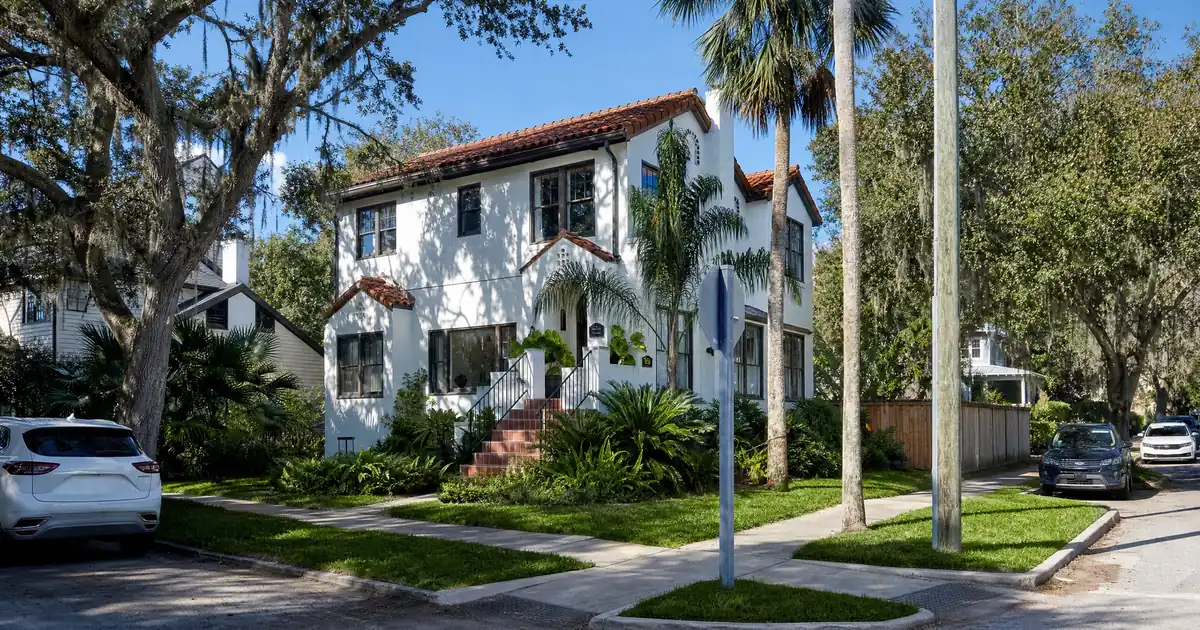
A rental in St. Augustine West hits the DSCR math like this: an investor finds a three-bedroom single-family home listed near the neighborhood’s median, puts roughly a quarter down, and runs the numbers against a regional workforce rent estimate rather than downtown tourist pricing. The property doesn’t come with a St. George Street address or a horse-drawn carriage route out front. It sits west of the historic core, in a corridor where the entry price is a fraction of what a comparable lot inside Old City would cost — and that gap is the whole story of how DSCR financing works in this city.
St. Augustine is a market of two economies wearing one zip code. One is the 1565 tourist economy — Castillo de San Marcos, Nights of Lights, the boutique inns clustered around Flagler College’s campus. The other is the county’s actual job engine: a school district, a hospital system, a defense-manufacturing base, and a fast-growing population that mostly can’t afford to live where the tourists stay.
DSCR Calculator
Run the numbers in your market
Rate source: Freddie Mac 30-yr average via FRED® — Federal Reserve Bank of St. Louis · effective Jul 30, 2026
Prefilled with starting assumptions — enter your own rent or nightly figures, taxes, insurance, and HOA for a more accurate picture.
Program parameters update from Lendmire’s centralized guideline source. Taxes and insurance are editable estimates.
As of Jul 30, 2026 · General Freddie Mac market benchmark, not a Lendmire loan offer. Rent, nightly rate, occupancy, taxes, and insurance are editable estimates. Short-term rental figures are estimates only and vary significantly by season, property type, management approach, and local short-term-rental rules — confirm local regulations before relying on them. Qualifying income for short-term rentals varies by program — some use appraisal market rent, others use documented STR history or projections — and is confirmed in underwriting. Not a Loan Estimate, approval, or commitment to lend. Program availability and eligibility are subject to lender guidelines, credit approval, property review, and underwriting.
At a Glance: In St. Augustine, Florida, a DSCR purchase loan is underwritten primarily on the subject property’s projected rent measured against its full monthly housing obligation rather than the borrower’s personal income, a structure that matters in a county where job growth has outpaced the national rate since 2020, according to St. Johns County’s economic development office.
- St. Augustine West trades toward the affordable end of the local market, with price-per-square-foot values trending upward year over year.
- Lincolnville rents run below much of the broader Florida market, yet feel tight relative to shrinking off-campus student inventory.
- Davis Shores comps have swung sharply from one period to the next on very thin sales volume.
- Old City’s premium price tier reflects tourism-driven appreciation, not workforce rent coverage.
- A downtown three-story height cap structurally limits new large-block apartment supply.
St. Augustine Market Snapshot
A quick read on the St. Augustine investor landscape — figures come from the cited sources below. Confirm current property-level numbers before underwriting.
| Metric | Detail |
|---|---|
| Home prices | $432,137 average home value (Zillow Home Value Index) |
| Typical rents | $1,845 average (RentCafe) |
| University enrollment | 2,407 total students (Flagler College Fact Book) |
| Population | 15,351 population (Census Reporter) |
| Employment | 114,406 jobs (St. Johns County Economic) |
| Vacancy | Jacksonville >12% (Bridge of Lions Realty) |
The Growth Numbers Behind the Rental Demand
St. Johns County has added residents at a pace well above the national rate since 2020, and the job base has grown even faster, outrunning national employment growth by a wide margin, per St. Johns County’s economic development data. The city of St. Augustine itself is compact in land area, according to Census Reporter’s ACS profile, while the broader urbanized footprint extends well beyond the historic core into a considerably larger population base. Median household income in the city runs comparable to the broader Jacksonville metro figure.
That growth doesn’t come from tourism alone. The top employer countywide is the St. Johns County School District, followed by UF Health St. Johns and county government, per the St. Johns County government’s official profile. The Florida School for the Deaf and Blind, a one-of-a-kind state institution headquartered in St. Augustine, employs a sizable workforce and produces a staff and boarding-family tenant base that no comparably sized Florida city can replicate. Add Carlisle Interconnect Technologies, one of the county’s largest private employers in aerospace wire and cable manufacturing, and a sizable PGA TOUR-linked workforce supporting operations out of Ponte Vedra Beach, and the tenant demand base looks a lot more like a diversified working county than a beach town, according to JAXUSA Partnership’s reporting.
Flagler College sits in the middle of it, downtown, occupying Henry Flagler’s historic 1888 Hotel Ponce de Leon. Enrollment is modest but concentrated, and roughly half the student body lives off campus — a meaningful rental pool concentrated in Lincolnville and Uptown.
St. Augustine West and San Sebastian: The Workforce Entry Point
This is a more affordable way into the market, and the math tends to be the cleanest. St. Augustine West’s median sale price sits toward the affordable end of the local spectrum, roughly flat year over year even as price per square foot has continued climbing, per Redfin’s neighborhood data. San Sebastian, just east of it, runs modestly higher. Both corridors are structurally underserved: the newly opened Villages of New Augustine, an income-restricted apartment project aimed at households earning a modest share of area median income, confirms — with a substantial public investment behind it — that hospitality staff, public-sector employees, and healthcare workers are being priced out of housing near their jobs, according to reporting on the project. Rents there scale with unit size and household income, staying well below market-rate levels, but that program only serves the tenant tier below the subsidy cutoff. The tier just above it — earning too much for income-restricted units but not enough for higher market-rate apartments — has almost no dedicated supply. That’s the gap a workforce single-family rental in San Sebastian or St. Augustine West is built to fill.
Lincolnville’s Small Multifamily Stock (and a Live Demand Shock)
Lincolnville is a historic, National Register neighborhood next to Flagler College, built mostly of studio-to-four-bedroom homes and small apartment buildings dating to before 1939, most of it renter-occupied. The median sale price sits well above many surrounding submarkets, while average rent remains comparatively affordable relative to much of Florida, per NeighborhoodScout. That rent picture looks soft until you factor in a demand shock that’s happening right now, not a hypothetical one: Flagler College’s new policy requiring freshmen and sophomores to live on campus has pushed upperclassmen into a tighter, costlier off-campus market. Students have described room rents roughly doubling, with some shared-housing situations running higher still, according to local news coverage of the policy shift. That’s a live, dateable tightening of Lincolnville’s off-campus rental pool — not generic “students exist” filler — and it favors small multifamily conversions over single large units, since the tenant base is splitting rooms and units, not renting whole houses.
Davis Shores: Waterfront Appeal, Thin Comps
Davis Shores looks attractive on paper and behaves erratically in practice. Redfin’s rolling neighborhood medians put North and South Davis Shores in a comparable upper-middle price tier, with rentals running well above the citywide average in both submarkets. But the more recent, narrower monthly snapshots tell a different story: South Davis Shores’ average house price jumped sharply in a recent monthly snapshot on just a handful of recorded sales, while North Davis Shores’ average reportedly climbed just as dramatically over the same period. Comp depth that thin means a single high or low sale can swing an appraisal-based valuation significantly. Investors buying — or refinancing — here should insist on a wider trailing comp window, 12 months or more across multiple streets, rather than anchoring to whatever number Redfin reported last month.
Old City’s Appreciation Story vs. the Beach Duplex Alternative
Old City is not a cash-flow neighborhood, and it isn’t trying to be one. The median sale price sits at a premium far above the rest of the market, trending down modestly year over year even as price per square foot has climbed sharply, a combination that signals a shrinking, ultra-premium sales pool rather than a broad workforce rental market. This is appreciation-and-STR territory, tied to Flagler College’s campus and the walkable historic core, and Lendmire’s loan-amount ceiling of up to $3,000,000 on standard programs comfortably covers even the priciest Old City listings for investors underwriting a tourism-linked equity play.
For investors who want coastal appeal without the downtown premium, St. Augustine Beach offers a workable middle ground. A handful of multi-family listings there carry asking prices well below what a comparable Old City property would fetch, and several already come with long-term tenants in place — two-unit duplexes that stack income at a fraction of what a comparable Old City property would cost, per Redfin’s multi-family listings data. It’s a genuine alternative for an investor who wants coastal exposure with rental coverage as the primary thesis rather than a bet on continued price appreciation.
What the Purchase Math Actually Looks Like
Run the numbers conceptually on the St. Augustine West scenario from the top of this piece: a home near the neighborhood’s $299,950 median — the affordable end of the local market — financed with a meaningful down payment — a common purchase structure many DSCR programs are built around — against a modeled monthly rent set at the regional single-family benchmark reported for the Jacksonville metro area, per ManageCasa’s Florida rental market analysis. Weighing that rent against a full housing payment obligation that includes taxes and insurance, the file models to roughly 1.05x-1.10x coverage — above the 1.00x line — a baseline floor some select DSCR programs use as their minimum — since rent covers the payment at that level, though actual eligibility review depends on credit profile, reserves, and lender guidelines. Terms vary by lender guidelines, property type, leverage, credit profile, and full file review.
Now consider the St. Augustine Beach duplex scenario. At a materially higher price point, with the same down-payment structure, modeling two units at the same regional rent benchmark produces combined monthly rent that still falls short against a materially larger payment obligation — landing below the 1.00x floor some select programs use as a minimum. That doesn’t mean the deal is dead. Some lenders review sub-1.00 scenarios with stronger compensating factors: a larger down payment, deeper reserves, or an interest-only structure that lowers the monthly obligation. Whether that path clears depends on the file, the lender, and the property — never a guarantee, and worth stress-testing before an investor gets attached to a specific address.
Lendmire’s deal desk tends to see the same pattern on files from markets structured like this one: the cleaner submissions come in with a documented rent comp from the actual submarket rather than a citywide average, and the friction point is almost always a coastal or historic-district property where the appraiser’s comp set is thinner than the borrower expects. Getting a tighter rent survey done before the file goes to underwriting tends to save a round of back-and-forth later.
Where the Structure Favors Small Multifamily
Downtown’s three-story height cap and historic-preservation overlay mean new large-block apartment supply physically cannot compete inside Lincolnville, Davis Shores, or Old City the way it does in Jacksonville, per market analysis of the city’s development constraints. That scarcity is structural, not cyclical, and it’s a real reason to favor 1-4 unit and small multifamily product over waiting for new construction to soften rents.
It also shows up in how deals get priced when investors buy at scale. A multi-unit portfolio combining two buildings was recently listed at a price that worked out to roughly half the per-unit basis implied by the broader multi-family market for far smaller two- and three-unit buildings, per Homes.com’s listing data. Portfolio and bulk small-multifamily purchases outside the historic core can meaningfully improve income-per-dollar-invested versus a single downtown duplex — a meaningful consideration for LLC-owned portfolios structured around scale, subject to lender program eligibility. Lendmire’s DSCR programs are built to work with that kind of entity-owned, multi-property structure directly.
The regional oversupply risk cuts the other direction, and it’s worth naming honestly. A substantial wave of multifamily units has been delivered statewide in a single recent year, and Jacksonville metro vacancy has climbed into double digits, according to ManageCasa’s analysis. Institutions accounted for a majority of recent buy-side deal flow in St. Augustine’s apartment market while controlling only a small share of the actual stock, per the Matthews North Florida multifamily report — meaning that oversupply is concentrated in large, newly delivered complexes, not the 1-4 unit and small-multifamily product most DSCR investors are buying here. That’s a meaningful distinction for anyone worried about softening rents: the softening is happening in a different asset class.
What Happens If Coverage Falls Short of 1.00x?
For an investor whose deal comes in below 1.00x on long-term rent — the beach duplex scenario above, or a downtown property carrying a tourism-priced acquisition cost against workforce-level rent — the honest answer is that the standard purchase path gets harder, not that the deal is dead. A lender may review a sub-1.00 file with reduced leverage, stronger reserves, or a rate-and-term structure built around the shortfall; some programs consider interest-only payment structures specifically to close a modest coverage gap. None of that is guaranteed, and it comes with tradeoffs: less leverage, a stronger credit file, or more cash into the deal than a purchase clearing 1.00x on its own would require. This is where the appreciation math matters. St. Augustine real estate has appreciated substantially over the past decade, at a pace that puts the market among the strongest nationally, per NeighborhoodScout’s appreciation data — even though the trailing twelve months slipped modestly, and the most recent quarter showed a rebound. An investor leaning on a sub-1.00 structure needs the appreciation story to justify the near-term yield gap. An investor who can’t stomach that bet is usually better served hunting for a workforce-tier property where the rent clears 1.00x on its own.
DSCR vs. conventional financing
Two common ways to finance an investment property in St. Augustine, FL. They qualify you differently — here’s how investors weigh them.
Why investors choose it
- Qualifies on the property’s rental income — no personal tax returns, W-2s, or pay stubs needed to document income.
- No personal debt-to-income ceiling to clear, so existing mortgages and obligations don’t cap your borrowing the same way.
- Can be closed in an LLC, keeping the property inside a business entity.
- Built for scaling — not held to the limit on number of financed properties that conventional financing applies.
- Underwriting centers on the deal: generally qualifies when the rent covers the payment, a 1.00x coverage ratio being a common baseline (confirmed in underwriting).
- Designed specifically for investment property, including long-term and, where the program allows, short-term rentals.
Where it’s strong
- Often the lowest ongoing financing cost for a buyer who fully qualifies on personal income — a fit for a first property or a cost-first purchase.
Trade-offs for investors
- Requires full personal income documentation and must fit within a debt-to-income limit — salary, existing debts, and other mortgages all count.
- Typically held in your personal name rather than a business entity.
- Caps how many financed properties you can carry, which can become a ceiling as a portfolio grows.
- Evaluates you as a borrower as much as the property, which usually means more paperwork.
How investors usually choose: a first or single property often optimizes for the lowest financing cost; portfolio builders often optimize for leverage, vesting in an LLC, and scaling past conventional caps. The right answer depends on your goals, the property, and current guidelines — both paths run through select lenders in Lendmire’s wholesale network, with eligibility and terms confirmed in underwriting.
Frequently Asked Questions
Why do Lincolnville and Old City price so differently for what looks like similar square footage?
Old City carries a tourism and STR-adjacent premium tied to walkability from Flagler College and St. George Street, while Lincolnville — despite sitting next door — trades closer to workforce and student-rental pricing. The gap reflects buyer demand, not building quality; a renovated Lincolnville home and a comparable Old City home serve entirely different tenant markets.
Is St. Augustine’s flood exposure something a DSCR lender factors into the file?
Flood risk is a real underwriting variable in several submarkets, and investors should confirm current flood-zone status, insurance requirements, and local regulatory details directly with qualified local professionals before underwriting any specific property. It doesn’t disqualify a deal outright, but it affects the total carrying cost a lender reviews against rent.
Does the Flagler College on-campus housing policy actually change rental demand, or is it temporary?
It’s a live, dated shift — the policy took effect recently and has already pushed upperclassmen into a tighter, pricier off-campus market. Whether it’s permanent depends on the college’s future housing capacity, but for now it’s tightening Lincolnville and Uptown room-rental demand in a way general “college town” analysis wouldn’t capture.
Why are Davis Shores comps so unreliable for financing purposes?
Sales volume is thin — a small handful of transactions produced a sizable year-over-year swing in one recent month. A lender’s appraisal will lean on whatever comp set is available, so a wider trailing window across multiple streets protects against a single outlier sale skewing the valuation.
How do you qualify for a DSCR loan in St. Augustine, FL?
Qualification centers on the property’s projected rent measured against its full monthly housing obligation rather than the borrower’s personal income documentation. Credit tiers on most DSCR programs run from a modest entry-level floor up through higher tiers for the strongest pricing and leverage, alongside several months of PITIA held in reserve — more at higher loan-amount ranges — with the property’s rental income carrying the underwriting rather than pay stubs or tax returns. Exact terms depend on lender guidelines, credit profile, and the property itself.
What down payment do investors typically need for a DSCR loan in St. Augustine?
Most standard DSCR purchase files here are structured around a meaningful down payment rather than the minimal down payments common in owner-occupied lending, with the exact leverage depending on the property’s rent coverage, the borrower’s credit profile, and reserves on hand. A file with weaker rent coverage — a below-threshold duplex, for instance — may need additional down payment or reserves to compensate, subject to lender guidelines.
The Advisory Case for and Against DSCR Here
DSCR financing fits an LLC-owned portfolio, a self-employed investor, or anyone buying a second or third property where traditional personal-income documentation doesn’t cleanly support rental add-backs — which describes a large share of the buyers active in Lincolnville and West Augustine right now. It’s a weaker fit for a W-2 employee buying a single rental with strong personal income; conventional investment financing may carry a simpler underwriting path and lower cost in that specific case, and the guide “Where DSCR and Conventional Diverge” is worth reading before committing to either lane. Lendmire’s DSCR walkthrough covers the mechanics in more depth for investors newer to rental-income underwriting, and Lendmire’s Florida DSCR platform covers program details specific to the state. Investors ready to move can request a quote by calling Lendmire at 828-256-2183 or through the site’s rental-income loan quote form — review details remain subject to lender overlays and the property’s own numbers.
If you only take one thing from this piece, it’s this: in St. Augustine, the neighborhood you pick determines which deal you’re actually making — an appreciation bet in Old City, a workforce-rent play west of downtown, or a small multifamily stacking strategy in Lincolnville — and the DSCR math only works if the financing matches the bet you meant to place.
About Lendmire
Lendmire — NMLS# 2371349 — is a DSCR and non-QM mortgage brokerage with investor loan programs in 41 markets, including Washington, D.C. DSCR eligibility is commonly reviewed by the lender on property-level rent rather than personal income documentation, subject to lender guidelines, and the brokerage helps arrange financing for LLC-owned portfolios beyond conventional financed-property limits. The firm has been recognized by Scotsman Guide as a top-ranked workplace in 2026 and as a 2025 Scotsman Guide Top Mortgage Workplace.
Get Started
Ready to find the right loan for you?
In about 30 seconds you can review financing options available for your investment property. No commitment required.
Informational only. Not a Loan Estimate, approval, or commitment to lend. Program availability and eligibility are subject to lender guidelines, credit approval, property review, and underwriting.
References
1. St. Johns County Economic Development — Data & Demographics
3. RentCafe
7. Census Reporter — St. Augustine, FL Profile
8. St. Johns County Government — County Profile
9. JAXUSA Partnership — Business Growth in St. Johns County
10. Redfin’s neighborhood data
11. Hoodline — Villages of New Augustine
12. NeighborhoodScout — Lincolnville
13. News4Jax — Flagler College Housing Concerns
14. Redfin — St. Augustine Beach Multi-Family Listings
15. ManageCasa — Florida Rental Market Analysis
16. KeyCrew — St. Augustine Market Resilience Analysis
17. Homes.com — Saint Augustine Multi-Family Listings
18. Matthews — 3Q24 North Florida Multifamily Market Report
19. NeighborhoodScout — St. Augustine Real Estate Appreciation
20. Scotsman Guide — Top Workplaces 2026
21. a 2025 Scotsman Guide Top Mortgage Workplace
This article is part of Lendmire’s DSCR loan program — full qualification details, guidelines, and scenarios live on the program page.
Related reading: DSCR Loans St. Augustine: Investor Financing for Historic District, Anastasia Island, St. Augustine Beach & Real Estate Investors · Cash Out Refinance Investment Property in St Augustine, Florida: How Much Equity Can You Actually Pull Out? · Cash Out Refinance Investment Property in Sebastian, Florida
Guides: DSCR Loans in St. Augustine, FL · DSCR Loans in Florida
Brandon Miller
Founder & CEO, Mortgage Loan Originator, Lendmire LLC
- Mortgage Loan Originator · NMLS# 1129696 · Verify on NMLS Consumer Access
- North Carolina Real Estate Broker · License# 343312 · Verify on NCREC
- North Carolina Insurance Producer · License# 19053198 · Property, Casualty, Life, Health · Verify on NAIC SBS
- Lendmire LLC · Firm NMLS# 2371349 · Verify firm licensure
Compliance and disclosures. Lendmire (NMLS# 2371349) is a licensed mortgage broker and is not a direct lender, depository institution, financial advisor, or tax professional. Content in this article is general market analysis and educational information — not financial, legal, or tax advice for any specific situation. Lendmire does not guarantee loan approval; every transaction is subject to underwriting by the funding lender. Mortgage pricing and loan program guidelines are subject to change at any time without notice and vary by borrower characteristics, property type, and state regulations. Lendmire complies with Equal Housing Opportunity. Licensure verification: NMLS Consumer Access.