
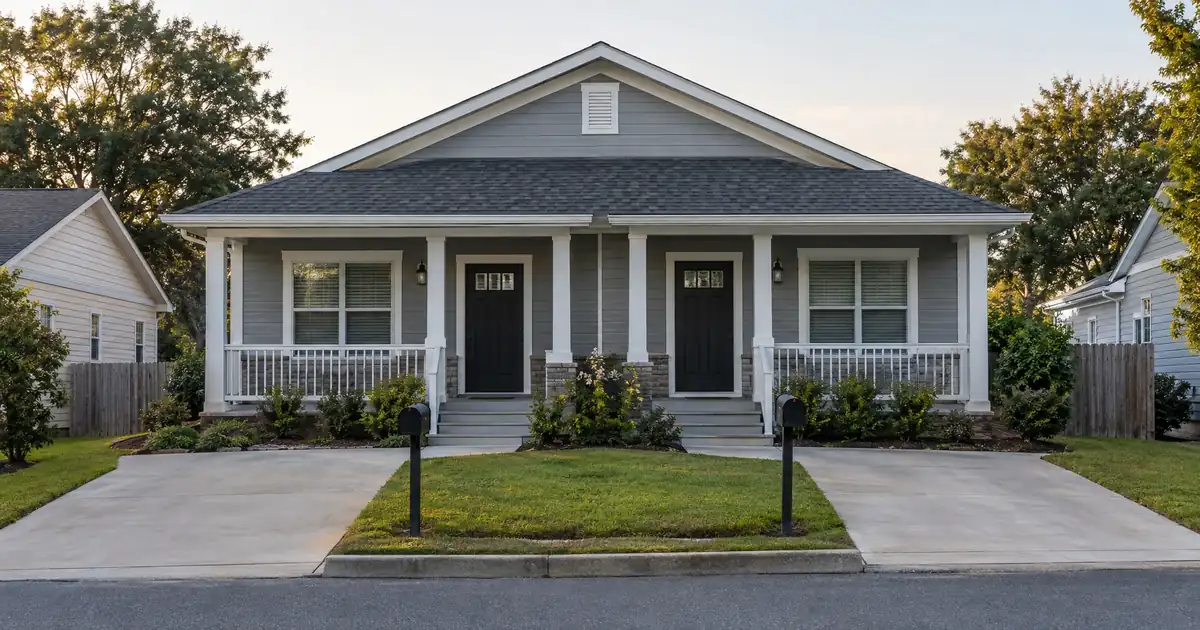
The Quick Read: A VA cash-out refinance can pay off a conventional or FHA loan on a two-to-four unit building, as long as you live in one of the units. You do not need an existing VA loan. The new loan can reach 100% of the appraised value, and the rent from your other units counts only in part when you qualify. Every point is subject to lender guidelines and full file review.
Key Takeaways
- A non-VA loan is a normal payoff. VA’s own cash-out page describes refinancing a non-VA loan into a VA-backed loan.
- You must occupy the building. In a 2-4 unit home, that means living in one unit.
- Rent helps, but it is discounted. Lenders count only a share of the rent from the other units, and they want reserves behind it.
- The streamline does not apply. The IRRRL only refinances an existing VA loan.
- Lenders can be stricter than VA. Many of the tighter rules on 3-4 unit homes come from lenders, not from VA.
VA cash-out estimate
Seeded with an example value, a typical balance, and a round cash request at the first-use fee; change any field.
Editable benchmark: 7.40% as of October 15, 2026 · Freddie Mac 30-year average via FRED®. A conventional market reference, not a VA cash-out refinance quote.
Illustrative starting assumptions: a $350,000 home value, a $193,000 current balance, the full-value VA cap with the first-use funding fee financed, a thirty-year term at the current Freddie Mac benchmark, and property taxes and insurance estimated at typical national rates. Every field is editable.
Illustrative estimate only — not a Loan Estimate, approval, quote, or commitment to lend. The rate field carries the weekly Freddie Mac thirty-year conventional benchmark, a market reference and not a VA cash-out refinance quote; a VA loan is priced by the lender at lock. The total loan, funding fee included, is capped at the program leverage on the reasonable value; the fee follows the tier chosen. The cash available is what the cap allows less the balances paid off and the fee, before closing costs, which are not included. The HELOC line is the line program’s combined loan-to-value ceiling applied to the same value and balance. Taxes and insurance are editable estimates. The debt-to-income figure is a guideline; residual income decides a VA file. Licensed in sixteen states for consumer mortgages.
Key Terms Defined
Cash-out refinance. A new loan that pays off your old loan and, if there is equity left, hands you the difference. With VA, the term also covers a swap with no cash received.
Certificate of Eligibility (COE). The document from VA that confirms your service qualifies you for the program.
Entitlement. The amount of VA backing you have available. Full entitlement means no VA loan limit applies to you.
Net tangible benefit. A VA test that asks whether the new loan puts you in a better financial position than the old one.
Residual income. The money left each month after your debts, taxes and basic living costs. It is the controlling test in VA underwriting.
Funding fee. VA’s one-time charge on the loan. It can be financed into the loan, and some veterans are exempt.
Seasoning. The waiting period a lender wants before you refinance a loan.
What Does a VA Cash-Out Do When Your Current Loan Isn’t VA?
It swaps your current loan for a VA-backed one. Say you bought a triplex with a conventional loan and live in one unit. The new VA loan pays off that loan and any other liens on the building. If equity remains after costs, you can take it as cash.
VA’s cash-out loan page says the product can take cash from equity or refinance a non-VA loan into a VA-backed loan. VA News makes the same point. Veterans with a conventional loan can move into a VA loan.
Some borrowers do this with no cash received at all. They want the VA structure, which carries no mortgage insurance. In the wholesale programs Lendmire places VA files with, the VA cash-out refinances any loan type into VA. It reaches 100% of the appraised value, financed fee included.
Many borrowers assume only a streamline or an existing VA loan opens the door. Not so. The streamline is a different product, and the next section covers it.
Why the Streamline Won’t Replace Your Conventional Loan
The interest rate reduction refinance loan, or IRRRL, refinances an existing VA loan to a lower rate or from adjustable to fixed. That is all it does. It cannot pay off a conventional, FHA or USDA loan. It cannot give you cash.
If your current loan is not VA, cash-out is the VA path. Think of the streamline as an upgrade for VA borrowers and the cash-out as the front door for everyone else.
One related point trips people up. Waiting-period and fee-recovery rules are written around VA-to-VA refinances. When the loan you are replacing is non-VA, ask your loan officer which tests the lender applies. Some lenders add their own timing rules. Those are lender choices, not VA rules.
How Does Occupancy Work in a 2-4 Unit Home?
You must live in the building, in one of the units. VA’s home loans page says VA-backed purchase and cash-out loans are for homes you occupy. Active-duty servicemembers are the exception: a spouse or dependent can occupy the home on their behalf.
You will certify your occupancy as part of the application. Renting out the other units is expected on a multi-unit home. Moving out of the building entirely is the problem. Lendmire’s piece VA Cash-Out Occupancy Rules for a 2-4 Unit Primary Home goes deeper on this.
Unit count matters too. VA’s definition of a dwelling tops out at four units. A building with more units, or more than one commercial unit, falls outside the program.
How Is the Loan Underwritten, Step by Step?
Cash-out loans get full underwriting. Here is the sequence on a multi-unit home:
1. Eligibility. You get a COE from VA. VA loans come from private lenders, and you need satisfactory credit and enough income.
2. Application. You certify occupancy. The lender gives you a net tangible benefit comparison early in the process.
3. Appraisal. A VA appraiser sets the reasonable value. On a multi-unit home, the appraiser also reports market rent for the units you do not occupy.
4. Underwriting. The lender reviews credit, income, debts and residual income. VA sets no minimum credit score. The wholesale programs Lendmire places VA loans with start at a 580 decision score, and some lenders set a higher floor.
5. Payoff and closing. The new loan pays off the old lien. The cash to you is what is left after the payoff, fees and costs.
Residual income is the controlling test. The 41% debt-to-income figure is a guideline, not a cap. A ratio above it needs residual income well above the table. VA’s income standards also say failing one test does not automatically disqualify you. Passing both does not automatically approve you either.
How Much Can You Borrow?
Up to 100% of the appraised value, funding fee included. The federal regulation caps the new loan at 100% of VA’s reasonable value. If the financed funding fee would push the loan past that ceiling, you pay the overage in cash at closing.
VA Circular 26-18-30 explains where this ceiling came from. VA lifted an older, lower cap. The change applies to applications taken on or after its effective date in early 2019. For a related look, see Lendmire’s piece Can a VA Cash-Out Cover Full Value on a 2-4 Unit Primary Home?.
Do not confuse that ceiling with the net tangible benefit tests below. A figure near 90% shows up in those tests, and it has led many borrowers to believe VA caps cash-out there. It does not.
With full entitlement, there is no VA loan limit. The wholesale programs Lendmire works with serve amounts up to $4,000,000 with full entitlement. With only partial entitlement, a down payment may be required. Speak with a loan officer about your situation.
What Is the Net Tangible Benefit Test?
It is VA’s check that the refinance helps you. The regulation requires the lender to give you the comparison and requires the loan to pass it. The loan has to meet at least one listed criterion. Several fit a non-VA payoff:
- Eliminating monthly mortgage insurance.
- Setting the new loan well below the value ceiling.
- Moving from an adjustable rate to a fixed one.
- Shortening the loan term.
- Raising monthly residual income.
The mortgage insurance route is the one to watch. A conventional or FHA loan with monthly mortgage insurance can pass this test cleanly, because VA charges none. A VA loan has a one-time funding fee instead.
The “lower payment” test is harder than it sounds. VA News warns that a cash-out rarely lowers your monthly payment. Cash added to the balance raises the loan amount and the lifetime interest. Be cautious if anyone says otherwise.
What Does the Funding Fee Look Like?
On a cash-out refinance, the fee is 2.15% of the loan for first use and 3.3% for later use. It can be financed into the loan, within the 100% ceiling. Veterans receiving compensation for a service-connected disability are exempt, as are certain other groups. If you qualify, the COE tells the lender.
Only the funding fee, and the cost of any energy-efficiency improvements, can be added to the loan. Other closing costs and any points come out of your proceeds. That can shrink or erase your cash at closing. It also means a high payoff on a thin-equity building leaves little room.
How Does Rent From the Other Units Count?
Partially. Under VA’s income rules, rental income used in qualifying is based on 75% of the lease or rental agreement amount, unless a higher percentage can be documented. The discount covers vacancy and upkeep.
The rules also ask for documentation of landlord experience. The lender wants to see you have managed rental units or handled collections before. A first-time landlord should expect more questions.
Reserves matter on these files. Lenders want cash set aside to cover payments if a unit sits empty. The amount varies by lender, and cash-out proceeds may not count toward it. Ask early what your lender requires.
Consider a borrower with a four-unit building who lives in one unit and rents three. Rent can strengthen the file, but it enters at a discount. The borrower still needs residual income to hold up on its own. If the file leans heavily on rent, expect a closer look.
Where VA Rules End and Lender Rules Begin
Many “VA rules” are lender overlays. VA sets the floor, and lenders can set a higher one.
| Topic | VA rule | Common lender overlay |
|---|---|---|
| Credit score | No VA minimum | Lender sets its own floor |
| Reserves, 3-4 units | Tied to rent use | Often stricter |
| Rent credit | 75% of the lease | Sometimes more documentation |
| Loan ceiling | 100% of value | Some set a lower cap |
On 3-4 unit homes, overlays tend to be tighter. That is one reason two lenders can respond differently to the same file. A broker who places files across several wholesale lenders can show you where each one lands.
State law can also limit cash-out in some places. If your state restricts it, the lender will flag it up front.
What Does the Property Have to Meet?
The whole building has to meet VA’s property standards, not just your unit. That includes any vacant units. The appraiser checks condition, safety and basic livability. A unit that is stripped out or unsafe can hold up the file until it is repaired.
Repair requests are common on older buildings. They are also fixable. Ask for a pre-application walkthrough if you know a unit has problems.
Is It Worth It? How the Decision Looks in Practice
Start with the reason you want out of the current loan. The answer changes the math.
- Monthly mortgage insurance on the current loan. A VA cash-out may remove it, which can help the net tangible benefit.
- Cash you need for repairs or debt. Add up your costs honestly. Cash-out increases the balance and the lifetime interest.
- A thin equity cushion. The 100% ceiling leaves little room once costs and the financed fee come in.
- Reliance on rent. Weigh the 75% treatment and the reserve requirement before counting on it. Terms vary by lender guidelines, property type, leverage, credit profile, and full file review.
The strongest files tend to have steady residual income, a documented rent history and real equity. The weakest lean on rent alone with thin reserves. Neither is a verdict. Lender review decides.
If you are weighing a cash-out refinance against keeping the loan you have, Lendmire can help you compare the programs and the equity each one reaches. You can learn how the VA cash-out refinance program works with Lendmire, or ask for a quote at 828-256-2183.
Frequently Asked Questions
Do I need an existing VA loan to do a VA cash-out?
No. VA says a cash-out can refinance a non-VA loan, such as a conventional or FHA loan, into a VA-backed loan. You still need a COE and must pass credit and income review.
Can I move out after closing and rent the whole building?
The occupancy requirement applies when the loan is made, and you certify that you will live there. Claims that you can convert to a full rental soon after are lender claims, not VA rules. Ask your lender directly before you plan around it.
Will a VA cash-out lower my monthly payment?
Rarely. Cash added to the balance raises the loan amount, and VA News cautions against claims otherwise. A payment drop is more likely when the current loan carries monthly mortgage insurance that the VA loan would remove.
Can I roll all my closing costs into the loan?
No. Only the funding fee and the cost of energy-efficiency improvements can be added to the loan. Other costs and points are paid from your proceeds or from your own funds.
Does the streamline refinance work for my conventional loan?
No. The IRRRL only refinances an existing VA loan. Replacing a conventional or FHA loan requires the cash-out refinance.
For your own numbers, request a scenario review with Lendmire.
About Lendmire
Lendmire — NMLS# 2371349 — is a mortgage broker that arranges FHA, VA, conventional and jumbo home purchase and refinance financing in 16 states through wholesale lenders. Every option is subject to the lender’s guidelines and full underwriting. Scotsman Guide named Lendmire a Top Mortgage Workplace in both 2025 and 2026.
Get Started
Ready to find the right loan for you?
In about 30 seconds you can review financing options available for your home or investment property. No commitment required.
Informational only. Not a Loan Estimate, approval, or commitment to lend. Program availability and eligibility are subject to lender guidelines, credit approval, property review, and underwriting.
References
1. VA.gov — Cash-out refinance loan
2. VA News — Home loan refinance
4. govinfo — 38 CFR 36.4340 (2025 edition)
This article is part of Lendmire’s VA Loans series — every loan program’s qualification details, guidelines, and scenarios live on the loan options page.
Related reading: Can You Get a VA Cash-Out on a Duplex With One Unit Vacant? · Type I and Type II VA Cash-Out Rules With an Existing VA Loan · VA Cash-Out Requirements for a Home Worth Far More Than the Loan
Brandon Miller
Founder & CEO, Mortgage Loan Originator, Lendmire LLC
- Mortgage Loan Originator · NMLS# 1129696 · Verify on NMLS Consumer Access
- North Carolina Real Estate Broker · License# 343312 · Verify on NCREC
- North Carolina Insurance Producer · License# 19053198 · Property, Casualty, Life, Health · Verify on NAIC SBS
- Lendmire LLC · Firm NMLS# 2371349 · Verify firm licensure
Compliance and disclosures. Lendmire (NMLS# 2371349) is a licensed mortgage broker and is not a direct lender, depository institution, financial advisor, or tax professional. Content in this article is general market analysis and educational information — not financial, legal, or tax advice for any specific situation. Lendmire does not guarantee loan approval; every transaction is subject to underwriting by the funding lender. Mortgage pricing and loan program guidelines are subject to change at any time without notice and vary by borrower characteristics, property type, and state regulations. Lendmire complies with Equal Housing Opportunity. Licensure verification: NMLS Consumer Access.