
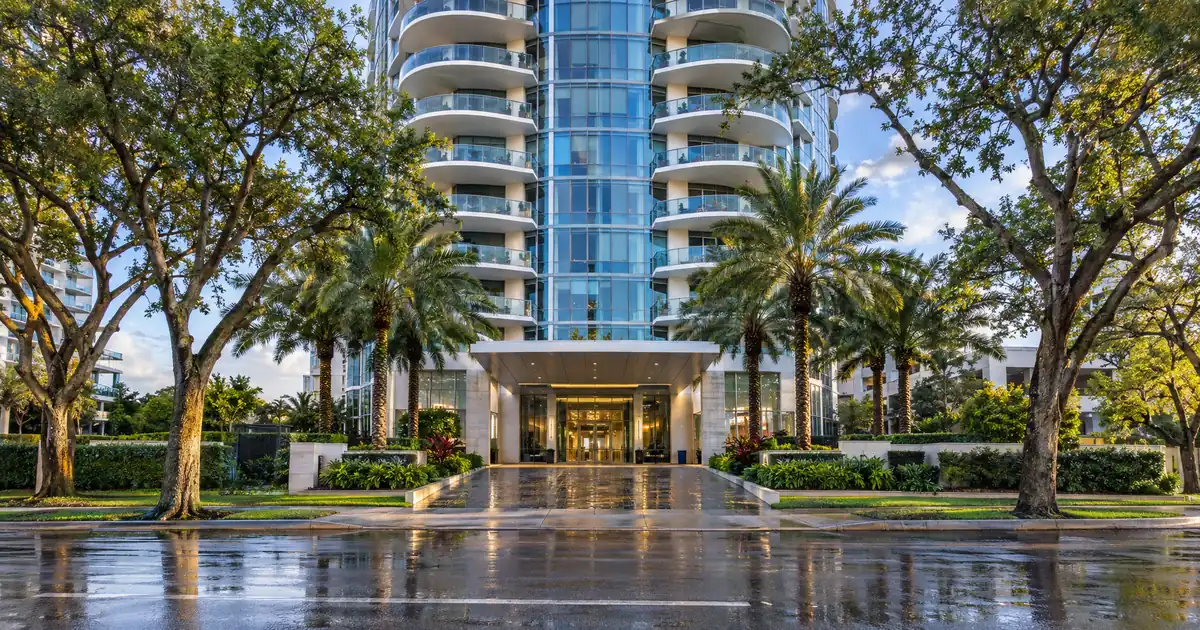
The Quick Read: Yes, you can use bank statements to qualify for a super jumbo condotel purchase, but only when the building, the loan size, and your deposits each clear review on their own terms through select wholesale programs, subject to full underwriting and lender guidelines. Statements prove your income. They do not change how a lender treats a hotel-style building or a balance above $3,000,000.
- A condotel is a property type, and bank-statement income is a documentation method. They are decided separately.
- Across Lendmire’s wholesale network, condotels are treated as non-warrantable, so the building gets its own review.
- Condotel leverage is capped by the property type and by the loan-size ladder. The lower number governs.
- Every loan above $4,000,000 is reviewed case by case before submission.
- If your personal deposits are thin or uneven, a rent-based DSCR loan may fit the same building better.
Key Terms Defined
Condotel: a condo unit in a building that runs like a hotel, with a rental desk, pooled rentals, nightly bookings, or on-site hospitality.
Bank statement loan: a mortgage that is reviewed around 12 or 24 months of deposits instead of traditional personal-income documentation.
Super jumbo: a loan far above the conforming limit. No official line exists, so each lender sets its own.
Non-QM: a mortgage that sits outside the standard agency rulebook and is underwritten under a lender’s own guidelines.
Non-warrantable: a condo project that does not meet agency standards, so agency programs will not buy the loan.
Expense ratio: the share of business deposits the lender subtracts as operating cost before counting the rest as income.
DSCR: debt service coverage ratio, which compares the property’s rent to its full monthly housing obligation.
Why a Condotel Changes the Conversation
A condotel is almost always non-warrantable, which pushes the file out of agency lending and into non-QM or portfolio programs. Those lenders will lend on these buildings. They simply look at them more closely.
Lenders look for a rental desk, mandatory rental pooling, nightly bookings, and hotel-style services. Any of these can make a building a condotel. When you submit, the lender reviews the project and the condo questionnaire even if your income is fully documented. A spotless income file cannot rescue a building the lender will not accept.
Buyers often assume strong deposits can fix a weak property. They cannot. The property can close the door before your income is ever calculated.
The Three Questions That Decide the File
Three separate questions decide whether a super jumbo condotel gets financed. Competing guides tend to blur them into one.
| Question | What the lender looks at | Where it can fail |
|---|---|---|
| The property | Rental pool, hotel services, HOA health | Building not accepted |
| The income | 12 or 24 months of deposits | Thin or erratic deposits |
| The loan size | Leverage ladder, reserves, credit score | Balance too high for the tier |
Fix them in that order. Confirm the building is acceptable first. Then pick the income method. Then check where the balance lands on the size ladder.
How Do Bank Statements Turn Into Income?
The lender totals your eligible deposits, subtracts an expense ratio on business accounts, and divides by the number of months.
Here is how the pieces work across the programs Lendmire places files with:
1. Pick the window. Twelve or 24 consecutive months. The bank portfolio program, one of two wholesale programs covered below, uses 12.
2. Strip out non-income. Transfers between your own accounts and one-time credits come out.
3. Apply the expense ratio. Fixed expense ratios typically scale with business size and type, with a lower ratio for a service business with no employees and higher ratios as headcount grows or for any product business. An accountant-provided ratio can replace the fixed one.
4. Adjust for ownership. Business statements need at least 25% ownership.
5. Divide by the months. The result is your qualifying monthly income.
Two details help high earners. Transfers from your own business into your personal account count at 100%, because the expense ratio was already applied upstream. A profit-and-loss method also exists, capped at 80%. Statements must be consecutive. A transaction history never substitutes for them.
For the account-side detail, see Lendmire’s piece How to Use Business Bank Statements for a Super Jumbo Loan.
A worked scenario
Picture a physician-owner of a practice with seven employees. The practice falls in the 50% expense-ratio bracket, so only about half of its deposits count as income. She wants a condotel priced in the $3,000,000 to $3,500,000 band as an investment purchase.
Her income can support the file, but the size ladder is the tighter constraint. On an investment-property purchase through select wholesale programs, the ladder in that band runs about 60%. The condotel’s own purchase cap of 75% is higher, so the 60% figure governs. She also faces the super-jumbo overlays and the 9-month reserve tier. These inputs are modeled for illustration, not a quote or an approval.
What Changes at Super Jumbo Size?
Leverage drops, reserves rise, and the credit requirement moves up. Lendmire’s network spans $300,000 to $30,000,000 through two wholesale programs. A portfolio non-QM bank-statement program carries files to $6,000,000.
On an investment-property purchase, the ladder typically runs like this, through select wholesale programs and subject to full underwriting:
| Loan size | Investment purchase LTV | Credit for this leverage |
|---|---|---|
| $300K–$1M | 85% | 700+ |
| $1M–$2.5M | 80% | 680–720+ |
| $2.5M–$3M | 75% | 720+ |
| $3M–$4M | 60% | 700+ (overlay minimum above $3M) |
| $4M–$5M | 65%, case by case | 760+ |
| $5M–$10M | 55%, case by case | 680+ |
The $3M–$4M row carries the 700 minimum because the super-jumbo overlays below apply to investment property above $3,000,000. Above $4,000,000, every figure is reviewed case by case before submission, so treat those rows as starting points rather than offers.
The condotel itself adds a second cap. A condotel purchase typically tops out at 75% through select programs, and cash-out at 65%, or 50% on the bank program. From $3,000,000 up, the size ladder is the tighter number.
Above $3,000,000 on an investment property or second home, a set of super-jumbo overlays applies:
- A 700 credit floor and a 0x30x24 housing history.
- 48 months of seasoning after any credit event.
- U.S. citizens and permanent residents only, with no non-occupant co-borrowers.
- No rural property, and ten acres maximum.
- Cash-out proceeds cannot be used to meet reserves.
Outside the super-jumbo overlays, the portfolio program’s credit floor is 660 and the bank program’s is 680. Debt-to-income can reach 50%. Reserves are 3 months to $500,000, 6 months to $1,500,000, and 9 months above that. Each additional financed property adds 2 months, to a 12-month maximum. First-time investors carry 12 months.
Statements or DSCR on a Condotel?
Pick statements when your personal deposits are strong and the unit’s rent is thin or hard to document. Pick DSCR when your deposits are uneven but the unit rents well. They qualify different things: one qualifies you, the other qualifies the property.
| Factor | Bank statements | DSCR |
|---|---|---|
| What qualifies | Your deposits | The unit’s rent |
| Best fit | Strong owner cash flow | Strong unit rent |
| Common weak point | Declining or erratic deposits | Operator splits shrink rent |
| Condotel risk | Building review still applies | Pooled rent is hard to count |
Condotel rent is where DSCR gets tricky. The operator often keeps a large share. It explains why coverage on a condotel often lands thin.
Many DSCR programs look for rent covering the full monthly obligation at roughly 1.0x. Select lenders in the network review below that level, but leverage and terms adjust. For a head-to-head on a single building, read Lendmire’s comparison of super jumbo DSCR and bank statement loans for a condotel. The complete DSCR loans guide covers the rent-based side in full.
What the Lender Checks on the Building
Expect the lender to review the HOA budget and financials, delinquency levels, reserves, the condo questionnaire, and the rental-program or pooling agreement. A building with heavy investor concentration, weak reserves, or a mandatory rental pool draws more scrutiny.
Lender appetite varies. Some programs accept condotels across documentation types. Others decline hotel-style buildings outright. Fewer still handle both a condotel and a very large balance. This is where a broker that sees many guidelines earns its keep: the right program for the building often decides the file before income is discussed.
Exit matters too. A future buyer will face the same narrow lender pool, so financing availability shapes resale.
Does Owner Use Change the Loan?
Yes. How you plan to use the unit decides which ladder applies. Condotels bought purely as rentals are business-purpose loans. The Federal Reserve’s Regulation Z guidance treats credit to buy non-owner-occupied rental property as business purpose and lists transaction size as one factor in that judgment.
If you will stay in the unit for part of the year, expect a second-home review instead. Second-home ladders run about five points lower than primary residence at every size. Second homes are one-unit only. On a second home, the asset-allowance path (liquid assets divided by 36, 60, or 84 months, 80% maximum) becomes an option that investment properties do not get.
Be honest with the lender about personal use. A condotel that is half vacation home and half rental sits in a gray zone, and the wrong label can sink a file late.
Does Non-QM Mean Less Paperwork?
No. Statement loans still verify income. The CFPB‘s ability-to-repay compliance guide accepts bank statements as a third-party record where consumer rules apply, and it says lenders generally cannot rely on a borrower’s word alone.
A typical package includes:
1. Consecutive statements for 12 or 24 months. 2. Business-ownership verification, and possibly an accountant letter for the expense ratio. 3. A credit report and reserve statements. 4. The condo questionnaire, rental-pool agreement, budget, and appraisal.
Why These Files Stall
- Deposit problems. Declining income, repeated overdrafts, or large unexplained deposits.
- Commingled accounts. Personal and business money mixed together.
- Building issues. Delinquent HOA dues, mandatory pooling, or weak reserves.
- Wrong leverage assumption. Planning on the condotel cap when the size ladder is lower.
- Reserve gaps. Using cash-out proceeds to meet reserves above the super-jumbo line.
Tax treatment can depend on how the funds are used and how the property is held; investors should keep clear records and speak with a qualified tax professional before relying on any deduction.
Frequently Asked Questions
Can a conventional loan finance a condotel?
Rarely. Agency programs generally exclude condotels because the buildings are non-warrantable. These files typically move to non-QM or portfolio programs, where the building gets a manual review.
Can I use short-term or condotel rental income to qualify?
Sometimes, but it works differently by program. On a statement loan, your deposits qualify you and the unit’s rent is not the basis. On DSCR, the rent matters, and operator splits and pooling can reduce the number the lender counts. Short-term rental rules can vary by city, county, HOA, and property type, so investors should confirm local rules before relying on projected rental income.
Can a foreign national use this route?
Above the super-jumbo line, no. The overlays above $3,000,000 on an investment property or second home limit those programs to U.S. citizens and permanent residents. Below that line, eligibility depends on the program and the borrower profile.
Can I refinance an existing condotel with bank statements?
Often, yes. Cash-out on a condotel typically tops out at 65% through the portfolio program and 50% on the bank program. The size ladder can be lower still. Above 60% LTV, cash in hand is capped at $1,500,000 on the portfolio program.
What if my deposits are weak but I have large liquid assets?
An asset path may fit. Asset allowance and assets-only programs review your file on liquid holdings rather than deposits. They apply to primary and second homes only, so they will not work for a pure investment condotel.
Next Step
If you are financing a high-balance property on business or personal bank statements and want to see how the numbers work, Lendmire can help you compare super jumbo bank statement loan options based on your deposits, the property, credit profile, leverage, and your goals. Lendmire’s consumer mortgage lending is licensed in AL, CA, CO, FL, GA, IN, MI, MT, NM, NC, OH, PA, TN, TX, VA, and WA. Reach the team at 828-256-2183. Nothing here is a commitment to lend, and every file is underwritten individually.
Condotel buyers who start with the building rather than the borrower waste the least time, because a lender’s no on the property ends the conversation before income ever comes up.
Lendmire’s self-employed mortgages page presents both super jumbo programs, bank statement and DSCR, side by side.
About Lendmire
A DSCR-focused mortgage broker, Lendmire (NMLS# 2371349) places investor financing across 41 markets — 40 states plus Washington, D.C. — with DSCR eligibility generally reviewed by the lender on property cash flow instead of traditional personal-income documentation, subject to lender guidelines. Scotsman Guide named Lendmire a Top Mortgage Workplace in 2025 and 2026.
Get Started
Ready to find the right loan for you?
In about 30 seconds you can review financing options available for your home or investment property. No commitment required.
Informational only. Not a Loan Estimate, approval, or commitment to lend. Program availability and eligibility are subject to lender guidelines, credit approval, property review, and underwriting.
References
1. CFPB
This article is part of Lendmire’s super jumbo bank statement loan program — full qualification details, guidelines, and scenarios live on the program page.
Related reading: How a Super Jumbo Bank Statement Second-Home Loan Works · Super Jumbo Bank Statement Loan vs Bank ARM After a Company Sale · Super Jumbo Bank Statements vs Adding Retirement Account Assets
Brandon Miller
Founder & CEO, Mortgage Loan Originator, Lendmire LLC
- Mortgage Loan Originator · NMLS# 1129696 · Verify on NMLS Consumer Access
- North Carolina Real Estate Broker · License# 343312 · Verify on NCREC
- North Carolina Insurance Producer · License# 19053198 · Property, Casualty, Life, Health · Verify on NAIC SBS
- Lendmire LLC · Firm NMLS# 2371349 · Verify firm licensure
Important disclosures. Lendmire (NMLS# 2371349) is a licensed mortgage brokerage. Lendmire is not a direct lender, depository institution, or financial advisor. All loan inquiries are subject to lender underwriting; this article does not constitute a commitment to lend. Rates, terms, and program guidelines are subject to change without notice and vary by borrower profile, property type, and state. Information in this article is general in nature and is not financial, legal, or tax advice. Equal Housing Opportunity. NMLS Consumer Access: nmlsconsumeraccess.org.