
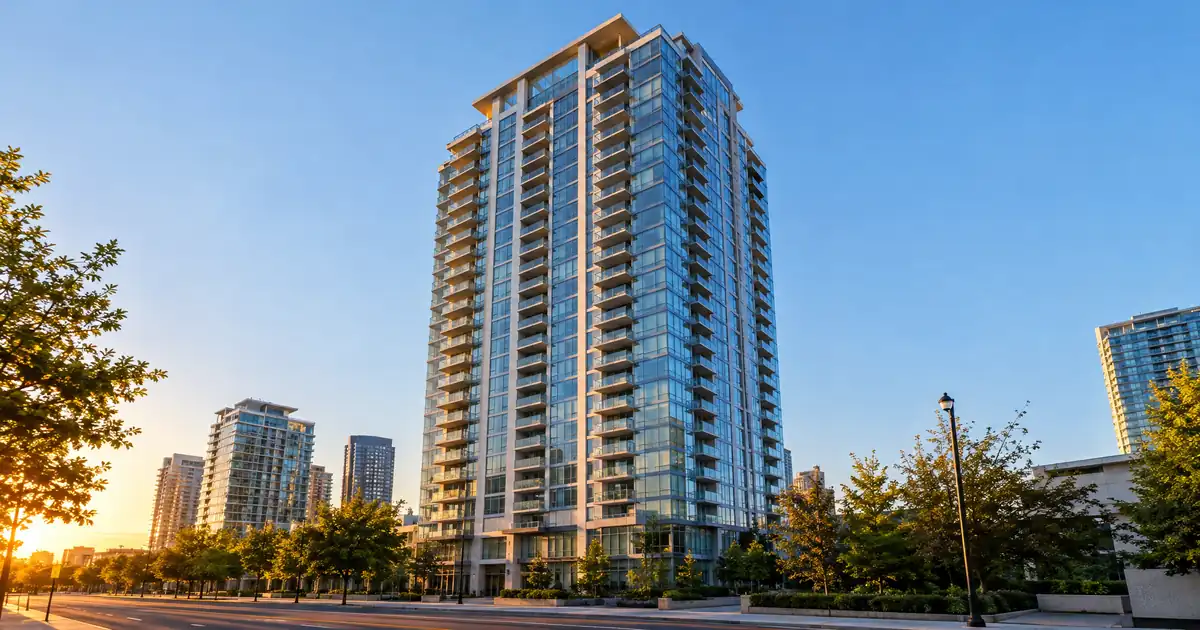
The Quick Read: A non-warrantable tower unit can be financed in an LLC through a DSCR or portfolio program, because those lenders judge the building and the unit’s rent on their own rules instead of agency condo standards, but only when the reason the building fails is one the lender accepts. The label describes the building, not you and not the unit. Your job is to find out why the tower fails, match that reason to a lender who accepts it, and prove the rent covers the full monthly obligation, dues included.
- Ask why the building is flagged first. Investor-heavy ownership is the easiest cause to finance. Litigation and hotel-style operation are the hardest.
- Mandatory association dues sit in the monthly obligation, so amenity-heavy towers squeeze coverage hard.
- Entity vesting is commonly available on investor programs, subject to lender program eligibility.
- On a non-warrantable condo, leverage tops out at 80% through select wholesale programs, subject to full underwriting.
- Plan the exit before you buy. Fewer buyers can finance these units, which narrows your resale pool.
What Does Non-Warrantable Actually Mean?
Non-warrantable is a project-eligibility label from agency condo standards. A building that fails any test is non-warrantable by exclusion, since the category is not separately defined in guidelines, as HomeBuyer.com explains. It says nothing about construction quality.
Towers trip the label for familiar reasons:
- Hotel-style or condotel operation.
- Pending litigation.
- Unfinished critical repairs or an assessment to fund them.
- Too much commercial space, such as retail or restaurants on the lower floors.
- High dues delinquency.
- Thin reserves.
- Heavy investor or single-entity ownership.
- A new project that has not presold enough.
Height alone is not on the list. A forty-story building with strong reserves and owner-occupants is fine. A six-story building with a lawsuit is not.
Most buyers in this lane are financing with a portfolio or non-QM loan, where the lender keeps the risk instead of selling the loan to an agency. Those lenders set their own rules. That is why a tower that fails the agency test can still be reviewable.
Key Terms Defined
Warrantable: A condo project that meets agency eligibility standards, so loans on its units can be sold to the agencies.
Non-warrantable: A project that fails one or more of those standards. The label attaches to the building.
DSCR (debt service coverage ratio): Monthly rent divided by the full monthly obligation: principal, interest, taxes, insurance and association dues.
Vesting: How title to the unit is held, such as in an LLC.
Condo questionnaire: The lender’s form on ownership mix, finances, litigation, rental program and development status.
Condotel: A condo run like a hotel, often with rental pooling or front-desk check-in.
Why Does the Reason the Tower Fails Decide Everything?
The cause of the label matters more than the label. “We do non-warrantable” is not an answer from a lender. The useful question is whether they finance your building’s specific problem.
Across the wholesale network Lendmire works with, programs split into two groups. Some issues block only agency loans. Others make nearly every lender hesitate. This table is a practitioner’s triage, not a promise of approval.
| Trigger | Agency loan | Investor program |
|---|---|---|
| High investor ownership | Often blocks | Usually workable |
| Unsold units in a new project | Blocks | Often workable, lower leverage |
| Heavy commercial podium | Can block | Reviewed case by case |
| Litigation | Blocks | Varies, often hard |
| Critical repairs or large assessment | Blocks | Varies, often hard |
| Condotel or rental pooling | Blocks | Hardest, some decline |
| High dues delinquency | Blocks | Varies by lender |
Here is the catch with investor-heavy buildings. A high investor share often travels with other problems, such as thin reserves or deferred maintenance. Confirm investor concentration is the only issue before you assume the easy case.
How Underwriting Treats the File, Step by Step
Underwriters review the building and the unit together, then set leverage, reserves and terms from the combined risk. The sequence is predictable.
1. Diagnose the flag. Order the condo questionnaire early. It reveals ownership mix, litigation, delinquency and rental structure.
2. Gather the building package. After recent structural-safety scrutiny, lenders commonly ask for inspection reports, engineering studies, board minutes, the reserve study and answers on special assessments and deferred maintenance. Reserve Deck describes the same document set for agency files, and non-QM underwriters ask for similar items. Each lender’s checklist governs.
3. Size the rent test. Market rent is typically documented on an appraisal rent schedule: Form 1007 for a single unit, Form 1025 for two to four units. Many programs use the lower of the lease or market rent.
4. Confirm vesting and guarantee. Investor programs commonly allow title in an LLC, subject to lender program eligibility, and a personal guarantee from the principal is typical.
5. Appraise the unit. Floor level, view and recent sales in the same building move value. Tower files usually need comps from inside the building.
6. Set terms. The lender fixes leverage, reserves and pricing from project risk plus borrower strength.
Problems on tower files usually come from the building package, not the borrower. Start that request before you finish negotiating the contract.
The Rent Test: Where Tower Dues Bite
Tower dues reduce coverage dollar for dollar, because mandatory association dues go in the denominator. They are not netted against rent. The same rent supports a smaller loan on an amenity-heavy tower unit than on a comparable house.
Run the numbers on a modeled unit, with these inputs as assumptions only. Say rent covers the full monthly obligation at roughly 1.25x before any change. Now suppose dues rise enough to add about a fifth to that obligation. Coverage drops to roughly 1.04x. Add a special assessment that the lender spreads across the term, pushing the obligation up another fifth, and coverage slips to about 0.87x.
Lenders treat pending assessments differently. Some add them to the obligation and some do not, so ask before you rely on a number.
When coverage lands below 1.00x on long-term rent, the options are narrower but real. Select lenders in the network offer programs below 1.00, though leverage and terms adjust. You can also bring more cash to the closing table or look at a different qualification path, covered next. Whether any of these fits depends on lender guidelines, credit approval and property review.
Which Financing Path Fits an LLC Portfolio?
DSCR is the natural lane for entity-held portfolios, because it qualifies primarily on property-level rental income covering the payment, subject to lender guidelines. Some investors are also self-employed and hold high balances, so a bank-statement path can be a second option. The complete DSCR loans guide covers how the property-income path works in detail.
| Path | Reviewed on | Best fit |
|---|---|---|
| DSCR | Property rent versus obligation | Entity-held rentals, scaling |
| Bank statement | Deposits after expense ratio | Self-employed, high income |
| Asset-based | Liquid assets | Cash-rich, thin income |
For context on the bank-statement lane, the network’s programs use 12 or 24 months of deposits after an expense ratio. Credit floors are 660 on the portfolio program and 680 on the bank portfolio program, with 700 above the super-jumbo line. Reserves are typically 3 months to $500,000, 6 months to $1,500,000 and 9 months above, plus 2 months per additional financed property to a 12-month maximum. First-time investors typically need 12 months.
On leverage, non-warrantable condos are capped at 80% through select wholesale programs, subject to full underwriting. On an investment-property purchase, the ladder allows 80% from $1,000,000 to $2,500,000 and 75% from $2,500,000 to $3,000,000. On an investment-property cash-out, it runs 75% through $2,000,000, then steps down to 70% and 60% in the next two bands. A condotel takes 75% on a purchase and 65% on a cash-out, and only 50% on a cash-out through the bank portfolio program.
Above $3,000,000 on an investment property, super-jumbo overlays apply, including a 700 credit floor and a longer wait after any credit event. Anything above $4,000,000 is reviewed case by case before submission. Every figure here is a ceiling, not a promise.
(If the tower unit is your first financed investment, the 12-month reserve requirement matters more than the leverage number.) Every figure here varies by lender and program, since guidelines, property type, leverage, and credit profile all apply.
Where the General Rule Breaks
Agency rules have loosened, so an old label may be stale. Fannie Mae’s Lender Letter LL-2026-03 retired the 50% investment-property concentration limit for established projects reviewed under full review. It keeps the 50% presale requirement for new and newly converted projects. HousingWire reports that limited review has ended, so every project now gets a full review. It also reports the reserve minimum rising from 10% to 15% of annual budgeted assessment income for later-dated applications. The Michigan Community Association Law Blog notes that single-investor limits remain, at 2 units in a 5 to 20 unit project and 20% in projects of 21 or more units. It adds that individual lenders may keep their own overlays.
This is contrast only. It does not set DSCR eligibility. It does mean a tower flagged for investor mix alone may now be agency-eligible, so check before assuming you need non-QM.
Condotel operation. This is the hardest case. Rental pooling, front-desk operation and deed restrictions on rental use can lead lenders to decline outright.
Short-term rental use. The governing documents must allow it, and rent comes from short-term rental data or a market schedule. Short-term rental rules can vary by city, county, HOA, and property type, so investors should confirm local rules before relying on projected rental income.
Florida towers. Post-Surfside rules require a Structural Integrity Reserve Study and milestone inspections. Boards of buildings three stories or higher can no longer waive structural reserve funding, per Board Deadline. Urban Land Magazine reports one 46-unit building’s per-unit assessment estimate rising from $20,000 to $200,000, and says lenders are scrutinizing association finances. Treat that as a warning about assessments in any aging tower, not a national average.
Pre-approval is not building approval. Borrowers get pre-approved and then learn late that the building’s rental ratio is too high. Get the building reviewed before you spend on inspections.
What Does the Decision Look Like in Practice?
Buy when three things line up: the cause of the label is one your lender accepts, coverage clears the lender’s floor after dues, and your reserves meet the portfolio count. If any one fails, move on. For a fuller walk-through of a high-end case, see Lendmire’s piece How a Portfolio Investor Finances a Non-Warrantable Luxury Tower Unit.
Scaling. Adding units in a building you already own raises your own share of the investor mix. That can undermine the next lender review of the project. Space out purchases and ask how a lender counts your holdings.
Entity structure. Whether one LLC or several fits depends on your lawyer’s advice and lender program terms. Vesting and borrower are not always the same thing, so settle that before you sign a contract.
Exit. Non-warrantable buildings shrink the buyer pool, since fewer buyers can finance, which can mean discounts or reliance on cash buyers, as Enact notes. Status is not permanent, though. If the issues are cured, a lender can re-review the project.
If the tower needs a discount to work, price it in at purchase. Do not count on the status curing.
This article is general information, not legal or tax advice. Consult a qualified attorney or CPA about your own situation, and treat every program figure as subject to lender guidelines and full underwriting, not a commitment to lend.
If you are financing a tower unit and want to compare structures, Lendmire arranges DSCR and high-balance financing through select lenders across 41 markets, including Washington, D.C., and can help you match the building’s issue to a program that accepts it.
Frequently Asked Questions
Can an LLC hold title to a non-warrantable tower unit?
Often, yes. Investor programs commonly allow entity vesting, subject to lender program eligibility, and typically ask for a personal guarantee from the principal. Agency loans generally do not allow it. Confirm how the lender treats the entity before you sign the purchase contract.
Does investor concentration alone make a tower hard to finance?
No. It is usually the easier cause, because investor programs care less about the ownership mix. The risk is that heavy investor buildings often carry other problems, like thin reserves or deferred repairs. Ask the lender to review the full building package, not just the ratio.
How much leverage is available on a non-warrantable condo?
Up to 80% through select wholesale programs, subject to full underwriting. The investment-property ladder also steps down with loan size, and anything above $4,000,000 is reviewed case by case. A condotel takes lower figures.
How do association dues affect the DSCR on a tower unit?
They go into the monthly obligation, so higher dues lower coverage directly. A rent that clears comfortably on a house can fall near or below 1.00x on an amenity-heavy tower. Select programs below 1.00x exist, with adjusted leverage and terms.
Can the non-warrantable status change after I buy?
Yes, if the underlying issues are fixed, because a lender can re-review the project. Repairs, resolved litigation or better reserves can change the answer. Do not underwrite your plan on a cure that has not happened.
For current guidelines and terms, see Lendmire’s super jumbo bank statement loan programs page.
Lendmire’s self-employed mortgages page presents both super jumbo programs, bank statement and DSCR, side by side.
About Lendmire
As a mortgage broker (NMLS# 2371349), Lendmire arranges financing for investors and high-net-worth borrowers through wholesale lenders, qualifying on property rental income, bank statements, a profit-and-loss statement or liquid assets instead of traditional personal-income documentation, with consumer mortgage lending licensed in 16 states. Lendmire is never the lender; program terms are set by the lender and its guidelines. Scotsman Guide named Lendmire a Top Mortgage Workplace in both 2025 and 2026.
Get Started
Ready to find the right loan for you?
In about 30 seconds you can review financing options available for your home or investment property. No commitment required.
Informational only. Not a Loan Estimate, approval, or commitment to lend. Program availability and eligibility are subject to lender guidelines, credit approval, property review, and underwriting.
References
2. Reserve Deck
3. Fannie Mae Lender Letter LL-2026-03
4. HousingWire
5. Michigan Community Association Law Blog
8. Enact MI
This article is part of Lendmire’s super jumbo bank statement loan program — full qualification details, guidelines, and scenarios live on the program page.
Related reading: How Much Non-QM vs Portfolio Lenders Lend on a Non-Warrantable Luxury Condo · How to Find a Lender That Accepts Non-Real-Estate Collateral on a Super Jumbo Loan · How to Qualify for a Bank Statement Loan for a High-Rise Condo
Brandon Miller
Founder & CEO, Mortgage Loan Originator, Lendmire LLC
- Mortgage Loan Originator · NMLS# 1129696 · Verify on NMLS Consumer Access
- North Carolina Real Estate Broker · License# 343312 · Verify on NCREC
- North Carolina Insurance Producer · License# 19053198 · Property, Casualty, Life, Health · Verify on NAIC SBS
- Lendmire LLC · Firm NMLS# 2371349 · Verify firm licensure
Disclosures. The information presented in this article is general market commentary, not financial, legal, or tax advice. Lendmire is a mortgage brokerage (NMLS# 2371349) — not a direct lender or depository institution — and loan placement is subject to lender underwriting. Nothing in this content represents a commitment to lend. Loan terms, pricing, and program availability vary based on borrower qualifications, property characteristics, and state of subject property, and are subject to change at any time. Lendmire complies with Equal Housing Opportunity requirements. Consumer access: nmlsconsumeraccess.org.