
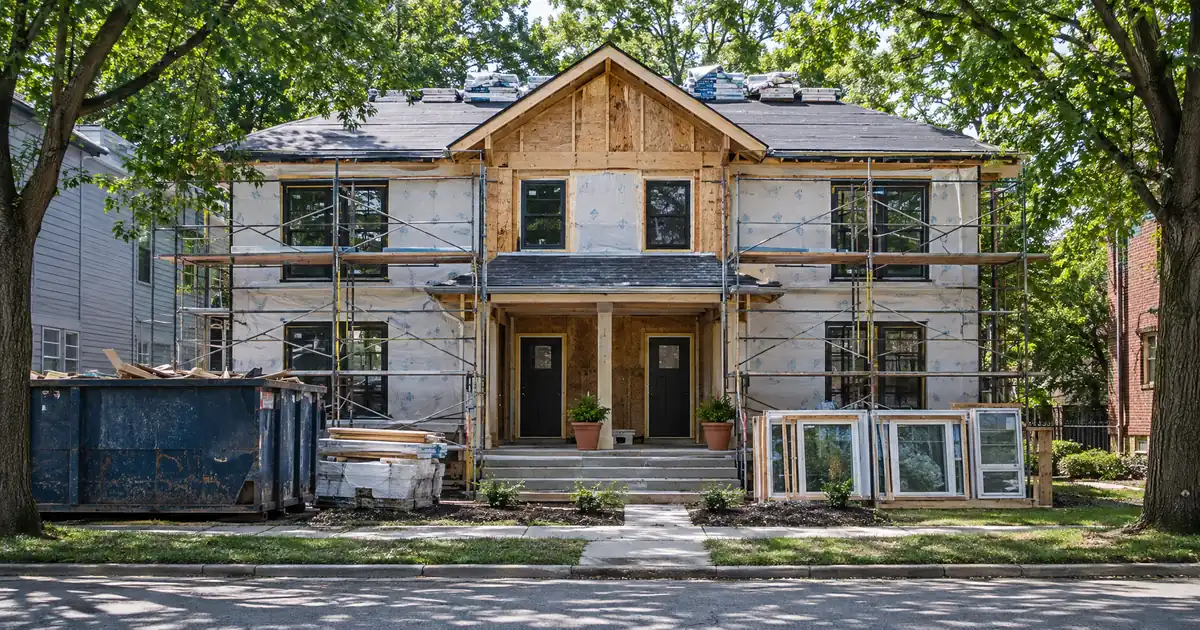
The Quick Read: Yes, a hard money bridge loan is built for units that are still mid-rehab, and a DSCR loan generally is not. The bridge looks at the property, the repair plan and your exit, not at rent that does not exist yet. Terms vary by lender, property and experience, and nothing here is a commitment to lend.
- The bridge funds the purchase and the repair budget. A DSCR loan usually pays the bridge off later.
- Rehab money is paid out in draws against finished, inspected work. It is not handed over at closing.
- Hard money loan sizing is tied to project cost and after-repair value, and the lower cap wins.
- Units under renovation are often left out of the rent calculation until they are finished and leased.
- Plan the exit before you close the bridge, because the exit is where most of these deals stall.
Key Terms Defined
Mid-rehab: A unit where demolition or repairs have started but the work is not finished, inspected and rentable.
Hard money loan: Short-term, asset-based financing from a private or non-bank lender. It is sized on the property and the plan, not on your income.
Bridge loan: Short-term financing that covers a gap until longer-term financing arrives. Corporate Finance Institute describes it as financing used to meet current obligations before permanent financing is secured. On rehab deals the two words are used interchangeably.
Holdback: Rehab money the lender keeps in reserve instead of paying out at closing.
Draw: A release of held-back money after a stage of work is finished and checked.
After-repair value (ARV): The appraised value of the property once the work is complete.
Loan-to-cost: The loan as a percentage of total project cost, meaning purchase price plus rehab budget.
DSCR: Debt service coverage ratio. It compares a property’s monthly rent to its monthly payment.
PITIA: Principal, interest, taxes, insurance and association dues. It is the payment side of the DSCR ratio.
Seasoning: The waiting period a lender wants before it will refinance a property you recently bought.
Why Can’t a DSCR Loan Fund Unfinished Units?
A DSCR loan qualifies primarily on property-level rental income covering the payment, subject to lender guidelines. That math needs a finished, rentable unit. A unit with open walls has no lease and no honest market rent, so there is nothing to test.
Across our wholesale network, the pattern is consistent. Properties needing structural or heavy work are not turnkey, and they are routinely bridged first. The DSCR loan comes after the work is done.
Here is a point that trips people up. Vacancy is not the problem. Condition is. A clean, rent-ready vacant unit can often be underwritten on market rent. A half-finished one cannot.
DSCR also has limits you should respect. It compares rent to PITIA only. Clearing the ratio is not the same as positive cash flow, because repairs, vacancy, management, utilities and capital spending sit outside the calculation.
How Do Lenders Treat Each Unit State?
On a small multifamily property, DSCR lenders review rent unit by unit. A leased unit counts at its lease. A vacant, finished unit counts at appraiser-supported market rent. A unit under renovation is often left out, or must be cured first.
| Unit state | What a DSCR lender looks for | What usually helps |
|---|---|---|
| Finished, leased | Signed lease, deposit proof | Lease and deposit records |
| Finished, vacant | Rent-ready condition | Market rent support |
| In progress | Completed work, closed permits | Finish before applying |
| Untouched | Condition, plus a plan | Treat as a bridge scope |
Heavy vacancy raises a separate issue. Some programs treat a building with heavy vacancy as unleased. That changes how the file is reviewed, so it pays to learn the rule before you size the project.
Some programs allow one or two vacant units in a small multifamily building, provided those units are rent-ready. Mid-rehab units are not rent-ready. They fall in the “finish first” column.
The bridge lender looks at the same building differently. It asks three questions: what is it worth now, what will it be worth finished, and how will you repay us? Rent is a secondary concern.
How Does the Rehab Money Actually Flow?
The bridge is not a lump sum. A typical sequence runs like this:
1. Closing. The lender funds the purchase and sets the rehab budget aside in a holdback.
2. Scope of work. You submit a line-item budget broken into stages.
3. Stage completed. The contractor finishes a stage, and you submit invoices, progress photos and lien releases.
4. Inspection. The lender checks that the stage is actually done.
5. Draw. Funds are released against that finished stage. Many lenders expect you to front the cost first and be reimbursed afterward.
The same logic shows up elsewhere. HUD’s 203(k) rehab program also escrows repair funds and releases them after inspection. That program serves owner-occupiers, not investors. The point is only that holdback-and-inspect is a standard way to fund repairs.
Now the leverage. On the hard money programs we place files with, fix-and-flip leverage typically runs up to 93% of project cost for investors with 5 or more completed projects. It is 90% of project cost at 2 or more projects and 85% below that. Every tier is capped at 75% of ARV. Up to 100% of the rehab budget funds in draws against completed work. That is a rehab-budget figure, never a purchase LTV.
There is no true 100% purchase program. When someone advertises 100% rehab financing, read it as draws against finished work. Technically accurate. Easy to misread.
The lower of the cost cap and the ARV cap controls. Picture a project where the cost-based number looks generous. If the finished value is modest, the 75% ARV cap becomes the binding limit. You then bring the difference as cash. Figures vary by lender, property and experience.
A bridge purchase with no rehab runs up to 80% of purchase price. A cash-out or rate-and-term refinance runs up to 65% of value. Loans go up to $5,000,000, with larger balances by exception.
Here is the practical consequence. You need cash at the start for the down payment and closing costs. You also need cash between draws. Lenders often check reserves before they start the project. Closing costs generally do not roll into the loan.
For a fuller look at how much equity a top-leverage file needs, see Lendmire’s piece How Much Equity a Top-Leverage Hard Money Rehab Needs for DSCR Cash-Out.
Bridge, Hard Money, or Construction: Which Fits?
The names overlap. The work scope is what separates them.
| Feature | Bridge / rehab loan | Ground-up construction |
|---|---|---|
| Work type | Repairs on an existing building | New build from the ground up |
| Property size | 1-4 units | Up to 10 units |
| Leverage basis | Project cost, capped by ARV | Cost and completed value |
| Experience | Tiers by completed projects | Top tier needs 5+ projects |
Moderate rehab fits a bridge well. A gut job or a new build is construction financing, which carries tighter controls. If your 1-4 unit project is a renovation of an existing building, you are in rehab territory.
Terms on these programs run 6 to 18 months, interest-only, with no prepayment penalty. There are no multi-year options on the current program. That short runway is the point. It forces a plan.
Credit starts at a 620 minimum score, with additional conditions below 660. Underwriting stays asset-based. First-time investors can qualify at the lower leverage tiers. The top tier is reserved for experienced investors.
Collateral means non-owner-occupied residential property. Commercial, industrial, land, hospitality and owner-occupied property are not on the sheet. Programs are available across 41 markets, including Washington, D.C., through select lenders in Lendmire’s wholesale network.
For a broader look at the lender category, read Lendmire’s piece Residential Rehab Hard Money Lenders.
Where Do These Deals Break?
Most failures are predictable.
| Failure point | What goes wrong | The fix |
|---|---|---|
| Stalled contractor | Draws stop, carry keeps running | Vet contractors before closing |
| Liens | Unpaid subs cloud the title | Collect lien releases each draw |
| Permits | Open permits block the refinance | Close permits and inspections |
| Budget overrun | Cash runs out mid-project | Hold a contingency in reserves |
| Maturity | Loan ends before units finish | Plan an extension or a rescue |
Extending a bridge usually costs a fee, and every extra month adds interest. Many units sit idle mid-rehab, so the carry adds up. Build slack into the schedule.
Bridge-to-bridge refinancing is the weakest rescue. Swapping one short-term loan for another is hard to do and often just delays the problem. Build the plan around a long-term exit.
Skipping the paperwork is another quiet killer. An appraiser needs an itemized list of improvements to support the ARV. Without that list, you get an appraisal gap at exactly the wrong moment.
How Do You Get Out?
You have three exits: refinance, sell or extend. For rentals, the usual path is a DSCR refinance. Many investors refinance out of hard money into long-term DSCR financing once the property is stabilized, and Lendmire brokers that path.
The DSCR lender will want the rehab finished, permits and inspections closed, and the units leased or lease-ready. It will also want an appraisal and enough seasoning. On a cash-out refinance of an investment property, seasoning of about 6 months is the common expectation, and leverage tops out around 75% LTV across most of the network. Exact terms depend on the lender’s guidelines, property type, leverage, and a full review of the borrower’s file.
Seasoning is where cost basis bites. Early in the clock, some programs size the loan on cost: purchase price plus documented rehab. Value you created can stay trapped until the clock runs. The investor who asks about seasoning at the start usually has the easier refinance.
Having a tenant does not clear seasoning. Those are separate clocks.
On coverage, 1.00 is where many select programs start. A separate select-lender path takes coverage below 1.00, with leverage and terms adjusted. No-ratio structures are available only through select lenders, generally for borrowers who already own a primary residence. Pricing and leverage differ on each path.
Strong files clear both tests: enough equity and enough rental coverage. Credit matters too. Most DSCR programs want around 660, and 700+ unlocks the strongest leverage tiers, though a 620 floor exists in parts of the network.
Agency programs offer a delayed financing exception that allows a quick cash-out after a cash purchase. A bridge-funded purchase does not qualify, so do not count on it. The Fannie Mae Selling Guide explains that contrast, but DSCR files follow their own guidelines. For the full picture of how these loans work, see the complete DSCR loans guide.
One more point from the desk. When a project touches bridge financing, the strongest files show the exit before the purchase. The weakest ones assume it.
What Should You Have Ready?
A lender reviewing an unfinished property wants to see a plan it can trust. Bring:
- A scope of work and a line-item budget, broken into stages
- Your contractor’s name, license and bid
- Permits, or a plan for pulling them
- A timeline that fits the loan term
- Proof of cash for the down payment and for floating draws
- A written exit plan, with the expected rent and refinance path
Keep draw requests organized too: invoices, progress photos and lien releases for each stage.
Frequently Asked Questions
Can a bridge loan fund the rehab on units I haven’t started?
Yes, through a holdback. The lender sets aside the rehab budget at closing and releases it in draws as stages are finished and inspected. Up to 100% of the rehab budget can fund this way on the programs we place, though that is a rehab-budget figure, not a purchase LTV. Terms vary by lender, property and experience.
Do tenants have to leave during the rehab?
Not necessarily. Rehab on an occupied building can proceed unit by unit, and leased units keep their lease for later DSCR review. Units under renovation are the ones left out or cured first. Heavy vacancy can change how a building is treated, so discuss the occupancy picture before you apply.
Does a bridge lender need rent or income documents?
Underwriting is asset-based, built around the property, the plan and the exit. Rent matters later, when a DSCR lender reviews the refinance. That review qualifies primarily on property-level rental income covering the payment, subject to lender guidelines.
What happens if the bridge matures before the last unit is done?
You have three options: extend, sell or refinance. An extension typically costs a fee and adds carry. Refinancing one short-term loan into another is hard, so the safer plan is a long-term exit sized to the term, which runs 6 to 18 months on these programs.
Can I use a DSCR loan to pay for repairs?
No. A DSCR loan is not a rehab-funding product.
Next Step
If you are buying, rehabbing or refinancing an investment property on a short timeline and want to see how the numbers work, Lendmire can help you compare hard money options based on the project, the exit plan, leverage, and your goals.
About Lendmire
A DSCR-focused mortgage broker, Lendmire (NMLS# 2371349) places investor financing across 41 markets — 40 states plus Washington, D.C. — with DSCR eligibility generally reviewed by the lender on property cash flow instead of tax returns, subject to lender guidelines. Scotsman Guide named Lendmire a Top Mortgage Workplace in 2025 and 2026.
Get Started
Ready to find the right loan for you?
In about 30 seconds you can review financing options available for your investment property. No commitment required.
Informational only. Not a Loan Estimate, approval, or commitment to lend. Program availability and eligibility are subject to lender guidelines, credit approval, property review, and underwriting.
References
1. Corporate Finance Institute – Bridge Loan
3. Fannie Mae Selling Guide B2-1.3-03: Cash Out Refinance Transactions
This article is part of Lendmire’s hard money loan program — full qualification details, guidelines, and scenarios live on the program page.
Related reading: Can a Six-Unit Building and Two Houses Get a Portfolio DSCR Loan? · Does a Portfolio DSCR Loan Save Money Over One Loan per Rental? · Is Closing One DSCR Loan on Ten Houses Cheaper Than Ten Loans?
Brandon Miller
Founder & CEO, Mortgage Loan Originator, Lendmire LLC
- Mortgage Loan Originator · NMLS# 1129696 · Verify on NMLS Consumer Access
- North Carolina Real Estate Broker · License# 343312 · Verify on NCREC
- North Carolina Insurance Producer · License# 19053198 · Property, Casualty, Life, Health · Verify on NAIC SBS
- Lendmire LLC · Firm NMLS# 2371349 · Verify firm licensure
Required disclosures. Lendmire (NMLS# 2371349) operates as a licensed mortgage broker, not a direct lender or depository. The discussion in this article is general in nature and should not be relied upon as financial, legal, or tax advice — every investment scenario is unique and should be reviewed by a qualified professional. Any loan inquiry is subject to lender underwriting, and this article is not a commitment to lend or a guarantee of approval. Mortgage rates, loan terms, and program guidelines vary by borrower, property, and state, and may change without notice. Equal Housing Opportunity. Verify licensure at NMLS Consumer Access.