
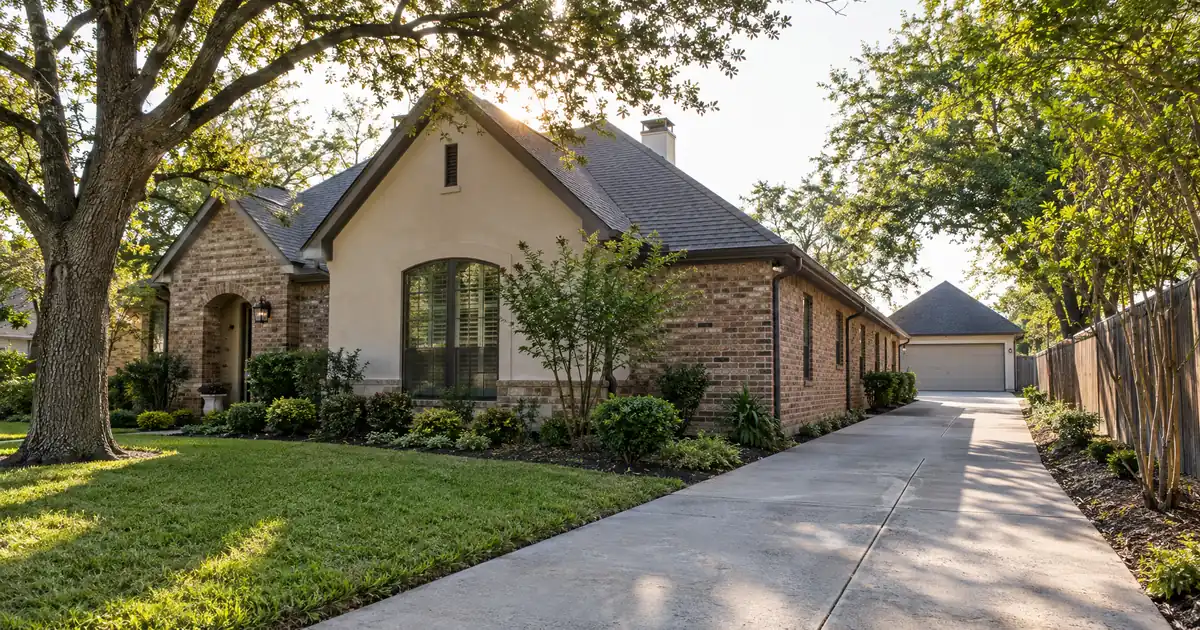
The Quick Read: Yes, Texas law allows it. The home-equity rules in the state constitution cover only a homestead, and a paid-off rental is not one. A line placed on it takes first position by default, and the real limits come from lender appetite, your credit, and how the property is titled. On Lendmire’s wholesale network, an investment-property line is subject to lender guidelines and tops out at 70% CLTV and $500,000.
- Texas homestead rules do not bind a rental you own outright.
- With no mortgage ahead of it, the line is the first lien.
- An investment-property line needs a 700 credit score and title held by you or your revocable living trust.
- LLC-held rentals cannot use this product, so a DSCR cash-out is the usual route for them.
- A HELOC qualifies you as a borrower. A DSCR loan is reviewed for the property. Each figure is subject to lender guidelines and a complete review of property type, leverage, and credit.
Key Terms Defined
Free and clear means no mortgage, tax lien, judgment, or other lien is recorded against the property.
First position means the lender’s lien is recorded ahead of every other lien. On a paid-off property, nothing sits ahead of it.
CLTV is combined loan-to-value. It adds every loan secured by the property and divides by the property’s value.
Homestead is the home a Texas owner lives in. Texas gives it special protection from forced sale and from certain liens.
Non-homestead affidavit is a signed statement that the property is not the borrower’s homestead. Lenders rely on it in Texas files.
DSCR is the debt service coverage ratio. It divides monthly rent by the full monthly housing payment: principal, interest, taxes, insurance, and any HOA dues.
How large a line the equity supports in Texas.
An equity line is sized by combined loan-to-value, occupancy, and credit — not by rental coverage. Switch the occupancy or the credit band and the ceiling moves with it.
Investment-property lines require a 700 minimum credit score; second-home lines start at a 640 minimum and primary-residence lines at 600, and the combined-LTV ceiling steps down as the credit band drops on primary-residence and second-home lines and holds on investment-property lines; the line cap steps down on primary-residence lines and holds at every tier on investment-property and second-home lines.
A debt-to-income ratio above 45% requires 680+ credit. Profiles under 640 are limited to single-family homes. At least 75% of the approved line is drawn at closing. Ceilings, floors, and caps update from Lendmire’s centralized guideline source.
Line estimate
Illustrative estimate only — not a quote, Loan Estimate, approval, or commitment to lend. The rate is an editable assumption; equity-line pricing is variable through both the draw and repayment periods and never converts to fixed. Occupancy and credit drive the ceiling together: an investment property tops out at 70% combined LTV (minimum credit 700, line cap $500,000); a second home tops out at 90% combined LTV (minimum credit 640, line cap $500,000), with the ceiling stepping down as the credit band drops (the cap holds at every tier); a primary residence tops out at 80% combined LTV (minimum credit 600), and its $750,000 maximum line is available only at 75% combined LTV or below with a 700-or-better credit profile (720 on the longer-runway program) and a full appraisal. Lines above $500,000 require a full appraisal. Credit, debt-to-income, property type, and full underwriting review all affect the final line.
Why Texas Seems to Ban Rental HELOCs
Texas does not ban them. The confusion comes from one rule set that is written for homesteads and gets applied to the wrong property.
The Texas A&M Real Estate Research Center explains that the home-equity rules sit in Article XVI, Section 50(a)(6) of the Texas Constitution. Those rules cover three loan types: cash-out refinances, home equity loans, and home equity lines of credit. The same source states that these loans may not be taken out on a secondary residence or a rental or investment property.
Read that sentence carefully. It does not say rentals cannot borrow. It says the homestead-protection regime does not apply to rentals, so the 80% combined cap and the other homestead conditions never attach.
The constitutional text points the same way. Section 50 is titled for homestead protection, and its lien limits apply only if the property is a homestead. The Justia copy of the Texas Constitution also lets a lender without actual knowledge rely on an affidavit that the encumbered property is not the homestead. That is why a rental line file usually carries a non-homestead or occupancy affidavit.
Consumer pages that say investment properties are not eligible for a Texas HELOC are usually describing homestead loans. They are right about the homestead and wrong about your rental.
| Factor | Texas primary home | Texas rental you own |
|---|---|---|
| Governing rule set | Section 50(a)(6) | Not covered by it |
| Combined cap | 80% CLTV in Texas | Set by lender program |
| One-loan-at-a-time rule | Applies | Does not apply |
| 12-day wait | Applies | Does not apply |
| Who sets terms | Texas rules plus lender | Lender and program |
On Lendmire’s network, the 12-day wait, the one-lien-at-a-time rule, and 12-month seasoning bind primary residences only. Texas second homes and investment properties are eligible as non-homestead transactions.
What First Position Means When Nothing Sits Ahead of You
First position is a recording-order fact, not a special Texas feature. A line secured by a deed of trust on a property with no other liens is the first lien the moment it records.
There are two routes into first position. The first is a property that is already free and clear. The second is a property with a mortgage, where the new line pays off that mortgage so it becomes the only lien. Investors in both cases use a first-position line to replace the old debt with a revolving one.
Your case is the simple one. There is nothing to pay off, so the line stands alone. That also makes the title search the most important document in the file, because the line is only first if the search says the property is clean.
Two cautions apply. Being first does not make the line permanent, because a lender can freeze or reduce a line under its own terms. And first position does not change who underwrites you. Lenders approve this product on your credit, income, and equity, not on the rent.
How to Confirm Your Rental Is Truly Free and Clear
Do not assume. Order a title search and read what it finds.
A title search typically looks for:
- Unreleased old mortgages that were paid but never formally released.
- Tax liens on the property.
- Judgments against you that attach to real property.
- Mechanics’ liens from contractors.
- Association liens from unpaid HOA dues.
An old mortgage that was paid years ago but never released is the most common surprise. It is fixable, but it has to be cleared before a lender will treat the new line as the first lien.
Then test the homestead question. Texas homestead protection attaches through use, and a lawyer-written Texas explainer notes that it is available only to natural persons, not to LLCs or corporations. If you ever lived in the property, the file should show clearly that you now live elsewhere and the property has become a true rental.
Here is the edge case. If the owner still lives in it, or it has not truly stopped being the residence, the homestead rules can apply. The 80% combined cap, the 12-day wait, and the one-lien rule would all come back. Whether a former residence has become a true rental is a fact question. Ask your title company or a Texas real estate attorney before you apply.
How Big Can the Line Be on This Network?
On an investment property, the line caps at 70% CLTV and $500,000. Since you own the property outright, the 70% cap is the only leverage limit, and the $500,000 ceiling binds on higher-value properties.
Here are the investment-property terms on Lendmire’s wholesale network, all subject to lender guidelines and full file review:
- Credit: a 700 minimum. A 720 score reaches the same 70% CLTV, so credit above 700 buys eligibility rather than more leverage.
- Line size: $25,000 to $500,000 on an investment property. Larger lines are available only on a primary residence.
- Structure: a standalone line in first or second lien position, with a 5-year interest-only draw followed by a 25-year fully amortizing repayment.
- Draw at closing: at least 75% of the line is drawn at closing.
- Pricing: the line floats during both the draw and repayment periods and never converts to fixed.
- Later draws: after closing, the minimum subsequent draw in Texas is $4,000.
- DTI: 50% maximum, with qualification run on the interest-only payment calculated on the maximum draw.
- Valuation: because the cap is $500,000, an investment line sits in the automated-valuation lane and commonly closes with no traditional appraisal.
The 75% draw rule matters for planning. You are not opening a line to leave it idle. Most of it is drawn at closing, so interest begins on most of the balance right away.
Market anecdotes run both ways. One investor on BiggerPockets describes a credit union line on rentals at a 75% maximum LTV. That is a single market anecdote from outside this network. On Lendmire’s network, the investment-property ceiling is 70% CLTV.
Who Can Qualify, and What Property Works
The borrower profile matters more than the rent. This product suits an individual with strong credit and moderate existing debt, who owns the rental in their own name.
Eligible property types include single-family homes, 2-4 unit properties, PUDs, townhomes, and condominiums, including non-warrantable ones. In Texas the property must be 10 acres or less. A property that is listed for sale, or was listed within the past 60 days, is ineligible in Texas.
Manufactured homes, co-ops, condotels, log homes, commercial and mixed-use properties, and agricultural zoning are not eligible. A borrower can hold up to three lines, and a borrower with more than 15 financed properties is not eligible.
Title is the sharpest dividing line. The property must be held by you as an individual or by your inter vivos revocable living trust. LLCs, corporations, partnerships, and irrevocable, blind, or land trusts cannot hold title on this product.
That creates a real tradeoff for investors who use entities. Moving a rental out of an LLC to qualify gives up the liability separation the LLC provided. If you want the equity but want to keep the entity, a DSCR cash-out is the usual alternative, subject to lender program eligibility.
HELOC or DSCR Cash-Out: Which Fits?
Both pull equity from a paid-off rental. They differ in who gets underwritten, how the money is repaid, and what the title must look like.
| Factor | First-position HELOC | DSCR cash-out |
|---|---|---|
| Underwritten on | Your credit, income, DTI | The property’s rent vs. payment |
| Max leverage (investment) | 70% CLTV | About 75% on a standard rental |
| Structure | Revolving, floating | Closed-end, fixed spine |
| Entity title | Not allowed | Often workable |
| Valuation | Usually automated | Full appraisal with rent schedule |
| Credit floor | 700 on this network | 620 in parts, about 660 typical |
For a DSCR cash-out, the cash-out ceiling is around 75% LTV on a standard rental across most of the network, and about 6 months of seasoning is the common expectation. If the collateral is a short-term rental, cash-out generally runs about 70% LTV, with a 640+ score and about 12 months of hosting history.
On coverage, 1.00 is where many select programs start. A separate select-lender path takes coverage below 1.00 with leverage and terms adjusted. Loans run up to $3,000,000 on standard programs (smaller balances available through select lenders), with reserves commonly around 6 months of PITIA, though that varies by lender, leverage, loan size, and transaction type. The complete DSCR loans guide covers those mechanics in detail.
Be careful with what a passing coverage ratio means. DSCR compares rent to the full housing payment only. Clearing 1.00 is not the same as positive cash flow, because repairs, vacancy, management, utilities, and capex sit outside the calculation.
The cleaner fit depends on three things:
- Choose the HELOC if you hold title personally or in a revocable trust, have a strong credit profile and manageable DTI, want a revolving balance, and are comfortable with a floating cost.
- Choose the DSCR cash-out if the rental sits in an LLC, your personal income documents are messy, or you would rather have one closed-end loan tied to rental income.
- Reconsider both if the plan depends on the equity covering a purchase with no cash of your own. A moderator in a BiggerPockets thread warns that funding a down payment entirely with a HELOC leaves you with no equity in the new property if values fall.
One practical observation from how these files tend to run: the order of operations matters more than investors expect. A borrower who opens a first-position line and later wants a DSCR refinance on the same property will need the line paid off or subordinated first, and subordination requires the lender’s written agreement. Decide on the end structure before the first closing.
Keep the Homestead Out of It
If you own a Texas primary home plus rentals, treat them as two different assets. The homestead is the constrained one, and the rentals are the flexible ones.
Using a primary-home HELOC to fund a rental secures the loan with the homestead, so the homestead rules govern it no matter what the money buys. In Texas, that means a primary residence caps at 80% combined loan-to-value, and the one-lien-at-a-time and 12-day rules apply. Pulling equity from the paid-off rental avoids stacking that loan on the home you live in.
The reverse choice has its own logic. Some investors prefer a home line because the cap and seasoning rules are familiar and the home may offer higher leverage. If you are weighing that, Lendmire’s article Should You Tap a Home HELOC Instead of a Free-and-Clear Rental? works through that decision.
Risks and When Not to Do It
A first-position line is a real lien on an asset you own outright. Weigh these before you sign:
- Floating cost. The line floats through both the draw and repayment periods and never converts to fixed. Budget for the cost to move.
- Payment shock. The 5-year interest-only draw ends and the 25-year amortizing repayment begins. The payment steps up when that happens.
- Freeze or reduction risk. First position does not guarantee the line stays open in a downturn.
- Debt now sits on a clean asset. You are trading a free-and-clear property for a leveraged one.
- Thin lender supply. Large retail lenders often decline rentals, and anecdotes in a BiggerPockets thread on rental HELOCs point to community banks, credit unions, and specialty lenders as the usual sources.
- Vesting limits. An LLC-held rental needs a title change or a different loan.
Skip the HELOC if your credit is under 700, if the property is in an LLC you plan to keep, if you need leverage above 70% CLTV, or if you plan a DSCR refinance soon and do not want a subordination problem.
The Path From Outright Ownership to a Funded Line
1. Confirm the property is a true rental. You live elsewhere, and the file shows it.
2. Check title and vesting. Make sure you or your revocable trust hold title. If an LLC holds it, price out a DSCR cash-out instead.
3. Run a title search. Clear any unreleased mortgage, lien, or judgment.
4. Check your credit and DTI. A 700 score is the floor, and DTI is tested on the interest-only payment on the maximum draw.
5. Match the property to the program. Check type, the 10-acre Texas limit, and the not-listed-for-sale condition.
6. Decide the line size. Stay at or below 70% CLTV and $500,000.
7. Plan the draw. At least 75% comes out at closing, so know what you will do with it.
8. Plan the exit. If a DSCR refinance is likely later, settle how the line will be paid off before you open it.
Lendmire arranges HELOCs through select wholesale partners in 16 full-service states, Texas among them, and DSCR investor loans across 41 markets, including Washington, D.C. Lendmire is a broker, not the lender, and every figure here is subject to lender guidelines and full file review.
Frequently Asked Questions
Does Texas ban HELOCs on rental properties?
No. Texas homestead rules, including the 80% combined cap, apply only to a borrower’s own home, and a rental you own outright is not a homestead. The limits you will actually face come from lender and program terms, such as credit score, DTI, vesting, and leverage.
Is a HELOC on a paid-off rental always a first lien?
Yes, if nothing else is recorded against the property. A line placed on a clean title is the first lien when it records. If a title search finds an unreleased mortgage, a tax lien, or a judgment, that item has to be cleared first for the line to be in first position.
Can I use an LLC for this?
Not on this product. On Lendmire’s network, an investment line requires title held by the individual borrower or a revocable living trust, and LLCs, corporations, partnerships, and irrevocable, blind, or land trusts cannot hold title. A rental already deeded to an LLC needs a vesting change or a DSCR cash-out instead.
Do the 12-day wait and the one-loan-at-a-time rule apply to my rental?
No. On this network, those rules, along with 12-month seasoning, bind primary residences only. A Texas second home or investment property is treated as a non-homestead transaction. The main rental-specific limit to know is that Texas subsequent draws after closing carry a $4,000 minimum.
Is the rent used to qualify?
No. A HELOC is underwritten on you: credit, income, DTI, and equity. A DSCR cash-out qualifies primarily on property-level rental income covering the payment, subject to lender guidelines.
If you are considering a home equity line and want to see how the numbers work, Lendmire can help you compare HELOC options based on the property, the equity available, credit profile, combined leverage, and your goals. Texas investors who hold rentals free and clear are often working from the false premise that state law blocks them, when the real work is matching title, credit, and structure to the right lender.
About Lendmire
Lendmire, NMLS# 2371349, is a mortgage brokerage that arranges home equity lines of credit through wholesale lending partners in its 16 full-service states. Lines on primary residences, second homes and investment properties are each reviewed individually by the lender under the program’s occupancy, credit and combined-loan-to-value guidelines. Scotsman Guide named Lendmire a Top Mortgage Workplace in both 2025 and 2026.
Get Started
Ready to find the right loan for you?
In about 30 seconds you can review financing options available for your investment property. No commitment required.
Informational only. Not a Loan Estimate, approval, or commitment to lend. Program availability and eligibility are subject to lender guidelines, credit approval, property review, and underwriting.
References
1. Texas A&M Real Estate Research Center, What to Know About Home Equity Loans in Texas
2. Texas Constitution Article XVI, Section 50
3. Lone Star Land Law, Homestead Protections in Texas
4. BiggerPockets: HELOC on investment property
5. BiggerPockets: using a HELOC for down payment of a rental
6. BiggerPockets: HELOC for rental properties in NC
This article is part of Lendmire’s investment property HELOC program — full qualification details, guidelines, and scenarios live on the program page.
Related reading: How to Get a DSCR Loan on Your First Rental After a Bank Said No · How to Appeal a Frozen HELOC or Replace It With a Second Lien · Can a Lender Cut Your HELOC Limit After Your Home Value Drops?
Guides: Investment Property HELOC in Texas
Brandon Miller
Founder & CEO, Mortgage Loan Originator, Lendmire LLC
- Mortgage Loan Originator · NMLS# 1129696 · Verify on NMLS Consumer Access
- North Carolina Real Estate Broker · License# 343312 · Verify on NCREC
- North Carolina Insurance Producer · License# 19053198 · Property, Casualty, Life, Health · Verify on NAIC SBS
- Lendmire LLC · Firm NMLS# 2371349 · Verify firm licensure
Disclosures. The information presented in this article is general market commentary, not financial, legal, or tax advice. Lendmire is a mortgage brokerage (NMLS# 2371349) — not a direct lender or depository institution — and loan placement is subject to lender underwriting. Nothing in this content represents a commitment to lend. Loan terms, pricing, and program availability vary based on borrower qualifications, property characteristics, and state of subject property, and are subject to change at any time. Lendmire complies with Equal Housing Opportunity requirements. Consumer access: nmlsconsumeraccess.org.