
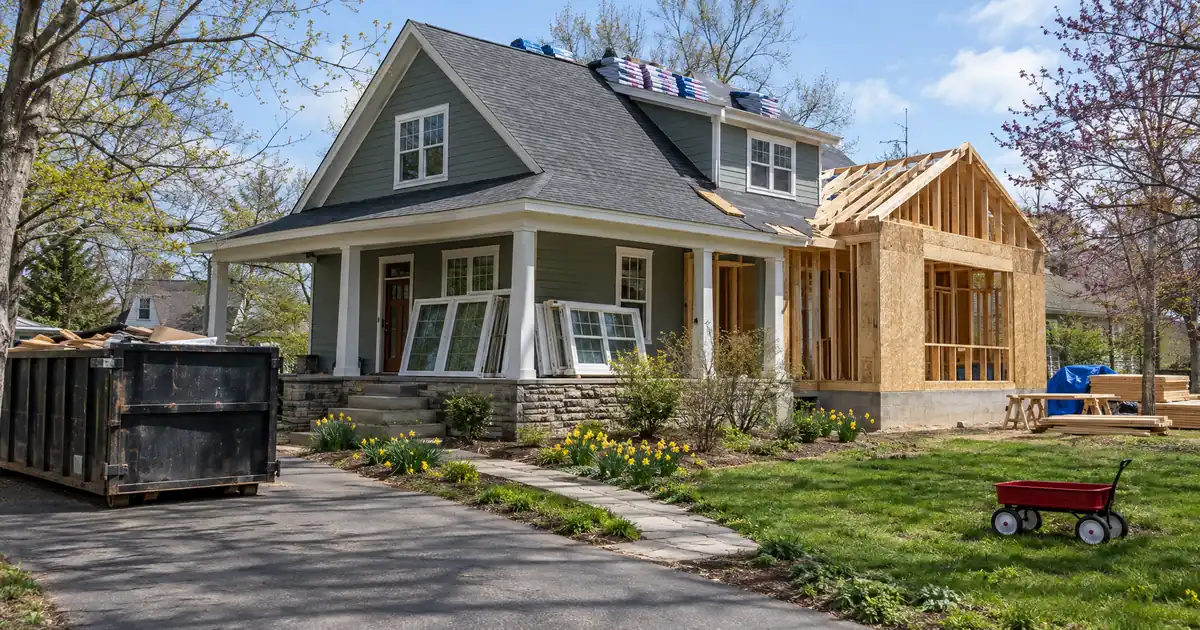
The Quick Read: Draw terms decide how much working capital a flipper needs, because rehab money is released in stages against completed work rather than handed over at closing. Track record is your strongest lever, and it works best when you negotiate it before closing rather than after demolition starts.
- Rehab funds are held back and released in draws as work is completed and verified.
- Across the wholesale network Lendmire works with, up to 100% of the rehab budget funds in draws against completed work. That is a rehab-budget figure, not a purchase LTV.
- Leverage on fix-and-flip purchases is measured against project cost, and completed projects move you up the tiers.
- Draw count, inspection method, fees, and treatment of scope changes are set lender by lender.
- At volume, overlapping projects multiply the cash you front between draws.
Most first-time flippers think about leverage. Experienced ones think about float. Float is the cash you spend on contractors before the lender reimburses you, and it grows with every project you add. This guide walks through how draws work, how underwriting treats them, what changes with experience, and where the usual rules break.
What this loan actually costs to carry.
Hard money is sized against the project and priced by time. Enter the deal and see how much the program will lend, the cash required at closing, the carry while you hold it, and what is left at the exit.
Leverage tiers on the current program: 85% with fewer than 2, 90% with 2 or more, 93% with 5 or more completed projects — every tier capped at 75% of after-repair value. Loan amounts up to $5,000,000, larger by exception; terms of 6 to 18 months, interest-only, no prepayment penalty. The rehab portion funds in draws against completed work, not at closing.
Program parameters shown update from Lendmire’s centralized guideline source. Rate, points, and months are editable assumptions, not quoted terms.
Cost cap sets the loan · positive spread
Illustrative estimate only — not a quote, Loan Estimate, approval, or commitment to lend. Rate, points, and months are editable assumptions. Hard money is business-purpose financing for real estate investors, not a consumer mortgage. Leverage on the current program tops out at 93% of project cost for investors with a documented track record, capped at 75% of after-repair value, with rehab funding up to 100% of the documented budget released in draws; actual terms vary by lender, borrower experience, property, and exit. Lendmire is a mortgage broker, not a lender.
Program figures below reflect select lenders in Lendmire’s wholesale network. They vary by lender, property, and experience, and nothing here is a commitment to lend.
Key Terms Defined
Draw: A release of rehab funds from the lender after a stage of work is finished and verified.
Holdback: The portion of the loan the lender keeps back at closing and releases later, usually tied to completed work.
Reimbursement draw: A draw that repays you for work you have already paid for. You front the cash first.
Advance (forward) draw: A release made before the work is done. It is less common and usually reserved for proven borrowers.
Scope of work (SOW): The line-item list of repairs and their costs. The draw schedule is built from it.
Change order: A written change to the SOW, such as new repairs found after demolition.
Loan-to-cost (LTC): The loan amount compared with total project cost, meaning purchase price plus rehab budget.
After-repair value (ARV): The estimated value of the property once the work is finished.
Interest reserve: Money set aside to cover interest payments during the project.
What a Rehab Draw Is, and Why Closing Does Not Pay for the Rehab
A hard money loan on a flip has two pieces. The first funds the purchase at closing. The second is the rehab budget, which the lender holds and releases in draws as the work gets done. The lender wants to see the renovation completed before the property is worth what the loan assumes.
On the network Lendmire works with, fix-and-flip leverage is based on project cost and tiered by documented completed projects. Typical tiers are:
- 93% of project cost at 5 or more completed projects.
- 90% of project cost at 2 or more completed projects.
- 85% with fewer than 2 completed projects.
Every tier is capped at 75% of after-repair value, and the tightest test governs. Up to 100% of the rehab budget funds in draws against completed work. These are typical ranges that vary by lender, property, and experience.
Notice what that means. The rehab budget funds in stages, so the cash needed to keep a job moving between releases comes from you. Market-wide, reimbursement is the common structure, and advance draws tend to go to borrowers with a record the lender trusts. Terms for these loans typically run 6 to 18 months, interest-only, with no prepayment penalty on the network’s current program.
How Underwriting Treats the Draw Schedule, Step by Step
A draw schedule is not a formality. It is the lender’s control system. Here is how the process typically runs.
1. Budget review. The lender reviews a line-item SOW and budget before closing. A vague budget produces a vague schedule, and a vague schedule produces disputes later.
2. Closing and holdback. The purchase funds. The rehab budget is held by the lender or an escrow.
3. You front the work. Contractors start, and you pay for the first stage from your own capital.
4. Draw request. You submit a request form, an updated budget showing completed versus remaining work, dated photos, invoices, and lien waivers from the contractors paid.
5. Verification. The lender confirms the work through a third-party inspector, or through photo and video review. Practices differ by lender, and the inspection fee usually falls on the borrower.
6. Partial credit. Many lenders pay line items in proportion to completion. A half-finished line item gets roughly half its budget.
7. Release and repeat. Approved funds go out. The final draw typically requires evidence of full completion.
(Yes, a request with a missing lien waiver gets sent back. Every time.)
What decides whether this process feels smooth or painful is a short list: how draws are scheduled, how inspections are scheduled and turned around, whether interest runs on undrawn funds, draw fees, how scope changes get approved, and permit status.
What Experience Changes
Experience changes leverage for certain. It can change draw handling too, but that part is negotiated, not printed on a rate sheet. Here is the split.
| Factor | Fewer than 2 projects | 2+ projects | 5+ projects |
|---|---|---|---|
| Fix-and-flip leverage | 85% of project cost | 90% of project cost | 93% of project cost |
| After-repair value cap | 75% | 75% | 75% |
| Rehab budget funded in draws | Up to 100% | Up to 100% | Up to 100% |
Every tier is subject to lender guidelines, and the top tier is reserved for experienced investors. First-time investors qualify at the lower tiers, with a 620 minimum credit score and additional conditions below 660.
Draw mechanics are where a flipper with a record has room to ask. Here is what an experienced borrower can reasonably put on the table:
- Fewer, larger draws. Fewer draws mean fewer inspection fees and fewer waiting periods.
- Lighter verification. Some lenders accept photo or video review for a borrower with clean prior files.
- Advance funding for a portion. It exists, mostly for proven borrowers, and is lender-specific.
- A single approval path for change orders. A written process beats an argument mid-project.
What stays fixed: the lender still wants completed work, clean lien status, and a budget it can trace. A track record gets you smoother terms, not an exemption from the control system.
Scaling Math: Float Across Overlapping Flips
Float is the number that breaks scaling flippers, and it rarely shows up in leverage discussions. Here is an illustrative model. The inputs are assumptions, not market data.
Assume a three-draw schedule on every project:
| Draw | Typical milestone | Share of rehab budget | Cumulative |
|---|---|---|---|
| 1 | Demolition, rough framing, roof or structural | 30% | 30% |
| 2 | Mechanical, drywall, windows | 40% | 70% |
| 3 | Finishes, fixtures, final completion | 30% | 100% |
On a single project, the most you front before a reimbursement lands is about one stage, so 30% to 40% of the rehab budget. Now run four projects at once, each at a different stage. Say two are in the 40% stage and two are in the 30% stage. You are fronting roughly 1.4 times one project’s full rehab budget at the same moment, before any draw hits your account.
That is the trap. Four projects do not need four times the first project’s cash. They need whatever the unluckiest week looks like, when several milestones land together and inspections stack up. Clustered milestones also mean clustered inspection requests, and scheduling becomes its own bottleneck.
The practical fixes:
- Stagger project start dates so no two jobs hit the expensive stage in the same week.
- Keep a draw tracker across properties showing what is fronted, what is requested, and what is approved.
- Hold a standing document library of contractor licenses, insurance certificates, and lien waiver templates so each request is assembled from ready parts.
- Ask for fewer draws on projects where the contractor is dependable and the scope is clean.
One pattern shows up on files like these. Flippers who scale well tend to treat the draw package as an operations task with its own checklist, owner, and calendar, not something done on the kitchen table after a long day on site.
Staging Contractor Payments So You Are Not the Bank
Your contractor agreement and your draw schedule should mirror each other. If your contractor expects payment weekly and your lender releases funds by milestone, you are the gap.
| Payment structure | How it maps to draws | Watch for |
|---|---|---|
| Milestone-based | Matches the lender’s stages | Milestones must match the SOW lines |
| Small deposit plus milestones | Deposit is your float | Recouped only after approval |
| Retainage on the final stage | Aligns with the last release | Contractor resistance on small jobs |
Pay for installed work, not materials sitting on site. Lenders generally verify installed work, and unpaid materials are the classic reason a stage comes back partially approved. Ask for lien waivers with each payment so your draw package is complete the day you request it.
Where the General Rule Breaks
The general rule is reimbursement against verified, completed work. These edge cases bend it.
Advance draws. They exist, mostly for experienced borrowers with a clean record. If you are scaling, ask for one on the first stage. The worst answer is no, and you will still have learned how the lender thinks about your file.
Inspection-light structures. Some lenders inspect once, rely on photos or video, or skip third-party inspectors entirely. Others send an inspector for every draw. The method shapes your carry cost more than most borrowers expect.
Scope changes mid-project. New repairs found after demolition are not automatically credited against the original budget. Without an approved change order, you may fund the gap in cash. Ask how a revised SOW gets approved, and who signs.
Contractor deposits. A startup deposit is usually the borrower’s cash until a draw recovers it.
Different sizing tests. Lenders size on loan-to-value, loan-to-cost, or after-repair value, and the tightest governs. A high cost tier does not override the 75% after-repair cap.
A government contrast worth knowing. The federal FHA 203(k) program is an owner-occupant rehab product, not a hard money loan. Still, it shows why holdbacks exist. HUD’s 203(k) borrower acknowledgment describes a 10% holdback on each draw request for completion and lien protection. HUD’s draw request form says the holdback is not released until all work is complete and no mechanic’s or materialmen’s liens have been placed. Private lenders set their own terms, so do not assume a 10% holdback on a private loan. The logic of completion and lien protection, however, is the same one your lender is working from.
Terms to Confirm Before You Sign
Negotiate these before closing. Once demolition starts, you have little leverage.
| Term | Why it matters at volume | What to ask |
|---|---|---|
| Number of draws | Fewer draws, fewer fees | Can the count be set at origination? |
| Inspection method | Affects scheduling and fees | Photo, video, or on-site? |
| Release turnaround | Drives your float | Is there a stated process after approval? |
| Draw and inspection fees | Multiplies across projects | Per draw or per inspection? |
| Interest on undrawn funds | Changes carry cost | Does interest run on the full loan or only on disbursed funds? |
| Change-order process | Prevents cash gaps | Who approves, and in writing? |
| Final release conditions | Holds your last tranche | Completion, final inspection, lien clearance? |
Practitioners often say the draw process matters as much as the headline cost of the loan. That fits what a broker sees. A loan with modest terms and a clean draw process can beat a loan with stronger terms and a draw desk that slows every project.
What Stalls a Draw
Most stalls come from five causes.
- Incomplete phase. The inspector sees a stage short of its budgeted completion, so the draw is partially approved. Fix it by requesting only after the stage is truly done.
- Missing permit or final sign-off. Release may depend on permit status. Confirm permit requirements per stage before you write the schedule.
- Unapproved change order. Extra work not tied to the approved SOW is not credited. Get the revision approved first.
- Missing lien waivers. Collect them with every payment to a contractor or supplier.
- A lien that surfaces. Resolve it with the contractor before requesting more funds. A lender will not release money against a clouded title.
Carry Cost, Loan Term, and the Exit
Draw delays cost money in two ways. They stretch your carry, and they push you closer to maturity. A job that runs long can collide with a 6 to 18 month term, so build your schedule backwards from the term and keep a buffer.
Carry matters because flip margins are thinner than the headline suggests. Reporting on ATTOM’s data notes that gross flip profit excludes rehab, financing, and carrying costs, which experienced flippers estimate at 20% to 33% of after-repair value. A draw process that adds weeks of unproductive carry eats directly into what is left.
Not every flip ends in a sale. Many investors refinance out of a hard money loan into long-term rental financing once the property is stabilized, and Lendmire brokers that path. Clean draw records, final permits, and completion paperwork help the appraisal and title that a DSCR loan needs. Lendmire’s piece Hard Money Bridge vs Portfolio DSCR for a Flipper Scaling Volume covers that decision in detail. And if you are weighing one blanket facility against separate loans, see Lendmire’s piece Blanket Hard Money vs Per-Rehab Loans for a High-Volume Flipper.
Tax treatment varies; consult a qualified professional.
Frequently Asked Questions
Can an experienced flipper get the rehab money at closing?
Not generally. Rehab funds are held and released in draws against completed work. On the network Lendmire works with, up to 100% of the rehab budget funds in draws, and the amount is a rehab-budget figure, not a purchase LTV. Experienced borrowers may negotiate advance funding on a portion with certain lenders, but it is lender-specific and never assumed.
Do more completed projects change my leverage?
Yes. Typical tiers are 85% of project cost with fewer than 2 completed projects, 90% at 2 or more, and 93% at 5 or more, each capped at 75% of after-repair value. Those figures vary by lender, property, and experience. The top tier is reserved for experienced investors.
How many draws should I ask for?
Fewer is usually better, because each draw brings an inspection, a fee, and a wait. The right count depends on the scope. A light cosmetic job may work with two or three draws. A full gut may need more to match its milestones. Set the number at origination, not mid-project.
What happens if I find extra repairs after demolition?
Treat it as a change order. Without approval, you may have to cover the difference yourself.
Can I refinance out after the rehab is done?
Many investors do. When a flip becomes a rental, a DSCR investor loan can replace the hard money loan, which qualifies primarily on property-level rental income covering the payment, subject to lender guidelines. Clean documentation of draws, permits, and completion makes the refinance smoother.
Next Step
If you are buying, rehabbing or refinancing an investment property on a short timeline and want to see how the numbers work, Lendmire can help you compare hard money options based on the project, the exit plan, leverage, and your goals. Lendmire is a broker arranging financing through select lenders in its wholesale network across 41 markets, including Washington, D.C. You can reach the team at 828-256-2183.
About Lendmire
As a DSCR and non-QM mortgage broker, Lendmire — NMLS# 2371349 — connects investors with wholesale lending channels across 41 markets, including Washington, D.C. The property’s rental income, not the borrower’s tax returns, is central to lender review, which works for self-employed operators and portfolios beyond four financed properties. Scotsman Guide named Lendmire a Top Mortgage Workplace in both 2025 and 2026.
Get Started
Ready to find the right loan for you?
In about 30 seconds you can review financing options available for your investment property. No commitment required.
Informational only. Not a Loan Estimate, approval, or commitment to lend. Program availability and eligibility are subject to lender guidelines, credit approval, property review, and underwriting.
References
1. HUD – 203(k). Borrower’s Acknowledgement (HUD-92700-A)
2. HUD-9746-A draw request form (reginfo.gov)
3. Home Flipping Returns, ATTOM profit margin (wrenews.com)
This article is part of Lendmire’s hard money loan program — full qualification details, guidelines, and scenarios live on the program page.
Related reading: How to Stabilize a Ten-Unit With Vacancies Using Hard Money and DSCR · How to Move From Flips to a 5-to-10-Unit Building With Hard Money · Hard Money Gap Funding vs Partner for a First-Time Flipper
Brandon Miller
Founder & CEO, Mortgage Loan Originator, Lendmire LLC
- Mortgage Loan Originator · NMLS# 1129696 · Verify on NMLS Consumer Access
- North Carolina Real Estate Broker · License# 343312 · Verify on NCREC
- North Carolina Insurance Producer · License# 19053198 · Property, Casualty, Life, Health · Verify on NAIC SBS
- Lendmire LLC · Firm NMLS# 2371349 · Verify firm licensure
Legal disclosures. Lendmire (NMLS# 2371349) is a state-licensed mortgage brokerage that arranges financing through wholesale lender relationships. Lendmire is not a direct lender, depository institution, or registered financial advisor. The discussion above is general informational content about real estate financing — it is not financial, legal, or tax advice, and readers should consult licensed professionals for guidance on their individual circumstances. Loan inquiries are subject to lender underwriting; this article does not represent a commitment to lend. Loan terms, rates, and qualification standards vary by borrower, property, and state, and are subject to change at any time. Equal Housing Opportunity. NMLS Consumer Access: nmlsconsumeraccess.org.