
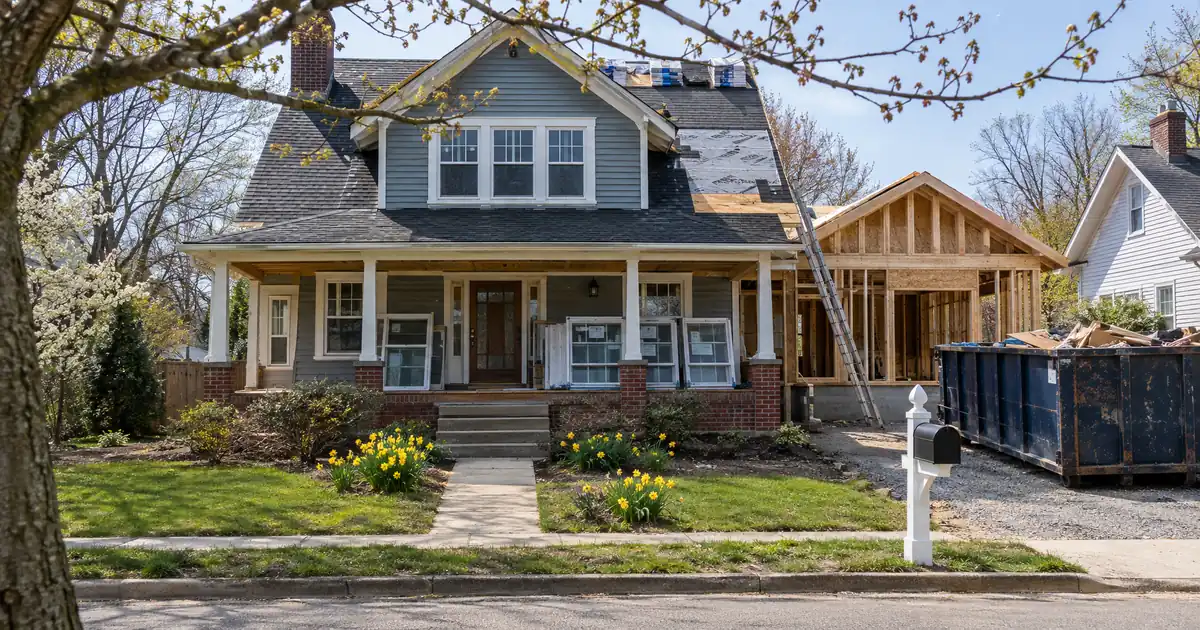
The Quick Read: Usually no, not as a like-for-like swap, because a bank statement loan is a way to document income and a hard money flip loan is a way to fund a property that is not finished yet. The one fair exception is a property that is already rentable at closing, where a long-term loan can replace the short-term one as the exit. These are different tools for different jobs, and the investor decision is about which job the property needs done.
- A bank statement loan proves income from deposits. It carries no rehab holdback and no draw schedule.
- Hard money flip loans are sized on cost and after-repair value, with rehab money released in draws.
- A finished or habitable property can move into long-term financing, which is a hold strategy, not a flip.
- Hard money tops out around 93% of project cost for experienced investors, always capped at 75% of after-repair value.
- Many flippers exit into DSCR financing instead, because the property’s rent carries the file.
Two Loans Built for Different Questions
A bank statement loan answers “how do I prove what I earn?” A hard money flip loan answers “how do I pay for a house that needs work?” Mixing those up is where most of the confusion starts.
What this loan actually costs to carry.
Hard money is sized against the project and priced by time. Enter the deal and see how much the program will lend, the cash required at closing, the carry while you hold it, and what is left at the exit.
Leverage tiers on the current program: 85% with fewer than 2, 90% with 2 or more, 93% with 5 or more completed projects — every tier capped at 75% of after-repair value. Loan amounts up to $5,000,000, larger by exception; terms of 6 to 18 months, interest-only, no prepayment penalty. The rehab portion funds in draws against completed work, not at closing.
Program parameters shown update from Lendmire’s centralized guideline source. Rate, points, and months are editable assumptions, not quoted terms.
Cost cap sets the loan · positive spread
Illustrative estimate only — not a quote, Loan Estimate, approval, or commitment to lend. Rate, points, and months are editable assumptions. Hard money is business-purpose financing for real estate investors, not a consumer mortgage. Leverage on the current program tops out at 93% of project cost for investors with a documented track record, capped at 75% of after-repair value, with rehab funding up to 100% of the documented budget released in draws; actual terms vary by lender, borrower experience, property, and exit. Lendmire is a mortgage broker, not a lender.
The bank statement loan is a non-QM product. The lender reads 12 or 24 months of personal or business deposits, screens out items that are not income, applies an expense factor to business accounts, and averages the result into qualifying income. Scotsman Guide lists bank statement loans among the non-QM products built for self-employed borrowers. Credit, assets, reserves and the property still get reviewed. It is not a no-paperwork loan.
Hard money works the other way. Across the wholesale network, hard money files are underwritten on the deal: the property, the rehab plan, the exit, and the sponsor’s track record. Personal income is not the driver.
The two programs price risk differently, document differently and end differently. One ends in a sale or a refinance within months. The other is built to be held.
Key Terms Defined
Bank statement loan: A mortgage that qualifies the borrower on deposit history instead of traditional personal-income documentation or pay stubs.
Hard money flip loan: A short-term, interest-only, asset-based loan that funds a purchase and a rehab.
After-repair value (ARV): The estimated value of the property once the renovation is finished.
Loan-to-cost: The loan amount measured against the total project cost, purchase plus rehab.
Rehab holdback: Renovation money the lender holds back and releases in draws after work is inspected.
Expense factor: The percentage of business deposits treated as operating cost and removed before income is averaged.
What a Hard Money Flip Loan Actually Funds
Hard money pays for two things: the acquisition and the repairs. The acquisition advance funds at closing. The rehab budget sits in a holdback and releases in draws against completed work.
Across the network, leverage on fix-and-flip files runs by experience. Typical tiers are 93% of project cost at five or more completed projects, 90% of project cost at two or more, and 85% with fewer than two. Every tier is capped at 75% of after-repair value. Up to 100% of the rehab budget funds in draws, which is a rehab-budget figure, not a purchase LTV. Terms run 6 to 18 months, interest-only, with no prepayment penalty. Credit starts at a 620 score, with added conditions below 660. All of this varies by lender, property, and experience.
Notice what the borrower’s personal income is doing in that structure. Nothing. The lender is lending against a house, a plan and an exit.
Why a Bank Statement Loan Can’t Do That Job
A bank statement loan has no draw mechanism. It funds a purchase against a property that is expected to stand as it is. If the house needs a new roof, a kitchen and a second bathroom, the loan has no way to pay contractors in stages, and the appraiser will value the property in its current condition.
Three structural gaps follow from that.
1. No rehab funding. Without a holdback, the investor must self-fund every repair dollar.
2. No after-repair leverage. The loan sizes on the current appraised value and the borrower’s documented income, not on what the house will be worth after renovation.
3. Property eligibility. A long-term lender wants a habitable, rentable property at closing. A gutted house usually fails that test.
A bank statement file also asks for different things. Expect statement history, an expense factor, credit review and reserves. A flip file asks about scope of work, budget, contractor and comparable sales.
There is also a regulatory layer that explains why the products diverge. A flip is typically a business-purpose loan. Regulation Z exempts business-purpose credit, and its commentary treats credit to acquire, improve or maintain non-owner-occupied rental property as business purpose. For a fixer-upper held for resale, Compliance Alliance notes a flip is not automatically exempt as a rental, so the loan’s primary purpose decides. Bank statement programs are typically written as ability-to-repay-documented non-QM mortgages. Program rules vary, so the guidelines on a specific file control.
Replace at Purchase vs. Replace at Exit
The question changes completely depending on when you ask it. At purchase, a bank statement loan is rarely a substitute. At exit, it can be one of several options.
At purchase. The property needs work. The investor needs both acquisition money and rehab money, and wants leverage tied to what the house will become. Only a flip loan is built for that. A bank statement loan would force the investor to bring the rehab capital and accept leverage based on the as-is condition.
At exit. The rehab is done. The property is rentable, the flip loan is approaching maturity, and the investor wants to hold it. Now a long-term loan makes sense. The lender sees a finished house, the appraisal reflects the improved condition, and the investor needs a way to pay off short-term debt without selling.
This is the one “yes, partly” case. It is not a replacement of the flip loan. It is a different strategy, buy-and-hold, that happens to follow a flip.
Side by Side
| Factor | Hard Money Flip Loan | Bank Statement Loan |
|---|---|---|
| Purpose | Buy and rehab | Document income for a long-term loan |
| Reviewed on | The deal and the exit | The borrower’s deposits |
| Rehab funding | Yes, in draws | None |
| Term | 6 to 18 months, interest-only | Long-term structures |
| Typical exit | Sale or refinance | Held as a long-term loan |
| Main risk | Budget overrun, missed exit | Property not rent-ready, deposits that don’t read as income |
Eligibility Checklist for the Exit Swap
If the plan is to pay off a flip loan with long-term financing, these conditions need to hold before the file goes in.
- Rehab is complete. Permits closed, systems working, finishes done.
- The property is habitable and rentable. No open draws and no unfinished scope.
- Seasoning is understood. Cash-out refinances in the network commonly expect about 6 months of seasoning. A short ownership period can limit the options.
- The appraisal supports the payoff. The new lender values the property as it stands, not on the original ARV projection.
- Statement history is clean. Deposits need to read as income, not as transfers or one-time windfalls.
- Credit and reserves are in order. Long-term programs commonly look at a score around 660, with 700 and up opening stronger leverage tiers, and reserves that vary by lender, leverage, loan size and transaction type.
An entity can complicate things. Entity vesting rules vary by program and are subject to lender program eligibility, so confirm that before assuming an LLC can borrow on a bank statement file.
How Deposits Get Read (and Why Flippers Struggle)
A flipper’s income is lumpy by nature. A big sale lands, then months pass. That pattern is why the statement window matters.
1. Statements are collected. Typically 12 or 24 months, personal or business.
2. Ineligible items come out. Transfers between your own accounts, loan proceeds and one-time windfalls are screened out before averaging.
3. An expense factor applies to business accounts. It depends on the business type. A lender-set factor, a CPA-prepared P&L or a third-party expense statement can be used.
4. The average becomes qualifying income. That number is run against the new payment and other debts.
5. Standard file review follows. Credit, assets, reserves and the property.
Here is the catch for flippers. Moving cash between accounts, or depositing hard money draw proceeds, can inflate or muddy the statements. Draws reimbursing contractor costs are not income. Clean, separate accounts for each project make the deposits far easier to read.
Scotsman Guide notes that non-QM borrowers still have to meet the ability-to-pay standard. Lighter reliance on traditional personal-income documentation does not mean lighter underwriting.
The Exit That Often Fits Better: Rental Income
A bank statement loan is reviewed for the person. A DSCR loan is reviewed primarily on property-level rental income covering the payment, subject to lender guidelines. For an investor who is keeping the property as a rental, that second path often fits the strategy more directly. Many investors refinance out of hard money into long-term DSCR financing once the property is stabilized, and Lendmire brokers that path.
On the DSCR side, 1.00 coverage is where select programs start. Stronger ratios open better pricing and leverage. A separate select-lender path takes coverage below 1.00, with leverage and terms adjusted. Clearing 1.00 is not the same as positive cash flow, because repairs, vacancy, management, utilities and capex sit outside the calculation.
The decision usually breaks down like this:
| Situation | Better-Fit Path |
|---|---|
| Needs rehab | Hard money flip loan |
| Rent-ready, income hard to show on returns | Bank statement loan |
| Rent-ready, rent carries the payment | DSCR loan |
| Flip is done, selling | Pay off from sale proceeds |
Scotsman Guide reports that DSCR loans have surged for rentals while transition loans finance fix-and-flips. That split mirrors how the products are used in practice. For the full picture of how a DSCR file works, see the complete DSCR loans guide.
A Worked Example
Run the numbers on a conceptual flip. An investor buys a distressed duplex on a flip loan, funds the rehab through draws, and finishes the work. The flip loan is interest-only and matures within its 6 to 18 month term.
The investor now has three decisions.
Option one: sell. The sale repays the flip loan. No new financing is needed.
Option two: refinance into a DSCR loan. Say the rents on the finished duplex clear roughly 1.2x coverage against the full monthly obligation. That is a ratio read, not a cash-flow promise. The lender reviews the appraisal, the borrower’s credit, reserves and the property. Cash-out refinances in the network top out around 75% LTV for standard rentals.
Option three: use a bank statement loan. This only makes sense if the property’s rent is thin but the investor’s documented deposits are strong. The loan is reviewed on income instead of the property’s rent, so it can carry a property whose coverage ratio is weaker.
In option two, the investor avoids requalifying on personal income. In option three, the investor leans on it. Which one fits depends entirely on which side of the file is stronger.
Lendmire’s piece Bank Statement vs DSCR for Rate-and-Term or Cash-Out Hard Money Exit walks through that choice in more detail.
Working Backward From the Maturity Date
The exit has to be lined up against the flip loan’s maturity, not after it. Three habits keep files clean.
- Start the exit file while the rehab is still in progress. Statements, entity documents and insurance can be gathered before the final draw.
- Plan for the appraisal, not the ARV. If the new appraisal lands below the original after-repair estimate, the payoff math changes. Know the shortfall plan before it happens.
- Know your plan B. An extension, a sale, or a different long-term program is better chosen in advance than under pressure.
If the flip loan matures before the replacement is ready, the investor has fewer options and less leverage in negotiating them. That is a planning problem, and it is a common reason exit files get stressed.
Who Should Not Try This
A bank statement loan is the wrong tool for several situations.
- The house still needs real work. No holdback, no draws. Use a flip or rehab loan.
- The property isn’t rentable at closing. Long-term lenders want a habitable property.
- The investor’s rental coverage is strong and personal income is also strong. Then a bank statement loan adds documentation work without adding much. A DSCR loan may be simpler.
- The business has under 24 months of history and few liquid assets. Underwriters may weigh assets and credit alongside a shorter history, but the file gets thinner.
A bank statement loan also does not make a risky borrower safe. Scotsman Guide reports that bank statement loans showed higher delinquency than DSCR loans on older vintages but performed better on more recent production. That is qualitative context, not a prediction for any file.
Lendmire’s article How to Pay Off a Hard Money Loan With a Bank Statement Cash-Out Refinance covers the payoff mechanics for investors who go that route.
Frequently Asked Questions
Is a bank statement loan the same as hard money?
No. A bank statement loan proves income through deposits and is built for long-term holds. Hard money is asset-based, short-term and funds the purchase plus rehab. The first underwrites the borrower’s cash flow, the second underwrites the deal.
Can I use a bank statement loan to pay off a flip loan?
Sometimes, when the rehab is done and the property is rentable. The new lender values the finished property, reviews credit and reserves, and checks that deposits support the income. It is an exit into a hold, not a replacement for the flip financing itself. Eligibility varies by lender, property, and borrower.
Can I use one to buy and rehab a property?
Rarely, and usually not for a house that needs real work. There is no holdback to pay contractors, so the investor funds repairs from other capital. A flip loan is built for that job. Hard money leverage varies by lender, property, and experience.
Do I need traditional personal-income documentation?
Not for the bank statement method, which is reviewed on documented deposits instead. The lender still reviews statements, credit, assets and reserves. A DSCR loan works differently again, qualifying primarily on property-level rental income covering the payment, subject to lender guidelines.
What if the appraisal comes in low?
The payoff math changes. The new lender sizes the loan on the appraised value, not the original after-repair estimate. Options include bringing cash to closing, requesting an appraisal reconsideration with recent comps, or choosing a different exit. Planning for that gap before maturity is better than finding it afterward.
About Lendmire
Lendmire, NMLS# 2371349, is a mortgage brokerage focused on investor financing, arranging DSCR loans in 40 states plus Washington, D.C. — 41 markets total. Qualification is based on the property’s income rather than personal income documentation, subject to lender guidelines, making it a fit for LLC-held rentals and scaling portfolios. Scotsman Guide named Lendmire a Top Mortgage Workplace in both 2025 and 2026.
Get Started
Ready to find the right loan for you?
In about 30 seconds you can review financing options available for your investment property. No commitment required.
Informational only. Not a Loan Estimate, approval, or commitment to lend. Program availability and eligibility are subject to lender guidelines, credit approval, property review, and underwriting.
References
1. Scotsman Guide – Dispel the common non-QM myths
3. Compliance Alliance – Regulation Z and Investment Properties
4. Scotsman Guide – Non-QM borrowers and ability to pay
5. Scotsman Guide – Investors anchor housing market
6. Scotsman Guide – Non-QM delinquencies
This article is part of Lendmire’s hard money loan program — full qualification details, guidelines, and scenarios live on the program page.
Related reading: Hard Money Rehab Draw Inspections for a Full-Gut Rehab · Can You Use One Super Jumbo DSCR Loan for 20 or More Rentals? · Hard Money Loan Requirements to Buy Out a Land Contract
Brandon Miller
Founder & CEO, Mortgage Loan Originator, Lendmire LLC
- Mortgage Loan Originator · NMLS# 1129696 · Verify on NMLS Consumer Access
- North Carolina Real Estate Broker · License# 343312 · Verify on NCREC
- North Carolina Insurance Producer · License# 19053198 · Property, Casualty, Life, Health · Verify on NAIC SBS
- Lendmire LLC · Firm NMLS# 2371349 · Verify firm licensure
Disclosures. The information presented in this article is general market commentary, not financial, legal, or tax advice. Lendmire is a mortgage brokerage (NMLS# 2371349) — not a direct lender or depository institution — and loan placement is subject to lender underwriting. Nothing in this content represents a commitment to lend. Loan terms, pricing, and program availability vary based on borrower qualifications, property characteristics, and state of subject property, and are subject to change at any time. Lendmire complies with Equal Housing Opportunity requirements. Consumer access: nmlsconsumeraccess.org.