
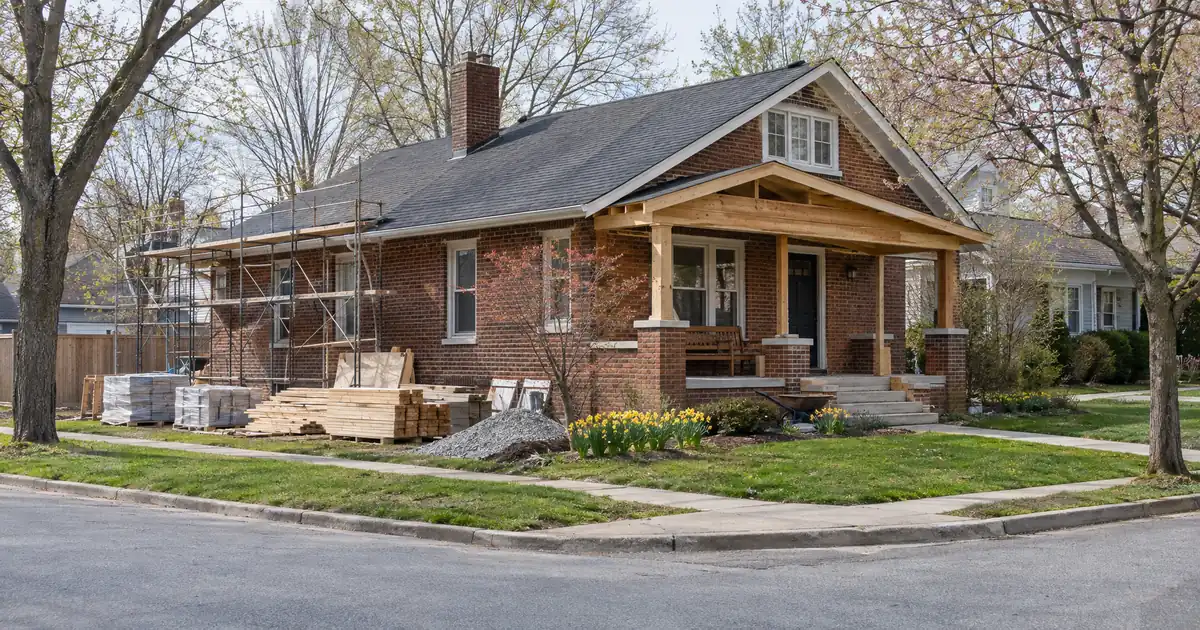
The Quick Read: Usually yes, if the project is a true flip with a defined exit, because hard money is secured by the property and sized on the project, not on where you live; the loan type matters less than whether you have a vetted local team and cash set aside for draw delays. Distance does not block the loan. It does make every delay more expensive.
- Hard money reviews the purchase price, the renovation plan, the after-repair value, and your exit. It does not underwrite your home address.
- Leverage on a flip typically runs 85% to 93% of project cost depending on your completed projects, always capped at 75% of after-repair value. It varies by lender, property, and experience.
- Rehab money usually arrives in draws, as reimbursement for finished and inspected work, so you fund the early steps yourself.
- Thin margins are the real danger. Typical flip profits have been shrinking, and a stalled draw eats what is left.
- If the plan is to keep the property, many investors refinance into a long-term rental loan after the rehab.
What Does Hard Money Do for a Flip, and What Doesn’t It Do?
Hard money is a short-term, interest-only business loan secured by the property. It fits a flip because it funds a house that is not yet livable or rentable. A long-term rental loan cannot do that job.
What this loan actually costs to carry.
Hard money is sized against the project and priced by time. Enter the deal and see how much the program will lend, the cash required at closing, the carry while you hold it, and what is left at the exit.
Leverage tiers on the current program: 85% with fewer than 2, 90% with 2 or more, 93% with 5 or more completed projects — every tier capped at 75% of after-repair value. Loan amounts up to $5,000,000, larger by exception; terms of 6 to 18 months, interest-only, no prepayment penalty. The rehab portion funds in draws against completed work, not at closing.
Program parameters shown update from Lendmire’s centralized guideline source. Rate, points, and months are editable assumptions, not quoted terms.
Cost cap sets the loan · positive spread
Illustrative estimate only — not a quote, Loan Estimate, approval, or commitment to lend. Rate, points, and months are editable assumptions. Hard money is business-purpose financing for real estate investors, not a consumer mortgage. Leverage on the current program tops out at 93% of project cost for investors with a documented track record, capped at 75% of after-repair value, with rehab funding up to 100% of the documented budget released in draws; actual terms vary by lender, borrower experience, property, and exit. Lendmire is a mortgage broker, not a lender.
Across the wholesale network Lendmire places files with, the structure is consistent. Terms typically run 6 to 18 months, interest-only, with no prepayment penalty. Loan sizes go up to $5,000,000, and larger by exception. Collateral is non-owner-occupied residential property with 1 to 4 units. Credit starts at a 620 minimum score, with added conditions below 660. Everything varies by lender, property, and experience, and nothing here is a commitment to lend.
Hard money does not make a weak deal good. It also does not remove the need for cash. Lenders want to see liquid funds in the bank, and home equity generally does not count as liquidity. Borrowing the down payment on a credit card is a red flag that many lenders will decline.
If you want the long-term side of the picture, Lendmire’s complete DSCR loans guide explains how rental loans differ from flip financing.
Does Being Out-of-State Change Whether You Can Get Approved?
Not in the way most people fear. Lenders in this space look at the asset: the contract price, the scope of work, the contractor bid, the comparable sales behind the after-repair value, and your track record. Your mailing address is a small part of the file.
What changes is verification. A lender cannot drive by, so the paper trail carries more weight. A strong remote file usually includes:
- The purchase contract
- An itemized scope of work and a contractor bid
- A renovation timeline
- Proof of funds
- Photos or inspection reports
- Comparable sales that support the after-repair value
Two limits matter before you start. First, availability is not universal. A handful of states and cities fall outside the footprint, so confirm the property location before you fall in love with a deal. Lendmire’s hard money programs cover 41 markets, including Washington, D.C. Second, entity questions are local. Many investors borrow through an LLC, subject to program terms, but whether you need to register it in the property’s state is a question for a real estate attorney, not a loan officer.
How remote closing usually works
Most of the paperwork can be done by e-signature. Where a document needs a notary, a mobile notary or remote online notarization can often handle it. Wire fraud is the part to take seriously. Call the title company on a phone number you already trust before you send any funds, and never act on wiring instructions that arrive by email alone.
How Does Distance Change the Risk on a Flip?
Distance does not create new risks. It makes the usual ones slower to see and slower to fix. A contractor who falls behind is a phone call when you live nearby. When you live far away, it can be a month before you know.
| Risk | Why distance amplifies it | How to reduce it |
|---|---|---|
| Contractor slippage | You can’t see progress | Referral-based contractor, milestone pay |
| Scope creep | Hidden problems found late | Inspection before offer, contingency budget |
| Permit surprises | Local rules are unfamiliar | Local agent or project manager checks first |
| Resale timing | You miss local demand shifts | Agent’s pricing opinion before you buy |
| Holding-time drift | Each delay extends interest-only carry | Longer note term, cash reserves |
Out-of-state investors often say the project lives or dies on the local team. That matches what a broker sees on files. The strongest remote borrowers line up an agent, a contractor, and a property manager before they make an offer, and they run conservative numbers with buffers.
Why Do the Margins Matter So Much?
Because they are thinner than the headlines suggest. ATTOM’s latest quarterly flipping report counted 77,991 flipped homes, about 6.2% of all sales. The typical gross margin was 21.5%, down from 25.7% the prior quarter and 27.6% a year earlier. Margins fell quarter over quarter in 126 of 186 metros.
Gross profit here means resale price minus purchase price. Renovation, loan, holding, and selling costs all come out of it. HousingWire’s coverage of ATTOM’s data cautions that stronger gross margins do not necessarily mean stronger net returns, and it reports a typical 14% loss on homes bought under $50,000.
Results also swing by place. WRENews reports that among metros over 1 million people, one returned 81.5% while another lost 0.3%. Choosing a market from a spreadsheet is risky for exactly that reason.
The carry period matters too. ATTOM’s state-level flipping data shows a national median of 165 days from purchase to resale. That is a long stretch of interest-only debt, and a distant, slow project can run well past the median.
How Do Draws and Inspections Work When You’re Not There?
Rehab money is not handed over at closing. Up to 100% of the rehab budget funds in draws against completed work, and that figure is a rehab-budget number, never a purchase loan-to-value. The sequence usually looks like this:
1. You close on the purchase, funded as a share of project cost.
2. The contractor starts work, and you or the contractor pay for the first stage.
3. You submit a draw request with photos, invoices, and proof of payment.
4. The lender verifies the work. Inspection style varies by lender, from a site visit to photo or video review, so confirm the method before you sign.
5. The lender reimburses you for the verified work, and the cycle repeats.
The practical effect is that you front early costs and get repaid. Missing lien waivers are a common reason a draw package stalls. Remote borrowers should keep a documented payment trail and have a local representative who can meet an inspector.
This is where an out-of-state flip most often loses money. A draw that stalls for a week or two can idle a crew. Idle crews drift to other jobs, and the schedule slips. Pay contractors in milestones that mirror the draw schedule, so the money you spend is always tied to work the lender can verify.
What Does a Local Flip Versus a Remote Flip Look Like?
The table below uses modeled assumptions, not sourced market facts or program terms. It shows direction, not dollars.
| Factor | Local investor | Out-of-state investor |
|---|---|---|
| Progress checks | Weekly in person | Photos, local rep |
| Draw cycle | Short, easy to fix | Longer if paperwork lags |
| Overrun discovery | Early | Often later |
| Interest-only carry | Close to plan | Extends with every delay |
| Resale timing | Tracks local market | Needs agent input |
Here is the effect on a deal. Say a flip lands the typical 21.5% gross margin from the ATTOM data. Renovation, loan, holding, and selling costs all come out of that margin. A remote project that runs two months over adds interest-only carry on top of a margin that is already thin. A flip with a comfortable margin can absorb that. A flip that was already close to break-even cannot.
Should You Do It? A Decision Framework
| Your situation | Read |
|---|---|
| Vetted local team, cash reserves, conservative ARV | Good fit |
| Strong deal, but first flip or first remote flip | Proceed with caution, start smaller |
| Tight margin, no reserves, unfamiliar rehab scope | Not yet |
| Livable house needing light cosmetic work | Compare other financing first |
| Plan is to hold as a rental | Think about the exit loan first |
A first-time flipper can qualify at the lower leverage tiers. The top tier is reserved for experienced investors with several completed projects. Starting with a smaller scope in a market you can visit once is a reasonable way to build that record.
Honest no-go conditions are worth stating. Skip the deal if the margin only works at the best-case resale price. Skip it if you have no cash cushion beyond the down payment. Skip it if you cannot name the person who will walk the property each week.
What Are the Alternatives for a Remote Flip?
| Option | Best when |
|---|---|
| Hard money | You need renovation funding and have a defined exit |
| Local partner or joint venture | You lack a team and will share profit |
| Local bank or credit union | The house is habitable and you have a relationship |
| Private capital | A trusted investor will fund on negotiated terms |
| Cash | You want no draw process and have the liquidity |
A local bank or credit union can beat hard money on a livable house with light cosmetic work, particularly if you already have a relationship there. A partner who lives nearby solves the oversight problem directly, at the cost of splitting the profit. Hard money tends to win when the house needs real renovation and the lender’s draw system gives you structure.
A DSCR loan is not an alternative for the flip itself. DSCR loans underwrite stabilized rent against the payment, so they suit a house that is already rentable. They come into play on the way out.
How Does the Exit Work If You Keep the Property?
Many investors refinance out of hard money into long-term DSCR financing once the property is stabilized and leased. Lendmire brokers that path. A DSCR loan is reviewed primarily on property-level rental income covering the payment, subject to lender guidelines.
A few mechanics matter here. A cash-out refinance on a standard rental tops out around 75% LTV across most of the network. About 6 months of seasoning is the common expectation, and the end of the rehab is not the start of that clock. Coverage of 1.00 is where select programs start. A separate select-lender path goes below 1.00, with leverage and terms adjusted. Leverage, reserves, and pricing vary by lender and program; the final terms follow the full file review.
One caution on the numbers. DSCR compares rent to the full monthly housing payment only. Clearing 1.00 is not the same as positive cash flow, because repairs, vacancy, management, and utilities sit outside the ratio. If the exit is a rental, build slack into the hard money term for a slow draw or a late tenant.
Lendmire’s article How an Out-of-State Investor Vets Hard Money for a DSCR Exit covers that handoff in more detail.
Pre-Commitment Checklist
- Market: you have studied recent sales, not just listings, and can name the resale buyer.
- Team: agent, contractor, and local representative are lined up by referral, with multiple bids in hand.
- Budget: the scope is itemized, with a contingency for overruns.
- Cash: you hold funds for the early work, for draw delays, and for interest-only carry.
- Exit: you know whether you sell or refinance, and what happens if the sale stalls.
- Entity: an attorney has confirmed how to hold title in that state.
- Location: the property sits inside a market the lender covers.
Key Terms Defined
After-repair value (ARV): the estimated market value of the property once the planned renovation is finished.
Loan-to-cost: the loan amount as a share of the total project cost, meaning purchase price plus renovation budget.
Draw: a staged release of rehab funds, paid as reimbursement after completed work is verified.
Interest-only: a payment structure where you pay interest during the term and the balance comes due at the end.
DSCR: debt service coverage ratio, which compares a rental’s monthly rent to its monthly payment of principal, interest, taxes, insurance, and dues.
Seasoning: the waiting period a lender wants between buying or rehabbing a property and refinancing it.
Frequently Asked Questions
Can I get a flip loan on a property in another state?
Yes, in most markets a lender covers. The lender reviews the purchase price, the scope, the after-repair value, and your exit. A small number of states and cities are outside the footprint, so confirm the property location first. Every file is underwritten individually and nothing is a commitment to lend.
Do I have to visit the property?
Not always, but you should see it at least once if you can. Remote closings run on e-signature and mobile or online notaries. What replaces your presence is documentation and a local person you trust. A site visit before you commit is still a more affordable way to catch a problem.
What if the project runs late?
Late projects cost interest-only carry. Hard money terms typically run 6 to 18 months with no prepayment penalty, which gives some room. Extensions vary by lender, so ask about them before you sign. Keep cash in reserve for the extra months, and decide in advance whether you will sell or refinance if the schedule slips.
Do I need an entity in the property’s state?
It depends on the state, the lender, and how you plan to hold title. Many investors borrow through an LLC, subject to lender program eligibility. Whether it must be registered where the property sits is a legal question, so ask a real estate attorney before you close.
Is hard money still worth it when margins are shrinking?
It can be, if the deal clears a realistic net margin after loan, holding, and selling costs. Hard money is a tool for funding renovation. It does not create profit. If a deal only works under best-case assumptions, the financing is not the problem.
If you are buying, rehabbing, or refinancing an investment property on a short timeline and want to see how the numbers work, Lendmire can help you compare hard money options based on the project, the exit plan, leverage, and your goals. You can reach the team at 828-256-2183.
A flip that works from a distance is rarely the one with the best resale price on paper; it is the one with enough margin and cash to survive a slow month.
About Lendmire
Lendmire is a non-QM mortgage brokerage (NMLS# 2371349) arranging DSCR investor loans in 41 markets, including Washington, D.C. DSCR eligibility is generally reviewed around property-level rental income rather than personal income, subject to lender and program guidelines, a fit for self-employed investors and LLC-owned portfolios. Lendmire was recognized as a Scotsman Guide Top Mortgage Workplace in 2025 and 2026.
Get Started
Ready to find the right loan for you?
In about 30 seconds you can review financing options available for your investment property. No commitment required.
Informational only. Not a Loan Estimate, approval, or commitment to lend. Program availability and eligibility are subject to lender guidelines, credit approval, property review, and underwriting.
References
1. attomdata.com: Home Flipping Profits Continue Gradual Two Year Decline
2. HousingWire coverage of ATTOM flipping data
3. WRENews summary of ATTOM flipping returns
4. ATTOM flipping trends by state
This article is part of Lendmire’s hard money loan program — full qualification details, guidelines, and scenarios live on the program page.
Related reading: Hard Money Loan Requirements to Exit Seller Financing or Subject-to · Can a W-2 Investor Request a Second Appraisal on a DSCR Purchase? · Seasoning Rules for a Two-Step DSCR Cash-Out After Hard Money
Brandon Miller
Founder & CEO, Mortgage Loan Originator, Lendmire LLC
- Mortgage Loan Originator · NMLS# 1129696 · Verify on NMLS Consumer Access
- North Carolina Real Estate Broker · License# 343312 · Verify on NCREC
- North Carolina Insurance Producer · License# 19053198 · Property, Casualty, Life, Health · Verify on NAIC SBS
- Lendmire LLC · Firm NMLS# 2371349 · Verify firm licensure
Disclosures. The information presented in this article is general market commentary, not financial, legal, or tax advice. Lendmire is a mortgage brokerage (NMLS# 2371349) — not a direct lender or depository institution — and loan placement is subject to lender underwriting. Nothing in this content represents a commitment to lend. Loan terms, pricing, and program availability vary based on borrower qualifications, property characteristics, and state of subject property, and are subject to change at any time. Lendmire complies with Equal Housing Opportunity requirements. Consumer access: nmlsconsumeraccess.org.