
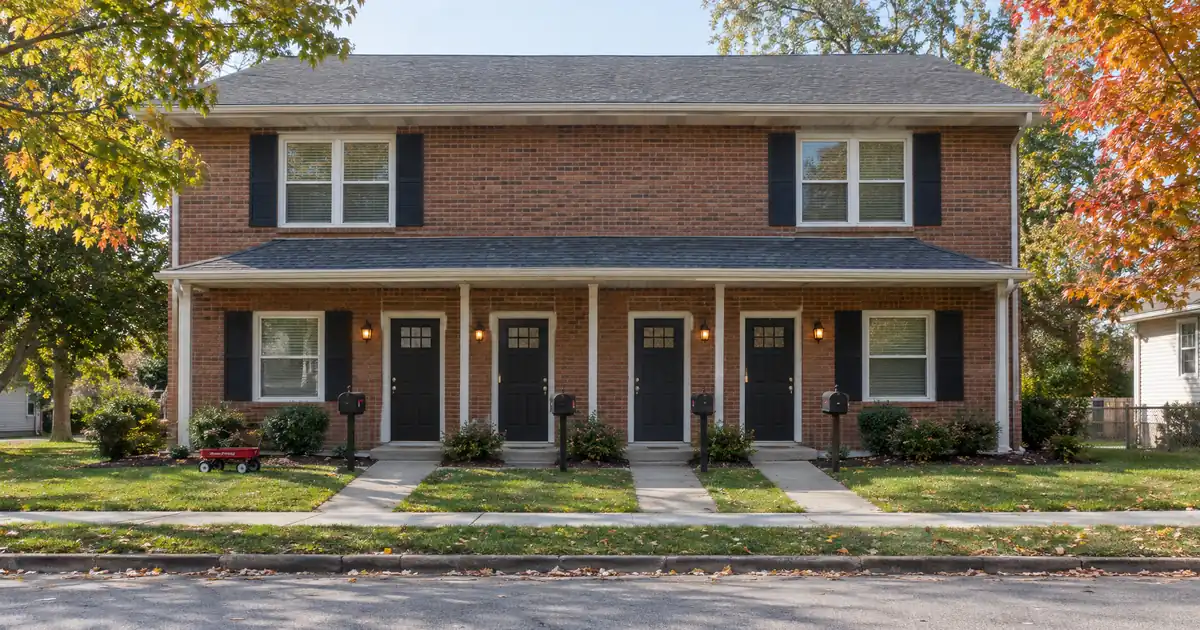
The Quick Read: No. Living in one unit and renting out the others does not end FHA mortgage insurance, and it does not end it sooner. The schedule runs on your loan term, loan amount and starting loan-to-value (LTV). A 3.5% down purchase starts above 90% LTV, so the annual premium usually lasts the whole term. For most house hackers, the way out is a refinance.
Why Does Unit Count Not Change the Schedule?
Unit count is not one of the variables. FHA sets the annual premium from three inputs: the loan term, the base loan amount and the LTV at the start. A duplex, triplex or fourplex is priced on that same grid as a single-family home.
FHA payment estimate
Starting assumptions reflect an example price and the FHA minimum investment. Replace them with your own figures.
Editable benchmark: 7.32% as of October 22, 2026 · Freddie Mac 30-year average via FRED®. A conventional market reference, not an FHA loan quote.
Illustrative starting assumptions: a $350,000 price, the FHA minimum investment as the down payment, a thirty-year term at the current Freddie Mac benchmark, and property taxes and insurance estimated at typical national rates. Every field is editable.
Illustrative estimate only — not a Loan Estimate, approval, quote, or commitment to lend. The rate field carries the weekly Freddie Mac thirty-year conventional benchmark, a market reference and not an FHA loan quote; your rate is set by the lender at lock. FHA mortgage insurance follows HUD’s published schedule for the term, leverage and loan size entered; taxes, insurance and dues are editable estimates; closing costs are not included; county loan limits are not checked here. Licensed in sixteen states for consumer mortgages. Lendmire is not affiliated with or acting on behalf of FHA, HUD, or the federal government.
Rent from the other units helps you qualify. It does not shorten the insurance. Those are two separate jobs, and mixing them up is a common mistake in house-hacking forums.
Here is the picture across the FHA loan programs a broker works with every week. The maximum financing is 96.5% LTV, with a 3.5% minimum investment from a decision score of 580 or higher. The loan carries an upfront premium of 1.75% of the base loan, which is usually financed into the balance. It also carries an annual premium, which falls somewhere between 0.15% and 0.75% of the balance depending on term, amount and LTV. Every figure here is subject to lender guidelines and full file review. None of it is a commitment to lend.
What Does the 3.5% Down Payment Do to the Timeline?
A 3.5% down payment is the minimum on an FHA purchase, and it puts the loan at the highest leverage the program allows.
It puts you on the long end of the schedule. On a thirty-year loan above 90% LTV, the annual premium lasts for the term. At or below 90% LTV, it ends after eleven years. HUD Mortgagee Letter 2023-05 lays out this schedule, and it also sets the 1.75% upfront premium as a separate charge. Final terms depend on the lender’s guidelines, the property type, and the borrower’s complete credit picture.
Do the math in percentages. Put 3.5% down and your starting LTV is 96.5%. To get under the 90% line, you would need roughly 10% down. That breakpoint is the one lever that changes how long the premium runs. Each figure is subject to lender guidelines and a complete review of property type, leverage, and credit.
That is a real tradeoff for a house hacker. Low cash down is the whole appeal of FHA on a 2-4 unit. The cost of that choice is a premium that likely outlasts your time in the property.
Which Situation Are You In?
Your answer depends on when your loan started and how much you put down. Find your row below.
| Your situation | Does the annual premium end? | What it means for you |
|---|---|---|
| 30-year, LTV above 90% at start | Not before the term ends | Plan on refinancing out |
| 30-year, LTV at or below 90% at start | Yes, after eleven years | Hold, or refinance sooner |
| Older loan from before HUD’s premium overhaul | Possibly, at 78% of original value after five years | Check your paperwork |
| FHA Streamline refinance | No, the premium continues | Payment may change; insurance stays |
Most people buying a 2-4 unit today fit the first row. Older loans follow different cancellation rules, and the five-year minimum applies there. Short-term loans have their own variants, so check your closing paperwork for your original term.
What Does Not Cancel It?
Several things feel like they should, and none of them do.
Rental income. Rent counts toward your qualifying income. It is not a cancellation factor.
A new appraisal. Say your rents rise and the building is now worth more. For newer loans, that extra value does not trigger cancellation. Even on older loans, HUD’s cancellation rule looks at the original value, not the new one.
Extra principal payments. Paying the balance down faster does not end the premium on newer loans. Cancellation, where it applies, follows the original amortization schedule. HUD publishes these servicing rules in Handbook 4000.1.
The conventional 20% equity rule. Conventional private mortgage insurance (PMI) has a federal borrower right to request removal at 80% of the original value. It terminates automatically at 78%. The CFPB’s examination procedures describe how that works. But that law covers private mortgage insurance, and it does not apply to FHA or VA loans. Borrowers also confuse the two labels: FHA calls it MIP, while conventional lenders call it PMI.
The upfront premium. That is a one-time charge, separate from the monthly one. Nothing cancels it later.
What Are Your Exit Paths?
You have four. Each fits a different house hacker.
Hold the loan. Nothing forces you out.
Refinance into a conventional loan. This is the usual exit. You go through new underwriting, a new appraisal and new closing costs. The new loan replaces FHA mortgage insurance with whatever the new loan needs based on its LTV. With enough equity, that can mean little or no mortgage insurance at all.
Refinance FHA to FHA. The Streamline refinances an existing FHA loan with no appraisal and a limited credit review. It requires a net tangible benefit, and it can change your payment. It keeps the premium in place. Across the wholesale programs a broker uses, an FHA rate-and-term refinance with an appraisal reaches 97.75% on a principal residence occupied for the previous twelve months. That one still carries FHA insurance too. Neither route ends it.
Sell or pay off. The premium ends when the loan does. For a hacker planning to trade up in a few years, this may be the real plan.
When Does the Refinance Make Sense?
It makes sense when the premium you stop paying outweighs the cost of the refinance. That is break-even logic, and you can run it without any dollar figure on this page. Take your closing costs on the new loan. Divide by the monthly savings. The result is how many months you must keep the new loan to come out ahead.
Three things shape that answer:
- Equity. More equity means the new loan needs less insurance, or none.
- Your hold period. If you plan to sell soon, a long break-even period kills the idea.
- The new loan’s terms. A different term or structure changes the payment in ways that have nothing to do with insurance. Compare the full Loan Estimate, not just the insurance line.
Lendmire’s piece How Mortgage Insurance Adds to a 2-4 Unit Cash-Out Refinance Payment shows how that insurance line behaves when you pull equity out instead.
What About the Occupancy Year and Moving Out?
FHA’s occupancy rule is about the day you close. You buy the property as your principal residence, meaning the home where you actually live most of the year. A person has only one at a time. The Handbook language generally expects at least one borrower to move in within a set period after closing and to intend to stay for at least a year. Confirm the exact wording in the current Handbook.
The sequencing question comes next. Say you finish the first year and want to move out and rent every unit. The FHA loan can stay in place. But a conventional refinance would likely treat the property as a rental after you leave. That changes leverage and eligibility. Occupancy decides the leverage on these loans. Many hackers who plan to refinance do it while they still live in the building. Ask your loan officer how this applies to your file before you move.
There is a second sequencing trap. Buy another owner-occupied home after your first year, and the first loan keeps its FHA insurance. Moving on does not shut the premium off.
Does Rental Income Help When You Refinance?
Yes, for qualifying. It does not touch the insurance rules. For a 2-4 unit with no rental history, HUD’s rental income guidance requires an appraisal showing market rent. Net rental income is 75% of the lesser of the appraiser’s market rent or the lease rent, minus the housing payment. Income from commercial space cannot be counted.
That 75% factor is a haircut for vacancy and upkeep. Conventional lenders handle rental income by their own rules, and those differ by lender and unit count.
Three- and four-unit FHA purchases also face a self-sufficiency test. In plain terms, the building’s rent has to cover the full housing payment on its own. Duplexes are exempt. If you are refinancing a triplex or fourplex out of FHA, ask your lender whether any similar test applies. It is a fair question, and the answer depends on the new loan.
A Scenario in Percentages
Picture a buyer who purchases a fourplex with 3.5% down, living in one unit and renting three. The starting LTV is 96.5%. That puts the annual premium on the full-term schedule, so waiting does not end it. Leverage, reserves, and pricing vary by lender and program; the final terms follow the full file review.
Equity builds through payments and appreciation. Say that after a few years the balance sits well below 80% of the property’s value. This buyer now has options. A conventional refinance could drop mortgage insurance altogether. The buyer weighs closing costs against the monthly insurance saved, and decides whether to hold the property for long enough to break even.
Now change one detail. The same buyer put 10% down. The start is at 90% LTV, so the annual premium ends after eleven years with no refinance needed. Same property, same rents, different exit. Terms vary by lender guidelines, property type, leverage, credit profile, and full file review.
What Should You Check on Your Own Loan?
Pull out your paperwork and look for these:
1. Your closing documents. Find your original term and your starting LTV.
2. The case number date. It tells you which cancellation rules apply to you.
3. Your monthly statement. It shows the annual premium line.
4. Your servicer’s escrow figures. The premium is part of the monthly payment.
5. Your current equity. A fresh estimate of value tells you what a conventional lender might offer.
Key Terms Defined
MIP (mortgage insurance premium): FHA’s insurance charge, paid as an upfront premium at closing and an annual premium spread across monthly payments.
PMI (private mortgage insurance): The insurance on conventional loans with low down payments, which can be removed once you have enough equity.
LTV (loan-to-value): Your loan balance divided by the property’s value, shown as a percentage.
Base loan amount: The loan before the financed upfront premium is added.
Streamline refinance: A simplified FHA-to-FHA refinance that keeps the insurance in place.
Net tangible benefit: A requirement that an FHA Streamline must leave the borrower measurably better off.
Self-sufficiency test: A rule for three- and four-unit FHA purchases that the building’s rent covers the full payment.
Frequently Asked Questions
Is FHA mortgage insurance permanent?
On a 3.5% down purchase of a 2-4 unit, it usually lasts the full term of the loan. With a thirty-year loan at or below 90% LTV at the start, the annual premium ends after eleven years. Either way, the one-time upfront premium is already paid at closing.
Can I remove it without refinancing?
Only in narrow cases. A loan that started at or below 90% LTV ends its premium on schedule. Older loans may qualify for the 78% rule after five years. For a newer loan above 90% LTV, paying down the balance or getting a higher appraisal does not cancel it. Your servicer can confirm which rules apply to you. Exact terms depend on the lender’s guidelines, property type, leverage, and a full review of the borrower’s file.
Does it matter whether I rent out the other units?
Rent helps you qualify for the loan, and it can strengthen a refinance application. It has no effect on when the premium ends. Cancellation turns on term, amount and starting LTV, not on how you use the property.
What if I move out after the first year?
The FHA loan generally stays in place. A later conventional refinance would likely treat the property as a rental, which changes leverage and eligibility. Talk to a loan officer before you move so you can decide whether to refinance while you still live there.
Does it work differently for a fourplex than a duplex?
The insurance schedule does not change with unit count. What changes is qualifying. A fourplex faces the self-sufficiency test at purchase, and a duplex does not. Any refinance out of FHA has its own underwriting, so ask the new lender how it treats three- and four-unit properties.
Next Step
If you are buying a home and want to see whether an FHA loan fits your file, Lendmire can help you compare the options and what each one asks of the file.
For your own numbers, request a scenario review with Lendmire.
About Lendmire
Lendmire — NMLS# 2371349 — is a mortgage broker that arranges FHA, VA, conventional and jumbo home purchase and refinance financing in 16 states through wholesale lenders. Every option is subject to the lender’s guidelines and full underwriting. Scotsman Guide named Lendmire a Top Mortgage Workplace in both 2025 and 2026.
Get Started
Ready to find the right loan for you?
In about 30 seconds you can review financing options available for your home or investment property. No commitment required.
Informational only. Not a Loan Estimate, approval, or commitment to lend. Program availability and eligibility are subject to lender guidelines, credit approval, property review, and underwriting.
References
1. HUD Mortgagee Letter 2023-05
2. HUD Handbook 4000.1 (current edition index)
3. CFPB Homeowners Protection Act examination procedures
4. HUD Mortgagee Letter 2023-17 (rental income)
This article is part of Lendmire’s FHA loan program — full qualification details, guidelines, and scenarios live on the program page.
Related reading: Can an Heir Living in an Inherited 2-4 Unit Home Get FHA Cash-Out? · FHA Cash-Out Documentation on the Use of Proceeds · Is an FHA Cash-Out Worth It Once the Insurance Is Counted?
Brandon Miller
Founder & CEO, Mortgage Loan Originator, Lendmire LLC
- Mortgage Loan Originator · NMLS# 1129696 · Verify on NMLS Consumer Access
- North Carolina Real Estate Broker · License# 343312 · Verify on NCREC
- North Carolina Insurance Producer · License# 19053198 · Property, Casualty, Life, Health · Verify on NAIC SBS
- Lendmire LLC · Firm NMLS# 2371349 · Verify firm licensure
Important disclosures. Lendmire (NMLS# 2371349) is a licensed mortgage brokerage. Lendmire is not a direct lender, depository institution, or financial advisor. All loan inquiries are subject to lender underwriting; this article does not constitute a commitment to lend. Rates, terms, and program guidelines are subject to change without notice and vary by borrower profile, property type, and state. Information in this article is general in nature and is not financial, legal, or tax advice. Equal Housing Opportunity. NMLS Consumer Access: nmlsconsumeraccess.org.