
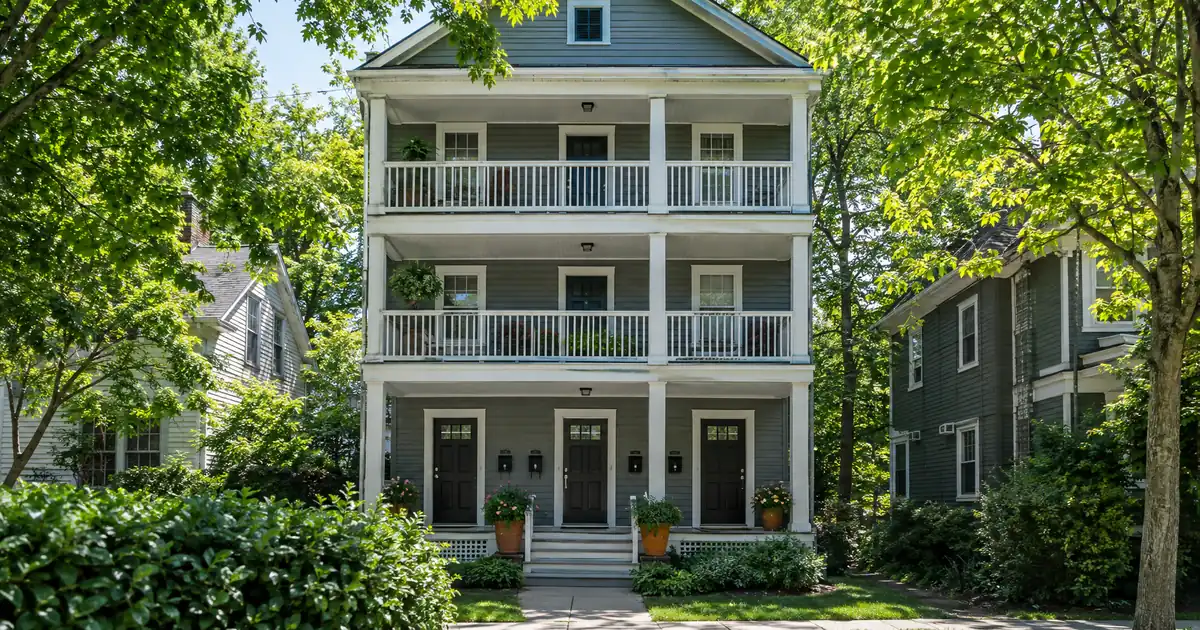
The Quick Read: FHA tends to fit buyers who want the smallest cash investment or who have a thinner credit profile. Conventional tends to fit buyers with stronger credit who want mortgage insurance that can eventually end. Both require you to live in one unit. The deciding factors are your credit, your cash, how long you plan to hold the loan, and, on three- and four-unit buildings, whether the property passes FHA’s rental-income test.
Buying a duplex, triplex, or fourplex and living in one unit is a different loan problem from buying a single-family home. The building’s rent can help you qualify, the appraisal looks at the whole property, and each loan type treats those facts differently. This article walks through where the two paths split and which borrower tends to land on each side. Every program figure here is subject to lender guidelines and full file review, and none of it is a commitment to lend.
FHA payment estimate
Starting assumptions reflect an example price and the FHA minimum investment. Replace them with your own figures.
Editable benchmark: 7.32% as of October 22, 2026 · Freddie Mac 30-year average via FRED®. A conventional market reference, not an FHA loan quote.
Illustrative starting assumptions: a $350,000 price, the FHA minimum investment as the down payment, a thirty-year term at the current Freddie Mac benchmark, and property taxes and insurance estimated at typical national rates. Every field is editable.
Illustrative estimate only — not a Loan Estimate, approval, quote, or commitment to lend. The rate field carries the weekly Freddie Mac thirty-year conventional benchmark, a market reference and not an FHA loan quote; your rate is set by the lender at lock. FHA mortgage insurance follows HUD’s published schedule for the term, leverage and loan size entered; taxes, insurance and dues are editable estimates; closing costs are not included; county loan limits are not checked here. Licensed in sixteen states for consumer mortgages. Lendmire is not affiliated with or acting on behalf of FHA, HUD, or the federal government.
Side-by-Side
| Factor | FHA | Conventional |
|---|---|---|
| Maximum financing (purchase) | 96.5% | Up to 95% on automated approvals |
| Minimum investment | 3.5% | Varies by approval type |
| Credit floor | 580 decision score | Typically higher |
| Mortgage insurance | Upfront plus annual | Private, can be cancelled |
| Occupancy | Live in one unit | Live in one unit |
| Rental income | Counts on 2-4 units, discounted | Other units can count, documented |
| Extra test | Self-sufficiency on 3-4 units | None of that kind |
| Documentation | Appraisal rent schedule | Appraisal rent schedule |
Two notes on the table. The FHA figures reflect the wholesale programs Lendmire places FHA loans with, which start at a 580 decision score. HUD’s own rules reach lower, but those programs do not. The conventional figures come from Fannie Mae’s Eligibility Matrix, which lists a 95% ceiling for 2-4 unit principal-residence purchases. That matrix changes often, so treat the number as the top of a range.
What Both Loans Share
Both loans require you to occupy one unit as your principal residence. That is the line separating an owner-occupied multi-unit loan from an investment-property loan, and it is why the leverage is so much higher than a landlord without a unit would get. Both also use a small residential income property appraisal, which reports what each unit would rent for in the market.
That appraised rent matters more than the listing or the seller’s claims. Whatever the seller says tenants pay, the lender works from the appraiser’s market rent and, where available, the actual leases.
One more shared point: the loans cover one to four units. A building with five or more units moves into commercial lending, which is a different world from either of these.
How FHA Handles a 2-4 Unit Purchase
The headline FHA figure is 96.5% maximum financing, which means a 3.5% minimum investment at a decision score of 580 or higher. Across the wholesale programs Lendmire works with, 580 is where FHA files begin. A non-occupant co-borrower is allowed, and seller or interested-party contributions can run to 6% of the price. On a multi-unit purchase, that combination can make the cash needed to get in unusually low.
The cost of that low entry is mortgage insurance. FHA charges an upfront premium of 1.75% of the base loan, which is typically financed into the loan. It also charges an annual premium that ranges from 0.15% to 0.75% of the balance, depending on term, loan amount, and LTV. On a thirty-year loan above 90% LTV, the annual premium lasts for the full term. At or below 90% LTV, it ends after eleven years. A state attorney general’s PMI fact sheet confirms that FHA insurance is paid to FHA and cannot be cancelled by paying principal down faster.
Ratios are the other piece. The base pair is 31/43 (housing and total debt to income) with no compensating factors. With documented compensating factors, ratios can reach 40/50 at the top tier, and the automated finding governs most files.
County loan limits apply, and they change every year. Two- to four-unit limits are higher than one-unit limits, but they vary by county, so a buyer in a high-cost area should check the county figure before shopping.
How FHA counts the rent
HUD allows rental income from a 2-4 unit subject property to count as qualifying income. Under HUD Mortgagee Letter 2023-17, the lender documents rent with the appraiser’s rent schedule, plus leases if they exist. The standard calculation uses 75% of the lesser of the appraiser’s market rent or the lease rent. The 25% haircut is meant to cover vacancy and upkeep.
The three- and four-unit test
On three- and four-unit properties, FHA adds a self-sufficiency test. In plain terms, the building’s net rent has to cover the full housing payment on its own, even counting the unit you live in. HUD’s Handbook 4000.1 is the governing source for the exact formula, and the lender completes the paperwork. Two-unit properties are not subject to it.
Here’s the catch. A fourplex can look like a bargain, then fail the test because appraised rents come in low against the payment. That tends to happen in higher-priced areas. A duplex avoids the issue entirely, which is one reason duplexes are the most common starting point for owner-occupants.
When FHA Is the Better Fit
FHA tends to be the stronger choice in four situations.
Limited cash. If your savings are the binding constraint, a 3.5% minimum investment plus the option of seller contributions can be the difference between buying and waiting. Conventional at the highest leverage exists too, but it depends on a clean automated approval.
Credit that’s good but not great. A 580 decision score opens the FHA door. Conventional pricing and mortgage insurance tend to punish middling credit more heavily, though that varies by lender and file.
A duplex with solid appraised rents. The rent can help the file, and there’s no self-sufficiency test to clear.
A plan to hold the loan for a long time at a lower-balance, smaller-cash strategy. If you expect to keep the home for years and accept that the annual premium may last the term, FHA’s entry cost can still make sense. The calculation changes if you plan to refinance later.
Think about it this way: FHA trades a cheaper entry for a stickier insurance cost. For a buyer who simply cannot reach the conventional down payment, that is a fair trade. For a buyer who can, it deserves a harder look.
When Conventional Is the Better Fit
Conventional tends to win in these situations.
Stronger credit and a bit more cash. When your credit profile is solid, private mortgage insurance on a conventional loan is often easier to live with. Under the Homeowners Protection Act, as the CFPB explains, the lender must end PMI the month after the loan reaches the midpoint of its amortization schedule if you’re current. That protection covers private mortgage insurance, not FHA premiums.
A three- or four-unit building that fails FHA’s test. Conventional has no self-sufficiency test of that kind, so a property with soft appraised rents can still work. This is conventional’s single biggest structural advantage on larger buildings.
A high-cost area where the FHA county limit is a constraint. Because FHA limits are county-based, a pricey building may press against the ceiling. Conventional conforming limits are set differently, so it’s worth comparing both.
A plan to avoid permanent insurance. If you don’t want a premium that could last the term of the loan, a conventional loan with cancellable PMI is the cleaner path.
The fine print on 95%
The 95% ceiling is not automatic. It applies to loans that run through Fannie Mae’s automated underwriting. Fannie Mae’s HomeReady matrix shows manually underwritten loans capped at 85% on two units and 75% on three or four. So a conventional buyer whose file needs manual review may face a much larger down payment than the headline suggests. Lender overlays can also be stricter than either program’s published minimum.
Fannie Mae’s Selling Guide treats 2-4 unit principal residences as eligible for subject-property rental income. The exact percentage and documentation rules sit in that guide, and a lender can walk you through how they apply to your file.
Edge Cases Worth Knowing
A few situations trip up buyers late in the process.
- ADUs and boarders. An accessory unit on a one-unit home does not turn it into a two-unit property for FHA purposes. HUD also revised boarder-income documentation in Mortgagee Letter 2025-04.
- Commercial space. If a building has a storefront, FHA does not count income from the commercial space in rental income.
- Repairs. A property needing work may fit FHA’s rehabilitation variation, known as 203(k), which rolls repair costs into the loan.
- Moving out later. Both loans assume you will live there when you close. Plans change, but misrepresenting your intent at application is a serious problem. Talk through your real timeline with your loan officer up front.
- Refinancing later. Some buyers start on FHA with the plan of refinancing into conventional once equity builds and insurance becomes the larger cost. That can work, though the result depends on your credit, the building’s value, and the program rules at the time. It is not guaranteed.
Which Loan Matches Which Buyer
| Buyer profile | Usually leans toward |
|---|---|
| Thin savings, decent credit | FHA |
| Strong credit, solid savings | Conventional |
| Duplex with good rents | Either, compare insurance |
| Fourplex, soft appraised rents | Conventional |
| Credit near the 580 line | FHA |
| Wants insurance to end | Conventional |
This is a lean, not a verdict. A buyer with strong credit and thin cash may still prefer FHA, and a buyer with modest credit and plenty of cash might find conventional costs less over time. Honestly, the two loans are closer than most advice suggests. The right pick usually shows up only when you run your actual file through both.
Key Terms Defined
Self-sufficiency test: An FHA check on three- and four-unit properties that asks whether net rent can cover the full housing payment.
Mortgage insurance premium (MIP): FHA’s insurance, charged upfront and annually, paid to FHA and not cancellable by paying down faster.
Private mortgage insurance (PMI): Insurance on conventional loans with less than 20% down, which can be cancelled under federal rules.
Automated underwriting: A system that scores the file; on conventional loans it unlocks the highest leverage on 2-4 units.
Compensating factors: Documented strengths, such as reserves or a strong payment history, that allow higher debt ratios.
Principal residence: The home you live in, which is the occupancy both loans require.
Practical Steps Before You Make an Offer
1. Decide how long you realistically expect to hold the loan and live in the building.
2. Get a pre-approval that names the property type, so the lender can treat rental income correctly.
3. On a three- or four-unit building, ask how the self-sufficiency test will be run before you fall in love with the property.
4. Compare the same building under both loans, looking at cash needed, mortgage insurance structure, and how long the insurance lasts.
5. Check the county loan limit if the building is expensive for its area.
Frequently Asked Questions
Can I use FHA on a fourplex?
Yes, FHA insures one- to four-unit principal residences. A fourplex has an extra hurdle, though: the self-sufficiency test, which asks whether net rent covers the housing payment. Properties with low appraised rents often struggle with it.
Does FHA mortgage insurance ever go away?
It depends on the loan. On a thirty-year loan above 90% LTV, the annual premium lasts for the term. Paying principal down faster does not cancel it, which is the main contrast with cancellable conventional PMI. Final terms depend on the lender’s guidelines, the property type, and the borrower’s complete credit picture.
How much of the rent counts toward qualifying?
Under FHA, the standard calculation uses 75% of the lesser of the appraiser’s market rent or the lease rent. Conventional rules also allow rent from the other units, with documentation. The appraiser’s market rent, not the listing, drives the number.
Is 95% conventional financing always available on a duplex?
No. That ceiling applies to loans approved through Fannie Mae’s automated underwriting. Manual underwriting caps two-unit loans at 85% and three- to four-unit loans at 75%, and a lender’s own overlays can be stricter still.
Can I buy with a co-borrower who won’t live there?
On FHA, a non-occupant co-borrower is allowed. That can help a household qualify, though the occupying borrower still has to live in the property as a principal residence.
Where This Leaves You
If cash is tight or credit sits near the line, FHA is often the practical way into a multi-unit building, with the understanding that its insurance stays longer. If your credit is strong and you can put more down, conventional usually gives you insurance that can end, plus a way around the three- and four-unit rental test. If you are buying a home and want to see whether FHA loan programs fit your file, Lendmire can help you compare the options and what each one asks of the file.
For buyers thinking past the purchase, Lendmire’s piece FHA vs Conventional Cash-Out When You Live in a 2-4 Unit Primary Home covers what changes once you own the building and want to tap equity.
For your own numbers, request a scenario review with Lendmire.
About Lendmire
Lendmire — NMLS# 2371349 — is a mortgage broker that arranges FHA, VA, conventional and jumbo home purchase and refinance financing in 16 states through wholesale lenders. Every option is subject to the lender’s guidelines and full underwriting. Scotsman Guide named Lendmire a Top Mortgage Workplace in both 2025 and 2026.
Get Started
Ready to find the right loan for you?
In about 30 seconds you can review financing options available for your home or investment property. No commitment required.
Informational only. Not a Loan Estimate, approval, or commitment to lend. Program availability and eligibility are subject to lender guidelines, credit approval, property review, and underwriting.
References
1. Fannie Mae Eligibility Matrix
3. HUD Mortgagee Letter 2023-17
4. HUD Single Family Housing Policy Handbook 4000.1
5. CFPB: When can I remove PMI?
6. Fannie Mae HomeReady Matrix
This article is part of Lendmire’s FHA loan program — full qualification details, guidelines, and scenarios live on the program page.
Related reading: How Many Weeks a VA Cash-Out Takes From a Conventional or FHA Loan · How Much FHA Cash-Out Costs vs Conventional on a 2-4 Unit Primary Home · Can a Homeowner With an FHA Loan Use an FHA Cash-Out for Any Purpose?
Brandon Miller
Founder & CEO, Mortgage Loan Originator, Lendmire LLC
- Mortgage Loan Originator · NMLS# 1129696 · Verify on NMLS Consumer Access
- North Carolina Real Estate Broker · License# 343312 · Verify on NCREC
- North Carolina Insurance Producer · License# 19053198 · Property, Casualty, Life, Health · Verify on NAIC SBS
- Lendmire LLC · Firm NMLS# 2371349 · Verify firm licensure
Disclosures. The information presented in this article is general market commentary, not financial, legal, or tax advice. Lendmire is a mortgage brokerage (NMLS# 2371349) — not a direct lender or depository institution — and loan placement is subject to lender underwriting. Nothing in this content represents a commitment to lend. Loan terms, pricing, and program availability vary based on borrower qualifications, property characteristics, and state of subject property, and are subject to change at any time. Lendmire complies with Equal Housing Opportunity requirements. Consumer access: nmlsconsumeraccess.org.