
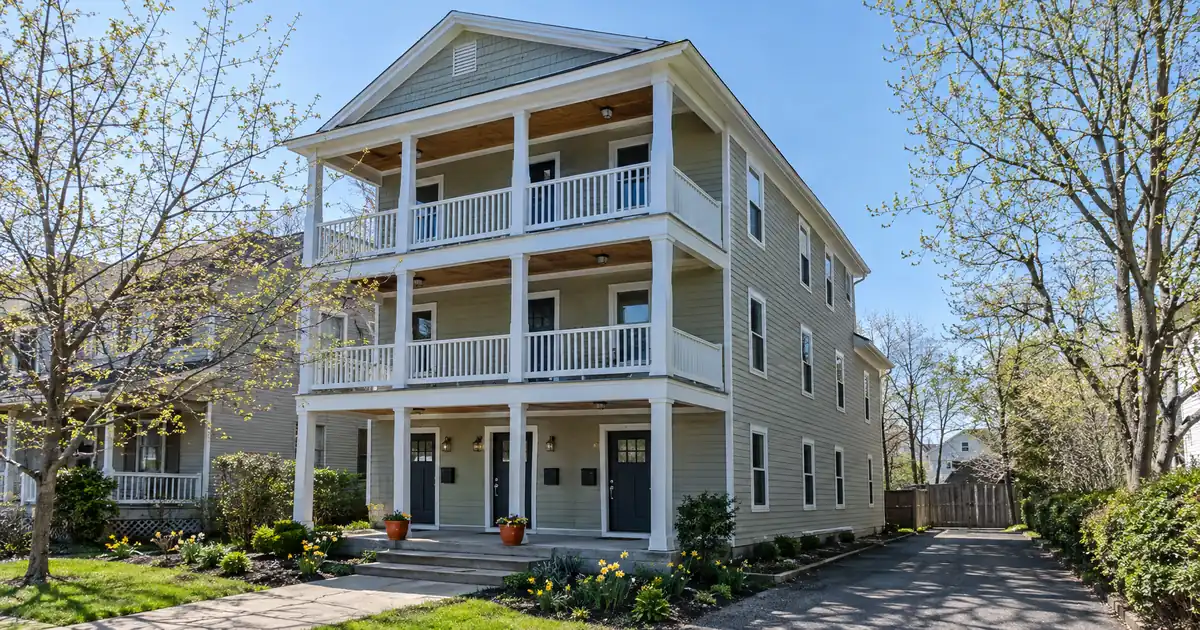
The Quick Read: Often yes, but only if the whole file passes the automated underwriting run. Most conventional files can go up to a 50% total ratio, and a 2-4 unit can help because part of the rent from the units you don’t live in can count as income. It is not a free pass. Credit, reserves, leverage, and the appraiser’s rent figure all decide the outcome.
What Does “Near the DTI Ceiling” Actually Mean?
Debt-to-income ratio (DTI) is your total monthly debts divided by your gross monthly income. The debts include the new housing payment: principal, interest, taxes, insurance, and any HOA dues (together called PITIA). If you earn 10 units of income and owe 5 units of debt, you sit at 50%.
Conventional payment estimate
The starting figures are an example price at the first-time buyer’s minimum down payment. Replace them with yours.
Editable benchmark: 7.32% as of October 22, 2026 · Freddie Mac 30-year average via FRED®. A conventional market reference, not a conventional loan quote.
Estimate seeded at the low end of Fannie Mae’s published range (0.58%–1.86% a year); the insurer prices the actual premium on the score and the leverage. Applies only above 80% loan-to-value.
Illustrative starting assumptions: a $350,000 price, the first-time buyer’s minimum down payment, a thirty-year term at the current Freddie Mac benchmark, mortgage insurance at the low end of Fannie Mae’s published range, and property taxes and insurance estimated at typical national rates. Every field is editable.
Illustrative estimate only — not a Loan Estimate, approval, quote, or commitment to lend. The rate field carries the weekly Freddie Mac thirty-year conventional benchmark, a market reference and not a conventional loan quote; your rate is set by the lender at lock. The mortgage insurance figure is an editable estimate seeded from Fannie Mae’s published typical range, not a premium quote; the insurer prices the actual premium, and the cancellation month assumes scheduled payments with no extra principal and no change in value. Taxes, insurance and dues are editable estimates; closing costs are not included. Conforming loan limits apply by county. Licensed in sixteen states for consumer mortgages.
On a conventional loan, the ceiling depends on how the file is underwritten. Across the wholesale programs Lendmire places files with, the automated finding governs most files, with a total ratio ceiling of 50%. The Fannie Mae Selling Guide sets that same maximum for loans run through its automated system, Desktop Underwriter (DU).
Manual underwriting is stricter. The base limit is 36%. It can stretch to 45% only when you meet the credit score and reserve factors in the agency’s Eligibility Matrix. So a buyer at 48% has exactly one path: an automated approval.
| Underwriting path | Total ratio limit | What it takes |
|---|---|---|
| Automated (DU) | Up to 50% | Approve/Eligible finding on the whole file |
| Manual, standard | 36% | Baseline manual file |
| Manual, stretched | 45% | Score and reserve factors met |
Why Is a 2-4 Unit Different From a Single-Family Home?
A 2-4 unit lets you use rent as income, and a one-unit home generally does not. You live in one unit and rent the others. The lender can count a share of the projected rent from the other units toward your qualifying income.
Here is the catch most buyers miss. The rent is added to your income. It is not subtracted from your payment. The full PITIA stays in your monthly obligations, as the Selling Guide’s rental income rules lay out. The benefit is the income add, not a payment offset.
The unit you live in earns nothing on paper. Rent from the occupied unit is generally not usable. The other units are a different story: Freddie Mac’s Guide Section 5306.1 also allows rent from a 2-4 unit primary residence to be used in qualifying.
Occupancy matters a great deal. A 2-4 unit you live in can go to 95% leverage on a purchase. Bought as an investment instead, the same building is limited to 75% on two to four units. Live in it, and the leverage and the rent rules both improve. Skip the occupancy, and you are in a different loan entirely. Final terms depend on the lender’s guidelines, the property type, and the borrower’s complete credit picture.
How Much of the Rent Counts?
Not all of it. Lenders discount projected rent to cover vacancy and upkeep. Freddie Mac applies 75% of gross rent for that reason, and Fannie Mae’s DU job aid uses 75% as its default formula for properties other than the subject. The exact method for an owner-occupied 2-4 unit varies by program and lender, so think of it as “a discount for vacancy and upkeep” rather than a fixed rule.
Two more conditions can limit the amount:
- Documentation. The appraiser reports market rent on a rent schedule inside a small residential income property appraisal (Fannie Mae uses Form 1025). Leases can supplement that figure, but the appraisal has to support the income on the lease.
- Housing and management history. Fannie Mae ties full use of rental income to the borrower having a primary housing expense and at least one year of property-management experience. Otherwise the credit can be limited. For a first-time house-hacker who rents today, the lease or rent history typically documents the housing expense.
Rent you count at qualification is a projection. If a unit sits empty, your household still carries the full payment. Budget for that before you push your ratio to the edge.
Three Scenarios Near the Ceiling
These use ratios only, with modeled assumptions, not market data.
Scenario one: the pass. Picture a buyer at 53% DTI on salary alone for a duplex purchase. After adding the discounted rent from the second unit to income, the ratio falls into the high 40s. Credit is solid and reserves are present. DU returns Approve/Eligible. This is the case rental income was built for.
Scenario two: still over. Say you own a triplex target at 55% on salary alone. Even after the rental credit, the ratio lands around 51%. That is above the 50% ceiling, so DU will not approve it. The fix is on the debt or income side, covered below.
Scenario three: the rent is smaller than hoped. Run the numbers on a fourplex where the appraiser’s market rent comes in under what the seller advertised. The counted rent shrinks, and the ratio barely moves. A ratio that cleared on the seller’s rent figure can fail on the appraiser’s. It is generally safer to qualify on the lower number, subject to lender guidelines.
What Moves You If You’re Still Too Close?
Work through these levers roughly in this order. The first ones cost the least.
1. Pay off installment debt. Clearing a car loan or personal loan removes its payment from the ratio entirely. Credit cards that carry a balance count too.
2. Add a qualifying co-borrower. More income can help, but a non-occupant co-borrower brings stricter limits on manual files.
3. Put more down. A larger down payment shrinks the loan, and so the payment. It also reduces mortgage insurance.
4. Choose a lower price or fewer units. A duplex carries a smaller payment than a fourplex, though it gives you less rent to count.
5. Strengthen credit and reserves. DU weighs DTI against the rest of the file. A stronger score and more cash in the bank can tip a borderline finding to Approve.
Do not open new credit while you shop. If a new debt appears before closing and the recalculated ratio exceeds 50% on a DU file, the loan is not eligible for delivery. An approval at 49% is not final until the loan closes.
What Do Leverage, Credit, and Reserves Look Like?
On a purchase, a two- to four-unit principal residence can reach 95% LTV (5% down), per the Fannie Mae Eligibility Matrix. That is loan-to-value (LTV), the loan balance as a percentage of the home’s value. The 97% option is for one-unit homes with a first-time buyer, so it does not apply here. Some high-balance 2-4 unit loans carry lower limits, so ask. Each figure is subject to lender guidelines and a complete review of property type, leverage, and credit.
Mortgage insurance is required above 80% LTV. You can request cancellation at 80% of the original value with a good payment history, and the servicer must end it automatically at 78%. Leverage, reserves, and pricing vary by lender and program; the final terms follow the full file review.
The wholesale conventional programs start at a 620 decision score. Many files near the ceiling need more than the floor, because DU stacks risks. A high ratio plus thin credit plus low cash rarely clears.
Reserves are the other piece. Fannie Mae requires no minimum reserves on a one-unit primary residence. A 2-4 unit gets no such exemption, and DU may require some months of housing payments depending on its overall read. Plan on having cash left after closing, not just enough to close.
What If DU Says Refer?
A Refer finding means the automated system did not approve the file as submitted. At a high ratio, manual underwriting is rarely a rescue, since it caps at 45% and demands strong score and reserve factors. If you are above 45%, only DU can approve you.
Your realistic moves are to fix the file and rerun it: lower the debts, raise the down payment, add reserves, or restructure the purchase. A broker can rerun scenarios against different wholesale lenders, because each lender’s overlays differ. Some set tighter limits than the agency maximum.
Staying Conventional or Switching Programs?
Occupancy decides leverage and rent treatment, so this is a home-buyer question first. If the conventional file will not clear, government-backed loans are another route to compare, with different ratio rules and mortgage insurance structures. They carry their own tradeoffs, so compare the full terms, not just the ratio. Related reading: Lendmire’s piece Conventional Cash-Out Refinance DTI on a 2-4 Unit Primary Home covers the refinance side.
Key Terms Defined
DTI (debt-to-income ratio): Your total monthly debts, including the new housing payment, divided by your gross monthly income.
PITIA: Principal, interest, taxes, insurance, and any HOA dues. The full amount counts as a debt.
DU (Desktop Underwriter): Fannie Mae’s automated system that scores the whole file and returns a recommendation.
Approve/Eligible: The automated finding that lets a file proceed at a higher ratio.
LTV: The loan amount as a percentage of the home’s value.
Risk layering: Stacking several risk factors, such as high DTI, thin reserves, and low credit, so each one counts more.
Principal residence: The home you occupy. In a 2-4 unit, it is the unit you live in.
Pre-Application Checklist
Gather these before you talk to a loan officer:
- Pay stubs, W-2s, and traditional personal-income documentation, as the file requires.
- Statements for every debt, with balances and payments.
- Bank statements for down payment and reserves.
- Your current lease or rent history if you rent today.
- Any evidence of property-management experience.
- The listing’s rent roll or leases, knowing the appraiser’s figure will govern.
Frequently Asked Questions
Can rent from the other units get me under the DTI limit?
Often, yes. A discounted share of projected rent is added to your income, which lowers your ratio. The full payment still counts as a debt. The appraiser’s rent figure, your housing history, and the automated finding all decide whether it is enough. All of this is subject to lender guidelines and full file review.
Is the maximum DTI really 43%?
No. The 43% hard cap was a General QM rule that the CFPB replaced with a price-based test. Conventional delivery limits still govern, and those allow up to 50% on an automated approval.
Do I need 25% down on a duplex, triplex, or fourplex?
No. A principal-residence purchase of two to four units can go to 95% LTV, or 5% down. Mortgage insurance applies above 80% LTV. Investment purchases are different, with much lower leverage limits. Terms vary by lender guidelines, property type, leverage, credit profile, and full file review.
Does the unit I live in count as rent?
No. Rent from the unit you occupy is generally not usable. Only the other units’ projected rent can be counted, after the vacancy and upkeep discount.
Does hitting 50% mean I’m approved?
No. 50% is a ceiling, not a guarantee. DU weighs the ratio against credit, reserves, and leverage. A new debt before closing can also force a rerun and an ineligible result.
If you are buying a home and want to see whether a conventional loan fits your file, Lendmire can help you compare the options and what each one asks of the file. Explore Lendmire’s conventional loan programs to start.
For your own numbers, request a scenario review with Lendmire.
About Lendmire
Lendmire, NMLS# 2371349, is a mortgage brokerage with consumer lending licenses in 16 states. FHA, VA, conventional and jumbo purchase and refinance loans are arranged through wholesale lending partners, and each application is reviewed individually by the lender. Scotsman Guide named Lendmire a Top Mortgage Workplace in both 2025 and 2026.
Get Started
Ready to find the right loan for you?
In about 30 seconds you can review financing options available for your home or investment property. No commitment required.
Informational only. Not a Loan Estimate, approval, or commitment to lend. Program availability and eligibility are subject to lender guidelines, credit approval, property review, and underwriting.
References
1. Fannie Mae Selling Guide B3-6-02, Debt-to-Income Ratios
2. Fannie Mae Selling Guide B3-3.8-01, General Rental Income Information
3. Freddie Mac Guide Section 5306.1
4. Fannie Mae Eligibility Matrix
5. CFPB, General QM final rule press release
This article is part of Lendmire’s conventional loan program — full qualification details, guidelines, and scenarios live on the program page.
Related reading: Conventional Loan Requirements for a House Hacker Buying a 2–4 Unit · Can a First-Time Buyer Use a Co-Signer on a Conventional Loan? · Can You Buy a 2-4 Unit With Little Down on a Conventional Loan?
Brandon Miller
Founder & CEO, Mortgage Loan Originator, Lendmire LLC
- Mortgage Loan Originator · NMLS# 1129696 · Verify on NMLS Consumer Access
- North Carolina Real Estate Broker · License# 343312 · Verify on NCREC
- North Carolina Insurance Producer · License# 19053198 · Property, Casualty, Life, Health · Verify on NAIC SBS
- Lendmire LLC · Firm NMLS# 2371349 · Verify firm licensure
Legal disclosures. Lendmire (NMLS# 2371349) is a state-licensed mortgage brokerage that arranges financing through wholesale lender relationships. Lendmire is not a direct lender, depository institution, or registered financial advisor. The discussion above is general informational content about real estate financing — it is not financial, legal, or tax advice, and readers should consult licensed professionals for guidance on their individual circumstances. Loan inquiries are subject to lender underwriting; this article does not represent a commitment to lend. Loan terms, rates, and qualification standards vary by borrower, property, and state, and are subject to change at any time. Equal Housing Opportunity. NMLS Consumer Access: nmlsconsumeraccess.org.