
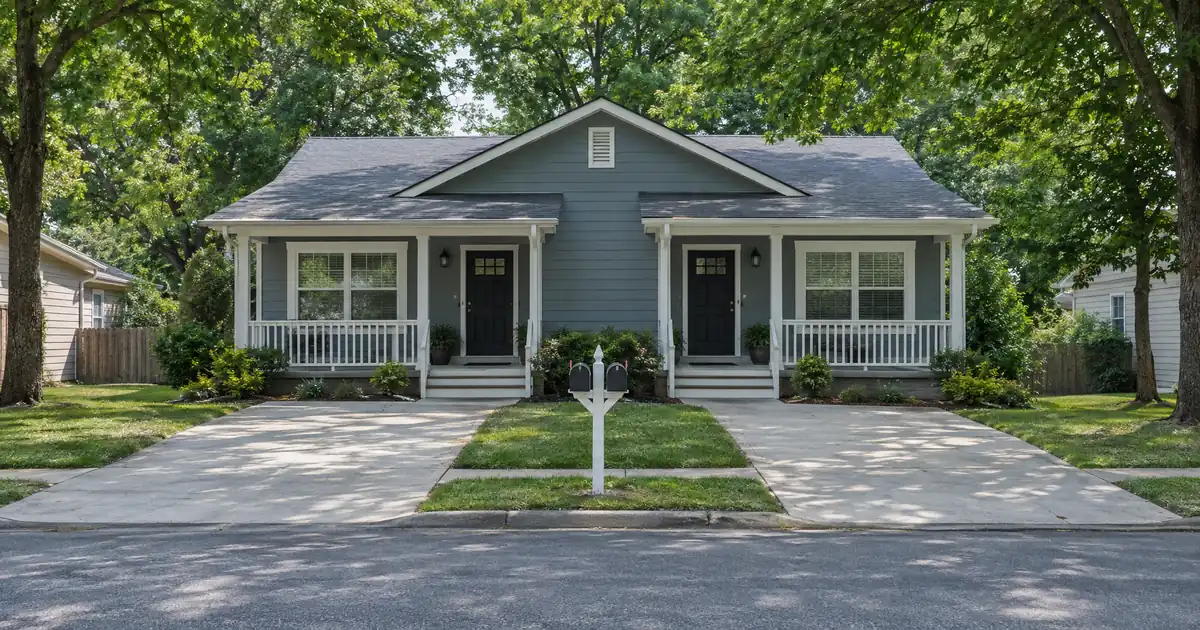
The Quick Read: Let your credit score and your debt-to-income ratio (DTI) pick the loan, then test the building itself. FHA tends to fit a mid-range score, a heavier debt load and a small down payment, with financing up to 96.5%. Conventional tends to fit stronger credit and a lighter DTI, mostly because its mortgage insurance can come off later. Plenty of buyers qualify for both, and for them the call comes down to how long they will keep the loan.
Key Takeaways
- Both loans finance an owner-occupied duplex, triplex or fourplex. You must live in one unit.
- FHA scores the file on the lowest score among all borrowers. A co-borrower with weaker credit can pull the whole file down.
- FHA’s base ratios are 31/43, and documented compensating factors can push them to 40/50 at the top tier.
- Three- and four-unit FHA deals add a test that two-unit deals skip. The building’s own rent has to carry the payment.
- FHA mortgage insurance on a high-leverage loan lasts for the term. Conventional insurance can usually be cancelled.
Same Building, Two Loans: What Actually Differs
The two loans differ on four points: how they score credit, how they stretch DTI, how they treat the other units’ rent, and how long mortgage insurance lasts. Everything else is similar. Both require owner-occupancy, and both finance one to four units.
FHA payment estimate
Starting assumptions reflect an example price and the FHA minimum investment. Replace them with your own figures.
Editable benchmark: 7.32% as of October 22, 2026 · Freddie Mac 30-year average via FRED®. A conventional market reference, not an FHA loan quote.
Illustrative starting assumptions: a $350,000 price, the FHA minimum investment as the down payment, a thirty-year term at the current Freddie Mac benchmark, and property taxes and insurance estimated at typical national rates. Every field is editable.
Illustrative estimate only — not a Loan Estimate, approval, quote, or commitment to lend. The rate field carries the weekly Freddie Mac thirty-year conventional benchmark, a market reference and not an FHA loan quote; your rate is set by the lender at lock. FHA mortgage insurance follows HUD’s published schedule for the term, leverage and loan size entered; taxes, insurance and dues are editable estimates; closing costs are not included; county loan limits are not checked here. Licensed in sixteen states for consumer mortgages. Lendmire is not affiliated with or acting on behalf of FHA, HUD, or the federal government.
Across the wholesale programs Lendmire places files with, FHA loan programs start at a 580 decision score. At that score and above, the minimum investment is 3.5% and maximum financing is 96.5%. A non-occupant co-borrower is allowed, and seller or interested-party contributions can reach 6% of the price. Conventional loans on 2-4 units generally ask for more down than that, though the exact leverage depends on the loan type and the file.
| Factor | FHA | Conventional |
|---|---|---|
| Credit measure | Lowest score of any borrower | Overall risk review |
| Minimum investment | 3.5% from a 580 score | Higher, varies by file |
| Mortgage insurance | Upfront plus annual | Monthly, score-sensitive |
| Insurance removal | Lasts term at high LTV | Cancellable |
| 3-4 unit property test | Yes, self-sufficiency | No equivalent |
How Does Your Credit Score Steer the Choice?
A score in the 580s to low 700s usually points toward FHA, and a score well above that usually points toward conventional. The reason is how each loan prices risk. FHA mortgage insurance is a set program fact. Conventional insurance moves with your score and your down payment.
FHA looks at the lowest score among all borrowers. Picture a couple buying a duplex where one has strong credit and one has thin credit. The FHA file runs on the thin one. A conventional file runs through an automated review that weighs the whole picture rather than one number. Fannie Mae dropped its hard minimum score for files run through its automated system, so weaker-credit buyers should test both paths. Individual lenders still set their own higher floors, called overlays, so the answer varies by lender.
Expect HUD to keep changing which score models lenders may use. HUD’s Mortgagee Letter 2026-11 opens the door to newer models. Ask your loan officer which model applies to your file.
How Does DTI Steer the Choice?
DTI is where FHA often has the edge for buyers carrying a lot of debt. Your DTI is your monthly debts, including the new housing payment, divided by your gross monthly income. FHA’s base pair is 31/43, housing over total. Documented compensating factors can lift that toward 40/50 at the top tier. Compensating factors include cash reserves, a stable job history and a small payment increase over current rent. The automated finding governs most files.
Conventional works differently. Fannie Mae’s Selling Guide separates manual underwriting from automated underwriting. The automated path allows the highest ratios. The manual path sets a noticeably lower ceiling, and it stretches only with a stronger score and reserves. That guide also states that government loans follow their own agency’s rules, so conventional ratios do not carry over to FHA.
Here’s the catch. Published DTI limits conflict across the internet because writers mix the manual and automated numbers. Ask which path your file is on.
The Credit × DTI Grid
Read the grid by finding your row, then treat the answer as a starting point. It reflects how files tend to sort, not a promise of approval.
| Your profile | Usually fits better | Why |
|---|---|---|
| Strong credit, low DTI | Conventional | Cancellable insurance |
| Strong credit, high DTI | Test both | Automated review may stretch |
| Mid credit, low DTI | Test both | Compare insurance cost |
| Mid credit, high DTI | FHA | Wider ratios, fixed premium |
| Score near 580 | FHA | Wholesale conventional options narrow |
The flip points matter more than the rows. A score bump can move you up a row. So can paying off a car loan or a card balance that trims DTI. A smaller loan amount, a bigger down payment, or removing a weak-credit co-borrower can also change which loan wins.
How Does Rent From the Other Units Change Your DTI?
Both loans can count part of the other units’ rent, but neither counts the unit you live in. Treat rent as a partial offset, not a full credit. Lenders haircut it to allow for vacancy and upkeep.
On conventional files, the appraiser documents each unit’s market rent on a rental form. The lender reports gross rent for every unit even when it doesn’t use the rent to qualify. Fannie Mae’s rental income rules generally disallow rent from the unit you occupy. Freddie Mac applies a percentage of gross rent to cover vacancy and costs. FHA calculates its own figure under its handbook.
Run a modeled example in words. A buyer’s DTI looks too high when only salary is counted as income and the full housing payment sits in the obligations. Once a portion of the rented units’ income is counted, the ratio drops into the range the automated review accepts. Rental-income rules differ by program, so run both loans. The same building can produce two different DTIs.
Triplex and Fourplex: The FHA Rent Test
On three and four units, FHA adds a self-sufficiency test: the property’s own adjusted rent has to cover the full housing payment. Duplexes skip it.
The test looks at the building, not at your paycheck. A buyer with strong income can still be turned down if the appraised rents come in low. HUD’s Handbook 4000.1 is the policy source for the test, and it also covers reserve requirements on three- and four-unit files. Plan for post-closing reserves on those deals. Terms depend on the lender’s guidelines, the property type, the leverage, and a full review of the credit profile.
If a fourplex fails, you have fixes:
- Look at a duplex instead.
- Put more money down to shrink the payment.
- Add a co-borrower with stronger income or credit.
- Pay off debts that weigh on DTI.
- Try conventional, which has no equivalent building test.
Conventional brings its own limits, mainly the higher cash it asks and a stricter reading of your score and DTI. Not ideal for every buyer. Still, it removes the rent-test risk.
Mortgage Insurance and the Long Game
FHA costs less to enter and more to keep; conventional costs more to enter and can be cheaper to keep. FHA charges an upfront premium of 1.75% of the base loan, which is typically financed. It also charges an annual premium between 0.15% and 0.75% of the balance, depending on term, loan amount and LTV. On a thirty-year loan above 90% LTV, the annual premium lasts for the term. At or below 90% LTV it ends after eleven years. At 96.5% financing, you are in the first group.
Conventional private mortgage insurance has no upfront FHA-style premium unless you choose a single-premium option. It depends on score and LTV, and it can be cancelled once you build enough equity. The tradeoff is simple. If you will keep the loan for many years and your credit is strong, conventional often wins on lifetime cost. If you may sell or refinance within a few years, FHA’s smaller entry cost can win.
One practitioner pattern worth knowing: buyers with a score near the top of FHA’s range often assume FHA is cheaper. Once they price conventional insurance for their actual score, the gap is smaller than they expected, and sometimes it flips. Compare both Loan Estimates side by side before deciding.
Loan Limits, Appraisal and Reserves
County loan limits apply to FHA, and they cap the loan amount rather than the price. HUD sets them each year between a floor and a ceiling tied to the national conforming limit, with higher limits for more units. Mortgagee Letter 2025-23 explains how the floor and ceiling work. In high-cost counties, a pricier building can push you toward conventional or a high-balance product.
On the conventional side, Fannie Mae’s Eligibility Matrix sets maximum leverage for 2-4 unit principal residences, and the numbers differ by loan purpose. Check the live matrix. The appraisal matters on both: it supplies unit-level rent and condition data. FHA also holds the property to its own condition standards, so a building with safety issues may need repairs before it qualifies.
If you are a veteran weighing a third path, Lendmire’s piece Should a Veteran House Hacking a 2-4 Unit Choose FHA Over a VA Loan? covers that tradeoff.
If You’re on the Borderline
Borderline buyers qualify for both loans, so the deciding variable is time. Ask three questions. How long will you keep this loan? How sensitive is your conventional insurance to your score? And could you refinance out of FHA later?
An FHA loan can be refinanced into a conventional loan once your score and equity improve, which is the usual exit from FHA insurance. That plan has a risk. It depends on equity and on the market when you decide to move. If you would rather not count on it, a conventional loan with cancellable insurance may be the cleaner choice, provided you can meet its higher cash requirement.
A buyer whose DTI is already tight might read the high-DTI path through Lendmire’s article on whether a 2–4 unit buyer with a high DTI can qualify for an FHA loan.
Before You Talk to a Lender
Gather a short list first:
1. Your score from each borrower, and a plan for any weak one.
2. A tally of monthly debts: cards, auto, student loans and any other payment.
3. Two years of income documentation.
4. Cash for the down payment, reserves and closing costs.
5. The building’s current rents or leases.
Compute your own DTI before the call. Count every debt, then add the new housing payment. Rerun it if you pay something off. Any new debt that appears before closing can push a file past its ceiling and force a re-review.
Key Terms Defined
DTI (debt-to-income ratio): Your monthly debts, including the new housing payment, divided by your gross monthly income.
Decision score: The credit score FHA uses, which is the lowest among all borrowers on the loan.
Self-sufficiency test: An FHA check on three- and four-unit homes that requires the building’s own adjusted rent to cover the full housing payment.
Compensating factors: Documented strengths, such as reserves or stable employment, that allow higher ratios.
Mortgage insurance: Coverage that protects the lender, paid through an upfront premium and an annual premium on FHA, or monthly on conventional.
Overlay: A lender’s own rule that is stricter than the program minimum.
Frequently Asked Questions
Can I use FHA if I don’t plan to live in the building?
No. FHA finances an owner-occupied principal residence of one to four units. Occupancy decides the leverage, so a building you won’t live in falls outside this lane.
Which loan is better with a high DTI?
FHA often stretches further, since documented compensating factors can reach 40/50 at the top tier. Conventional’s automated review can also allow high ratios, so test both. The automated finding governs most files, and a high ratio is not an approval.
Does rent count toward my DTI?
Partly. Lenders generally ignore rent from the unit you live in and count a portion of the other units’ rent. Each program has its own formula, so the same building can produce different DTIs under FHA and conventional.
Why was my fourplex turned down under FHA?
The usual cause is the self-sufficiency test. If the appraised rents don’t cover the full housing payment, the property fails regardless of your income. A duplex, a larger down payment, a co-borrower or a conventional loan may solve it.
Can I switch from FHA to conventional later?
Yes, through a refinance, usually after your score and equity have improved. It’s the common way out of FHA’s long-lasting mortgage insurance. It depends on your equity and the market at that time, so treat it as a plan, not a certainty.
Next Step
If you are buying a home and want to see whether an FHA loan fits your file, Lendmire can help you compare the options and what each one asks of the file. Program figures are subject to lender guidelines and full file review, and nothing here is a commitment to lend.
For your own numbers, request a scenario review with Lendmire.
About Lendmire
Lendmire, NMLS# 2371349, is a mortgage brokerage with consumer lending licenses in 16 states. FHA, VA, conventional and jumbo purchase and refinance loans are arranged through wholesale lending partners, and each application is reviewed individually by the lender. Scotsman Guide named Lendmire a Top Mortgage Workplace in both 2025 and 2026.
Get Started
Ready to find the right loan for you?
In about 30 seconds you can review financing options available for your home or investment property. No commitment required.
Informational only. Not a Loan Estimate, approval, or commitment to lend. Program availability and eligibility are subject to lender guidelines, credit approval, property review, and underwriting.
References
1. HUD Mortgagee Letter 2026-11
2. Fannie Mae Selling Guide B3-6-02
3. Fannie Mae Selling Guide B3-3.8-01
5. HUD Mortgagee Letter 2025-23
6. Fannie Mae’s Eligibility Matrix
This article is part of Lendmire’s FHA loan program — full qualification details, guidelines, and scenarios live on the program page.
Related reading: Is a Conventional Loan Better Than FHA With Good Credit? · Should a Veteran With Strong Credit Skip FHA for a Conventional Loan? · Should a Dentist With Strong Credit Pick FHA or a Conventional Loan?
Brandon Miller
Founder & CEO, Mortgage Loan Originator, Lendmire LLC
- Mortgage Loan Originator · NMLS# 1129696 · Verify on NMLS Consumer Access
- North Carolina Real Estate Broker · License# 343312 · Verify on NCREC
- North Carolina Insurance Producer · License# 19053198 · Property, Casualty, Life, Health · Verify on NAIC SBS
- Lendmire LLC · Firm NMLS# 2371349 · Verify firm licensure
Required disclosures. Lendmire (NMLS# 2371349) operates as a licensed mortgage broker, not a direct lender or depository. The discussion in this article is general in nature and should not be relied upon as financial, legal, or tax advice — every investment scenario is unique and should be reviewed by a qualified professional. Any loan inquiry is subject to lender underwriting, and this article is not a commitment to lend or a guarantee of approval. Mortgage rates, loan terms, and program guidelines vary by borrower, property, and state, and may change without notice. Equal Housing Opportunity. Verify licensure at NMLS Consumer Access.