
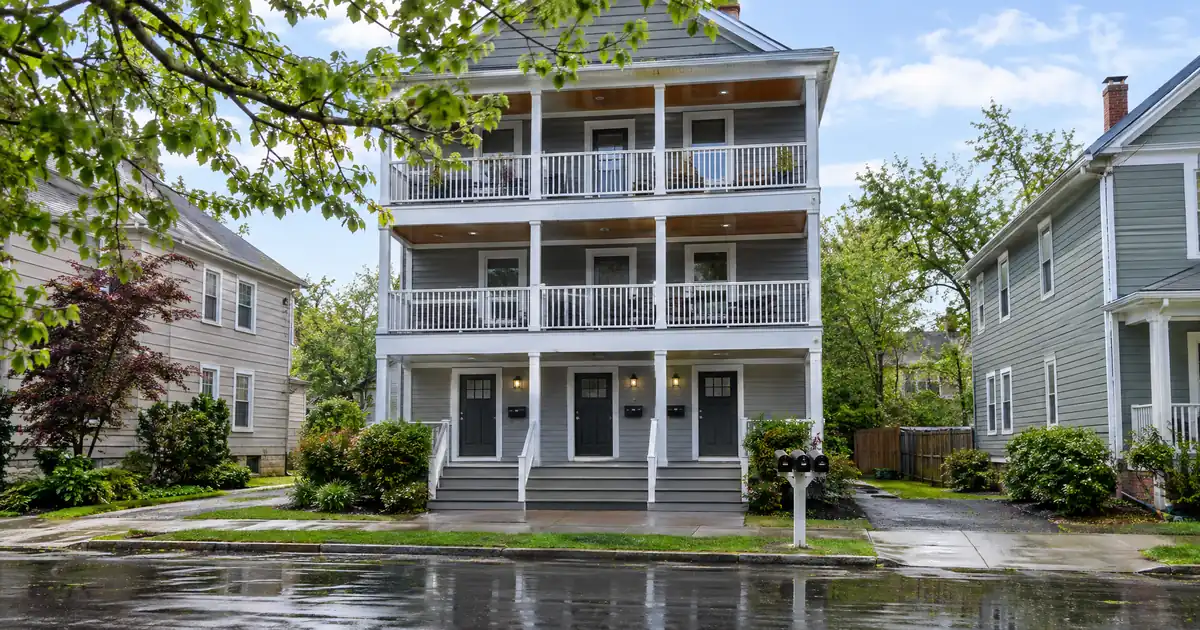
The Quick Read: To qualify for a conventional loan on a 2-4 unit with high DTI, you need an automated underwriting approval, which allows a total debt-to-income ratio up to 50%. Rent from the units you don’t occupy can be added to your income. The full payment still counts as a debt, though. Credit, reserves and down payment decide whether the file clears, and every figure here is subject to lender guidelines and full file review.
A 2-4 unit you live in is one of the few home purchases where tenants help you qualify. It is also one of the few where a high DTI can sink you late in the process. This guide walks through how the loan is underwritten, step by step, where the rules bend, and what your decision looks like in practice.
Conventional payment estimate
The starting figures are an example price at the first-time buyer’s minimum down payment. Replace them with yours.
Editable benchmark: 7.32% as of October 22, 2026 · Freddie Mac 30-year average via FRED®. A conventional market reference, not a conventional loan quote.
Estimate seeded at the low end of Fannie Mae’s published range (0.58%–1.86% a year); the insurer prices the actual premium on the score and the leverage. Applies only above 80% loan-to-value.
Illustrative starting assumptions: a $350,000 price, the first-time buyer’s minimum down payment, a thirty-year term at the current Freddie Mac benchmark, mortgage insurance at the low end of Fannie Mae’s published range, and property taxes and insurance estimated at typical national rates. Every field is editable.
Illustrative estimate only — not a Loan Estimate, approval, quote, or commitment to lend. The rate field carries the weekly Freddie Mac thirty-year conventional benchmark, a market reference and not a conventional loan quote; your rate is set by the lender at lock. The mortgage insurance figure is an editable estimate seeded from Fannie Mae’s published typical range, not a premium quote; the insurer prices the actual premium, and the cancellation month assumes scheduled payments with no extra principal and no change in value. Taxes, insurance and dues are editable estimates; closing costs are not included. Conforming loan limits apply by county. Licensed in sixteen states for consumer mortgages.
What Does “High DTI” Mean on a 2-4 Unit?
DTI means debt-to-income ratio. It is your total monthly debts, including the new housing payment, divided by your total monthly income. A 2-4 unit raises the numerator, because the payment covers the whole building: taxes, insurance and the mortgage on every unit.
“High” has no single definition. Across the wholesale programs we place files with, a file in the mid-40s is usually where the conversation changes. Under manual underwriting that is a hard stop for many borrowers. Under automated underwriting, it can still work.
There is also a common myth that a federal 43% cap exists. It does not. The CFPB replaced the 43% limit in its General QM rule with a test based on the loan’s pricing. The ceilings that bind you come from Fannie Mae, Freddie Mac and the individual lender.
Key Terms Defined
DTI (debt-to-income ratio): Your total monthly debt payments divided by your gross monthly income.
DU (Desktop Underwriter): Fannie Mae’s automated system that weighs credit, reserves, down payment, income and DTI together and returns a finding.
PITIA: Principal, interest, taxes, insurance and any association dues. It is the full monthly housing payment.
Reserves: Savings left over after closing, counted in months of the payment.
Manual underwriting: A person reviews the file against fixed limits when the automated system does not approve it.
Refer: A DU finding that sends the file to manual underwriting instead of approving it.
How the DTI Ceiling Is Set
Your ceiling depends on how the file is underwritten. That one fact explains most of the confusion online.
| Underwriting path | Total DTI limit |
|---|---|
| Automated (DU) | Up to 50% |
| Manual, standard | 36% |
| Manual, with strong score and reserves | Up to 45% |
The Fannie Mae Selling Guide on debt-to-income ratios sets the 50% and the 36%/45% structure. It also says a loan above 45% (manual) or 50% (DU) is not eligible for delivery to Fannie Mae if DTI is recalculated before closing.
Our wholesale conventional programs start at a 620 decision score. The automated finding governs most files, with a 50% total ratio ceiling. Manually underwritten loans run 36% or 45%, with the reserve and score factors in the Eligibility Matrix. Freddie Mac has its own automated system and its own rental-income rules, so a lender may choose one path over the other for your file.
Fifty percent is a ceiling, not an entitlement. The Guide has no flat “high-DTI exception” for 2-4 units. DU has to approve the whole picture, and a lender can add its own tighter rules.
How Is the Loan Underwritten, Step by Step?
Here is the sequence a 2-4 unit purchase follows. It runs in a different order than most borrowers expect.
1. The lender gathers income, debts and the property. DTI is all monthly obligations, including the new payment, divided by total monthly income.
2. Rent is added to income. It is not subtracted from the payment. Fannie Mae’s DU job aid on rental income says to calculate net rental income without subtracting the proposed PITIA, add it to qualifying income, and include the PITIA in DTI.
3. The rent gets a haircut. Lenders do not count 100% of gross rent. They adjust for vacancy and operating expenses, so only a percentage of gross rent lands in your income.
4. Rent is documented. The appraisal or a rent schedule supports it. If a unit is vacant, the appraiser’s opinion of market rent is used. Existing landlords usually show Schedule E from their traditional personal-income documentation. Leases fill in when there is no tax history.
5. The appraisal covers the whole building. 2-4 unit purchases use a small residential income property report, which includes a rent analysis.
6. Reserves and leverage are checked. Purchase leverage on a 2-4 unit principal residence goes to 95%. A first-time buyer gets 97% only on a one-unit home, so 2-4 units sit at 95%. Mortgage insurance applies above 80%.
7. Loan size is checked. Multi-unit properties carry higher conforming limits than one-unit homes. The FHFA conforming loan limit FAQs explain how those limits are set. County figures vary, so ask your loan officer for yours.
8. The file is re-checked before closing. If a new debt or lower income pushes DTI past the allowed tolerance, the loan must be re-underwritten. Do not open new credit.
The Fannie Mae Selling Guide rental income section names the 2-4 unit principal residence as an exception to the general ban on counting rent from your own home. It also requires the lender to report gross monthly rent per unit, even when rent isn’t used to qualify.
Why Doesn’t Rent Cancel the Payment?
On a home you live in, rent raises your income but the whole payment stays in your debts. That is the part most buyers miss.
Picture a borrower at 55% DTI on base income alone. Adding the haircut rent from two other units raises the denominator, and the ratio may fall into the high 40s. It does not drop to zero. The housing payment is still fully counted.
Compare that with an investment property, where rent is netted against the payment. That is a different loan with different leverage. Occupancy decides which set of rules applies. If you will live in one unit, you are on the owner-occupied side.
Run the logic both ways. If rent were netted, a fourplex would almost always look cheap. Because it is added to income instead, the benefit is real but smaller. A larger building adds more rent, but it also adds more tax, insurance and payment. The net improvement in DTI is not automatic as unit count grows.
What Levers Actually Lower DTI?
Four moves do most of the work. Try them in this order.
Pay off or pay down installment debts. Installment debts with ten or fewer remaining payments generally need not be counted. Confirm with your lender before relying on it. Revolving balances paid off at or before closing also drop out of the payment total.
Target the worst payment-to-balance ratio first. A card with a small balance and a large minimum payment often moves DTI more than a big balance with a small payment.
Add a co-borrower with income. A non-occupant co-borrower can raise qualifying income. Manual underwriting caps the occupying borrower’s own DTI lower in that case.
Adjust the structure. A larger down payment shrinks the loan and the mortgage insurance. A cheaper building lowers the payment. Sometimes a duplex works where a fourplex does not.
Where the Rules Break: Edge Cases
First-time landlord. Freddie Mac generally wants one year of investment property management experience before rental income above the payment counts on a new rental purchase. For a 2-4 unit you will occupy, the rules differ, so ask which treatment your lender applies.
A DU “refer.” Expect manual limits of 36% or 45%. A high-DTI file will usually fail there. Many 2-4 unit files only work under DU, so a refer is a signal to restructure rather than appeal.
Cash-out refinance. This article is about purchases, but the contrast matters. Conventional cash-out on a 2-4 unit principal residence tops out at 75% LTV, below the 80% available on a one-unit home. The maximum DTI can also be lower for cash-out. Terms depend on the lender’s guidelines, the property type, the leverage, and a full review of the credit profile.
HomeReady. This income-limited program allows 95% leverage on 2-4 units. Income limits apply: HomeReady and Home Possible use an income limit of 80% of area median income.
ADU income. On a one-unit home with an accessory unit, ADU income is capped at 30% of qualifying income, under Fannie Mae’s SEL-2025-08 announcement. Do not mix that up with a true 2-4 unit, which follows the ordinary rental-income rules.
Credit events. Agency waiting periods apply: four years from a chapter 7 discharge, seven from a foreclosure, and four from a short sale or deed-in-lieu. Documented extenuating circumstances can shorten them.
Short-term rentals. Treatment varies by lender, so raise it early if you plan to rent a unit that way.
Does Unit Count Change the Math?
Yes, but not the way people expect. Unit count affects rent, payment and reserves together.
| Factor | Duplex | Triplex or fourplex |
|---|---|---|
| Rent counted | One other unit | Two or three other units |
| Payment in DTI | Smaller building | Larger building |
| Max purchase leverage | 95% | 95% |
| Reserves | Typically lower | Typically higher |
Reserve demands rise with unit count and with DTI. The Fannie Mae Eligibility Matrix lists the manual-underwriting reserve and score combinations. Read it with your loan officer rather than guessing from a grid.
Here is the honest tradeoff. A fourplex gives you the most rent but demands the most reserves and carries the heaviest payment. A duplex is easier to qualify for and easier to run. Which one wins depends on your debts, not the building.
What Does Your File Need to Show?
Build the file before you write an offer. Underwriters tend to ask for the same things.
- Pay stubs, W-2s and traditional personal-income documentation for your base income.
- A full list of debts with current balances and payments.
- Leases for occupied units, or the appraiser’s market rent for vacant ones.
- Schedule E if you already own rentals.
- Bank statements showing down payment and reserves.
- A letter of explanation for any credit event.
Fannie Mae offers a rental income worksheet for 2-4 unit principal residences, Form 1037. Your lender may use it to walk through the math.
Conventional, FHA or Something Else?
If conventional will not stretch far enough, FHA is the usual alternative for high-DTI 2-4 unit buyers. Lendmire’s piece Can a 2–4 Unit Buyer With a High DTI Qualify for an FHA Loan? covers that route. The two loans weigh the file differently, so it is worth comparing before you commit.
Mortgage insurance is part of the conventional picture above 80% LTV. You can request cancellation at 80% of the original value with good payment history, no subordinate liens and no decline in value. The servicer must terminate it automatically at 78%. Published typical annual premiums run 0.58% to 1.86% of the balance, a range and never a quote. Final terms depend on the lender’s guidelines, the property type, and the borrower’s complete credit picture.
Why Do High-DTI Files Fail Anyway?
A passing DTI on paper still gets denied for a few repeat reasons.
- Appraised rent comes in low. Less rent means less income and a higher ratio.
- Vacant units without support. No lease and a thin market rent opinion leave the rent uncounted.
- A new debt before closing. A car loan or card balance can push DTI past the ceiling.
- A DU refer. The file lands in manual underwriting, where 36% and 45% apply.
- Thin reserves. DTI is weighed together with reserves, not alone.
Most of these are fixable before you apply. That is why the sequence matters: clean up debts first, then price the building, then write the offer.
What Is the Decision in Practice?
Start with your DTI under the realistic rent haircut, not the headline rent. If it lands at or under the automated ceiling with decent reserves, conventional is worth pursuing. If it sits above, work the levers: debts, co-borrower, price. If those do not close the gap, compare FHA.
Lendmire works with conventional loan programs through wholesale lenders, so one file can be compared across several sets of guidelines. Tax treatment can depend on your situation; borrowers should speak with a qualified tax professional before relying on any deduction or credit.
Frequently Asked Questions
Can I qualify with a DTI above 45%?
Usually only through automated underwriting, which allows up to 50%. Manual underwriting stops at 45% at most. Strong credit, reserves and down payment help the automated finding, but nothing is guaranteed and lenders may set tighter limits.
Does projected rent count if I have never been a landlord?
It can count on a 2-4 unit principal residence, supported by the appraiser’s market rent or leases. Lenders treat experience differently, and Freddie Mac asks for management experience in some rental cases. Ask which rules your lender applies.
Is a fourplex harder to qualify for than a duplex?
Often, yes. A fourplex adds more rent, but it also adds a bigger payment and typically higher reserve demands. Run both buildings through the same debts before choosing.
What if the appraised rent comes in low?
Your counted income drops, and DTI rises. You can lower the price, add down payment, pay off debts or add a co-borrower. Some borrowers switch to a smaller building.
Can I take on a new debt after I’m approved?
Avoid it. New debt or reduced income found before closing can force re-underwriting, and a loan above the ceiling is not eligible for delivery.
If you are buying a home and want to see whether a conventional loan fits your file, Lendmire can help you compare the options and what each one asks of the file. Every program figure here is subject to lender guidelines and full file review, and nothing is a commitment to lend.
For your own numbers, request a scenario review with Lendmire.
About Lendmire
Lendmire — NMLS# 2371349 — is a mortgage broker that arranges FHA, VA, conventional and jumbo home purchase and refinance financing in 16 states through wholesale lenders. Every option is subject to the lender’s guidelines and full underwriting. Scotsman Guide named Lendmire a Top Mortgage Workplace in both 2025 and 2026.
Get Started
Ready to find the right loan for you?
In about 30 seconds you can review financing options available for your home or investment property. No commitment required.
Informational only. Not a Loan Estimate, approval, or commitment to lend. Program availability and eligibility are subject to lender guidelines, credit approval, property review, and underwriting.
References
1. CFPB archive: Two Final Rules
2. Fannie Mae Selling Guide B3-6-02 Debt-to-Income Ratios
3. Fannie Mae DU Job Aid: Entering Income from Rental Property
4. FHFA Conforming Loan Limit FAQs
5. Fannie Mae Selling Guide B3-3.1-08 Rental Income
6. Fannie Mae’s SEL-2025-08 announcement
7. Fannie Mae Eligibility Matrix
This article is part of Lendmire’s conventional loan program — full qualification details, guidelines, and scenarios live on the program page.
Related reading: How to Get Preapproval for a Conventional Loan · How to Qualify for a Low Down Conventional Loan on a 2-4 Unit Home · How to Qualify Together on a Conventional Loan as Unmarried Buyers
Brandon Miller
Founder & CEO, Mortgage Loan Originator, Lendmire LLC
- Mortgage Loan Originator · NMLS# 1129696 · Verify on NMLS Consumer Access
- North Carolina Real Estate Broker · License# 343312 · Verify on NCREC
- North Carolina Insurance Producer · License# 19053198 · Property, Casualty, Life, Health · Verify on NAIC SBS
- Lendmire LLC · Firm NMLS# 2371349 · Verify firm licensure
Compliance and disclosures. Lendmire (NMLS# 2371349) is a licensed mortgage broker and is not a direct lender, depository institution, financial advisor, or tax professional. Content in this article is general market analysis and educational information — not financial, legal, or tax advice for any specific situation. Lendmire does not guarantee loan approval; every transaction is subject to underwriting by the funding lender. Mortgage pricing and loan program guidelines are subject to change at any time without notice and vary by borrower characteristics, property type, and state regulations. Lendmire complies with Equal Housing Opportunity. Licensure verification: NMLS Consumer Access.