
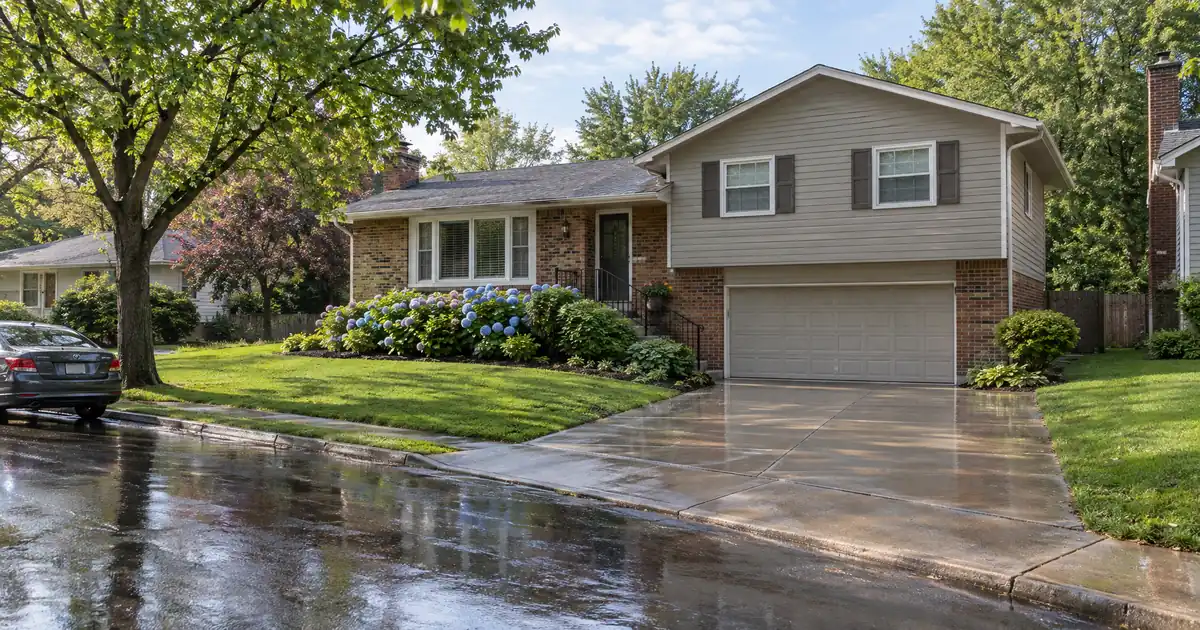
The Quick Read: A lender generally requires flood coverage equal to the lowest of three numbers: the combined balance of the first mortgage and the new line, the insurable value of the building, and the federal program maximum for that building type, which is $250,000 for most one-to-four-family buildings. The first mortgage counts toward the total, so a small line behind a large first lien can still call for a large policy. The rule applies only when the building sits in a mapped high-risk flood zone.
- The test uses all liens on the building, not just the new line.
- Land is excluded. Coverage is sized to the building.
- The lender can ask for more than the minimum.
- On an investment property, this network’s equity line tops out at 70% CLTV, with a 700 minimum credit score.
Flood coverage is a file item, not a pricing item. It either sits in the file or it stops the file. The sections below walk through how the number gets built.
How large a line the equity supports.
An equity line is sized by combined loan-to-value, occupancy, and credit — not by rental coverage. Switch the occupancy or the credit band and the ceiling moves with it.
Investment-property lines require a 700 minimum credit score; second-home lines start at a 640 minimum and primary-residence lines at 600, and the combined-LTV ceiling steps down as the credit band drops on primary-residence and second-home lines and holds on investment-property lines; the line cap steps down on primary-residence lines and holds at every tier on investment-property and second-home lines.
A debt-to-income ratio above 45% requires 680+ credit. Profiles under 640 are limited to single-family homes. At least 75% of the approved line is drawn at closing. Ceilings, floors, and caps update from Lendmire’s centralized guideline source.
Line estimate
Illustrative estimate only — not a quote, Loan Estimate, approval, or commitment to lend. The rate is an editable assumption; equity-line pricing is variable through both the draw and repayment periods and never converts to fixed. Occupancy and credit drive the ceiling together: an investment property tops out at 70% combined LTV (minimum credit 700, line cap $500,000); a second home tops out at 90% combined LTV (minimum credit 640, line cap $500,000), with the ceiling stepping down as the credit band drops (the cap holds at every tier); a primary residence tops out at 90% combined LTV (minimum credit 600), and its $750,000 maximum line is available only at 75% combined LTV or below with a 700-or-better credit profile (720 on the longer-runway program) and a full appraisal. Lines above $500,000 require a full appraisal. Credit, debt-to-income, property type, and full underwriting review all affect the final line.
Does a Second Mortgage or HELOC Trigger a Flood Requirement?
A new lien on a building in a mapped high-risk flood zone triggers a fresh flood review, even if the first mortgage never required coverage. The review depends on three conditions: the building is collateral, it sits in a high-risk zone, and the community participates in the federal flood program.
Borrowers get surprised here. Maps change. Lenders differ. A first lender may have missed the zone, or the property may have been remapped since that closing. A new line is a new loan, so it gets its own flood determination. No waiting period applies when added coverage is needed to close a second lien.
Lendmire brokers equity lines through select wholesale partners and is never the lender. Across those partners, a property in a mapped high-risk zone is treated as needing flood coverage in the file. Treat that as the working assumption, whether or not the lender is a bank.
How the Lesser-of Test Works, Step by Step
The test takes the combined debt, the building’s insurable value, and the federal cap, then uses whichever is lowest. Here is the order a flood reviewer follows on a second-lien file.
1. Flood determination. The lender orders a standard determination on the collateral. It shows whether the building sits in a high-risk zone, usually a zone starting with A or V, and whether the community participates.
2. Aggregate the debt. The reviewer adds the first mortgage balance to the new line. Per the FDIC’s flood compliance manual, when a junior lien is added, required coverage is measured against the combined loans, including the junior lien. That holds whether the junior lien is a home equity loan or another type.
3. Price the building. Insurable value means the building’s replacement cost. The same FDIC manual notes that flood coverage applies to the building and not the land, so a high land value does not raise the requirement.
4. Apply the federal cap. The program maximum is $250,000 for one-to-four-family residential buildings and $500,000 for other residential and non-residential buildings, per the OCC’s consumer guidance.
5. Take the lowest number. That is the minimum required coverage.
6. Collect evidence. The borrower supplies a declarations page showing the lender named, the coverage amount, and the effective date.
7. Monitor. If coverage lapses or falls short, the servicer can buy a force-placed policy for the shortfall and bill the borrower.
One point trips people up. If replacement cost is below the loan balance, the lender does not have to require coverage up to the balance. The building value controls in that case.
Four Illustrative Stacks
These examples use modeled assumptions, not market data. The point is which input wins.
| Scenario | Combined balances | Building replacement cost | What controls |
|---|---|---|---|
| Low first lien, modest line | $120,000 | $300,000 | Combined balances |
| Large first lien, small line | $410,000 | $520,000 | Federal cap, $250,000 |
| Balance above building value | $380,000 | $200,000 | Building value |
| Condo unit | $350,000 | $290,000 (unit share) | Unit cap, $250,000 |
The second row is the one investors miss. The line itself might be small, but the stack is large, so the policy has to reach the federal cap. The fourth row follows the unit-share method: replacement cost of the whole building divided by the number of units, then capped.
How an Open-End Line Gets Sized
For a revolving line, the lender picks one of two approaches. It can review the file periodically so coverage tracks draws and repayments. Or it can require coverage at origination equal to the total line, the property’s insurable value, or the federal maximum, whichever is least.
On this network’s programs, at least 75% of the line is drawn at closing. That makes the periodic-review approach less relevant in practice. The drawn balance is already close to the full line on day one.
Later draws generally do not trigger a new determination. A limit increase, an extension, or a renewal can. A map change during the draw period is a different problem. It can put a building into a high-risk zone after closing, and the servicer will notify the borrower to add coverage.
Where the General Rule Breaks
The rule bends at a few predictable points. Each one changes either the cap or the paperwork.
Condominiums. The unit’s insurable value is the building’s replacement cost divided by the unit count. The federal limit for a residential unit is $250,000. A large building often produces a unit share above the cap, so the cap controls. The network accepts condominiums, including non-warrantable ones, but confirm who holds the master policy and whether it carries flood.
Two-to-four-unit buildings. These are treated as residential, so the $250,000 building limit is the usual reference. Have the lender’s flood vendor confirm the cap before you quote the number to a borrower. The network does take 2-4 units on these lines, with a 640 minimum score on the longer-runway structure.
Mixed-use and commercial. A building with a large share of non-residential floor area is treated as non-residential, which lifts the cap to $500,000. This is moot for these lines. Commercial, mixed-use, and agricultural-zoned properties are not eligible.
Non-participating communities. The federal mandate does not apply. A lender may still require private coverage as a policy matter.
Private flood policies. Regulated lenders must accept private policies that meet federal criteria. A lender can accept others at its discretion. Get the lender’s acceptance in writing before binding anything.
Lender overlays. The federal number is a floor. Some lenders require more than the legal minimum to protect their collateral. Expect that on high-balance stacks. Lendmire’s own piece Flood Insurance Requirements for a Second Mortgage or HELOC covers the file items in more detail.
Vesting. On these lines, title must sit with the individual borrower or a revocable living trust. LLCs, corporations, and irrevocable or land trusts cannot hold title. Flood paperwork must carry the same named insured as the vesting.
Availability. The equity line programs run in Lendmire’s 16 full-service states only (AL, CA, CO, FL, GA, IN, MI, MT, NM, NC, OH, PA, TN, TX, VA, WA). That is narrower than the 41-market DSCR footprint.
Is the Minimum Enough?
The minimum protects the lender’s collateral. It does not rebuild the owner’s property. On a high-balance stack, the federal cap can sit well below replacement cost. Everything above the cap is uninsured unless the owner buys excess or private coverage.
A simple decision frame helps. First, compare replacement cost to the lender’s minimum. If the gap is wide, ask a flood agent for an excess or private quote. Second, check what the lender will accept. Third, price it before the contract deadline, not after.
For rentals, three more points matter.
- Standard landlord policies exclude flood. A flood policy is a separate purchase per building.
- Coverage has to be in place when the line closes. Get quotes during contract or application.
- Contents coverage is separate from building coverage. Lenders size to the building.
Rental Properties, Equity Lines, and Where DSCR Fits
For investment property, the equity line is narrow. The ceiling is 70% CLTV, with a 700 minimum credit score and a maximum line of $500,000. Investment lines run a 5-year interest-only draw with a 25-year fully amortizing repayment, and pricing floats rather than converting to fixed. Properties over 15 financed units for the borrower are not eligible, and a borrower is limited to three lines.
Flood adds one more variable to the leverage math. A building in a high-risk zone needs a policy before closing, and the premium is a real carrying cost. On a DSCR loan, which qualifies primarily on property-level rental income covering the payment, subject to lender guidelines, the flood premium sits in the monthly obligation alongside taxes and insurance. It moves the coverage ratio directly. Clearing 1.00 is not the same as positive cash flow, since repairs, vacancy, and management sit outside the calculation.
If a property is already deeded to an LLC, an equity line is out, because the line cannot be vested in an entity. The usual alternatives are a vesting change or a DSCR cash-out refinance, subject to lender program eligibility. Cash-out on standard rentals tops out around 75% LTV across most of the network, with about 6 months of seasoning common. The complete DSCR loans guide walks through that path. Final terms depend on lender guidelines, property type, leverage, and the borrower’s complete credit picture.
Key Terms Defined
Special flood hazard area: A mapped zone with a higher flood risk, usually labeled with an A or V.
Insurable value: The cost to replace the building, not counting land.
Combined balance: The first mortgage plus the new line, which together set the debt side of the test.
Federal program maximum: The most the federal flood program will insure on a given building type.
Force-placed policy: Coverage the servicer buys when the borrower’s policy lapses or falls short.
CLTV: Combined loan-to-value, meaning all liens on the property divided by its value.
Frequently Asked Questions
Does the flood requirement look at the HELOC alone or the whole stack?
The whole stack. The first mortgage balance and the new line are added together before the three-number test runs. A small line behind a large first lien can still require a policy up to the federal cap.
Can a lender ask for more than the federal minimum?
Yes. The federal number is a floor, and some lenders add their own overlays to protect collateral. Ask early what the lender requires on replacement cost, deductibles, and policy type.
Does a rental property in a flood zone need a separate flood policy?
Yes. A standard landlord or homeowner’s policy excludes flood, so the building needs a separate policy. Quote it during contract or application, since coverage has to be in place at closing.
What happens if the property is remapped after closing?
The servicer will notify the borrower that coverage is needed, and the borrower has to add a policy. If the borrower does not respond, the servicer can buy a force-placed policy and charge the cost.
Does a later draw trigger a new flood determination?
Generally no. A limit increase, extension, or renewal can. On these programs most of the line is drawn at closing, so the original sizing does most of the work.
Next Steps for the File
1. Order or request the flood determination at application, before any appraisal or title work moves forward.
2. Get replacement cost from the insurance agent, not the appraisal.
3. Add the first lien and the line, then run the lesser-of test against the cap.
4. Ask the lender what it accepts: private policies, excess coverage, deductible limits.
5. Bind the policy with the lender named, and keep the declarations page in the file.
If you are considering a home equity line and want to see how the numbers work, Lendmire can help you compare HELOC options based on the property, the equity available, credit profile, combined leverage, and your goals. Reach the team at 828-256-2183.
About Lendmire
Lendmire (NMLS# 2371349) is a mortgage broker arranging DSCR investor loans through a wholesale network across 40 states plus Washington, D.C., which makes 41 markets. It was recognized as a Scotsman Guide Top Workplace for 2026 and again in 2025. Lendmire is not a lender, and every figure here is subject to lender guidelines and full file review.
The flood map is the one input the investor cannot negotiate, so the cleanest files check it before they pick a lien structure.
Get Started
Ready to find the right loan for you?
In about two minutes you can review financing options available for your home or investment property. No commitment required.
Informational only. Not a Loan Estimate, approval, or commitment to lend. Program availability and eligibility are subject to lender guidelines, credit approval, property review, and underwriting.
References
1. $250,000 for most one-to-four-family buildings
2. FDIC Consumer Compliance Examination Manual, Section V-6 (PDF)
This article is part of Lendmire’s HELOC & home equity loan program — full qualification details, guidelines, and scenarios live on the program page.
Related reading: How a Lender Sizes a HELOC by Combined Loan-to-Value · 2nd Lien HELOC Rules When Your First Mortgage Is Large · HELOC Homeowners Insurance Requirements for Qualifying
Brandon Miller
Founder & CEO, Mortgage Loan Originator, Lendmire LLC
- Mortgage Loan Originator · NMLS# 1129696 · Verify on NMLS Consumer Access
- North Carolina Real Estate Broker · License# 343312 · Verify on NCREC
- North Carolina Insurance Producer · License# 19053198 · Property, Casualty, Life, Health · Verify on NAIC SBS
- Lendmire LLC · Firm NMLS# 2371349 · Verify firm licensure
Disclosures. The information presented in this article is general market commentary, not financial, legal, or tax advice. Lendmire is a mortgage brokerage (NMLS# 2371349) — not a direct lender or depository institution — and loan placement is subject to lender underwriting. Nothing in this content represents a commitment to lend. Loan terms, pricing, and program availability vary based on borrower qualifications, property characteristics, and state of subject property, and are subject to change at any time. Lendmire complies with Equal Housing Opportunity requirements. Consumer access: nmlsconsumeraccess.org.