
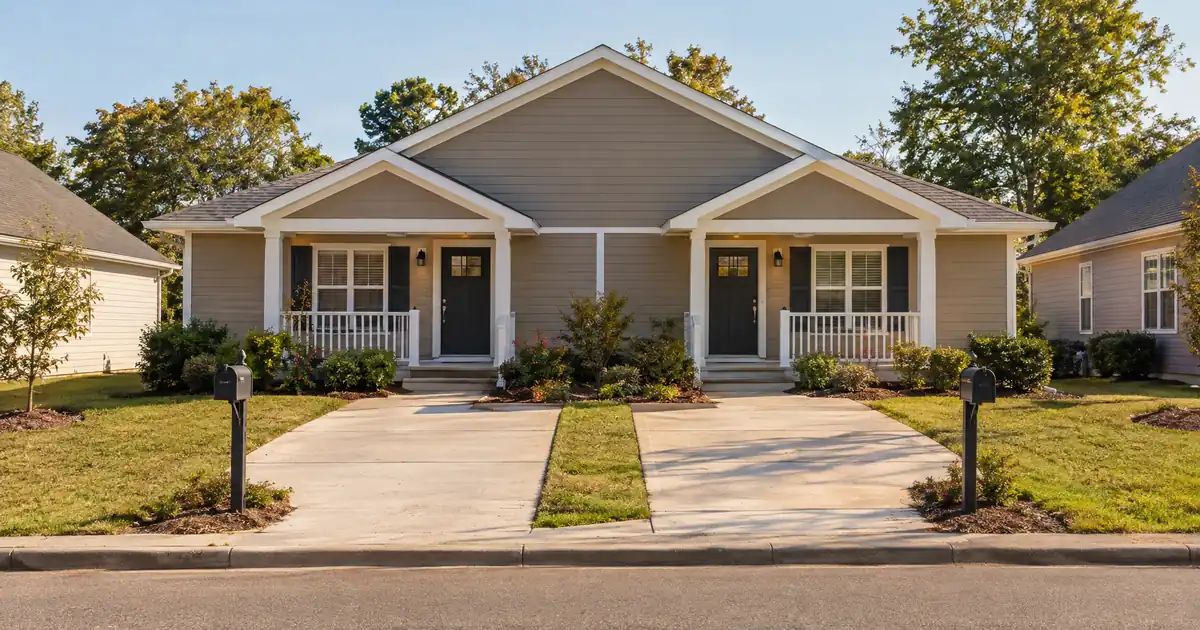
The Quick Read: You buy a two-unit building with an FHA loan, live in one unit, and rent out the other. The loan works because you occupy the home, so the owner-occupied rules and low down payment apply. The wholesale programs Lendmire places FHA loans with allow financing up to 96.5% with a 3.5% minimum investment at a 580 decision score or higher. Part of the second unit’s rent can help you qualify, subject to lender guidelines and full file review.
Key Takeaways
- A duplex is FHA-eligible when you live in one unit as your principal residence.
- You move in within 60 days of closing and plan to stay at least a year.
- The lender can count part of the other unit’s rent as income, based on an appraiser’s rent estimate.
- The rent a lender counts and the rent you actually collect are two different numbers.
- Mortgage insurance applies to every FHA loan, and county loan limits apply.
What Does It Mean to House-Hack a Duplex?
House-hacking means living in part of a property and letting a tenant pay down your cost of housing. A duplex is the simplest version. Two units, one building, one loan, one landlord (you).
FHA payment estimate
Starting assumptions reflect an example price and the FHA minimum investment. Replace them with your own figures.
Editable benchmark: 7.32% as of October 22, 2026 · Freddie Mac 30-year average via FRED®. A conventional market reference, not an FHA loan quote.
Illustrative starting assumptions: a $350,000 price, the FHA minimum investment as the down payment, a thirty-year term at the current Freddie Mac benchmark, and property taxes and insurance estimated at typical national rates. Every field is editable.
Illustrative estimate only — not a Loan Estimate, approval, quote, or commitment to lend. The rate field carries the weekly Freddie Mac thirty-year conventional benchmark, a market reference and not an FHA loan quote; your rate is set by the lender at lock. FHA mortgage insurance follows HUD’s published schedule for the term, leverage and loan size entered; taxes, insurance and dues are editable estimates; closing costs are not included; county loan limits are not checked here. Licensed in sixteen states for consumer mortgages. Lendmire is not affiliated with or acting on behalf of FHA, HUD, or the federal government.
The FHA part is what makes it reachable. Across the wholesale programs I arrange files with, the owner-occupied purchase path asks for as little as 3.5% of the price or appraised value, whichever is lower. Compare that with the larger down payments many lenders require once a buyer says the word “rental.”
Here is the catch. This is a loan for a home you live in. It is not an investment-property loan, and it will not work for a building you plan to rent out entirely. If you are weighing a bigger building, Lendmire’s piece Can a House Hacker Use an FHA Loan to Live in One Unit of a Fourplex? covers the three- and four-unit version.
What Are the FHA Rules for a Duplex?
The core rule is occupancy. HUD’s FHA Answer Center says at least one borrower must move in as a principal residence within 60 days of signing the security instrument. That borrower must intend to stay for at least one year.
A principal residence is where you live most of the year. You can have only one at a time. HUD allows documented exceptions, such as a job relocation or a growing household.
Here is how the main pieces fit together on the owner-occupied purchase path:
| Piece | How it works |
|---|---|
| Occupancy | You live in one unit as your primary home |
| Leverage | Up to 96.5% financing, 3.5% minimum investment |
| Credit | Decision score of 580 or higher on the wholesale programs |
| Mortgage insurance | Upfront premium plus an annual premium |
| Loan size | County loan limits apply |
| Co-borrower | A non-occupant co-borrower is allowed |
Every figure above is subject to lender guidelines and a full review of your file. None of it is a commitment to lend.
You can also receive help from the seller. Seller or interested-party contributions can reach 6% of the price on these programs.
Lendmire’s FHA loan programs page lays out the wider program, and the team’s piece on FHA loan requirements for a duplex when you live in one unit goes deeper on the checklist.
How Is the Loan Underwritten, Step by Step?
The FHA program is a standard mortgage. The twist is the second unit’s rent. Here is the sequence a duplex file follows.
1. Pick an eligible property. It needs to be a two-unit home on one parcel, within the county loan limit. It must also be something an FHA-roster appraiser can value.
2. Get preapproved. The lender reviews your income, credit, assets and debts the same way as for any FHA purchase.
3. Make an offer and order the appraisal. For a two- to four-unit home, HUD says the appraiser uses the Small Residential Income Property Appraisal Report. That report gives a market value and a fair market rent estimate for the units.
4. Document the rent. HUD Mortgagee Letter 2023-17 says that with no rental history on the property, the lender relies on the appraiser’s fair market rent, plus prospective leases if available. No commercial-space income can be included.
5. Add net rent to income. HUD’s handbook text tells the lender to add net rental income from the subject property to your gross income. The lender may not simply subtract that rent from the mortgage payment.
6. Finish underwriting. Your ratios, credit and the appraisal all have to work together.
7. Close and move in. Occupy within 60 days and keep your one-year intent.
Notice step 5. Only a portion of the rent counts, and the lender does not take your word for the number. The appraiser’s estimate and any lease drive it.
How Does the Rent Help You Qualify?
It raises the income side of the equation. It does not erase the payment.
On the owner-occupied purchase path, the base ratio pair is 31/43. That means housing costs up to 31% of income and total debts up to 43%, with no compensating factors. Documented compensating factors can reach 40/50 at the top tier, and the automated finding governs most files.
Picture a buyer who finds a duplex with a vacant second unit. The appraiser estimates fair market rent for that unit. The lender counts a reduced share of it as income. That added income can lift the ratios into range where the buyer’s wages alone might have fallen short.
A duplex has one big advantage here. Three- and four-unit properties face an extra test called the self-sufficiency test, which looks at whether the building’s rent covers its own payment. HUD’s Handbook 4000.1 glossary defines the concept as rent over and above the payment. A duplex does not face it. You qualify on your own income plus counted rent.
Qualifying Rent vs. Real Cash Flow
This is where most new house hackers get tripped up. Two numbers are in play, and they rarely match.
Rent used for lender review is what the lender counts. It comes from the appraisal and any lease, and it is reduced.
Real cash flow is what lands in your account after vacancy, repairs, utilities you cover and reserves. It depends on actual tenants.
A lender-counted rent can help you get approved. It does not mean the tenant’s check wipes out your housing cost. Budget with conservative rent, a repair cushion, and a month or two of vacancy. If the deal only works when the unit is full all year, it is too thin.
Mortgage insurance also sits on top of the payment. The upfront premium is 1.75% of the base loan and is financed. The annual premium runs between 0.15% and 0.75% of the balance, depending on term, loan amount and LTV. HUD Mortgagee Letter 2023-05 lays out the upfront premium and the annual premium reduction. On a thirty-year loan above 90% LTV, the annual premium lasts the full term. At or below 90%, it ends after eleven years. The exact numbers vary by lender and program and follow a full review of property, leverage, and credit.
That is a program fact, not a price quote. Your Loan Estimate shows what applies to your file.
How Do You Pick and Vet the Duplex?
Choose the building before you fall for the rent math. A few checks save real grief.
- Two true units. Each should have its own kitchen, bath and entrance or clear separation. Confirm the second unit is a legal, separately usable dwelling.
- Condition. FHA appraisals flag safety and soundness issues. Peeling paint, a failing roof or broken systems can stall a file until fixed.
- Rent comps. Look at what similar units rent for nearby before you offer. Do not rely on the seller’s number.
- Local rules. Rental licensing and zoning vary by town. Ask the agent and the local office.
- Short-term rentals. Treat these cautiously. FHA is built around a principal residence and long-term housing, so confirm with a lender before planning on transient use. Local rules may also limit it.
When the appraiser flags repairs, you have options. Ask the seller to fix them, negotiate a credit within program limits, or walk. Some buyers use a renovation loan for a fixer-upper, which a loan officer can explain.
What About Boarders, Roommates and Other Edge Cases?
The general rule has several named wrinkles.
Boarders. Renting a room is different from renting a unit. HUD Mortgagee Letter 2025-04 sets the rules for boarder income. The lender looks for a documented history of receiving it. Where the income is documented for at least nine of the last 12 months, the lender averages it over 12 months. Ask your loan officer how the letter applies to your situation.
Only one FHA home at a time. Because the loan is for your principal residence, you generally cannot hold two FHA loans for two homes you each claim to live in. Documented exceptions exist.
Military. Active-duty buyers who cannot live in the home right away can sometimes be treated as owner-occupants. The conditions are specific, so check them with your loan officer before relying on this.
Conventional loans. Fannie Mae’s guidelines generally do not let a buyer count rent from the unit they occupy, with exceptions for boarders and certain accessory units. Treatment of the other unit differs by program. That contrast is why many house hackers look at FHA first.
Bigger buildings. If you eventually look at three or four units, the self-sufficiency test arrives. The fourplex piece linked earlier weighs that tradeoff.
What Happens After the First Year?
You made a one-year occupancy promise, not a lifetime one. After that year, many owners move out and keep both units rented. Others stay, refinance or sell.
Be honest about occupancy at the start. Claiming you will live there when you will not is misrepresentation on a mortgage application, and it carries real consequences.
Moving out can affect later options. Some FHA refinance paths depend on how long you have lived in the home. The FHA Streamline refinances an existing FHA loan with no appraisal and a net tangible benefit. The FHA cash-out reaches 80% LTV on a home you owned and occupied for 12 months before the case number. If you plan to move out, ask your loan officer how that timing affects you before you sign a lease for both units. Final terms depend on the lender’s guidelines, the property type, and the borrower’s complete credit picture.
You become a landlord for real: leases, repairs, tenant screening, and fair housing rules.
Is a Duplex House Hack Right for You?
This one is a genuine toss-up for some buyers, and a clear yes or no for others.
It tends to fit if you want a low down payment, can tolerate a landlord’s phone calls, and live where two-unit homes are priced within the county limit. It tends to fit poorly if you hate dealing with tenants, if local rules restrict renting, or if you cannot afford the payment during a vacancy.
Here is a quick comparison to frame the decision:
| Factor | FHA duplex | Conventional duplex |
|---|---|---|
| Minimum investment | 3.5% at 580+ | Often higher, varies by lender |
| Other unit’s rent | Part can count as income | Treatment varies by program |
| Mortgage insurance | Upfront plus annual | Depends on down payment |
| Occupancy | One unit, principal residence | One unit, principal residence |
The tradeoff is cost. FHA tends to suit borrowers with lower scores or smaller down payments, and can cost more for borrowers with strong credit and larger down payments, per the CFPB’s FHA guidance. Compare both on your Loan Estimate.
Key Terms Defined
Principal residence: The home where you live most of the year.
Owner-occupant: A borrower who lives in the property being financed.
Fair market rent: The rent an appraiser estimates a unit would bring on the open market.
Self-sufficiency test: An FHA check for three- and four-unit homes that asks whether the building’s rent covers its own payment. Duplexes are exempt.
Mortgage insurance premium (MIP): The FHA insurance cost, paid as an upfront premium and an annual premium.
LTV: Loan-to-value, the loan amount as a percentage of the home’s value or price.
Frequently Asked Questions
Can I use an FHA loan to buy a duplex as a pure rental?
No. FHA requires that one borrower occupy the home as a principal residence within 60 days and intend to stay a year. A building you plan to rent entirely does not qualify.
How much of the second unit’s rent can count toward qualifying?
Only a portion. The lender uses the appraiser’s fair market rent or a lease and applies a reduction, then adds net rent to your gross income. The exact treatment depends on lender guidelines and your file.
Do I need 20% down to avoid mortgage insurance?
No, and 20% down will not remove it. Mortgage insurance applies to every FHA loan. Your down payment and loan term affect how long the annual premium lasts. Each figure is subject to lender guidelines and a full file review.
Does the self-sufficiency test apply to a duplex?
No. It applies to three- and four-unit properties. A duplex is reviewed on your income plus the rent the lender counts.
Can I move out and rent both units after a year?
Often, yes, once you have met the occupancy rule. Moving out can limit some later options, such as an FHA cash-out until you re-establish occupancy, so talk to your loan officer first.
If you are buying a home and want to see whether an FHA loan fits your file, Lendmire can help you compare the options and what each one asks of the file. Details of every program are subject to lender guidelines and full file review, and nothing here is a commitment to lend.
For your own numbers, request a scenario review with Lendmire.
About Lendmire
Lendmire — NMLS# 2371349 — is a mortgage broker that arranges FHA, VA, conventional and jumbo home purchase and refinance financing in 16 states through wholesale lenders. Every option is subject to the lender’s guidelines and full underwriting. Scotsman Guide named Lendmire a Top Mortgage Workplace in both 2025 and 2026.
Get Started
Ready to find the right loan for you?
In about two minutes you can review financing options available for your home or investment property. No commitment required.
Informational only. Not a Loan Estimate, approval, or commitment to lend. Program availability and eligibility are subject to lender guidelines, credit approval, property review, and underwriting.
References
3. HUD Mortgagee Letter 2023-17: Revisions to Rental Income Policies
5. HUD Mortgagee Letter 2023-05
6. HUD Mortgagee Letter 2025-04
This article is part of Lendmire’s FHA loan program — full qualification details, guidelines, and scenarios live on the program page.
Related reading: Can You Apply for an FHA Loan Before Choosing a Home? · How to Qualify for an FHA Loan With a Relative as Cosigner · How to Get an FHA Loan From Application to Closing
Brandon Miller
Founder & CEO, Mortgage Loan Originator, Lendmire LLC
- Mortgage Loan Originator · NMLS# 1129696 · Verify on NMLS Consumer Access
- North Carolina Real Estate Broker · License# 343312 · Verify on NCREC
- North Carolina Insurance Producer · License# 19053198 · Property, Casualty, Life, Health · Verify on NAIC SBS
- Lendmire LLC · Firm NMLS# 2371349 · Verify firm licensure
Important disclosures. Lendmire (NMLS# 2371349) is a licensed mortgage brokerage. Lendmire is not a direct lender, depository institution, or financial advisor. All loan inquiries are subject to lender underwriting; this article does not constitute a commitment to lend. Rates, terms, and program guidelines are subject to change without notice and vary by borrower profile, property type, and state. Information in this article is general in nature and is not financial, legal, or tax advice. Equal Housing Opportunity. NMLS Consumer Access: nmlsconsumeraccess.org.