
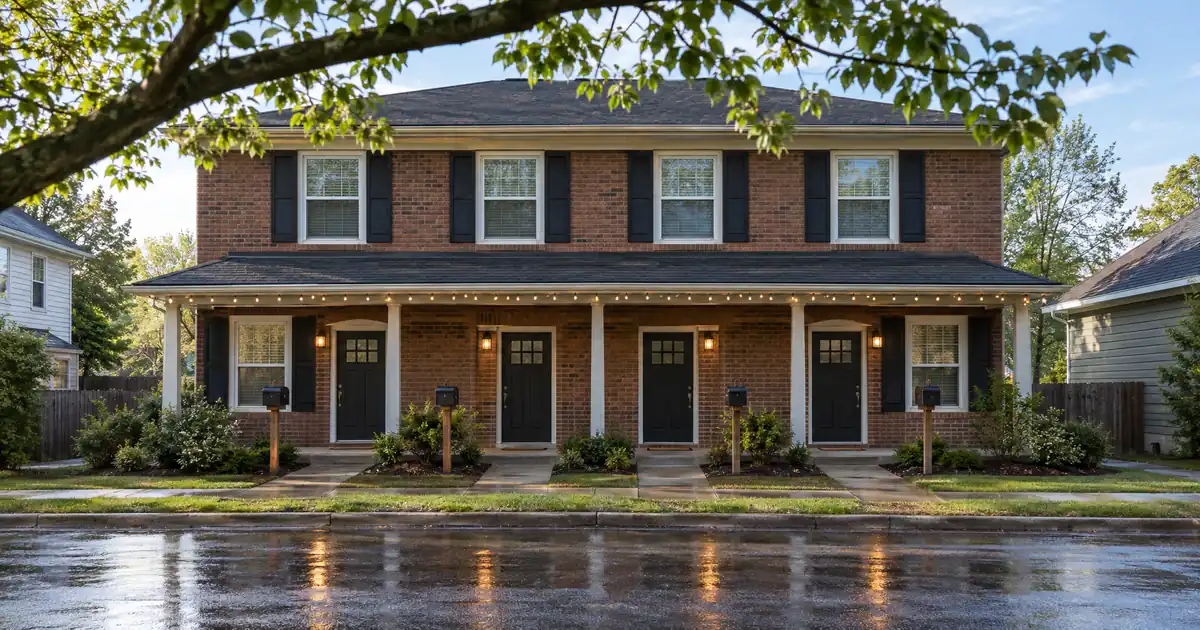
The Quick Read: Neither product fits a fourplex while you live in one of the units. Both are built for non-owner-occupied rentals, and the occupancy gate comes before any comparison of structure. The comparison starts to matter once the building is a pure rental, or if you hold a different rental that qualifies.
- A DSCR HELOC is a standalone second lien behind the first mortgage you keep. It can also be a first lien on a paid-off rental.
- A DSCR cash-out refinance pays off your first mortgage and replaces it with one new loan.
- Both qualify primarily on property-level rental income covering the payment, subject to lender guidelines. Neither is available on a home you occupy.
- While you live there, owner-occupied multi-unit financing is the realistic path. After you move out and lease all four units, the DSCR choice opens up.
The honest answer on who each option is for: the HELOC is for the owner who likes the existing first mortgage and wants a line to draw on. The cash-out refinance is for the owner who wants one lump sum and is fine replacing the first loan. Both are tools for a fourplex that is fully rented to tenants.
Side-by-Side
The HELOC column reflects terms available through select programs in Lendmire’s wholesale network, subject to underwriting. The cash-out column reflects published industry norms, which vary by lender.
| Factor | DSCR HELOC | DSCR cash-out (industry norms) |
|---|---|---|
| Review basis | Rent covers the stress payment, 1.10x minimum | Rent covers the full payment, floor varies |
| Occupancy | Non-owner-occupied only | Non-owner-occupied only |
| Lien position | Second lien, or first lien if paid off | New first lien, old one paid off |
| Funds | Revolving line, 5-year draw period | Single lump sum at closing |
| Property types | 1-4 units, PUD, townhome, condo | 1-4 units, condo, varies by lender |
| Entity vesting | LLC allowed, members guarantee | LLC commonly allowed per program |
| Documentation | Lease, rent schedule, credit, valuation | Lease, rent schedule, credit, appraisal |
| Reserves | None required | Commonly required |
| Seasoning | 6 months of ownership | Varies, often a minimum hold period |
| Existing first mortgage | Stays in place | Paid off and replaced |
Does Living in One Unit Change the Answer?
It does, and it ends the DSCR conversation. Across the wholesale network, DSCR loans are written on non-owner-occupied property. The borrower signs an occupancy attestation saying they do not live in the property and do not plan to. Live in unit 1 and the file is owner-occupied. The rent from the other three units does not change that.
A few edge cases come up on these files:
- An LLC does not cure occupancy. Vesting the building in an entity changes who holds title. It does not change who sleeps there.
- Planning to move in later. Future occupancy can conflict with the attestation you sign at closing. Don’t sign what you don’t intend to honor.
- A vacant unit is a different question. An empty unit between tenants is not the owner living there. On the DSCR HELOC, a two-to-four-unit property may have at most one vacant unit, and a lease must be in place.
- Counting the owner’s unit as rental income. Some online guides say a house-hack fourplex works under DSCR if the occupied unit’s market rent is counted. That is not how the programs placed through Lendmire’s network treat it. The occupancy attestation governs.
Misstating occupancy on a business-purpose file creates serious exposure. Skip the shortcut.
What Each Product Looks Like Once the Building Is a True Rental
Here is the DSCR HELOC in full, because its parameters are narrow and the details drive fit. It is a standalone second lien behind the first mortgage you keep, or a standalone first lien on a rental with no mortgage. It is never closed together with a purchase. The rent qualifies the line, not your personal income: no traditional personal-income documentation, W-2s or personal income calculation, subject to lender guidelines. Subject to underwriting:
- Coverage: minimum 1.10x. Gross monthly rent is divided by a fully amortizing payment on the entire credit limit, at a stress rate. That is a qualifying calculation, not your actual payment. The lender’s own calculation governs, including how the first mortgage payment is treated on a second lien.
- Rent counted: the lesser of the appraiser’s market rent on Form 1007 or the lease.
- Leverage, second lien: up to 70% combined loan-to-value (the first mortgage balance plus the new line, divided by value) at a 720 score or better, on lines of $50,000 to $500,000.
- Leverage, first lien: up to 75% loan-to-value at 740 or better, and 70% from 700 to 739, on lines to $500,000. Lines above $500,000 run to $1,000,000, with a 65% loan-to-value ceiling at 720 or better.
- Structure: 5-year interest-only draw period, then a 25-year repayment period, 30-year maturity. The rate is variable. At least 80% of the line is drawn at closing, and later draws are at least $5,000.
- File items: lines to $400,000 use an automated valuation with a property inspection report, or a full appraisal. Larger lines take a full interior appraisal. Six months of seasoning, no reserves.
The program is offered in 15 of Lendmire’s 16 licensed states, every licensed state except Tennessee: Alabama, California, Colorado, Florida, Georgia, Indiana, Michigan, Montana, New Mexico, North Carolina, Ohio, Pennsylvania, Texas, Virginia and Washington.
The cash-out refinance is simpler to describe. One new first-lien loan replaces the old one. Leverage on a standard rental cash-out generally sits at or below 75% LTV through select programs. The file carries a rent schedule on Form 1007 for one unit or Form 1025 for two to four units. Lenders commonly ask for reserves, entity documents if the building is in an LLC, insurance and title.
When a DSCR HELOC Is the Better Fit
The HELOC wins when the existing first mortgage is worth keeping. That is the case when the first loan was set up on terms you would not get again. A cash-out refinance would give that up. The HELOC leaves it alone.
It also wins on staged needs. Say you own a fully leased fourplex and expect to fund a unit renovation now and a roof later. A line lets you draw in pieces after the first draw, instead of taking one lump sum and paying on all of it. And it wins on file friction: no reserves, no personal income file.
The catches are real. The rate is variable. The qualifying payment runs on the whole line, so a large limit can pull coverage under 1.10x even when your current balance looks safe. Leverage on a second lien tops out at 70% combined, which can leave less room than a cash-out on a building with a large first mortgage. And a line is not a lump sum: at least 80% is drawn at closing, so you start with a large balance.
Equity from one rental can also fund a purchase elsewhere. A line on a separate, qualifying rental is the clean version of that move. For a related view on how the choice changes when ownership is shared, see Lendmire’s piece DSCR HELOC vs DSCR Cash-Out Refinance When One Co-Owner Applies on a Joint Home.
When a DSCR Cash-Out Refinance Is the Better Fit
Cash-out wins when you want one number, one payment and one lender relationship. If the first mortgage is expensive or maturing, replacing it is not a cost. It is the point. Picture an owner who moved out, leased all four units, and wants to pull equity and fix the loan structure in one step. A single new first lien does both.
It also suits larger, one-time uses. A purchase deposit on the next building is the common example. A fixed repayment structure on the new loan, where a program offers one, avoids the variable-rate exposure of a line.
The tradeoffs: you give up the old first mortgage, reserves are commonly required, and the full new balance is on the books from day one. Cash-out also assumes seasoning and a clean lease-up. A recently bought building with one empty unit may not clear the coverage test on the lender’s rent figure.
One Fourplex, Two Realistic Paths
Treat these as the sequence, not a pick-one choice.
While you live there. The file is owner-occupied, so you look at owner-occupied multi-unit financing. Those loans are underwritten on personal income and are built for house hacking. Home equity on a home you occupy is a different, owner-occupied product, and the DSCR HELOC is never offered on an owner’s own home.
After you move out. Document the move, lease up all four units and let the seasoning clock run. The building is then a rental, and both DSCR options open up.
Coverage on four doors needs a stress test. One empty unit is 25% of the rent. A fourplex that clears 1.2x with every unit full can drop under 1.0x with one vacant, depending on the first mortgage and the market rent. Clearing the ratio and actually cash-flowing are two different things. Run it both ways before choosing leverage.
Proceeds matter too. DSCR loans are designed for non-owner-occupied investment properties. Because they are business-purpose investor loans, they are reviewed differently from a standard owner-occupied mortgage. The CFPB’s rule text on business-purpose credit weighs what the money is for, and the Cornell Legal Information Institute’s copy of the same regulation lays out the exemption itself. Spending proceeds on personal items weakens that position. Tax treatment can depend on how the funds are used and how the property is held; borrowers should keep clear records and speak with a qualified tax professional before relying on any deduction.
Network parameters are ceilings, set by credit tier, lien position and property, and always subject to underwriting. The complete DSCR loans guide covers the loan family end to end.
Key Terms Defined
DSCR (debt service coverage ratio): the property’s monthly rent divided by its qualifying monthly obligation, used to test whether the rent supports the loan.
Second lien: a loan recorded behind an existing first mortgage, which stays in place.
Combined loan-to-value (CLTV): the first mortgage balance plus the new line, divided by the property’s value.
Draw period: the stretch when you can borrow from the line and pay interest only on what you drew.
Seasoning: the minimum time you must own or have refinanced a rental before a new loan is available.
Occupancy attestation: the signed statement that you do not live in the property and do not plan to.
The Verdict
If you live in the fourplex today, neither one. Plan the move-out, document it, and use owner-occupied financing in the meantime. If the building is already a clean, fully leased rental, the choice is about structure, not qualification. Pick the HELOC to keep a good first mortgage and draw as needs arise. Pick cash-out to replace the first loan and take one lump sum.
It is a genuine toss-up when the first mortgage is middling and the need is large. In that case the deciding factor is coverage: run the stress payment on the whole line against the full-payment math on the new loan, and see which clears with a vacancy built in. The strongest fit usually shows up in that comparison, not in the product label.
If you are considering a home equity line on a rental property and want to see how the numbers work, Lendmire can help you compare DSCR HELOC options based on the property, the rent, the equity available, credit profile, combined leverage, and your goals. Reach the team at 828-256-2183 or through the quote request page.
Frequently Asked Questions
Can I use a DSCR loan if I live in one unit of a fourplex?
Not on the programs placed through Lendmire’s network. They require a non-owner-occupied property and a signed occupancy attestation. Moving out and leasing all four units reopens the option, subject to seasoning and underwriting.
Does the rent from my own unit count toward coverage?
No, because the file does not qualify while you occupy the unit. Once the building is fully leased, rent is the lesser of the appraiser’s Form 1007 market rent or the lease. A vacant unit, where permitted, is counted at market rent by the appraiser.
Can an LLC hold title if I live in one unit?
Holding title in an LLC does not fix an occupancy problem. On an eligible rental, the DSCR HELOC allows LLC vesting with members signing as guarantors, subject to program terms.
What if one unit is empty between tenants?
A single vacant unit in an otherwise tenant-occupied building is generally treated differently from owner occupancy. On the DSCR HELOC, a two-to-four-unit property may have at most one vacant unit.
Is the DSCR HELOC available in every state?
No. It is offered in 15 of Lendmire’s 16 licensed states, every licensed state except Tennessee. Availability and terms are subject to underwriting.
About Lendmire
Lendmire, NMLS# 2371349, is a mortgage brokerage that arranges home equity lines of credit through wholesale lending partners in the 16 states where it holds consumer mortgage licenses. Each file is reviewed individually by the lender under the program’s occupancy, credit and combined-loan-to-value guidelines. Scotsman Guide named Lendmire a Top Mortgage Workplace in both 2025 and 2026.
Investors weighing their equity options can start with Lendmire’s guide to cash-out refinance on an investment property.
Get Started
Ready to find the right loan for you?
See your offer in seconds. No credit pull, no obligation.
Informational only. Not a Loan Estimate, approval, or commitment to lend. Program availability and eligibility are subject to lender guidelines, credit approval, property review, and underwriting.
References
1. CFPB – Regulation Z § 1026.3
2. Cornell Legal Information Institute – 12 CFR 1026.3
This article is part of Lendmire’s DSCR HELOC program — full qualification details, guidelines, and scenarios live on the program page.
Related reading: DSCR HELOC vs DSCR Cash-Out Refinance to Consolidate Business Debt · DSCR HELOC vs DSCR Cash-Out Refinance to Fund a Small Business · DSCR HELOC vs DSCR Cash-Out Refinance Qualified on the Rent With a 1.10 DSCR
Brandon Miller
Founder & CEO, Mortgage Loan Originator, Lendmire LLC
- Mortgage Loan Originator · NMLS# 1129696 · Verify on NMLS Consumer Access
- North Carolina Real Estate Broker · License# 343312 · Verify on NCREC
- North Carolina Insurance Producer · License# 19053198 · Property, Casualty, Life, Health · Verify on NAIC SBS
- Lendmire LLC · Firm NMLS# 2371349 · Verify firm licensure
Disclosures. The information presented in this article is general market commentary, not financial, legal, or tax advice. Lendmire is a mortgage brokerage (NMLS# 2371349) — not a direct lender or depository institution — and loan placement is subject to lender underwriting. Nothing in this content represents a commitment to lend. Loan terms, pricing, and program availability vary based on borrower qualifications, property characteristics, and state of subject property, and are subject to change at any time. Lendmire complies with Equal Housing Opportunity requirements. Consumer access: nmlsconsumeraccess.org.