
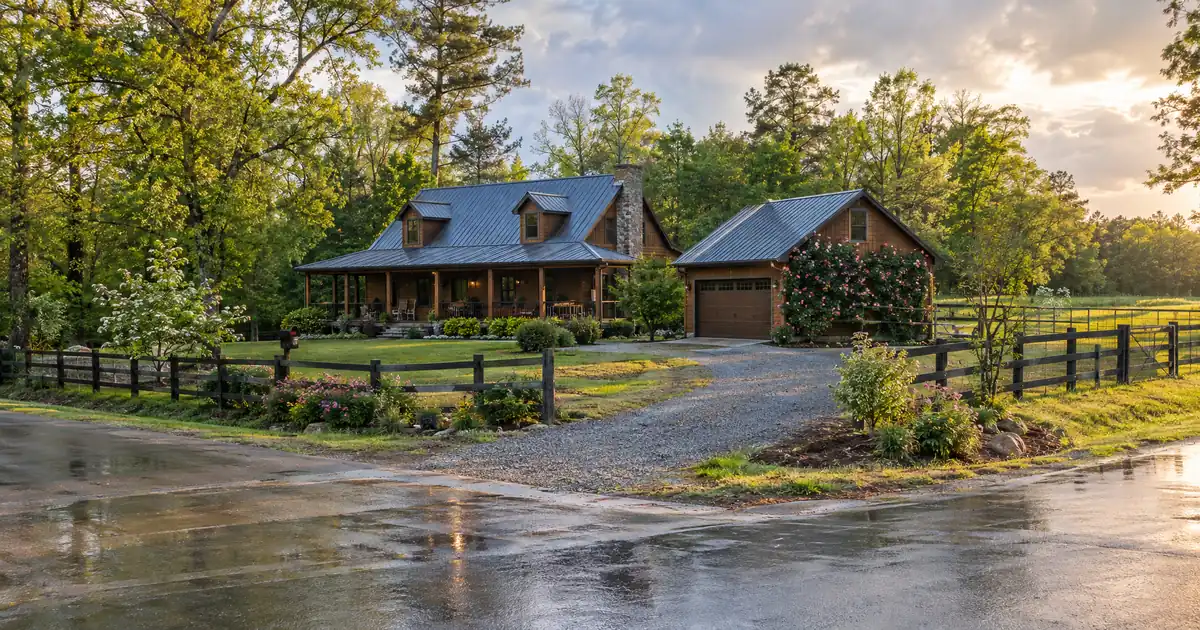
The Quick Read: The right program is the one where the property passes first and your deposits only prove income. On an investment property, lines through Lendmire’s wholesale network top out at 70% CLTV and $500,000, with title in your own name or a revocable trust, and agricultural or hobby-farm land is out.
- The line is sized by your deposits and the equity left after your first mortgage, not by the rent.
- An investment-property line needs a 700 credit score. Anything above that buys eligibility, not extra leverage.
- An LLC cannot hold title on this line, so title has to sit in your own name or a revocable trust.
- Acreage turns valuation into the pivot point, so screen the land before you spend on an application.
- Subject to lender guidelines and full file review, and not a commitment to lend.
What “Best” Means for This Property
No program is best in the abstract. The best program for your situation depends on three tests, and a bank statement only helps with the first.
How large a line the equity supports.
An equity line is sized by combined loan-to-value, occupancy, and credit — not by rental coverage. Switch the occupancy or the credit band and the ceiling moves with it.
Investment-property lines require a 700 minimum credit score; second-home lines start at a 640 minimum and primary-residence lines at 600, and the combined-LTV ceiling steps down as the credit band drops on primary-residence and second-home lines and holds on investment-property lines; the line cap steps down on primary-residence lines and holds at every tier on investment-property and second-home lines.
A debt-to-income ratio above 45% requires 680+ credit. Profiles under 640 are limited to single-family homes. At least 75% of the approved line is drawn at closing. Ceilings, floors, and caps update from Lendmire’s centralized guideline source.
Line estimate
Illustrative estimate only — not a quote, Loan Estimate, approval, or commitment to lend. The rate is an editable assumption; equity-line pricing is variable through both the draw and repayment periods and never converts to fixed. Occupancy and credit drive the ceiling together: an investment property tops out at 70% combined LTV (minimum credit 700, line cap $500,000); a second home tops out at 90% combined LTV (minimum credit 640, line cap $500,000), with the ceiling stepping down as the credit band drops (the cap holds at every tier); a primary residence tops out at 90% combined LTV (minimum credit 600), and its $750,000 maximum line is available only at 75% combined LTV or below with a 700-or-better credit profile (720 on the longer-runway program) and a full appraisal. Lines above $500,000 require a full appraisal. Credit, debt-to-income, property type, and full underwriting review all affect the final line.
1. Does your income documentation work? Bank statements answer this one.
2. Is the collateral eligible? Land, zoning, use and property type decide this.
3. Do the lien and leverage fit? Your first mortgage balance and the CLTV cap decide this.
Lendmire is a mortgage broker, not a lender. It shops multiple wholesale lenders and matches a file to the program whose rules fit it. So the useful question is not which name to call. It is which rules your property and paperwork satisfy.
Key Terms Defined
Bank statement HELOC: a revolving line of credit secured by property, where the lender reviews your file on documented deposits instead of tax-return income.
CLTV (combined loan-to-value): your first mortgage balance plus the new line, divided by the property’s value.
Draw period: the stretch when you can borrow from the line, which on investment lines here is 5 years of interest-only payments.
Repayment period: the amortizing stretch after the draw ends, when you can no longer borrow. On investment lines it runs 25 years.
Vesting: how title is held, such as in your own name, a revocable trust or an LLC.
Rural-designated: a property the lender classifies as rural. That label is separate from lot size, and a modest lot can still carry it.
Automated valuation: a computer estimate of value used in place of a full appraisal.
How the Line Works, Step by Step
A HELOC is revolving credit. The CFPB describes it as an open-end line you borrow against repeatedly. It has a draw period, then a repayment period in which borrowing stops and the balance is paid down.
On an investment property in our network, the structure is a standalone line in first or second lien position. Here is how a file moves.
1. Pick the statement type. The program decides whether personal accounts, business accounts or both are used.
2. Set the lookback. Programs across the market use 12 to 24 months of statements. Our network typically works from 12 months.
3. Clean the deposits. Transfers between your own accounts, refunds, loan proceeds and one-off credits come out. What remains is averaged.
4. Apply the expense factor to business deposits. The lender sets this factor, not you. It estimates what part of business deposits is really yours.
5. Test the rest. Credit, debt load, lien position, CLTV, title and vesting all get checked.
6. Value the property. On rural land, this step carries the most risk. More on that below.
7. Open the line. At least 75% of the line is drawn at closing. Pricing floats through both the draw and the repayment period and never converts to fixed.
Debt-to-income can reach 50%. The lender reviews your file on the interest-only payment calculated on the maximum draw, so a line you never fully use is still tested as if you did.
The Gate Order: Property First, Income Second
Strong deposits cannot offset a collateral problem. Run the gates in this order, because the cheap ones to check come first.
| Gate | What is tested | Pass looks like |
|---|---|---|
| Property type | Dwelling and zoning | Single-family or 2-4 unit, residential zoning |
| Land use | Farm, hobby farm, agricultural | Residential use only |
| Rural and acreage | Lender’s classification and lot size | Within the lender’s land lines |
| Vesting | Who holds title | You or a revocable trust |
| CLTV room | First lien plus new line | Combined balance at or below 70% of value |
| Credit | Score and housing history | 700 or better |
| Income | Deposit analysis | Averaged deposits support the debt load |
Several property types are simply not eligible: manufactured homes, log homes, co-ops, condotels, commercial and mixed-use property, and anything with agricultural zoning. Rural properties often meet these rules head-on. A farmhouse with a working barn can raise the question of whether it is residential or agricultural.
How Deposits Get Read
The bank statement element is documentation of income, not an absence of it. Qualification runs on documented income under the applicable program, subject to lender guidelines. Think of it as three buckets.
| Deposit type | Treatment |
|---|---|
| Regular business or personal income | Counted |
| Large or irregular deposits | Scrutinized, often asked to explain |
| Transfers, refunds, loan proceeds | Excluded |
Rent deposited into your accounts is ordinary income in this analysis. The rent does not size the line. That is the key difference from a rent-qualified DSCR product, which compares rent to the property’s full payment instead.
This approach helps most when your tax returns show thin net income after write-offs. Your deposits can tell a stronger story than your return does.
Business accounts need a 680 minimum credit score for the deposit analysis. Investment lines already floor at 700, so on this line the income method is never your binding constraint. Credit, title and collateral are.
Why Acreage Makes Valuation the Pivot
Investment lines are capped at $500,000, and a full appraisal is required only on lines above that. So an investment line ordinarily runs on an automated valuation, with no traditional appraisal.
That works well in subdivisions with many recent sales. It works poorly on land. Rural parcels have few comparable sales, and a computer estimate can miss badly. A secondary valuation may be required at higher CLTV, and you can request a full appraisal in any case. On acreage, requesting one is often the smarter move because the value is the number that sizes your line.
Lenders also treat land differently from the house. Excess acreage beyond a lender’s line is often carved out of value, which means you are borrowing against the dwelling and a limited amount of land. A lower value shrinks the CLTV room one-for-one.
Picture a rental with a first mortgage at 50% of the property’s value. At a 70% ceiling, the line can use up to 20 points of value. If the valuation drops because the lender discounts surplus land, those 20 points shrink with it. Your income can be perfect and the line still comes in small.
For a closer look at how valuations work on rural homes, see Lendmire’s piece on bank statement HELOC appraisal rules for a rural home with acreage.
Lot-size limits vary by program, and acreage and rural classification are separate tests. No single acreage figure applies across programs. A first-lien bank statement loan, a DSCR cash-out and a HELOC each carry their own land rules, and blending them leads to bad assumptions. Your broker should screen the specific parcel against the specific program before you apply.
Choosing the Structure
A line is not always the right tool. Compare the three paths an investor with a rural rental usually weighs.
| Factor | Bank statement HELOC | Rent-qualified DSCR cash-out | First-lien bank statement loan |
|---|---|---|---|
| What is tested | Deposits | Rent vs. full payment | Deposits |
| Existing first mortgage | Stays in place | Replaced | Replaced |
| Title | You or revocable trust | LLC possible, per program | Per program |
| Leverage on rentals | 70% CLTV, investment | Up to 75% on a standard rental cash-out | Per program |
| Main trade-off | Floating pricing, $500,000 cap | Resets your first loan | Resets your first loan |
Both bank statement and DSCR loans are established non-QM products, and they answer different borrowers.
Pick the line when:
- You hold a low-rate first mortgage you do not want to replace.
- Your personal income is strong but rent is thin.
- You want a draw you can use in pieces.
Pick a DSCR cash-out when:
- Rent is strong but your documented personal income is thin.
- Your title sits in an LLC.
- You need more than the $500,000 line cap. Cash-out on a standard rental tops out around 75% LTV, typically with about 6 months of ownership, subject to lender guidelines.
A DSCR cash-out generally starts at a 1.00 coverage ratio in select programs, with stronger ratios opening better leverage. A separate select-lender path takes coverage below 1.00, with leverage and terms adjusted. Clearing 1.00 is not the same as positive cash flow, since repairs, vacancy and management sit outside that math.
DSCR programs do not take barndominiums, log homes or manufactured homes. If your rural rental is one of those, neither product works as written. Lendmire’s complete DSCR loans guide covers what the rent-qualified side requires.
Where the General Rule Breaks
LLC-owned rentals. Many investors hold title in an LLC for liability reasons. On this line, an LLC cannot hold title, and neither can a corporation, partnership or irrevocable, blind or land trust. Investors have long warned about this trap: one BiggerPockets discussion shows an investor cautioning that moving a rental into an LLC can leave you unable to get a line on it. If the property is already in an LLC, you either change the vesting or use a DSCR cash-out instead. Changing title has its own consequences, so talk to your attorney first.
Ownership seasoning. Some programs want a minimum ownership period before a line. Confirm the rule for your specific program before you assume you are past it.
Large balances. A property with a small first mortgage hits the $500,000 line cap first. A property with a large first mortgage runs out of CLTV room first. Which wall you hit tells you whether the line or the refinance fits better.
Portfolio size. A borrower is limited to three lines in total, and an investor with more than 15 financed properties is not eligible.
Availability. This product is written in Lendmire’s 16 full-service states, which is narrower than the 41-market DSCR footprint. Check the property’s state early.
Lender scarcity. Lines on rentals are harder to find than lines on a primary home, and an investor discussion on BiggerPockets shows many borrowers calling small banks and credit unions one by one. A broker doing that shopping across wholesale lenders replaces the phone tree.
Three Illustrative Scenarios
These are modeled situations, not sourced market data.
The paid-off cabin rental. An investor owns a rural rental free and clear, titled personally, on residential land. There is no first lien, so the CLTV room is the full 70% of value. The line may hit the $500,000 cap before the CLTV ceiling. The valuation is the open question, so a full appraisal is worth requesting.
The rental with a first mortgage. A self-employed investor has a low-rate first mortgage at roughly half the property’s value. Tax returns show thin income, but deposits are steady. A line fits well: the first stays, and the CLTV room is about 20 points of value, subject to the valuation.
The LLC-held rental. An investor holds a strong-rent property in an LLC. The line is out unless title moves. A DSCR cash-out, subject to program eligibility, may fit better, because rent rather than personal deposits drives qualification.
Prepare Before You Apply
A short checklist saves a round of declines.
- 12 months of statements for the accounts being used, with large deposits explained
- Your current first mortgage statement
- A deed or title report showing how the property is vested
- A credit report no more than 90 days old at closing
- Land details: survey or plat, how the acreage is used, and any outbuildings
- Evidence the property is residential in use, not farmed for income
Do the land screen first. If the parcel is agriculturally zoned or used as a working farm, stop there.
Why Rural Files Stall
Most delays trace back to a few causes. Title sits in an LLC. The property is classified rural or agricultural. The valuation comes in below the contract or your estimate. The CLTV math, once the first lien is counted, leaves little room. Or the deposits include large unexplained credits.
Each has a fix. Move title, switch products, order a full appraisal, size the line down or document the deposits. The worst outcome is paying for an application before the gates are checked.
Frequently Asked Questions
Can a rural rental with acreage qualify for a bank statement HELOC at all?
Sometimes. The property has to be residential in use and zoning, and land and rural classification are screened separately from income. Acreage alone neither qualifies nor disqualifies the file. A broker can screen the parcel against several lenders’ rules before you apply.
Does the rent count toward qualifying?
No. On a bank statement line, your documented deposits drive the income test, not the property’s rent. If rent is your strength and personal income is thin, a rent-qualified DSCR cash-out is the better path.
Do I need a full appraisal?
Not by rule on an investment line, since lines at or below $500,000 ordinarily use an automated valuation. But thin rural comps make those estimates unreliable. You can request a full appraisal in any case, and on acreage it often protects the size of your line.
Is the interest on a HELOC tax-deductible?
It depends. Tax treatment can depend on how the funds are used and how the property is held; borrowers should keep clear records and speak with a qualified tax professional before relying on any deduction.
Is the payment fixed?
No. Pricing floats during both the draw and repayment periods. As the CFPB notes on its HELOC versus home equity loan page, these lines usually carry adjustable rates, and the payment moves with the balance.
Next Steps
If the parcel passes the property gates, the rest is arithmetic: first lien, 70% ceiling, $500,000 cap.
If you are considering a home equity line and want to see how the numbers work, Lendmire can help you compare HELOC options based on the property, the equity available, credit profile, combined leverage, and your goals. Rural land rewards the investors who check the property before the paperwork.
About Lendmire
Lendmire is a mortgage brokerage (NMLS# 2371349) arranging home equity lines of credit — primary-residence, second-home and investment-property lines — through a wholesale lending network in its 16 full-service states. Eligibility is determined by the lender on each file. Scotsman Guide named Lendmire a Top Mortgage Workplace in both 2025 and 2026.
Get Started
Ready to find the right loan for you?
See your offer in seconds. No credit pull, no obligation.
Informational only. Not a Loan Estimate, approval, or commitment to lend. Program availability and eligibility are subject to lender guidelines, credit approval, property review, and underwriting.
References
1. CFPB
2. BiggerPockets – HELOC on a rental property
3. BiggerPockets – Taking a HELOC out from a paid-off rental property
4. CFPB – Difference between a home equity loan and a HELOC
This article is part of Lendmire’s bank statement HELOC program — full qualification details, guidelines, and scenarios live on the program page.
Related reading: DSCR Loan vs Bank Statement Loan for a Stonington Rental Buyer · Can You Get a Bank Statement HELOC on a Second Home or Mountain Cabin? · How to Use a Bank Statement Loan on a Rental Instead of a DSCR Loan
Brandon Miller
Founder & CEO, Mortgage Loan Originator, Lendmire LLC
- Mortgage Loan Originator · NMLS# 1129696 · Verify on NMLS Consumer Access
- North Carolina Real Estate Broker · License# 343312 · Verify on NCREC
- North Carolina Insurance Producer · License# 19053198 · Property, Casualty, Life, Health · Verify on NAIC SBS
- Lendmire LLC · Firm NMLS# 2371349 · Verify firm licensure
Legal disclosures. Lendmire (NMLS# 2371349) is a state-licensed mortgage brokerage that arranges financing through wholesale lender relationships. Lendmire is not a direct lender, depository institution, or registered financial advisor. The discussion above is general informational content about real estate financing — it is not financial, legal, or tax advice, and readers should consult licensed professionals for guidance on their individual circumstances. Loan inquiries are subject to lender underwriting; this article does not represent a commitment to lend. Loan terms, rates, and qualification standards vary by borrower, property, and state, and are subject to change at any time. Equal Housing Opportunity. NMLS Consumer Access: nmlsconsumeraccess.org.