
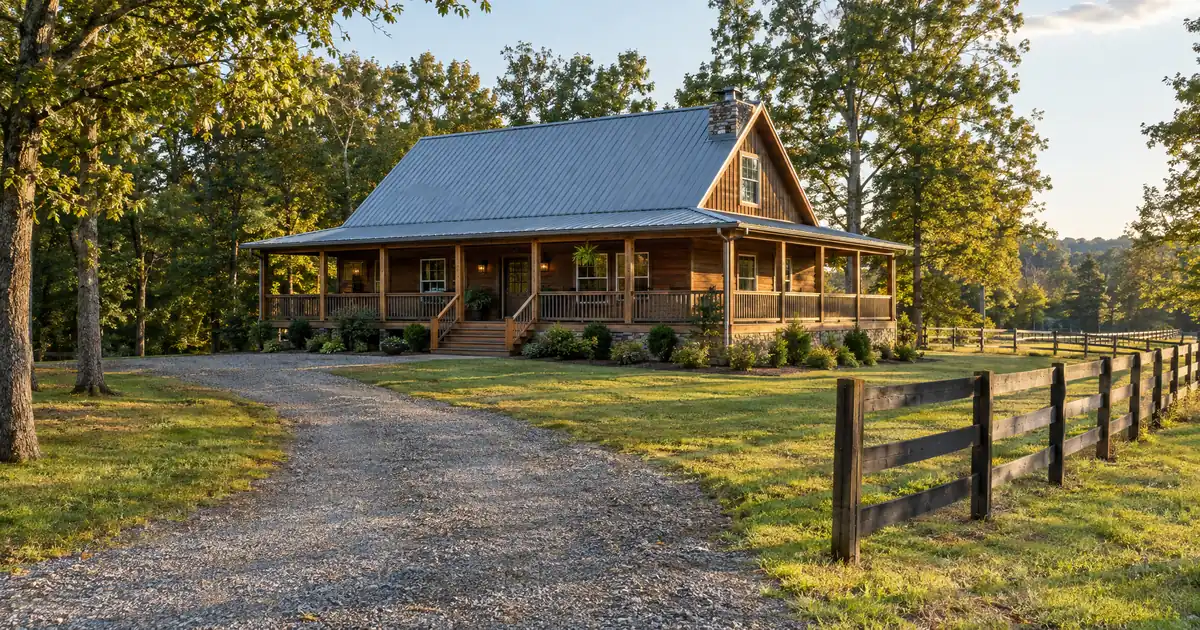
A home on ten, twenty, or forty acres does not fit the usual equity-line template. Your deposits can show a lender that you earn enough, but they say nothing about what the land is worth. That is a separate question with its own rules.
The Quick Read: On a rural home with acreage, the bank statement only decides your income side, while the property is valued on a separate track, and acreage is a common reason that valuation moves from an automated estimate to a full appraisal by a licensed appraiser.
How large a line the equity supports.
An equity line is sized by combined loan-to-value, occupancy, and credit — not by rental coverage. Switch the occupancy or the credit band and the ceiling moves with it.
Investment-property lines require a 700 minimum credit score; second-home lines start at a 640 minimum and primary-residence lines at 600, and the combined-LTV ceiling steps down as the credit band drops on primary-residence and second-home lines and holds on investment-property lines; the line cap steps down on primary-residence lines and holds at every tier on investment-property and second-home lines.
A debt-to-income ratio above 45% requires 680+ credit. Profiles under 640 are limited to single-family homes. At least 75% of the approved line is drawn at closing. Ceilings, floors, and caps update from Lendmire’s centralized guideline source.
Line estimate
Illustrative estimate only — not a quote, Loan Estimate, approval, or commitment to lend. The rate is an editable assumption; equity-line pricing is variable through both the draw and repayment periods and never converts to fixed. Occupancy and credit drive the ceiling together: an investment property tops out at 70% combined LTV (minimum credit 700, line cap $500,000); a second home tops out at 90% combined LTV (minimum credit 640, line cap $500,000), with the ceiling stepping down as the credit band drops (the cap holds at every tier); a primary residence tops out at 90% combined LTV (minimum credit 600), and its $750,000 maximum line is available only at 75% combined LTV or below with a 700-or-better credit profile (720 on the longer-runway program) and a full appraisal. Lines above $500,000 require a full appraisal. Credit, debt-to-income, property type, and full underwriting review all affect the final line.
- Lines of $500,000 or less ordinarily run on automated valuation, though a higher CLTV may require a secondary valuation. A borrower may request a full appraisal in any case.
- Every line above $500,000 requires a full appraisal, and those larger lines are available on primary residences only.
- On an investment property, the ceiling is 70% CLTV with a $500,000 maximum line. Primary-residence and second-home lines reach 90% CLTV only at a 720-or-better credit profile.
- Agricultural zoning, mixed-use, and commercial properties are not eligible, no matter how clean your deposits look.
- A conservative land value shrinks your available line by a larger percentage than the value cut itself.
All figures here are typical ranges from select wholesale lenders, subject to lender guidelines and full file review. This is not a commitment to lend.
Income Review and Valuation Are Two Separate Tracks
Your bank statements and your property’s value never touch each other. The statements establish whether you can carry the line. The valuation establishes how much equity the lender can lend against.
On the income side, the lender reads your deposits. Programs commonly ask for 12 to 24 months of statements, depending on the program. Transfers, loan proceeds, refunds, gifts, and security deposits come out of the qualifying total. The file is reviewed on documented income under the applicable program, subject to lender guidelines. The lender also checks credit, existing debt, and the property itself.
On the collateral side, the lender estimates value and applies a combined loan-to-value cap. Your available line is the value times that cap, minus any existing liens. Lendmire’s piece on how lien position works on a bank statement HELOC for a paid-off home covers the lien side in more depth.
Here is the catch for rural buyers. Clean deposits do not buy you a simpler valuation. A hard-to-value property can still need a human-written report even when the income file is spotless.
Key Terms Defined
CLTV (combined loan-to-value): Your existing mortgage plus the new line, divided by the home’s value.
AVM (automated valuation model): Software that estimates value from recent sales data, with no one visiting the property.
Confidence score: The number an AVM attaches to its own estimate, which drops when comparable sales are scarce.
Comparable sale (comp): A recent sale of a similar property that an appraiser uses as a yardstick.
Adjustment: A dollar change an appraiser makes to a comp to account for differences, such as lot size or a barn.
Contributory value: What a feature, such as extra acreage, adds to market value, which is not always its cost.
The Valuation Ladder
Lenders pick from a ladder of valuation tools, and each rung sees more of the property than the one below it. Most standard homes stay on the bottom rung. Rural acreage tends to climb.
| Valuation type | What it is | Typical trigger | What it can’t see |
|---|---|---|---|
| Automated (AVM) | Software estimate from sales data | Standard home, line ≤ $500,000 | Condition, land quality, outbuildings |
| Desktop | Appraiser reviews data, no visit | AVM confidence is low | Anything off the record |
| Drive-by | Exterior look only | Modest uncertainty | Interior, well, septic |
| Full appraisal | Inspection plus comps and adjustments | Line > $500,000, unusual property, or your request | Little; it is the most complete rung |
Across the wholesale network, lines of $500,000 or less ordinarily run on automated valuation with no traditional appraisal. A higher CLTV may require a secondary valuation. You can ask for a full appraisal whenever you want one. Above $500,000, it is required.
Why Acreage Pushes a File Up the Ladder
Acreage breaks automated valuation because software needs many similar nearby sales, and large parcels rarely have them. Each rural parcel is partly unique. The AVM returns a weak confidence score, and the deal works to a person.
A person then faces the same thin data. One mortgage insurer’s rural appraisal training deck shows the problem. Its illustrative case is a ranch-style home on about 44 acres. The best available comps are two-story homes on 6 to 12 acres, sitting 8 to 18 miles away. The appraiser must then explain why those comps are reasonable. Those figures are the deck’s own example, not a rule.
Land does not add value by simple multiplication. A practitioner appraisal firm explains that early acres support the homesite, and additional acreage may add value at different marginal rates. The analysis can split out the homesite, contributing acreage, and surplus land. So price per acre is a poor guide to what your parcel will appraise for.
Appraisers also test highest and best use. The current use must be legal, physically possible, financially feasible, and the most productive option for the site. A residential home on extra land usually passes. A working farm may not.
Which Parcel Features the Appraiser Has to Address
Rural parcels carry features that a suburban lot never has. Each one raises a question, and you can answer most of them before anyone orders a report.
| Feature | Why it matters | What to bring |
|---|---|---|
| Well and septic | Confirms a working water and waste system | Permits, recent test results |
| Road access | Public vs. private access affects value | Recorded easement or road agreement |
| Barns, outbuildings | May add value or none, depending on use | Photos, size, build year, permits |
| Guesthouse or second dwelling | May be a second unit rather than an outbuilding | Floor plan, permits, any lease |
| Timber, pasture, ponds | Can count as contributing land or surplus | Survey, plat, acreage by use |
| Easements | Can limit how land may be used | Title report and easement documents |
Parcel splits deserve a second look. Assessors often divide a homesite from the remaining acreage into separate tax lots. That split does not set value. Market sales of similar acreage do.
Standard Property or Unusual One? A Quick Self-Check
You can estimate which rung your property lands on with a few questions. The more yes answers, the more likely a full appraisal.
- Does the parcel run well beyond the typical lot size in your area?
- Are recent sales of similar acreage within a few miles scarce?
- Is there a second dwelling, large outbuilding, or income-producing land?
- Is the road private, or is the well and septic system unusual?
- Does the line you want exceed $500,000?
Zero or one yes answers suggest an automated valuation may be workable. Two or more suggest planning for a full appraisal from the start. You may even request one yourself, which can be cleaner than waiting for the AVM to fail.
Leverage and Limits by Occupancy
Leverage ceilings depend on how the property is used, so a single number would mislead you. Lendmire arranges these lines through two wholesale programs: a higher-leverage program and a longer-runway program with longer draw and repayment periods. Each figure below applies within its own program’s terms.
| Occupancy | Max CLTV | Max line | Minimum credit |
|---|---|---|---|
| Investment property | 70% | $500,000 | 700 |
| Second home | 90% (720+ only); lower tiers below | $500,000 | 640 |
| Primary residence | 90% (720+ only); lower tiers below | $500,000, or $750,000 at 75% CLTV | 600 |
Lines above $500,000 are primary-residence only. They cap at 75% CLTV and require a full appraisal. The credit requirement for those larger lines is 700 or better (720 on the longer-runway program).
Investment lines use a five-year interest-only draw followed by a 25-year repayment. Title must be held by you individually or in a revocable living trust. An LLC cannot hold title, which is a sharp difference from a DSCR loan. If your rural rental is already deeded to an LLC, the file needs a vesting change or a different structure.
A Worked Example: How a Conservative Land Value Cuts the Line
Run the numbers on a rural investment property, treating every figure as a percent of the owner’s own estimate of value. These are modeled assumptions, not market data.
Say you believe the property is worth 100, and the existing first mortgage equals 50. At the 70% CLTV ceiling for an investment property, the room is 70 minus 50, or 20.
Now suppose the appraiser values the land conservatively and lands at 90. The CLTV cap now allows 63, and after the 50 in existing debt, the room is 13.
A 10% value cut reduced your available equity by 35%. The line is a thin slice of the property’s value, so every bit of valuation movement hits it hard. The same math applies on a second home or primary residence, where leverage can be higher and equity thinner.
Beyond the CLTV cap, the program’s line limits and credit floors still apply. A strong value does not override them.
Where the General Rule Breaks
Acreage by itself does not make a property ineligible. Use does. The mortgage insurer’s rural property training deck says Fannie Mae and Freddie Mac set no maximum acreage. It also says many lenders do set limits, so each lender’s guidelines matter. A non-agency program such as this one sets its own rules. One concrete example: Texas properties are limited to 10 acres on these lines.
The cleanest edge cases:
- Agricultural zoning or farm use. Agricultural zoning, mixed-use, and commercial properties are not eligible on these lines. The same deck lists farms, orchards, ranches, and undeveloped land as uses that generally fall outside residential. A few goats do not matter. Farm income on your tax return, or leased pasture, can change the lender’s view of the property.
- Road access. Properties without access that meets local standards can fail a lender’s review.
- Manufactured and log homes. Manufactured homes and log homes are not offered on these programs.
- Second dwellings. A guesthouse may be treated as a second unit. How it is treated depends on the program and the appraiser’s finding.
- No appeal on an AVM. An automated value cannot be argued with the way an appraisal report can. The practical fix is to request a full appraisal.
- Regulation. A federal rule on automated valuation quality control was adopted by six agencies. It covers AVMs used for loans secured by a consumer’s principal dwelling. An investment-property line is not clearly within it. The OCC’s bulletin lists five quality control standards and notes the rule does not dictate how institutions structure their policies. So program guidelines, not that rule, decide your valuation path.
Availability matters too. These HELOC programs are offered through Lendmire’s 16 full-service states, which is narrower than the broker’s DSCR footprint.
If the Value Comes in Low
A low value is a starting point for a conversation, not a final answer. How you respond depends on which rung produced it.
If a full appraisal came in low, ask the lender about a reconsideration request. Bring better comps: recent sales of similar acreage, with details on why they are closer matches than the ones used. Also show anything the appraiser may have missed, such as outbuilding permits or a recent well upgrade.
If an AVM produced the number, you cannot challenge it directly. Request a full appraisal instead. A person can see the land, the buildings, and the access in ways software cannot.
If the number still stands, you have choices. Take a smaller line, wait and revisit when more comps exist, or look at a different structure.
What to Bring Before Anyone Orders a Valuation
You help yourself most by assembling the rural file in advance.
- A survey or plat showing acreage and boundaries.
- Acreage broken out by use: lawn, timber, pasture, water.
- Outbuilding details: size, build year, permits.
- Records of improvements to the home or well and septic system.
- A short list of nearby land sales you know of.
- Statements covering the months your program asks for, with the qualifying deposits marked.
When a DSCR Cash-Out Fits a Rural Rental Better
If the property is a pure rental and your personal deposits are uneven, a DSCR cash-out refinance may be a better fit than a HELOC. A bank statement HELOC reads your deposits and leaves the first mortgage in place. A DSCR loan reads the property’s rent and replaces the first mortgage. Lendmire’s complete DSCR loans guide walks through the mechanics.
On most files, DSCR cash-out tops out around 75% LTV. About six months of seasoning is the common expectation. Coverage of 1.00 is where select programs start, and stronger ratios open better leverage. A separate select-lender path takes coverage below 1.00 with leverage and terms adjusted.
Credit works in tiers. A 620 floor exists in parts of the network, most programs want about 660, and 700 or higher unlocks the strongest leverage. Loan sizes run up to $3,000,000 on standard programs (smaller balances available through select lenders). Reserves vary by lender, leverage, and loan size, and are commonly around six months of PITIA (principal, interest, taxes, insurance, and any HOA dues).
Clearing 1.00 is not the same as positive cash flow. DSCR compares rent to PITIA only. Repairs, vacancy, management, and utilities sit outside the ratio. Large-acreage rentals may also rent below what the land value implies, which can weigh on coverage. DSCR investor loans are available across 41 markets, including Washington, D.C., and the same ineligible property types apply: manufactured homes, log homes, and barndominiums are not offered.
Another path is worth knowing about. Lendmire’s piece How Acreage Affects the Appraisal on a Bank Statement Second-Home Loan covers the second-home version of this same valuation question.
Tax treatment can depend on how the funds are used and how the property is held; investors should keep clear records and speak with a qualified tax professional before relying on any deduction.
Frequently Asked Questions
Can I get a bank statement HELOC on acreage without a full appraisal?
Sometimes. Lines of $500,000 or less ordinarily run on automated valuation, but acreage often produces a weak confidence score, and the deal works to a person. A higher CLTV may also require a secondary valuation. You can request a full appraisal at any point.
How many acres is too many?
There is no single cutoff across lenders. The mortgage insurer’s training deck says the agencies set no maximum, while many lenders do. On these lines, Texas properties are limited to 10 acres. The better test is use: a residential home on extra land is treated very differently from working farmland or agricultural zoning, which is not eligible here.
Does the appraiser count my barn?
Often yes, but the value depends on the market, not on what you spent. A barn used for storage may add little, while a well-built outbuilding in an area where buyers want one can add more. Bring permits, photos, and build details so the appraiser has what is needed.
Can I challenge the value?
An AVM cannot be appealed, so the fix is to request a full appraisal. A full appraisal can go through a reconsideration request with stronger comps and documentation. Whether the lender changes the number is up to the lender.
Does the income method change the appraisal rules?
No. Bank statements decide the income side only. The collateral side follows the same valuation ladder, and your leverage ceiling follows the property’s occupancy.
Next Step
If you are considering a home equity line and want to see how the numbers work, Lendmire can help you compare HELOC options based on the property, the equity available, credit profile, combined leverage, and your goals. An editable, illustrative calculator on this site can give you a rough sense of how value and CLTV interact.
Acreage rewards the borrower who shows up with the survey and the comps in hand, because the land is where the valuation gets decided.
About Lendmire
Lendmire (NMLS# 2371349) is a mortgage brokerage serving homeowners and real estate investors in its 16 full-service states. Home equity lines of credit are arranged through wholesale lending channels; Lendmire brokers the line and the lender underwrites each application under its occupancy-based guidelines. Scotsman Guide named Lendmire a Top Mortgage Workplace in both 2025 and 2026.
Get Started
Ready to find the right loan for you?
In about 30 seconds you can review financing options available for your home or investment property. No commitment required.
Informational only. Not a Loan Estimate, approval, or commitment to lend. Program availability and eligibility are subject to lender guidelines, credit approval, property review, and underwriting.
References
1. Enact – Rural Appraisals training presentation
2. Appraisal Services of Oregon – Acreage and Rural Property Appraisals
3. Enact – Appraisal Rural Properties training presentation
4. Federal Register – Quality Control Standards for Automated Valuation Models
This article is part of Lendmire’s bank statement HELOC program — full qualification details, guidelines, and scenarios live on the program page.
Related reading: How Much Equity a Founder Unlocks With a Super Jumbo Cash-Out · Bank Statement HELOC vs DSCR HELOC When Buying the Next Rental · How to Pick a Bank Statement or DSCR HELOC on a Rental You Own
Brandon Miller
Founder & CEO, Mortgage Loan Originator, Lendmire LLC
- Mortgage Loan Originator · NMLS# 1129696 · Verify on NMLS Consumer Access
- North Carolina Real Estate Broker · License# 343312 · Verify on NCREC
- North Carolina Insurance Producer · License# 19053198 · Property, Casualty, Life, Health · Verify on NAIC SBS
- Lendmire LLC · Firm NMLS# 2371349 · Verify firm licensure
Compliance and disclosures. Lendmire (NMLS# 2371349) is a licensed mortgage broker and is not a direct lender, depository institution, financial advisor, or tax professional. Content in this article is general market analysis and educational information — not financial, legal, or tax advice for any specific situation. Lendmire does not guarantee loan approval; every transaction is subject to underwriting by the funding lender. Mortgage pricing and loan program guidelines are subject to change at any time without notice and vary by borrower characteristics, property type, and state regulations. Lendmire complies with Equal Housing Opportunity. Licensure verification: NMLS Consumer Access.