
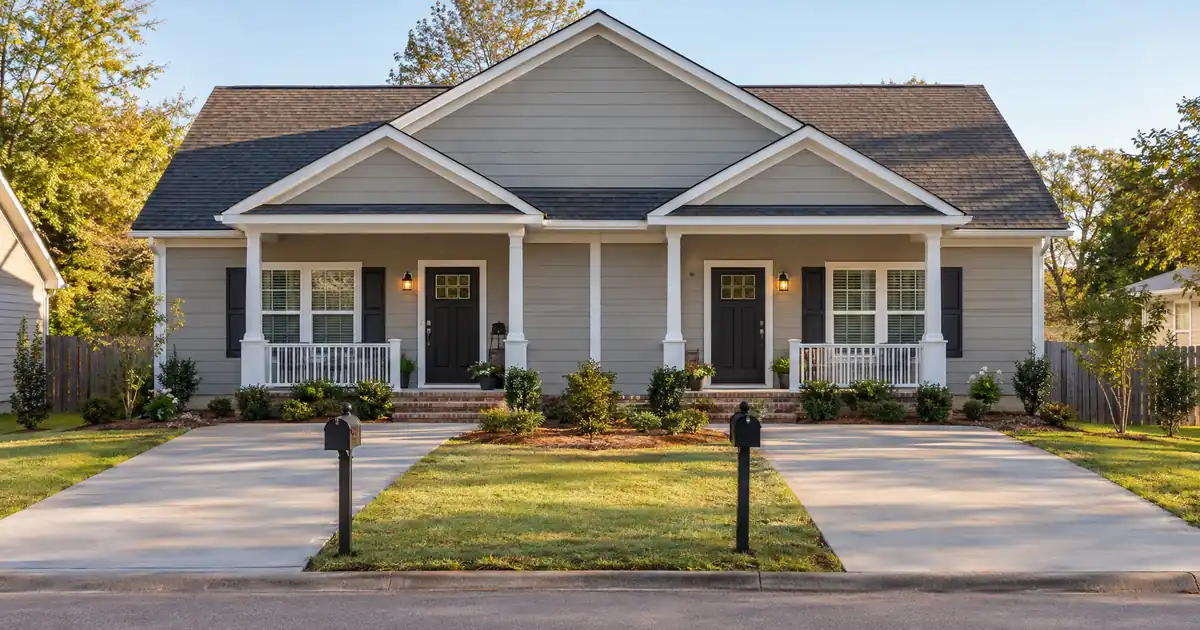
The Quick Read: The best program for your duplex depends on the property’s condition, your experience, and your exit, because a hard money cash-out refinance is a short, interest-only loan sized on value that you repay with a sale or a long-term refinance. Hard money lenders in Lendmire’s wholesale network typically allow cash-out up to about 65% of value on 1-4 unit non-owner-occupied property, and that cap, not the bridge cap, sets how much cash you actually pull out.
- Terms typically run 6-18 months, interest-only, with no prepayment penalty. These terms vary by lender, property, and experience.
- A duplex qualifies as 1-4 unit residential collateral. Owner-occupied properties are not offered.
- Credit minimums start around 620, with added conditions below 660. Underwriting stays asset-based: property, plan, and exit.
- Cash back is the new loan minus the payoff minus closing costs. Value that slips a few points can erase it.
- A bridge with no clear exit is the main failure mode, so pick the exit before you close the bridge.
What Is a Hard Money Cash-Out Refinance on a Duplex?
It is a short-term loan secured by your duplex that pays off what you owe and puts the leftover equity in your pocket. “Hard money” describes the source, usually a private lender rather than a bank. “Bridge” describes the job: Corporate Finance Institute defines a bridge loan as short-term, collateral-backed financing repaid by permanent financing. For a duplex investor the two overlap. Both are asset-based loans that need a takeout.
Why use one? A bridge cash-out fits when the duplex isn’t ready for long-term financing. Maybe one unit is vacant. Maybe you just finished a rehab. Maybe you hold it with little debt and want capital for the next deal now.
Key Terms Defined
Hard money loan: a short-term, interest-only loan from a private lender, sized mainly on the property’s value and your plan rather than your income.
Bridge loan: temporary financing that carries you until a sale or a long-term refinance repays it.
Cash-out refinance: a new loan that pays off the old one and returns the extra cash to you.
Payoff-only refinance: a new loan that covers only the old balance plus closing costs, with no cash back.
Seasoning: the waiting period a lender wants after you buy or record title before it will lend against the higher value.
DSCR: debt service coverage ratio, meaning monthly rent divided by the full monthly payment (principal, interest, taxes, insurance, and any HOA dues).
ARV: after-repair value, the estimated worth of the property once the work is done.
How Does the Program Work on a Duplex, Step by Step?
1. Define the scenario. You share the property, the current payoff, the plan for the cash, and the exit. A broker matches that to the lenders whose guidelines fit.
2. Appraisal. A duplex is a two-to-four unit property, so the appraiser typically uses the small residential income property form. Fannie Mae’s Selling Guide names that form 1025 and lists it for two- to four-unit properties. Agency rules don’t govern this loan. The form name is just the standard format. Both units’ rents and condition feed the value.
3. Sizing. On a cash-out refinance, hard money programs in the network typically lend up to 65% of value, varying by lender, property, and experience.
4. Payoff and closing. Title pulls a payoff statement from your current lender. That figure includes principal, accrued interest, and fees. The new loan pays it off, and what remains after costs is released to you.
5. Carry. You pay interest only during the term, with no prepayment penalty. Then you sell or refinance.
Loan sizes run up to $5,000,000, with larger by exception. Smaller balances vary by lender. Collateral must be non-owner-occupied. Commercial, land, and owner-occupied properties are not on the sheet.
What Does the Net Cash Look Like? A Worked Example
Run the numbers in percentages. Assume the duplex appraises at 100% of value. Assume your current payoff, including accrued interest and fees, equals 45% of that value. These are modeled assumptions, not market data.
- New loan at the 65% cap: 65% of value.
- Minus payoff: 45% of value.
- Leaves roughly 20% of value before closing costs and any reserves the lender asks for.
Now see how fragile that is. If the appraisal lands 5% under your expectation, the value is 95% of the original figure. The cap is then about 61.75% of the original value. Your cash drops to roughly 16.75% of the original value before costs, compared with the cushion you first modeled. If the payoff were 60% instead of 45%, a small value slip could turn a cash-out into a cash-to-close problem. Size the new loan from the exit backward, and treat the appraisal as the one number you don’t control.
How Do You Judge the Best Program for Your Situation?
No single program wins for every duplex. Which program fits best depends on your property status, your experience, and your exit. Use this scorecard to compare programs your broker brings you.
| Criterion | What to look for | Why it matters |
|---|---|---|
| Cash-out leverage | Up to 65% of value typical | Sets your cash back |
| Term and extension | 6-18 months, interest-only | Must outlast your exit |
| Prepayment | None on this program | Lets you exit early |
| Documentation | Asset-based file | Less paperwork, more property focus |
| Experience tier | Higher tiers need completed projects | Affects leverage and pricing |
| Exit fit | Matches a sale or long-term loan | The takeout decides success |
The bridge cap and the exit cap are separate. A short-term loan can look generous until the next lender’s limit lands lower than your payoff. A broker who shops several wholesale lenders can line up the cash-out against the exit before you commit.
When Is Hard Money the Right Tool on a Duplex?
It fits when the property can’t yet qualify for long-term financing. A half-rehabbed duplex, a unit that just turned over, or a building with no lease history all have no rent to underwrite. A bridge earns its place there.
It fits less when the duplex is leased, stable, and seasoned. In that case you pay for a temporary loan and then pay again to refinance out of it. A long-term rental loan alone is often cleaner.
Here is how the choice usually breaks down:
| Property status | Usual better fit |
|---|---|
| Vacant or mid-rehab | Hard money bridge |
| Newly leased, not yet seasoned | Bridge now, long-term loan later |
| Leased, stable, equity in place | Long-term rental financing |
Duplex-Specific Underwriting Issues
Two units mean two income streams and two risks. The appraiser looks at rent for each unit. A vacant second unit drags value and complicates any later rental coverage test.
Expect these questions on a duplex:
- Are both units leasable today, and is there a lease for each?
- Is each unit separately metered, and does the layout read as a true two-unit building?
- Do the rents the appraiser supports match what you plan to tell the exit lender?
- Is there deferred work that would show up in the value?
Beyond the property itself, the file also rests on the story behind it. Hard money underwriting runs on the property, the plan, and the exit, so a clean account of how the duplex gets stabilized does real work. Credit still matters. A 620 minimum is typical, with additional conditions below 660. First-time investors qualify at the lower leverage tiers, and the top tiers are reserved for experienced investors.
Seasoning and the Payoff-Only Versus Cash-Out Label
If cash comes back to you, it is a cash-out. It is a payoff-only refinance only when the new loan covers the old balance and costs and nothing more. That label matters because any cash back brings the cash-out treatment, and with it the waiting period and the leverage limits that apply to cash-out.
Seasoning is lender policy, not law. Lenders differ on where the clock starts: some count from the date title was recorded, and others from the bridge closing. Because that choice can change when you become eligible, ask each lender which date it uses before you plan around a timeline.
A two-step plan is common. Do a payoff-only refinance now, then take the cash-out later once the waiting period has passed. Some lenders size a loan on your documented cost basis instead of the after-repair value when the bridge is paid off early, so in that case expect the cap to apply to documented cost rather than the ARV.
Where Does This Go Wrong? Exit Risks
Mismatched timing is the usual failure. These are the situations to plan for:
- Appraisal comes in short. Less cash back, or cash to close. See the example above.
- Second unit isn’t leased. The exit lender may not count the rent, which weakens the takeout.
- Bridge matures first. You face an extension fee or default pressure. Keep a second exit, such as a sale.
- Maxed-out bridge. If the bridge is already near its cap and the exit is capped lower, there is no cushion.
Start the exit conversation well before the maturity date. Don’t wait until the final stretch of a 6-18 month term to find out what the next lender needs.
Who Should Skip This
Skip a hard money cash-out if your duplex already qualifies for long-term financing and you have time. Skip it if the exit is a hope rather than a plan. Skip it if the cash is meant for something with no clear payback. Owner-occupied homes, commercial buildings, and land are outside this program.
What Happens at the Exit?
Many investors refinance out of hard money into long-term DSCR financing once the duplex is leased and stable, and Lendmire arranges that path. DSCR loans qualify primarily on property-level rental income covering the payment, subject to lender guidelines. On a cash-out, DSCR programs in the network top out around 75% LTV, with about six months of seasoning as the common expectation. Coverage of 1.00 is where select programs start, and stronger ratios open better leverage. A separate select-lender path takes coverage below 1.00, with leverage and terms adjusted.
Clearing 1.00 is not the same as positive cash flow. DSCR compares rent to the full payment only, so repairs, vacancy, management, and utilities sit outside it. For the full picture, see the complete DSCR loans guide.
What to Prepare
Gather these before you talk to a broker:
- The payoff statement or current loan balance.
- Entity documents if you hold title in an LLC, subject to lender program eligibility.
- Current insurance on the duplex.
- Leases and deposit records for each unit, where they exist.
- Your renovation scope and a plain statement of how you’ll repay the loan.
- A list of completed projects, if you have them, since experience drives the leverage tier.
Frequently Asked Questions
Can a duplex get a hard money cash-out refinance?
Yes, in most cases. Hard money programs in the network accept non-owner-occupied residential property with 1-4 units, so a duplex fits. Cash-out leverage typically runs up to 65% of value, varying by lender, property, and experience.
Is paying off a hard money loan with a new loan a cash-out?
Only if cash comes back to you. If the new loan covers just the old payoff and closing costs, it is treated as a payoff-only refinance. Any cash returned makes it a cash-out, and the cash-out limits apply.
Is there a prepayment penalty on a bridge loan?
Not on this program. Terms are typically 6-18 months and interest-only, with no prepayment penalty, so you can exit early when a sale or refinance is ready. Terms vary by lender and property.
Does the duplex need to be leased?
Not always. A vacant or mid-rehab duplex is a common reason to use a bridge, since there’s no rent to underwrite. A lease matters more once you move to long-term financing that tests rental coverage.
Do I need strong credit?
A 620 minimum score is typical, with additional conditions below 660. Underwriting is asset-based, so the property, plan, and exit carry the file. Nothing is a guarantee of approval, and every file is reviewed individually.
Next Step
If you are buying, rehabbing or refinancing an investment property on a short timeline and want to see how the numbers work, Lendmire can help you compare hard money options based on the project, the exit plan, leverage, and your goals. Lendmire is a mortgage broker that arranges financing through select lenders in its wholesale network across 41 markets, including Washington, D.C. Program terms are subject to lender guidelines and are not a commitment to lend. A duplex with a clear exit and a realistic appraisal leaves the least room for a bridge to go wrong.
About Lendmire
Lendmire is a non-QM mortgage brokerage (NMLS# 2371349) arranging DSCR investor loans in 41 markets, including Washington, D.C. DSCR eligibility is generally reviewed around property-level rental income rather than personal income, subject to lender and program guidelines, a fit for self-employed investors and LLC-owned portfolios. Lendmire was recognized as a Scotsman Guide Top Mortgage Workplace in 2025 and 2026.
Get Started
Ready to find the right loan for you?
See your offer in seconds. No credit pull, no obligation.
Informational only. Not a Loan Estimate, approval, or commitment to lend. Program availability and eligibility are subject to lender guidelines, credit approval, property review, and underwriting.
References
1. Corporate Finance Institute: What Is a Bridge Loan
This article is part of Lendmire’s hard money loan program — full qualification details, guidelines, and scenarios live on the program page.
Related reading: How Much Cash Comes Out of a Short-Term Rental Cash-Out Refinance at 75% Loan-to-Value? · How Much Cash Comes Out of a DSCR Cash-Out Refinance When the Hard Money Note Is Due?
Brandon Miller
Founder & CEO, Mortgage Loan Originator, Lendmire LLC
- Mortgage Loan Originator · NMLS# 1129696 · Verify on NMLS Consumer Access
- North Carolina Real Estate Broker · License# 343312 · Verify on NCREC
- North Carolina Insurance Producer · License# 19053198 · Property, Casualty, Life, Health · Verify on NAIC SBS
- Lendmire LLC · Firm NMLS# 2371349 · Verify firm licensure
Important disclosures. Lendmire (NMLS# 2371349) is a licensed mortgage brokerage. Lendmire is not a direct lender, depository institution, or financial advisor. All loan inquiries are subject to lender underwriting; this article does not constitute a commitment to lend. Rates, terms, and program guidelines are subject to change without notice and vary by borrower profile, property type, and state. Information in this article is general in nature and is not financial, legal, or tax advice. Equal Housing Opportunity. NMLS Consumer Access: nmlsconsumeraccess.org.