
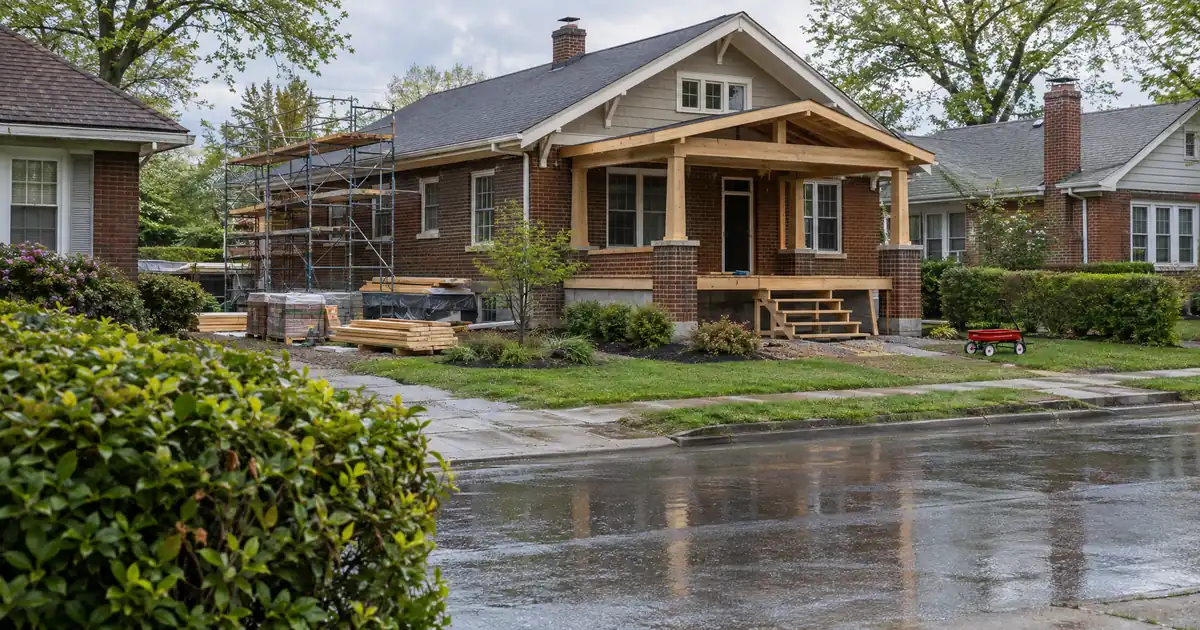
The Quick Read: A bank statement HELOC changes only how your income is documented. The value of the property, the combined loan-to-value limit, and the lien position are still underwritten the normal way. A rehab earns credit only if the valuation actually sees it, so the fix depends on who or what set the number.
- Bank statements prove income. They do not relax the collateral review.
- On investment lines in Lendmire’s wholesale network, value is ordinarily an automated estimate of the property as it stands today.
- If software set the value, you ask for a full appraisal. If a person set it, you ask for a documented reconsideration.
- The investment-property ceiling on this network is 70% combined loan-to-value, with a maximum line of $500,000.
- Cost is not value. Comparable sales decide what a rehab is worth.
Lendmire is a mortgage broker, not a lender. It places these files with select wholesale partners, and every figure below is subject to lender guidelines and full file review. This is not a commitment to lend.
How large a line the equity supports.
An equity line is sized by combined loan-to-value, occupancy, and credit — not by rental coverage. Switch the occupancy or the credit band and the ceiling moves with it.
Investment-property lines require a 700 minimum credit score; second-home lines start at a 640 minimum and primary-residence lines at 600, and the combined-LTV ceiling steps down as the credit band drops on primary-residence and second-home lines and holds on investment-property lines; the line cap steps down on primary-residence lines and holds at every tier on investment-property and second-home lines.
A debt-to-income ratio above 45% requires 680+ credit. Profiles under 640 are limited to single-family homes. At least 75% of the approved line is drawn at closing. Ceilings, floors, and caps update from Lendmire’s centralized guideline source.
Line estimate
Illustrative estimate only — not a quote, Loan Estimate, approval, or commitment to lend. The rate is an editable assumption; equity-line pricing is variable through both the draw and repayment periods and never converts to fixed. Occupancy and credit drive the ceiling together: an investment property tops out at 70% combined LTV (minimum credit 700, line cap $500,000); a second home tops out at 90% combined LTV (minimum credit 640, line cap $500,000), with the ceiling stepping down as the credit band drops (the cap holds at every tier); a primary residence tops out at 90% combined LTV (minimum credit 600), and its $750,000 maximum line is available only at 75% combined LTV or below with a 700-or-better credit profile (720 on the longer-runway program) and a full appraisal. Lines above $500,000 require a full appraisal. Credit, debt-to-income, property type, and full underwriting review all affect the final line.
What Is a Bank Statement HELOC?
A bank statement HELOC is a home equity line of credit where you prove income with deposit history instead of tax returns and pay stubs. It is built for self-employed borrowers and business owners whose tax returns understate their real cash flow.
The typical setup is simple. A borrower with no W-2 provides 12 to 24 months of personal or business bank statements, and the lender can apply an expense factor or use a profit-and-loss statement from a third-party tax professional, as Scotsman Guide describes the general non-QM pattern. The lender sets the expense factor, not you.
It is not a no-doc product. The file is reviewed on documented income under the applicable program, subject to lender guidelines. Credit, equity, and the property are all still reviewed.
That distinction is the whole point of this article. Income and value are two separate tests. Passing the first does nothing for the second.
How Underwriting Treats It, Step by Step
Here is the sequence a file follows, from statements to a final line size.
1. Statement window. The lender collects consecutive statements, commonly 12 to 24 months.
2. Deposit cleanup. Transfers between your accounts, loan proceeds, and refunds come out. Only real business or personal income deposits count.
3. Expense factor. On business accounts, the lender applies a factor to reflect operating costs. You do not choose it.
4. Credit and debt review. Debt-to-income tops out at 50% on this network, and 45% for profiles from 600 to 679. A ratio above 45% requires a 680 score. Qualifying runs on the interest-only payment calculated on the maximum draw.
5. Valuation. This is where rehabs get lost. More on it below.
6. Line sizing. The formula is value times the maximum combined loan-to-value, minus all existing liens. Combined loan-to-value (CLTV) is the total of all mortgage balances against the property, as a percentage of its value. On this network it counts the full credit limit, not just the drawn balance.
Steps one through three are about you. Steps five and six are about the property. A rehab only matters at step five.
Why the Valuation Missed Your Rehab
Lines at or below $500,000 ordinarily run an automated valuation model (AVM), a software estimate of value built from public records and recent sales. A higher CLTV may trigger a secondary valuation, and you may request a full appraisal in any case. Every line above $500,000 requires a full appraisal, though investment lines cap at $500,000.
An AVM cannot walk through your kitchen. It does not see new mechanicals, a finished basement, or a gutted-and-rebuilt bath. It sees square footage, location, and what nearby properties sold for.
That is why unfinished work does not count toward the limit, and why after-repair value is not the base. The line is sized on the property as it stands today.
NerdWallet notes that a HELOC on an investment property is not offered by every lender, has strict qualification requirements, and may involve multiple appraisals to confirm value. Treat that as a signal. Investment lines are the most scrutinized category.
Use this table to diagnose what happened.
| What set the value | Can it see the rehab? | Your move |
|---|---|---|
| AVM (software) | No | Request a full appraisal |
| Full appraisal | Only if comps support it | Ask for a reconsideration of value |
| Secondary valuation | Partly | Ask which type it was, then follow the matching path |
| Appraisal, work unpermitted | May be excluded | Resolve permit status first |
Ignored, Under-Credited, or Correctly Valued?
Not every low number means the rehab was ignored. Sort your situation into one of these.
Ignored. The valuation never saw the work. This is the classic AVM miss. The fix is a better valuation.
Under-credited. A human appraiser saw the work but lacked renovated comparable sales nearby. Appraisers are constrained by comparable sales, so a thin set of comps holds the number down.
Correctly valued below cost. You spent more than the market will pay for. This is over-improvement. Spending does not equal value, and no reconsideration will change that.
Too early. You finished the work just before applying. There may be too few recent sales reflecting similar upgrades. Waiting a few months can let more renovated comps close.
Two other traps deserve a name. Unpermitted additions or renovations may be excluded from an appraisal altogether. And unfinished work simply does not count.
Honest advice: the stronger play is often to figure out which of these four you are in before spending a dollar on a fix. The remedy for “ignored” does nothing for “correctly valued below cost.”.
What a Missed Rehab Does to Your Line
The line follows the value the model sees, not your rehab budget. Because the same lien balance is a larger share of a lower value, a missed rehab squeezes your room twice.
Run the numbers on a modeled example. Assume a rental the software values at 100 units and a true post-rehab value of 120 units. Assume an existing first mortgage equal to 50 units. These are illustrative assumptions, not market data.
- At the 70% investment ceiling, the AVM value gives a CLTV capacity of 70 units. Subtract the 50-unit lien and the available line is 20 units.
- At the true value, capacity is 84 units. Subtract the same lien and the line is 34 units.
The missed rehab cost you 14 units of line, which is a substantial shortfall against the 20 units you were left with. The percentage swing gets sharper the thinner your equity cushion is. The calculator on this site can give an illustrative estimate of your own numbers, but it is not a quote.
The flip side matters too. If a reconsideration or second valuation comes back lower, you lose room instead. A review can hold the value or reduce it.
Build Your Rehab Evidence File
Whether you are asking for a full appraisal or a reconsideration, evidence wins. A reconsideration request goes to your lender, not to the appraiser directly. How to Read an Appraisal explains that a good request names the appraisal’s effective date and appraiser, describes what is wrong or missing, and explains why the new information supports reconsidering.
| Document | What it proves | Where to get it |
|---|---|---|
| Recent renovated comps | What similar work sells for | Your agent, public sales records |
| Permits and final sign-off | Work was legal and completed | Local building department |
| Contractor invoices and scope | What was done and when | Your contractor, your records |
| Before and after photos | Condition change | Your own files |
| Property-detail corrections | Errors in square footage or bed/bath count | Public records, floor plan |
Opendoor offers a similar evidence list as supporting color: missed comps, documentation of upgrades and permits, and errors in property details. Comps are the heaviest item. An appraiser reflects contributory value, and comparable sales set it.
The Step-by-Step Fix
The order depends on who set the value.
1. Find out what produced the number. Ask your loan officer whether it was an AVM, a secondary valuation, or a full appraisal.
2. If it was an AVM, request a full appraisal. There is no report to reassess, so there is nothing to challenge. A model can’t see physical condition or recent improvements, and the appraisal is the right fix.
3. If it was a human appraisal, submit a reconsideration of value (ROV). An ROV is a request, routed through the lender, asking the appraiser to reassess value. Lead with recent renovated sales near your property.
4. Know the limits. Appraisers can reject a request that relies on non-comparable sales or does not show enough discrepancy.
5. If it still does not move, wait and revalue. More renovated comps may close in a few months.
The federal guidance on this process is aimed at institutions. The Federal Register carries interagency guidance describing how lenders can build ROV processes into their risk management. It is not a borrower right. Your lender decides, and the appraiser changes the number only if the evidence supports it.
What Won’t Work
- Arguing with software. An AVM has no one to persuade. Ask for the appraisal.
- Treating receipts as value. Cost is not value. A $60,000 kitchen can appraise for less than $60,000.
- Assuming a bank statement file gets softer collateral treatment. It does not. Documentation changes, nothing else.
- Expecting the appraisal to be forced. A reconsideration is a request, not a demand.
- Finishing work the week you apply. The comps may not exist.
Also, a note on regulation, because borrowers sometimes assume protections apply. The federal AVM quality-control rule covers AVMs used on mortgages secured by a consumer’s principal dwelling. A rental is not a principal dwelling, so it likely does not reach an investment-property line. That is a reading of the rule’s wording, so do not count on it either way.
Where the General Rule Breaks
Several edge cases change the answer.
Title and entity. The line must be held by you personally or in a revocable living trust. LLCs, corporations, partnerships, and irrevocable, blind, or land trusts cannot hold title. A property already deeded to an LLC needs a vesting change, or a DSCR cash-out refinance instead. Per lender program requirements, that is the sharpest structural difference from a DSCR loan.
Draw structure. Investment lines run a 5-year interest-only draw with a 25-year repayment. At least 75% of the line is drawn at closing, so it behaves more like a lump-sum second lien than a flexible repair reserve. Pricing floats and does not convert to fixed.
Credit floor. Investment properties require at least a 700 credit profile, and the CLTV ceiling is 70% whether you are at 700 or 720-plus.
Portfolio size. A borrower owning more than 15 financed properties is not eligible. Exposure is also limited to three lines.
Property type. Single-family, 2-4 units, PUDs, townhomes, and condominiums (including non-warrantable) are eligible. Manufactured homes, co-ops, condotels, log homes, commercial, mixed-use, and agricultural-zoned properties are not.
Recent purchase. Some lenders use the lesser of sale price or current value on a recently purchased property, which means a rehab done right after buying may get no credit at all. That is a common lender practice, not a universal one.
Availability. These HELOC programs are available only in Lendmire’s 16 full-service states, narrower than its DSCR footprint of 41 markets, including Washington, D.C.
When Another Path Fits Better
If the valuation simply cannot capture your rehab, a different product may fit. A DSCR cash-out refinance is reviewed on property-level rental income rather than your personal debt load, and it uses its own full appraisal. It qualifies primarily on property-level rental income covering the payment, subject to lender guidelines, and it can be held in an LLC, depending on program guidelines.
DSCR cash-out compares rent to the full monthly obligation. Clearing 1.00 is not the same as positive cash flow, because repairs, vacancy, and management sit outside the ratio. Cash-out leverage on standard rentals tops out around 75% LTV across most of the network, with about six months of seasoning commonly expected, and select lenders offer coverage below 1.00 with leverage and terms adjusted. The tradeoff is a new first-lien loan, not a standalone line.
Compare the two in Lendmire’s HELOC versus cash-out refinance breakdown, or see the complete DSCR loans guide for how the investor loan side works.
Because a broker shops multiple wholesale lenders, the right program depends on your situation: property type, credit profile, leverage need, and how the property is titled.
Key Terms Defined
Combined loan-to-value (CLTV): All loans against the property added together, divided by its value.
AVM: An automated valuation model, a software estimate of value with no interior inspection.
ROV (reconsideration of value): A lender-routed request that a valuation be reassessed using new information.
Contributory value: What a specific improvement is worth in the market, as shown by comparable sales.
Superadequacy (over-improvement): Spending on upgrades beyond what nearby comparable properties support.
Lien position: Whether a loan sits first or second in line to be repaid.
Frequently Asked Questions
Does bank statement income change the appraisal?
No. Bank statements only document income. Value, CLTV limits, and lien position are underwritten the same way as on any other line, so a rehab gets credit only if the valuation sees it.
Can I request a full appraisal?
Yes. On this network a borrower may request a full appraisal in any case, even when an automated valuation would ordinarily be used. It is the usual fix when software missed your work. Your loan officer can confirm the process and any added cost.
Can the value go down after a review?
Yes. A second appraisal or reconsideration can hold the value or lower it. That is why the comps in your evidence file matter more than the receipts.
What if the work is unpermitted?
Unpermitted work may be excluded from the appraisal. Resolve permit status before you request a new valuation, or expect the work to be left out of the value.
Can I use an LLC for a bank statement HELOC on a rental?
No. The borrower must hold title personally or in a revocable living trust. A property already in an LLC needs a vesting change, or a DSCR cash-out refinance may fit better, subject to program terms.
If you are considering a home equity line and want to see how the numbers work, Lendmire can help you compare HELOC options based on the property, the equity available, credit profile, combined leverage, and your goals. Call 828-256-2183 or request a quote.
The investors who get paid for their rehab are rarely the ones with the biggest budgets; they are the ones who timed the work to the comps and showed the valuation exactly what changed.
About Lendmire
Lendmire (NMLS# 2371349) is a mortgage brokerage serving homeowners and real estate investors in its 16 full-service states. Home equity lines of credit are arranged through wholesale lending channels; Lendmire brokers the line and the lender underwrites each application under its occupancy-based guidelines. Scotsman Guide named Lendmire a Top Mortgage Workplace in both 2025 and 2026.
Get Started
Ready to find the right loan for you?
See your offer in seconds. No credit pull, no obligation.
Informational only. Not a Loan Estimate, approval, or commitment to lend. Program availability and eligibility are subject to lender guidelines, credit approval, property review, and underwriting.
References
1. Scotsman Guide – Rev Up the Engine for Non-QM Lending
2. NerdWallet
3. How to Read an Appraisal – Reconsideration of Value
4. Opendoor – What Appraisers Look For
5. Federal Register – Interagency Guidance on Reconsiderations of Value
6. Federal Register – Quality Control Standards for Automated Valuation Models
This article is part of Lendmire’s bank statement HELOC program — full qualification details, guidelines, and scenarios live on the program page.
Related reading: How a Bank Statement HELOC Works for Investors With Rentals in Several States · How a Bank Statement HELOC Works and Keep Your Current First Mortgage · How a Bank Statement HELOC Works With One Year of History
Brandon Miller
Founder & CEO, Mortgage Loan Originator, Lendmire LLC
- Mortgage Loan Originator · NMLS# 1129696 · Verify on NMLS Consumer Access
- North Carolina Real Estate Broker · License# 343312 · Verify on NCREC
- North Carolina Insurance Producer · License# 19053198 · Property, Casualty, Life, Health · Verify on NAIC SBS
- Lendmire LLC · Firm NMLS# 2371349 · Verify firm licensure
Compliance and disclosures. Lendmire (NMLS# 2371349) is a licensed mortgage broker and is not a direct lender, depository institution, financial advisor, or tax professional. Content in this article is general market analysis and educational information — not financial, legal, or tax advice for any specific situation. Lendmire does not guarantee loan approval; every transaction is subject to underwriting by the funding lender. Mortgage pricing and loan program guidelines are subject to change at any time without notice and vary by borrower characteristics, property type, and state regulations. Lendmire complies with Equal Housing Opportunity. Licensure verification: NMLS Consumer Access.