
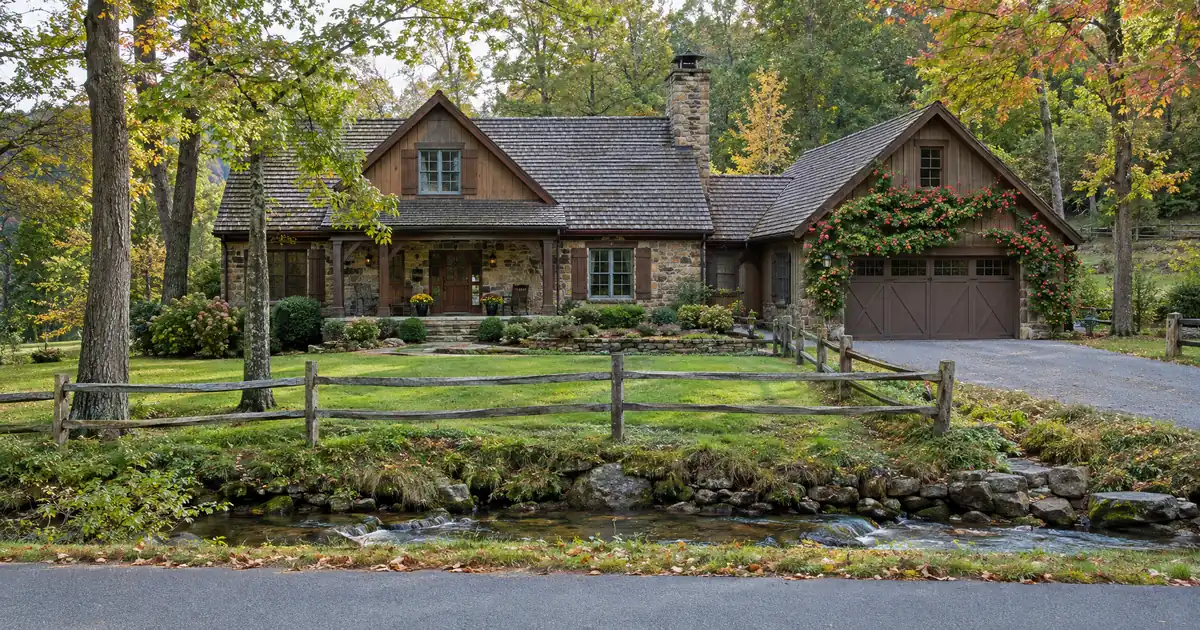
The Quick Read: The right program is the one whose lender accepts deposit-based income documentation, credits the land it can actually value, and fits your occupancy, credit profile, and combined leverage, so the match depends on the property as much as on the income. A bank statement proves income only, and the property has to pass its own separate test.
- Income and property are two separate lanes. Deposits can document income, but zoning, acreage, appraisal and title decide whether the line can close.
- On this network, an investment-property line tops out at 70% combined loan-to-value. A line on a primary residence or second home can reach 90% only at a 720 credit profile.
- Agricultural zoning, manufactured homes, and log homes are not eligible.
- LLC-held rentals cannot hold title on these lines.
- Excess land is often valued low, and in a high-cost market that can shrink usable equity more than owners expect.
What a Bank Statement HELOC Actually Is
A bank statement HELOC is a documentation method laid over a home equity line. It is not a separate legal product. Instead of tax-return net income, the lender reads 12 to 24 months of personal or business deposits. It removes deposits it cannot source and applies an expense factor to business accounts. Then it averages the result over the statement period.
How large a line the equity supports.
An equity line is sized by combined loan-to-value, occupancy, and credit — not by rental coverage. Switch the occupancy or the credit band and the ceiling moves with it.
Investment-property lines require a 700 minimum credit score; second-home lines start at a 640 minimum and primary-residence lines at 600, and the combined-LTV ceiling steps down as the credit band drops on primary-residence and second-home lines and holds on investment-property lines; the line cap steps down on primary-residence lines and holds at every tier on investment-property and second-home lines.
A debt-to-income ratio above 45% requires 680+ credit. Profiles under 640 are limited to single-family homes. At least 75% of the approved line is drawn at closing. Ceilings, floors, and caps update from Lendmire’s centralized guideline source.
Line estimate
Illustrative estimate only — not a quote, Loan Estimate, approval, or commitment to lend. The rate is an editable assumption; equity-line pricing is variable through both the draw and repayment periods and never converts to fixed. Occupancy and credit drive the ceiling together: an investment property tops out at 70% combined LTV (minimum credit 700, line cap $500,000); a second home tops out at 90% combined LTV (minimum credit 640, line cap $500,000), with the ceiling stepping down as the credit band drops (the cap holds at every tier); a primary residence tops out at 90% combined LTV (minimum credit 600), and its $750,000 maximum line is available only at 75% combined LTV or below with a 700-or-better credit profile (720 on the longer-runway program) and a full appraisal. Lines above $500,000 require a full appraisal. Credit, debt-to-income, property type, and full underwriting review all affect the final line.
It is not a no-paperwork loan. The borrower is reviewed on documented income under the applicable program, subject to lender guidelines. Credit, debt-to-income, equity, reserves and title all still apply. The statements replace the tax return and nothing else.
Lendmire is a mortgage broker, not a lender. It places these files with wholesale lenders, and each lender sets its own menu for self-employed income. Some accept only personal statements, some accept business statements, and some use an expense factor. The “best” program is therefore not a brand. It is a fit between your file and a lender’s rules.
Key Terms Defined
CLTV (combined loan-to-value): All liens on the property added together and divided by the appraised value.
Excess land: Acreage beyond what supports the home as a residential site, which appraisers often value separately and sometimes give little credit.
Draw period: The stretch when you can borrow against the line and pay interest only, before the balance begins to amortize.
Expense factor: A lender-set percentage of business deposits treated as operating cost and removed before income is counted.
High-cost state: A loose term with three meanings, covered below. They are not interchangeable.
Vesting: The way title is held, for example by an individual or in a revocable trust.
Lane One: How Deposits Become Qualifying Income
Underwriting follows the same order on most files.
1. Choose the lien position. The line can sit as a standalone second behind an existing first mortgage, which leaves that first mortgage untouched. On a free-and-clear property it can sit in first position.
2. Pick the statement set. Lenders read 12 or 24 months of deposits. Business accounts get an expense factor, and personal accounts generally do not.
3. Clean the deposits. Transfers between your own accounts, loan proceeds, and one-off windfalls come out. Expect a letter of explanation for anything large and unusual.
4. Run the ratios. Debt-to-income is capped at 50% on this network, and 45% for credit profiles from 600 to 679. A ratio above 45% requires at least a 680 score. The line is qualified on the interest-only payment calculated on the maximum draw, so the test is stricter than the first month’s payment suggests.
5. Test the property. This is where acreage decides the outcome, and it gets its own section below.
One point about regulation, kept short. The federal ability-to-repay framework does not apply to open-end credit such as HELOCs, according to the CFPB’s small-entity compliance guide. The same guide lists bank statements among reliable third-party income records. The practical effect is that no federal rule writes a bank statement menu for a line. The menu comes from lender policy, which is why two lenders can treat the same deposits differently.
Lane Two: Why Acreage Is the Real Test
Bank statements fix the income question, not the property question. A file can pass on income and still stall at valuation.
Rural appraisers often have to use comparable sales that sit far from the subject or differ from it. Training material from Enact MI says appraisers must support those comps in the report. Thin comps mean wider adjustments and more room for a low number.
Three property issues come up again and again.
- Land use. Agricultural zoning is not eligible on this network, so a parcel used mainly for farming or timber is a problem before income is ever reviewed.
- Excess land. The residential site is valued off residential comps. Extra acreage is usually valued separately, often near raw-land prices, and may add little to collateral value.
- Structure type. The eligible list covers single-family, 2-4 units, PUD, townhome, and condominium, including non-warrantable condos. Modular factory-built homes are eligible on the longer-runway program only. Barndominiums are not on the eligible list either.
At least one state in the network limits properties to 10 acres. Other states have their own homestead and acreage rules, and the lender’s appetite is a separate gate from state law. Check both before you order anything.
Acreage count and “rural” status are also separate questions. A smaller parcel can still be rural by location, and a large parcel near town may not be. Ask the lender how it defines each before you assume.
What “High-Cost State” Changes
Three meanings of “high-cost” get mixed together. The first is a high-priced housing market. The second is a county with a conforming loan limit above the national baseline. The third is a state with unusual closing, recording or homestead rules.
Only the first one matters much for this product. The second is a first-lien concept. According to Orrick, the current baseline one-unit conforming limit is $832,750, with a high-cost ceiling of $1,249,125. HousingWire explains that the ceiling is 150% of the baseline and that an area qualifies where 115% of local median value exceeds it. Those limits size agency first mortgages. They are not an automatic cap on a second-lien line.
What high values do change is the arithmetic.
- Dollar caps bind before percentages do. On an investment property the ceiling is 70% CLTV with a maximum line of $500,000. In an expensive market, 70% of the value can exceed the amount the line allows, so the dollar cap sets the size.
- Land can be a large share of value. When land makes up a big part of the price, a lender discount on that land removes more usable equity than it would in a cheaper market.
- The first mortgage eats the room. CLTV counts every lien. A large first mortgage at a high price can leave little room under the ceiling.
Here is a hypothetical, with no dollar amounts. Say the home and its residential site make up 60% of the appraised value, and excess acreage makes up the other 40%. Suppose the lender gives the excess land little credit. The collateral value then moves toward the 60% figure, and the CLTV ceiling applies to that lower number. The headline price overstates the equity you can reach. The numbers are illustrative only, and each lender and appraiser will treat the land differently.
The Program Parameters That Matter
The ceilings below are tiered by occupancy. Do not read any one of them as the general ceiling. Every figure is subject to lender guidelines and full file review, and none is a commitment to lend.
| Occupancy | Max CLTV | Credit floor | Max line |
|---|---|---|---|
| Primary residence | Up to 90% (720+ only) | 600 | $500,000 at 90% CLTV; $750,000 at 75% CLTV, 700+ (720 on the longer-runway program) |
| Second home | Up to 90% (720+ only) | 640 | $500,000 |
| Investment property | 70% | 700 | $500,000 |
Several details sit beneath that table.
- Primary residence tiers. A 720 profile reaches 90% CLTV on lines up to $500,000. A 700 profile reaches 85% on lines up to $500,000. Lower scores step down, to 80% at 640 and 70% at 620.
- Lines above $500,000. These are primary residence only. They cap at 75% CLTV, require a full appraisal, and need a credit profile of 700 or better (720 on the longer-runway program).
- Investment lines. They need at least a 700 profile and carry a 70% CLTV ceiling at either tier, $500,000 maximum.
- Market contrast. Consumer education from Experian describes investment-property equity lines as commonly capped near 80% market-wide. That is a market statistic. On this network, an investment line stops at 70% CLTV.
The longer-runway program is the structure with a 5-year interest-only draw followed by 25 years of repayment. The other structure uses a 3-year draw and 17 years of repayment, and it exists only for primary residences and second homes. Investment lines use the 5-year structure only. At least 75% of the line is drawn at closing on both, and pricing floats through draw and repayment without converting to fixed. That matters for the payment shock when the draw period ends.
Valuation on a Rural Parcel
Lines at or below $500,000 ordinarily run an automated valuation with no traditional appraisal. A higher CLTV may require a second valuation. A full appraisal is required on every line above $500,000, and a borrower may request one in any case.
On acreage, asking for a full appraisal is often the better call. An automated model has little to work with where sales are sparse and parcels differ. A full appraiser can explain the comps and the land treatment. If the first number comes in light, an appraisal reconsideration request is a normal step. A good packet includes recent nearby sales, a survey, zoning confirmation, and notes on easements.
Edge Cases Where the General Rule Breaks
LLC-held rentals. Title must sit with an individual or a revocable living trust. LLCs, corporations, partnerships, and irrevocable, blind, or land trusts cannot hold title on these lines. A property already deeded to an LLC needs a vesting change first. The other route is a DSCR cash-out, which qualifies primarily on property-level rental income covering the payment, subject to lender guidelines. On most DSCR files a cash-out refinance tops out around 75% LTV, with about six months of seasoning common. Entity treatment depends on program terms. The complete DSCR loans guide covers that route.
Second liens behind an existing HELOC. A line behind another line is a third lien. It may need a subordination agreement, and it counts against the three-line limit per borrower.
Exposure limits. A borrower is capped at three lines, with combined exposure of $2,000,000 on the higher-leverage program and $750,000 on the longer-runway program. A borrower with more than 15 financed properties is not eligible.
Credit events. A bankruptcy needs four years of seasoning from discharge or dismissal. Foreclosure history splits by program. One program seasons a foreclosure at seven years and a deed-in-lieu or short sale at four. The other declines that history regardless of age.
Listed properties. In some states, a property listed for sale, or listed in the past 60 days, is ineligible.
Availability. These lines are available only in Lendmire’s 16 full-service states, which is narrower than the 41-market DSCR footprint.
How to Find the Best Bank Statement HELOC Program for Your Acreage
The right program depends on your situation: the property type, occupancy, credit profile, leverage need, and the way you document income. A broker that shops several wholesale lenders can match a file to the lender whose overlays fit it. The match runs through these questions.
1. Does the property pass first? Check zoning, structure type, title holder and acreage before you gather statements.
2. Which occupancy applies? The 70% investment ceiling and the 90% primary-residence ceiling are different programs in practice.
3. How much equity is left after the land discount? Estimate it conservatively, using the lowest credible value for excess acreage.
4. Do the deposits support the income you need? Business statements with a heavy expense factor can produce less income than personal statements, and the reverse can also be true.
5. What do you need the funds for? A line meant for a down payment raises a separate question, because whether a purchase lender accepts borrowed funds varies by program.
Lenders in the network differ on these points. Some want business statements only. Some weigh the expense factor more heavily. Some are stricter on rural definitions. The strongest files are the ones that arrive with a clean statement set, a survey, proof of zoning, and a clear picture of the first mortgage.
If the Property Does Not Fit
| Situation | Likely path |
|---|---|
| Agricultural zoning | Not eligible; consider a different property or a different product |
| Rental held in an LLC | Vesting change, or DSCR cash-out |
| Manufactured or log home | Not eligible on these lines |
| Equity too thin after land discount | Smaller line, or wait for a stronger appraisal |
| Parcel can be split | Ask whether a separate parcel is workable |
A DSCR cash-out is a different decision from a line. It is a new first-lien loan that replaces the existing mortgage, so it changes the whole loan rather than adding to it. A line can leave a low-rate first mortgage in place, which is often the main reason to choose one. Even then, the line payment comes out of pocket, and clearing underwriting does not mean the property cash flows.
Frequently Asked Questions
Is there a maximum acreage for a bank statement HELOC?
It depends on the lender, the state, and the property’s land use. At least one state in the network limits properties to 10 acres, and lenders set their own rural limits. Agricultural zoning is ineligible regardless of acreage, so land use matters as much as the count.
Will I need a full appraisal on acreage?
A full appraisal is required on every line above $500,000. Below that, lines ordinarily use an automated valuation, but a borrower can request a full appraisal in any case. On a rural parcel with thin comps, requesting one often gives a more defensible value.
Can I use a manufactured, log, or barn-style home?
Manufactured homes and log homes are not eligible. Barndominiums are not on the eligible property list either.
Can I borrow against a rental that sits in an LLC?
Not as titled. An LLC cannot hold title on these lines, so the property needs a vesting change to an individual or a revocable living trust, or a DSCR cash-out instead. Whether an entity structure works depends on program terms.
Can I draw on the line to fund a down payment on another property?
A line is drawn against a property you already own, so it can supply cash. Whether the purchase lender accepts borrowed funds varies by program. Tax treatment can depend on how the funds are used and how the property is held; borrowers should keep clear records and speak with a qualified tax professional before relying on any deduction.
Next Step
Lendmire has written separately on whether a bank statement HELOC is possible on acreage in a high-cost state and on how the process works when the closing state adds its own rules. If you are considering a home equity line and want to see how the numbers work, Lendmire can help you compare HELOC options based on the property, the equity available, credit profile, combined leverage, and your goals. The site’s illustrative calculator gives a starting estimate only. In an expensive market, the land discount and the dollar cap usually decide the final line size.
About Lendmire
Lendmire — NMLS# 2371349 — is a mortgage broker that arranges home equity lines of credit in its 16 full-service states through wholesale lenders, on primary residences, second homes and investment properties. Every line is subject to the lender’s guidelines and full underwriting. Scotsman Guide named Lendmire a Top Mortgage Workplace in both 2025 and 2026.
Get Started
Ready to find the right loan for you?
See your offer in seconds. No credit pull, no obligation.
Informational only. Not a Loan Estimate, approval, or commitment to lend. Program availability and eligibility are subject to lender guidelines, credit approval, property review, and underwriting.
References
1. CFPB ATR/QM Small Entity Compliance Guide
2. Enact MI: rural appraisal training presentation
3. Orrick InfoBytes: FHFA conforming loan limit announcement
4. HousingWire: conforming loan limit overview
5. Experian: HELOC on an investment property
This article is part of Lendmire’s bank statement HELOC program — full qualification details, guidelines, and scenarios live on the program page.
Related reading: How a Bank Statement HELOC Works for BRRRR Investors · How a Bank Statement HELOC Works Without the Other Owner · How to Qualify for a Bank Statement HELOC for Out-of-State Rental Owners
Brandon Miller
Founder & CEO, Mortgage Loan Originator, Lendmire LLC
- Mortgage Loan Originator · NMLS# 1129696 · Verify on NMLS Consumer Access
- North Carolina Real Estate Broker · License# 343312 · Verify on NCREC
- North Carolina Insurance Producer · License# 19053198 · Property, Casualty, Life, Health · Verify on NAIC SBS
- Lendmire LLC · Firm NMLS# 2371349 · Verify firm licensure
Legal disclosures. Lendmire (NMLS# 2371349) is a state-licensed mortgage brokerage that arranges financing through wholesale lender relationships. Lendmire is not a direct lender, depository institution, or registered financial advisor. The discussion above is general informational content about real estate financing — it is not financial, legal, or tax advice, and readers should consult licensed professionals for guidance on their individual circumstances. Loan inquiries are subject to lender underwriting; this article does not represent a commitment to lend. Loan terms, rates, and qualification standards vary by borrower, property, and state, and are subject to change at any time. Equal Housing Opportunity. NMLS Consumer Access: nmlsconsumeraccess.org.