
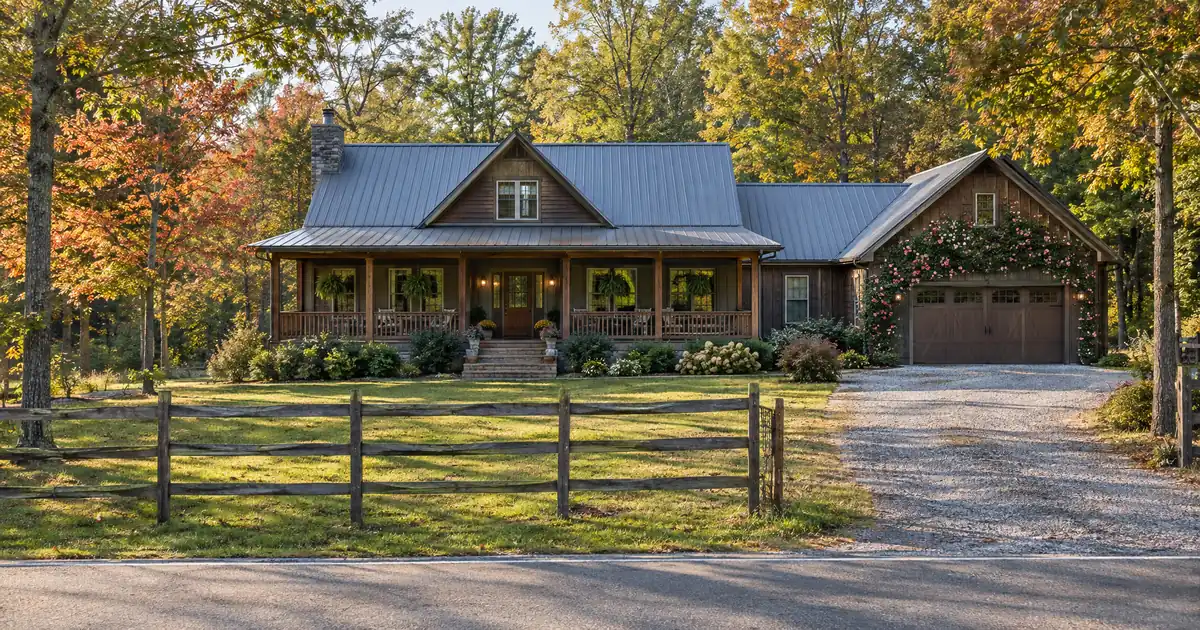
The Quick Read: A lender, not federal law, decides whether acreage blocks or shrinks an equity line. The land matters in three ways: whether the parcel and its zoning read as a residence, how an appraiser values the extra acres, and whether title sits with you or a revocable trust.
- Acreage limits are lender and investor overlays, plus homestead law in a few states.
- Agricultural zoning, log homes and manufactured homes are not eligible on the network’s equity-line programs.
- An investment-property line tops out at 70% CLTV (combined loan-to-value) and a $500,000 line, with a 700 minimum credit score.
- Extra acres rarely add value per acre, so a thin-comp valuation can shrink the line you expected.
- A property held in an LLC needs a vesting change or a different product, often a DSCR cash-out refinance.
Everything below is subject to lender guidelines and full file review. It is not a commitment to lend.
How large a line the equity supports.
An equity line is sized by combined loan-to-value, occupancy, and credit — not by rental coverage. Switch the occupancy or the credit band and the ceiling moves with it.
Investment-property lines require a 700 minimum credit score; second-home lines start at a 640 minimum and primary-residence lines at 600, and the combined-LTV ceiling steps down as the credit band drops on primary-residence and second-home lines and holds on investment-property lines; the line cap steps down on primary-residence lines and holds at every tier on investment-property and second-home lines.
A debt-to-income ratio above 45% requires 680+ credit. Profiles under 640 are limited to single-family homes. At least 75% of the approved line is drawn at closing. Ceilings, floors, and caps update from Lendmire’s centralized guideline source.
Line estimate
Illustrative estimate only — not a quote, Loan Estimate, approval, or commitment to lend. The rate is an editable assumption; equity-line pricing is variable through both the draw and repayment periods and never converts to fixed. Occupancy and credit drive the ceiling together: an investment property tops out at 70% combined LTV (minimum credit 700, line cap $500,000); a second home tops out at 90% combined LTV (minimum credit 640, line cap $500,000), with the ceiling stepping down as the credit band drops (the cap holds at every tier); a primary residence tops out at 90% combined LTV (minimum credit 600), and its $750,000 maximum line is available only at 75% combined LTV or below with a 700-or-better credit profile (720 on the longer-runway program) and a full appraisal. Lines above $500,000 require a full appraisal. Credit, debt-to-income, property type, and full underwriting review all affect the final line.
Key Terms Defined
HELOC: A home equity line of credit. You borrow against equity as needed, up to an approved limit, during a set draw period.
CLTV (combined loan-to-value): All loans secured by the property, added together, divided by the property’s value.
Homesite versus excess land: The homesite is the house and the land it needs. Excess land is acreage that could be sold off separately.
AVM (automated valuation model): A computer estimate of value built from nearby sales, with no one visiting the property.
DSCR (debt service coverage ratio): Monthly rent divided by the full monthly payment on a rental. It is the test behind a DSCR loan, and it measures the property, not your paycheck.
Rural designation: A lender’s label for a property in a rural area. It is a separate test from parcel size.
Is There a Maximum Acreage on a HELOC?
No federal rule sets a maximum acreage for a HELOC. The CFPB’s HELOC brochure covers disclosure of terms and costs and the right to cancel, and it says nothing about lot size. Any acreage ceiling you run into comes from one of three places.
| Layer | Who sets it | What it controls |
|---|---|---|
| Lender policy | Each lender | Lot size, rural label, zoning |
| Investor overlay | The party buying the loan | Property types, valuation method |
| State law | The state | Homestead acreage, lien rules |
Because lenders set their own limits, two lenders can look at the same 12-acre parcel and give opposite answers. Across a wholesale network, the pattern is consistent. Parcel size, rural designation and agricultural zoning are three different tests, and a file can pass one and fail another.
On the network Lendmire places equity lines with, properties zoned for agriculture are not eligible. Neither are log homes, manufactured homes, co-ops, condotels, commercial or mixed-use properties. Lendmire is a broker, so the lender makes the final eligibility call on every file.
The Five Tests a Lender Runs on Acreage
Underwriting an equity line on acreage is a sequence of checks. Passing one does not mean approval.
| Test | What the lender asks | What to bring |
|---|---|---|
| Property type | Does it read as a residence? | Photos, utilities list |
| Zoning and use | Is any part agricultural or commercial? | Zoning letter |
| Valuation | What do the home and homesite support? | Survey, outbuilding details |
| Title and vesting | Who holds title? | Deed, trust paperwork |
| Borrower | Credit, debt load, lien position | Mortgage statement |
Property type and use. The lender first asks whether the place looks like a home with land or a farm with a house on it. It weighs lot size, utilities, zoning, local land use and whether comparable sales exist. A bank statement or a lease can document income, but neither fixes a property problem.
Zoning. Agricultural zoning is a common disqualifier. A small parcel can still be treated as rural, and a larger parcel in a suburban zone might not be. That is why rural designation and size are separate questions.
Valuation. This is where acreage usually bites, and the next section covers it.
Title. The equity line must sit on property held by you personally or by a revocable living trust. LLCs, corporations, partnerships and irrevocable, blind or land trusts cannot hold title. That is the sharpest structural difference from a DSCR loan, which can usually be placed to an LLC subject to program terms.
Borrower. Credit, debt-to-income and lien position come last. The network’s maximum DTI is 50%, with tighter limits for lower credit tiers.
How Lenders Value Land on an Equity Line
Acreage is a valuation problem more than an eligibility problem. Appraisers do not multiply a per-acre price by the acres. They separate the land into two buckets.
McKissock Learning, an appraiser-education provider, describes surplus land as land the existing use does not need and that cannot be sold separately. Excess land can be separated and has its own highest and best use. Appraisers weigh zoning, surrounding uses and supply and demand before deciding which one applies. Excess land generally earns a higher value than surplus land.
The practical result is simple. If your 20 acres are mostly woods and a creek bed that cannot be split off, the appraiser may give the extra land little credit. The house and homesite carry the value.
For contrast, rural agency lending takes a looser approach. USDA Rural Development’s appraisal Q&A says there is no acreage cap on those loans. The appraiser simply has to explain comp adjustments and whether the site is typical. Equity lines on the network are a different product, and the agency approach does not carry over. The point is that even agencies lean on appraiser judgment rather than a hard acreage number.
AVM or full appraisal
On the network, lines of $500,000 or less ordinarily use an AVM with no traditional appraisal. A higher CLTV may require a secondary valuation, and you can request a full appraisal at any size. Every line above $500,000 requires one.
Rural comps are thin, and an AVM leans on nearby sales. Many borrowers with acreage ask for the full appraisal because it gives the lender a human read on the land.
What a thin valuation does to your line
The maximum line is the appraised value times the CLTV cap, minus your existing liens. Your first mortgage does not shrink when the appraiser is conservative. So a modest drop in value cuts the line by a larger share.
Say the appraised value comes in 15% lower than you hoped because the extra acres earned little credit. The line shrinks by more than 15%, because the same first-mortgage balance comes off a smaller number. A property with a large mortgage balance feels this the most.
What the Network’s Parameters Look Like
Equity-line ceilings on the network depend on occupancy. Do not quote one number for all properties.
| Occupancy | Typical top CLTV | Line size | Minimum credit |
|---|---|---|---|
| Investment property | 70% | Up to $500,000 | 700 |
| Second home | 90% (at 720+) | Up to $500,000 | 640 |
| Primary residence | 90% (at 720+) | $500,000 at 90% CLTV; $750,000 at 75% CLTV, 700+ (720 on the longer-runway program) | 600 |
Those are ranges across wholesale partners, not promises. Lendmire places lines with two wholesale programs, one built for higher leverage and one built for a longer repayment runway. Where they differ, each figure applies only within its own program’s terms.
A few more points matter for acreage owners:
- Investment lines use a 5-year interest-only draw followed by a 25-year repayment. At least 75% of the line is drawn at closing.
- Lines above $500,000 are primary-residence only. They need a credit profile of 700 or better (720 on the longer-runway program), cap at 75% CLTV and require a full appraisal.
- Lien position: the line can sit in first or second position.
- Market comparison: market surveys of equity lines for rentals report wider CLTV ranges. Those describe the broader market. On this network, an investment-property line stops at 70% CLTV.
- Availability: equity lines are limited to Lendmire’s 16 full-service states, which is narrower than its DSCR investor-loan footprint across 40 states plus Washington, D.C.
A borrower can hold at most three lines, and a borrower with more than 15 financed properties is not eligible. Qualification also assumes the interest-only payment on the maximum draw, so a larger approved line can strain debt-to-income even before you borrow.
Closing Costs on Acreage in a High-Cost Closing State
A high-cost closing state has heavier closing mechanics. Think of more required steps, more fees tied to title and recording, and in some cases attorney involvement. Your title company or closing attorney can give you the actual state numbers.
What matters for acreage is which costs move with the land and which do not.
| Cost category | What drives it | Scales with acreage? |
|---|---|---|
| Appraisal | Property complexity, travel | Often, on rural land |
| Survey or plat | Parcel size and legal description | Often |
| Title work | Number of parcels, liens | Sometimes |
| Recording and state fees | State rules | Usually not |
Fixed costs favor one larger, well-planned transaction over several small ones. If you are in a high-cost closing state and only need a modest amount of cash, a small line may cost proportionally more than a larger one. That is a reason to size the line to the need rather than the maximum, and to compare it against a full refinance before you commit.
Documents to Gather Before You Apply
Collect these first, because acreage files stall on missing paperwork:
1. A survey or plat and the legal description.
2. Acreage broken out by use: lawn, timber, pasture, water.
3. Outbuilding details: size, build year and permits.
4. Title or vesting documents, so you can confirm you or your revocable trust holds title.
5. Your first-mortgage statement and a current insurance declaration.
6. Photos and a utilities list that show the home reads as a residence.
If the parcel is divisible, say so up front. An appraiser may treat it as two properties, and a lender may exclude the second parcel’s value. Releasing a split-off parcel later would need the first-lien holder’s consent.
Where State Law Adds a Layer
Homestead law is a separate source of limits from lender policy. Texas is the best-documented example. FindLaw’s summary of Texas homestead law says Texas limits the acreage of a homestead, not its value. An urban homestead caps at 10 connected acres, and a rural homestead caps at 200 acres for a family or 100 for a single adult.
On the network, Texas properties are limited to 10 acres. A Texas primary residence is a homestead and caps at 80% combined loan-to-value. It also carries a 12-day waiting period, a one-lien-at-a-time rule and 12-month seasoning. Texas second homes and investment properties are eligible as non-homestead transactions and follow the standard tables above.
Other states handle homesteads differently, and some use acreage limits instead of value limits. If your parcel is large, ask the lender whether a state overlay applies before you order an appraisal.
The cancel-right rules are the other legal layer. A primary-residence HELOC carries the federal three-day right to cancel. A law-firm explainer on HELOC rescission rights says that right does not reach investment or second-home properties.
If Your Property Does Not Fit
Failing an acreage test does not end the conversation. It points you to a different structure. A thin-comp or rural-designated parcel, a rental held in an LLC, or a parcel above a lender’s lot-size limit each has a practical alternative.
| Situation | Options to review |
|---|---|
| Parcel over a lender’s acreage limit | Ask about a lender with a higher limit, or a split |
| Agricultural zoning | Equity line is not offered; look at a refinance |
| Rental held in an LLC | Vest in your name or a revocable trust, or use a DSCR cash-out |
| Thin rural comps | Request a full appraisal |
| Need above the line’s limits | A cash-out refinance replaces the first mortgage |
Most investors with acreage rentals land in the same place. A bank-style equity line underwrites you personally, so a rental competes with your own debts. A DSCR cash-out refinance qualifies primarily on whether the property’s rental income covers the payment, subject to lender guidelines. The tradeoff is that it replaces your first mortgage rather than adding a line behind it.
Here are the DSCR figures across the wholesale network. Cash-out refinances top out around 75% LTV on a standard rental, and about 6 months of seasoning is the common expectation. Short-term-rental cash-outs run lower, at 70%. Coverage of 1.00 is where select programs start, and a separate select-lender path goes below 1.00 with leverage and terms adjusted. Most programs want a score near 660, and 700 or higher unlocks the strongest tiers. Reserves commonly sit near 6 months of PITIA (principal, interest, taxes, insurance and association dues). These vary by lender, leverage and loan size.
Clearing 1.00 does not mean positive cash flow. DSCR compares rent to the payment only, and repairs, vacancy, management and utilities sit outside the calculation.
Property types matter too. DSCR loans are designed for non-owner-occupied investment properties. Manufactured homes, log homes and barndominiums are not offered in the network’s DSCR programs, so acreage does not change that answer.
For the full picture of how these loans work, see Lendmire’s complete DSCR loans guide. Another piece explains how a bank statement HELOC works on acreage in a high-cost closing state.
Lien order is worth a thought if you pair products. One approach is to place a fixed-structure first loan and add a line behind it, rather than the reverse. That depends on your equity, how long you need the money, and the cost of each piece. Compare a second-position line against a full cash-out refinance before choosing.
Frequently Asked Questions
Is there a legal maximum acreage for a HELOC?
No federal limit exists. The limit comes from the lender’s policy, an investor overlay, or state homestead law. Lenders and states set their own numbers, so confirm the figure for your lender before you pay for an appraisal.
Can I get a HELOC on a log home or a manufactured home?
Not on the network’s equity-line programs. Manufactured homes, log homes and co-ops are not eligible, and neither are commercial, mixed-use or agriculturally zoned properties. Modular factory-built homes are eligible on the longer-runway program only. Lenders may take a different view.
Does acreage change how much I can borrow?
It can, indirectly. The line is the appraised value times the CLTV cap, minus your existing liens. If the appraiser gives the extra land little credit, the value drops and the line shrinks. A full appraisal can help when the automated estimate does not reflect the home and outbuildings.
Can I use a HELOC on a rental that sits on acreage?
Sometimes. An investment-property line on the network runs up to 70% CLTV and $500,000, with a 700 minimum credit score. The property must be held by you or a revocable living trust, not an LLC. An LLC-held rental usually needs a vesting change or a DSCR cash-out instead, subject to program terms.
What if the lot size is missing or wrong in the property records?
Fix it before applying. A survey or plat and the legal description give the lender a clean number. Wrong acreage in public records can send an automated valuation off course or trigger an eligibility problem. Ask the lender how it treats missing lot-size data.
Next Step
If you are considering a home equity line and want to see how the numbers work, Lendmire can help you compare HELOC options based on the property, the equity available, credit profile, combined leverage, and your goals. Reach Lendmire at 828-256-2183 or request a quote through the quote form.
For current guidelines and terms, see Lendmire’s home equity page.
About Lendmire
As a mortgage broker (NMLS# 2371349), Lendmire helps homeowners and real estate investors in its 16 full-service states open home equity lines of credit arranged through wholesale lenders. Lendmire is never the lender; line amounts, ceilings and terms are set by the lender under its guidelines. Scotsman Guide named Lendmire a Top Mortgage Workplace in both 2025 and 2026.
Get Started
Ready to find the right loan for you?
See your offer in seconds. No credit pull, no obligation.
Informational only. Not a Loan Estimate, approval, or commitment to lend. Program availability and eligibility are subject to lender guidelines, credit approval, property review, and underwriting.
References
2. McKissock Learning: surplus land vs excess land
3. USDA Rural Development appraisal and property requirements Q&A
4. FindLaw: Texas homestead laws
5. Beacon Law Partners: HELOC draw periods, freezes and rescission rights
This article is part of Lendmire’s HELOC & home equity loan program — full qualification details, guidelines, and scenarios live on the program page.
Related reading: DSCR HELOC Requirements on a Paid-Off Home With High DTI · DSCR HELOC Requirements for a Small Landlord · DSCR HELOC Requirements on Acreage in a High-Cost State
Brandon Miller
Founder & CEO, Mortgage Loan Originator, Lendmire LLC
- Mortgage Loan Originator · NMLS# 1129696 · Verify on NMLS Consumer Access
- North Carolina Real Estate Broker · License# 343312 · Verify on NCREC
- North Carolina Insurance Producer · License# 19053198 · Property, Casualty, Life, Health · Verify on NAIC SBS
- Lendmire LLC · Firm NMLS# 2371349 · Verify firm licensure
Compliance and disclosures. Lendmire (NMLS# 2371349) is a licensed mortgage broker and is not a direct lender, depository institution, financial advisor, or tax professional. Content in this article is general market analysis and educational information — not financial, legal, or tax advice for any specific situation. Lendmire does not guarantee loan approval; every transaction is subject to underwriting by the funding lender. Mortgage pricing and loan program guidelines are subject to change at any time without notice and vary by borrower characteristics, property type, and state regulations. Lendmire complies with Equal Housing Opportunity. Licensure verification: NMLS Consumer Access.