
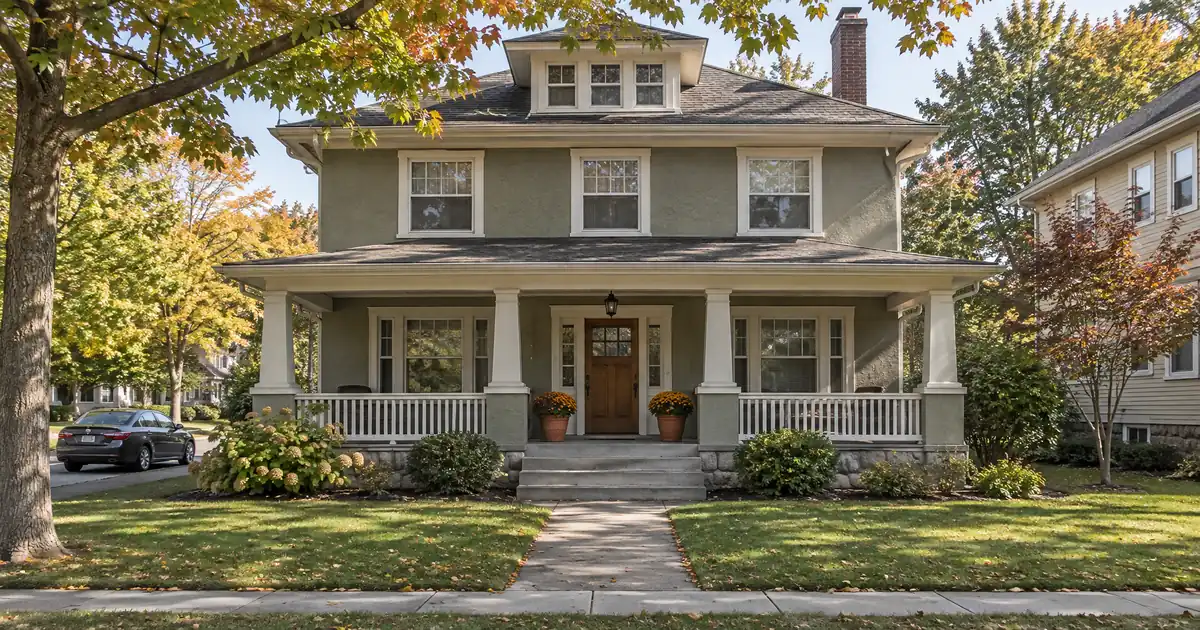
The Quick Read: Yes, but only once the retiree holds recorded title to the home in their own name or in a revocable living trust, the property is rented rather than lived in, and the file clears the investment-line limits: 70% combined loan-to-value, a 700 credit score, and a line of no more than $500,000, subject to lender guidelines. Retirement is not a disqualifier. Inheritance changes the order of operations, not the eligibility.
- Recorded title comes first. Being named in a will does not give anyone authority to sign a lien.
- The line is underwritten on the retiree’s documented income and debt, not on the rent. If personal income is thin, a rent-based DSCR cash-out is the usual alternative.
- Investment lines are available in 16 states only, which is narrower than the DSCR footprint.
What Does Inheriting the Home Actually Change?
Inheriting changes who holds title and when you can borrow. It does not change what the lender asks once you are the owner. The home is simply a property you now own. If you rent it out or plan to, it is an investment property, and the investment-line rules apply no matter how you came to own it.
How large a line the equity supports.
An equity line is sized by combined loan-to-value, occupancy, and credit — not by rental coverage. Switch the occupancy or the credit band and the ceiling moves with it.
Investment-property lines require a 700 minimum credit score; second-home lines start at a 640 minimum and primary-residence lines at 600, and the combined-LTV ceiling steps down as the credit band drops on primary-residence and second-home lines and holds on investment-property lines; the line cap steps down on primary-residence lines and holds at every tier on investment-property and second-home lines.
A debt-to-income ratio above 45% requires 680+ credit. Profiles under 640 are limited to single-family homes. At least 75% of the approved line is drawn at closing. Ceilings, floors, and caps update from Lendmire’s centralized guideline source.
Line estimate
Illustrative estimate only — not a quote, Loan Estimate, approval, or commitment to lend. The rate is an editable assumption; equity-line pricing is variable through both the draw and repayment periods and never converts to fixed. Occupancy and credit drive the ceiling together: an investment property tops out at 70% combined LTV (minimum credit 700, line cap $500,000); a second home tops out at 90% combined LTV (minimum credit 640, line cap $500,000), with the ceiling stepping down as the credit band drops (the cap holds at every tier); a primary residence tops out at 90% combined LTV (minimum credit 600), and its $750,000 maximum line is available only at 75% combined LTV or below with a 700-or-better credit profile (720 on the longer-runway program) and a full appraisal. Lines above $500,000 require a full appraisal. Credit, debt-to-income, property type, and full underwriting review all affect the final line.
Three questions decide the file:
1. Is the deed recorded in your name, or in your revocable living trust?
2. Is the property non-owner-occupied?
3. Does your personal income carry the loan?
If the answer to the first is no, nothing else matters. No lender can take a lien on a property whose owner cannot sign. If the answer to the second is yes, you are in investment-property territory, where NerdWallet notes that not every lender offers a line, qualification is stricter than on a primary home, and borrowers get less than they could against their own residence.
Where Does Title Stand at Each Stage?
Whether a line is possible depends on the stage the estate has reached. The table below shows who can sign at each point.
| Stage | Who can sign | Investment line possible? |
|---|---|---|
| Owner has died, no probate opened | No one | No |
| Probate open | Court-authorized personal representative only | Not as a standard line |
| Deed or court order recorded to heir | The heir | Yes, if the file qualifies |
| Held in a funded revocable trust | The trustee | Yes, if the trust is eligible |
| Transfer-on-death deed recorded | The named beneficiary | Yes, after recording |
| Property held in an LLC | The LLC’s authorized signer | No, see below |
Typical title evidence is a recorded executor’s deed or court order, a trust certification, or a transfer-on-death deed with a death certificate. The title commitment will show which of these applies. If a file reaches the lender without one, the file waits.
What About Co-Heirs and Existing Liens?
When several heirs share title, generally every title holder has to sign the lien. One heir who declines stalls the file. A quitclaim deed moves title between family members, but it does not remove anyone from an existing mortgage.
Existing liens matter as much as the heirs do. The decedent may have left a first mortgage, an old equity line, or a reverse mortgage. Every recorded lien counts against combined loan-to-value (CLTV), measured against the property’s current value rather than what it was worth when the decedent bought it.
Here is a modeled example using percentages only. Say the inherited rental carries a first mortgage equal to 50% of its current value. At a 70% CLTV ceiling, the new line can add up to about 20 points of value, and only if the credit, income, and property clear review. With no existing lien, the line can run up to 70% of value, but never above $500,000. The line can sit in first or second lien position, so a low-cost inherited first mortgage can stay in place.
A reverse mortgage on the home needs its own review. It is a lien with its own payoff rules, and it can leave little room under the 70% ceiling.
How Does a Retiree Qualify on Income?
A retiree is reviewed on documented income and debt, not on age or retirement status. The investment line runs a maximum 50% debt-to-income ratio, with 45% as the cap for credit profiles from 600 to 679, and any ratio above 45% requires a 680 minimum. The payment is calculated on the interest-only amount at the maximum draw, which is stricter than the payment a retiree will actually see during the first years.
The question is what counts as income. The CFPB’s compliance guide says qualifying income can include retirement benefits and rental income. It also says savings and vested retirement accounts can be considered as assets, but not the value of the home securing the loan. The underlying Federal Register rule lists eight factors a creditor must weigh, including income or assets, debts, and credit history.
| Income source | What the file usually needs |
|---|---|
| Social Security | Award letter and recent deposits |
| Pension | Award letter and proof of continuance |
| Retirement-account distributions | Account statements showing the distribution pattern |
| Rent from the inherited home | Lease and rental history, treated per lender guidelines |
| Savings and investments | Statements, as supporting assets where the program allows |
Whether rent from the inherited home counts toward qualifying on a personal-income line, and at what share, is lender-specific. Ask before you assume it helps.
What Are the Hard Limits on an Investment Line?
An investment-property line has narrow limits, and they do not stretch. A 700 credit score is the floor. Both 720 and 700 reach the same 70% ceiling, so a higher score buys eligibility rather than leverage. The exact numbers vary by lender and program and follow a full review of property, leverage, and credit.
For context, market surveys report that lenders typically cap an investment-property line at 80% loan-to-value, per Experian. The network’s ceiling on an investment property is lower, at 70% CLTV. A retiree comparing offers should use the network figure.
Other parameters that shape a retiree’s file:
- Structure. Investment lines run a 5-year interest-only draw followed by a 25-year fully amortizing repayment. No shorter structure is offered on an investment property.
- Draw at closing. At least 75% of the line is drawn at closing. Pricing floats during both the draw and the repayment period and never converts to a fixed figure.
- Valuation. Because the line cannot exceed $500,000, it normally uses an automated valuation, and a full appraisal is not required unless the borrower requests one. A higher CLTV may call for a secondary valuation.
- Credit history. A bankruptcy needs 4 years of seasoning from discharge or dismissal. On investment files, a foreclosure needs 7 years, and a deed-in-lieu, pre-foreclosure, or short sale needs 4.
- Exposure. A borrower is limited to three lines, and an owner of more than 15 financed properties is not eligible.
- Property types. Single-family, 2-4 units, PUDs, townhomes, and condominiums, including non-warrantable condos. Manufactured homes, co-ops, condotels, log homes, commercial, mixed-use, and agricultural-zoned properties are not offered.
Every figure above is subject to lender guidelines and full file review.
The Draw Period Matters More to a Retiree Than to Most Borrowers
At the end of the draw, the monthly obligation steps up because principal enters the payment. For a retiree on fixed income, that step needs a plan before closing, not after.
Two other features deserve attention. Because pricing floats, the cost of the line moves with the market for the life of the loan. And because at least 75% is drawn at closing, a retiree who wanted a quiet reserve for repairs will find most of the line already borrowed and accruing cost. That is a different tool from a standby credit line. If the goal is reserves, a smaller line is the cleaner fit.
Default is the real downside. The lender can foreclose on the inherited property itself, and the lien often sits alongside whatever the decedent left behind.
When the Line Is the Wrong Product
An investment-property line cannot be held by an LLC. Title has to sit with the individual borrower or an inter vivos revocable living trust. LLCs, corporations, partnerships, and irrevocable, blind, or land trusts cannot hold title. That is the sharpest structural difference from a DSCR loan.
An inherited rental that already sits inside an LLC therefore needs one of two moves: a vesting change into the retiree’s name, or a rent-based DSCR cash-out, subject to program terms. The heir also needs documented authority over the LLC, such as the operating agreement, court letters covering the membership interest, and a signing resolution.
The line is also limited by geography. The investment HELOC is available only in Lendmire’s 16 full-service states: AL, CA, CO, FL, GA, IN, MI, MT, NM, NC, OH, PA, TN, TX, VA, and WA. The DSCR program covers 40 states plus Washington, D.C., which is 41 markets.
How Does a DSCR Cash-Out Compare for an Inherited Rental?
A DSCR cash-out qualifies primarily on property-level rental income covering the payment, subject to lender guidelines. It is the usual alternative for retirees whose documented income is thin, whose home sits in an LLC, or whose line would run above $500,000.
Across the wholesale network, the typical DSCR cash-out parameters look like this:
- Cash-out tops out around 75% LTV on standard rentals and 70% on short-term-rental collateral.
- About 6 months of seasoning is the common expectation, and where that clock starts on an inherited home (date of death or deed date) varies by lender. Ask early.
- Most programs want around 660 credit, a 620 floor exists in parts of the network, and 700+ unlocks the strongest leverage.
- Coverage of 1.00 is where select programs start. A separate select-lender path takes coverage below 1.00, with leverage and terms adjusted.
- Loan sizes reach up to $3,000,000 on standard programs, with smaller balances available through select lenders, and reserves commonly run around 6 months of PITIA, though they vary by lender, leverage, and loan size.
- A 30-year fixed is the spine. Extended terms, interest-only periods, and ARMs are available through select lenders.
One caution: DSCR compares rent to PITIA only. Clearing 1.00 does not mean the property produces positive cash flow, because repairs, vacancy, management, and utilities sit outside the calculation. For the full picture, see the complete DSCR loans guide.
| Option | Underwritten on | Structure | Fits a retiree when |
|---|---|---|---|
| Investment HELOC | Personal income and DTI | 70% CLTV max, draw then repayment | Documented income is solid and title is clear |
| DSCR cash-out | Property rent vs. PITIA | Lump sum, replaces the first lien | Income is thin or the property is in an LLC |
| Sale | Not applicable | Proceeds | The property does not fit the plan |
What Are the Mistakes That Stall These Files?
These are program facts, not predictions, and each maps to a rule above.
1. Borrowing before title is recorded. A will or a probate petition is not authority to sign.
2. Treating basis as value. Inherited-basis figures are for tax purposes. The lender orders its own valuation.
3. Assuming a large portfolio replaces income. On a personal-income line, assets are supporting evidence, and the debt-to-income ratio still has to clear.
4. Missing a co-heir. Generally every title holder signs.
5. Overlooking the existing lien. A reverse mortgage or old equity line reduces room under the 70% ceiling.
6. Applying in the wrong vesting. An LLC-held property cannot take this line as-is.
Inheriting the home is not, by itself, loan-qualifying income. Tax treatment varies; consult a qualified professional.
Key Terms Defined
CLTV (combined loan-to-value): The total of all liens on the property divided by its current value.
Probate: The court process that confirms who has authority over a deceased owner’s property.
Vesting: The form in which title is held, such as an individual name or a revocable living trust.
Draw period: The stretch, here 5 years, when payments are interest-only and the borrower can access the line.
DSCR: Debt service coverage ratio, which compares a property’s rent to its full monthly obligation.
Seasoning: The minimum time a borrower must own the property before a cash-out is available.
A Retiree’s Readiness Checklist
1. Confirm the deed, trust certification, or court order is recorded. 2. Obtain written consent and signatures from every co-heir. 3. Order a payoff statement for any first mortgage, equity line, or reverse mortgage. 4. Gather benefit letters, distribution statements, and the lease. 5. Check credit against the 700 floor and any bankruptcy or foreclosure seasoning. 6. Check your state against the 16-state list. 7. Decide whether the structure suits you, including the step-up at the end of the draw. 8. If the file fails one test, compare the DSCR cash-out path.
A related guide covers how to use an investment property HELOC as a down payment on another home, which is relevant if the plan is to build a rental portfolio from the inheritance.
Frequently Asked Questions
Can I get a HELOC on an inherited house before probate ends?
Generally no. A standard line needs recorded title in your name or your revocable living trust, and an open probate means no one can sign a lien. A court-authorized estate loan is a separate short-term product with different rules.
Does being retired hurt my chances on an investment line?
Retirement itself does not disqualify a file. Social Security, pensions, and retirement distributions can count as income, subject to lender guidelines. What decides the file is documented income and debt, a 50% maximum debt-to-income ratio, and a 700 credit score.
How much can I borrow against an inherited rental?
Up to 70% combined loan-to-value, capped at a $500,000 line, with all existing liens counted against that ceiling. The ceiling is the same at 700 and at 720, so a higher score does not raise it.
What if the inherited home is held in an LLC?
The HELOC cannot be written on LLC-held title. The options are moving title into your name or revocable trust, or using a rent-based DSCR cash-out, subject to program terms. You also need documentation of your authority over the LLC.
Is a HELOC or a DSCR cash-out better for a retiree with limited income?
A DSCR cash-out is often the better fit, because it qualifies primarily on the property’s rent covering the payment rather than on personal income, subject to lender guidelines. The HELOC fits a retiree with strong documented income who wants to keep an existing first mortgage in place.
Next Step
If you are considering a home equity line and want to see how the numbers work, Lendmire can help you compare HELOC options based on the property, the equity available, credit profile, combined leverage, and your goals. Investment lines and DSCR cash-outs are arranged through select lenders in a wholesale network, and Lendmire is not the lender. Details are not a commitment to lend and depend on the full file.
About Lendmire
Lendmire — NMLS# 2371349 — is a mortgage broker that arranges home equity lines of credit in its 16 full-service states through wholesale lenders, on primary residences, second homes and investment properties. Every line is subject to the lender’s guidelines and full underwriting. Scotsman Guide named Lendmire a Top Mortgage Workplace in both 2025 and 2026.
Get Started
Ready to find the right loan for you?
See your offer in seconds. No credit pull, no obligation.
Informational only. Not a Loan Estimate, approval, or commitment to lend. Program availability and eligibility are subject to lender guidelines, credit approval, property review, and underwriting.
References
1. NerdWallet, HELOC on an investment property
2. CFPB, ATR/QM Small Entity Compliance Guide
3. Federal Register, ATR/QM final rule
4. Experian, HELOC on an investment property
This article is part of Lendmire’s investment property HELOC program — full qualification details, guidelines, and scenarios live on the program page.
Related reading: Does an Investment Property HELOC Make Sense for Home Improvements? · Can You Get an Investment Property HELOC on a Jointly Owned Home With a Friend or Sibling? · Can You Get an Investment Property HELOC After a Denial on Returns?
Brandon Miller
Founder & CEO, Mortgage Loan Originator, Lendmire LLC
- Mortgage Loan Originator · NMLS# 1129696 · Verify on NMLS Consumer Access
- North Carolina Real Estate Broker · License# 343312 · Verify on NCREC
- North Carolina Insurance Producer · License# 19053198 · Property, Casualty, Life, Health · Verify on NAIC SBS
- Lendmire LLC · Firm NMLS# 2371349 · Verify firm licensure
Disclosure information. Lendmire is a state-licensed mortgage brokerage under NMLS# 2371349. Lendmire is not a depository institution, direct lender, or financial advisor — all loans referenced are placed through wholesale lender partners and are subject to each lender's underwriting standards. This article is provided for general informational purposes and is not a commitment to lend, nor does it constitute financial, legal, or tax advice. Loan programs, terms, rates, and qualification standards change without notice and depend on borrower profile, property type, and the state in which the subject property is located. Equal Housing Opportunity provider. NMLS Consumer Access: nmlsconsumeraccess.org.