
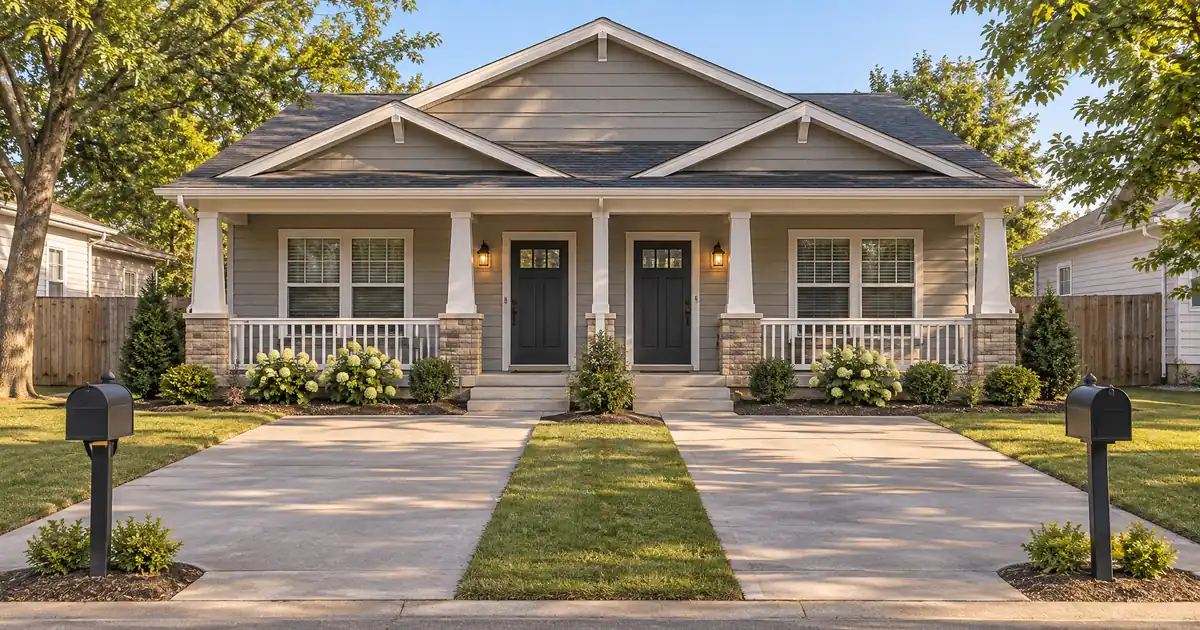
The Quick Read: An investment property HELOC keeps the duplex and lets you draw as care bills arrive, while a sale turns the duplex into one lump of cash and ends ownership. The right choice depends on how long care will last, how the duplex is titled, and how much equity and rental income you can count on.
- A HELOC (home equity line of credit) is a revolving credit line secured by the duplex. On an investment property, Lendmire’s wholesale network tops out at 70% combined loan-to-value, with a 700 minimum credit score.
- A sale pays off the mortgage and delivers net cash. It also ends the rent, the depreciation benefit, and your ability to borrow against the asset later.
- Title decides a lot. The network’s investment lines require the property to be titled in a person’s name or a revocable living trust, not an LLC.
- Memory care has no fixed end date. Both options can fail if the need outlasts the plan.
The Honest Answer First
Choose the HELOC if you want to keep a duplex that performs, you hold title personally or in a revocable trust, you have meaningful equity, and your credit and debt load clear the line’s tests. The line suits uncertain, month-by-month costs.
How large a line the equity supports.
An equity line is sized by combined loan-to-value, occupancy, and credit — not by rental coverage. Switch the occupancy or the credit band and the ceiling moves with it.
Investment-property lines require a 700 minimum credit score; second-home lines start at a 640 minimum and primary-residence lines at 600, and the combined-LTV ceiling steps down as the credit band drops on primary-residence and second-home lines and holds on investment-property lines; the line cap steps down on primary-residence lines and holds at every tier on investment-property and second-home lines.
A debt-to-income ratio above 45% requires 680+ credit. Profiles under 640 are limited to single-family homes. At least 75% of the approved line is drawn at closing. Ceilings, floors, and caps update from Lendmire’s centralized guideline source.
Line estimate
Illustrative estimate only — not a quote, Loan Estimate, approval, or commitment to lend. The rate is an editable assumption; equity-line pricing is variable through both the draw and repayment periods and never converts to fixed. Occupancy and credit drive the ceiling together: an investment property tops out at 70% combined LTV (minimum credit 700, line cap $500,000); a second home tops out at 90% combined LTV (minimum credit 640, line cap $500,000), with the ceiling stepping down as the credit band drops (the cap holds at every tier); a primary residence tops out at 90% combined LTV (minimum credit 600), and its $750,000 maximum line is available only at 75% combined LTV or below with a 700-or-better credit profile (720 on the longer-runway program) and a full appraisal. Lines above $500,000 require a full appraisal. Credit, debt-to-income, property type, and full underwriting review all affect the final line.
Choose the sale if the duplex is a weak performer, equity is thin, care may run for many years, or you would rather not carry new debt on a property you may need to repair or re-let. It gives you certainty and a clean break.
A third case applies if the duplex sits in an LLC. In that situation a personal HELOC does not fit, and the decision cannot be made quickly. That case gets its own section below.
Side-by-Side
The HELOC column reflects Lendmire’s wholesale network. The sale column describes how selling generally works under published industry norms, and details vary by state and by your tax situation.
| Factor | Investment HELOC | Selling the duplex |
|---|---|---|
| What is judged | Your credit, debt-to-income, equity | Market value and buyer demand |
| Review basis | Personal, not rent alone | None, apart from buyer financing |
| Documents | Credit, income, mortgage statement, title | Listing, disclosures, payoff statement |
| Property types | 2-4 units eligible, including duplexes | Any property a buyer will purchase |
| Entity vesting | Individual or revocable trust only | LLC can sell, with tax passing to members |
| Keeps the duplex | Yes | No |
| Cash arrives | Draws as needed after a closing draw | One lump sum at sale |
| Reserve expectations | Lender reviews liquidity and debt load | Cash on hand covers closing and moving costs |
| Reversibility | Can be repaid and kept | Final |
| Tax event | Not a sale | Gain may be taxable |
How an Investment Property HELOC Works Here
A HELOC is a line of credit secured by the property. Rental HELOCs are a narrower product than primary-home lines. NerdWallet’s guide to HELOCs on investment properties says not all lenders offer them, and lenders treat them as higher risk. Lendmire’s network follows that pattern, with these parameters:
- Leverage: The ceiling on an investment property is 70% combined loan-to-value (CLTV). That means the first mortgage plus the new line cannot exceed 70% of the property’s value. Credit above 700 buys eligibility, not extra leverage.
- Line size: $25,000 to $500,000.
- Credit: 700 minimum. There is no lower tier for an investment line.
- Debt load: Debt-to-income can run up to 50% at most, and the line is qualified on the interest-only payment at the maximum draw.
- Structure: A 5-year interest-only draw period, then 25 years of fully amortizing repayment. At least 75% of the line is drawn at closing. The payment floats and does not convert to a fixed schedule.
- Valuation: Lines at or below $500,000 ordinarily use an automated valuation, so a traditional appraisal is commonly not needed.
- Property: Single-family and 2-4 unit properties are eligible, so a duplex fits.
- Availability: The HELOC program runs in Lendmire’s 16 full-service states only, which is narrower than its DSCR footprint.
Every figure is subject to lender guidelines and full file review. This is not a commitment to lend.
Here is how the leverage cap works in practice. Say the duplex has a first mortgage at 50% of its value. A 70% CLTV ceiling leaves up to 20 points of value to borrow against. If the first mortgage is already at 60%, only 10 points remain. Equity that looks large on paper can shrink fast at the cap.
When an Investment Property HELOC Is the Better Fit
The HELOC fits when you want to keep a working asset and the care budget is hard to predict. A few situations point this way:
- The duplex earns its keep. Rent, appreciation, and depreciation continue. A sale ends all three.
- Title is clean. You hold the duplex personally or in a revocable living trust, so the property is eligible.
- Equity is deep. A low first-mortgage balance leaves room under the 70% cap.
- Your personal file is strong. The line is underwritten on your credit, income, and debts, not on rent alone.
- You want to avoid a forced sale. Borrowing buys time if the market is soft or a unit is vacant.
The tradeoffs are real. Under federal consumer-finance guidance on home equity lines, a HELOC has a draw period and then a repayment period. Payments are often much higher in repayment, and in some cases the whole balance comes due when repayment begins. Care can last longer than five years. Plan for that before you sign.
Two more features matter for care costs. Because at least 75% of the line is drawn at closing, you pay on most of the balance from day one, even if you spend it slowly. And the payment is yours personally. A vacant unit does not pause it.
A line also adds a lien and a new monthly obligation to your personal liabilities. That can matter when you later apply for another loan on a different property. For more on this use, see Lendmire’s piece How to Use an Investment Property HELOC to Pay for Medical or Elder-Care Costs.
When Selling the Duplex Is the Better Fit
Selling fits when certainty is worth more than the asset. It tends to make sense in these cases:
- The duplex is a drag. Deferred repairs, chronic vacancy, or tenant trouble can make owning harder than the care bill itself.
- Equity is thin or the cap blocks you. If the first mortgage is high, the 70% CLTV ceiling may leave little room, and a sale is the only way to free much cash.
- Your credit or debt load misses the line. A score under 700 or a debt-to-income ratio above 50% takes the investment HELOC off the table.
- Care may run for many years. One lump sum avoids the draw-then-repay clock.
- Your goal is simplicity. No new debt, no draw deadline, no payment to track.
Selling has costs. You lose the rent and the duplex’s potential growth. You also owe tax on any gain. IRS Topic 409 explains that gain is the amount you receive minus your adjusted basis. A like-kind exchange defers that gain but does not put spendable cash in your hands, so it does not fit this goal. Tax treatment can depend on how the funds are used and how the property is held; borrowers should keep clear records and speak with a qualified tax professional before relying on any deduction.
Cash from a sale is also a one-time pile. If care runs longer than planned, you cannot go back and borrow against the property you no longer own.
What if Dad Owns the Duplex?
Everything above shifts if the duplex is in Dad’s name. A HELOC would then have him, or someone with legal authority for him, as the borrower. His credit, income, and title all feed the file. Title must sit with an individual or a revocable living trust to be eligible.
The Medicaid angle matters here. If the family may apply for Medicaid later, how you move the property can matter as much as whether you do. ElderLawAnswers reports a 60-month look-back for transfers, 30 months in California, and notes that state rules can differ. A sale below fair market value to a relative can trigger a penalty period. A HELOC does not transfer ownership. A sale at fair market value does not violate the look-back, but the cash may count toward asset limits.
Treat this as a conversation for an elder-law attorney before any step. Rules vary by state, and a wrong move is hard to undo.
The Third Option for LLC-Owned Duplexes
If an LLC owns the duplex, the investment HELOC is usually off the table. LLCs, corporations, partnerships, and irrevocable or land trusts cannot hold title on these lines. You would need to move title out of the entity first, which has its own legal and tax consequences, or look at a different product.
One alternative is a DSCR cash-out refinance. It qualifies primarily on property-level rental income covering the payment, subject to lender guidelines, and it can work for LLC borrowers, subject to program eligibility. Across Lendmire’s wholesale network, here is what it looks like:
- Leverage: Cash-out tops out around 75% LTV on a standard rental.
- Seasoning: About 6 months of ownership is the common expectation.
- Credit: A 620 floor exists in parts of the network. Most programs want around 660, and 700 or more opens the strongest leverage tiers.
- Loan size: up to $3,000,000 on standard programs (smaller balances available through select lenders).
- Reserves: They vary by lender, leverage, and loan size, and are commonly around 6 months of PITIA (principal, interest, taxes, insurance, and any HOA dues).
- Coverage: DSCR is monthly rent divided by PITIA. Select programs start at 1.00, and stronger ratios open better terms.
Clearing 1.00 does not mean the duplex cash-flows. Repairs, vacancy, management, and utilities sit outside the calculation. A cash-out is also a single lump sum, so it shares the HELOC’s weakness if care outlasts the money. Lendmire’s complete DSCR loans guide covers how these files are built. If you live in one unit, see how the options compare in Lendmire’s article on a HELOC versus a DSCR cash-out on a duplex you live in.
Key Terms Defined
- CLTV: Combined loan-to-value, which is all liens on the property divided by its value.
- Draw period: The stretch when you can borrow from the line before repayment starts.
- Seasoning: The waiting period a lender wants between buying or owning a property and borrowing against it.
- Look-back: The window Medicaid reviews for asset transfers made before an application.
- Adjusted basis: What you paid for the property, adjusted for improvements and depreciation, used to measure gain on a sale.
The Verdict
Neither option wins in every case. Use the HELOC when you hold title personally or in a revocable trust, have enough equity under the 70% cap, clear the 700 score and 50% debt-to-income tests, and care costs may stretch out in uneven amounts. Use the sale when the duplex is a burden, the equity is thin, or care may last longer than any draw period.
Run both against four questions. Who holds title? How much equity remains at the cap? What happens when the draw ends? Can the duplex carry its own costs if a unit sits empty?
If the answers conflict, consider a hybrid. Some families borrow for a defined stretch and sell later. Others sell and keep their cash for care while exploring a DSCR loan on a different property. Bring in an elder-law attorney and a tax professional before choosing.
Frequently Asked Questions
Can I get a HELOC on a duplex that is a rental?
Yes, in some cases. Lendmire’s network treats 2-4 unit properties as eligible. The line caps at 70% CLTV with a 700 minimum credit score, up to $500,000, and it requires title in a person’s name or a revocable living trust. Availability for this program is limited to Lendmire’s 16 full-service states. Approval is subject to lender guidelines.
What happens when the draw period ends?
Borrowing stops and repayment begins. On an investment line in the network, that means a 5-year interest-only draw followed by 25 years of fully amortizing repayment. Payments can rise sharply at that point. Plan the care budget so the repayment phase does not land at the worst moment.
Does my LLC-owned duplex qualify for a HELOC?
No. These investment lines cannot be vested in an LLC. You would need to change vesting, with legal and tax review first, or look at a DSCR cash-out refinance on the property.
Should I sell the duplex to Dad’s child or another relative at a discount?
Be careful. A below-market transfer to a relative can trigger a Medicaid penalty period under the look-back rules described by ElderLawAnswers. Talk to an elder-law attorney before any family transfer.
Is a DSCR cash-out refinance better than a HELOC for memory care?
It depends. A DSCR cash-out qualifies primarily on rental income, works for LLC owners subject to program terms, and delivers one lump sum. A HELOC lets you draw over time but depends on your personal file. If you have strong rent coverage and an LLC, it can be worth comparing both.
Next Step
If you are considering a home equity line and want to see how the numbers work, Lendmire can help you compare HELOC options based on the property, the equity available, credit profile, combined leverage, and your goals. An illustrative calculator estimate can help frame the conversation, but each file is reviewed individually.
About Lendmire
As a mortgage broker (NMLS# 2371349), Lendmire helps homeowners and real estate investors in its 16 full-service states open home equity lines of credit arranged through wholesale lenders. Lendmire is never the lender; line amounts, ceilings and terms are set by the lender under its guidelines. Scotsman Guide named Lendmire a Top Mortgage Workplace in both 2025 and 2026.
Get Started
Ready to find the right loan for you?
See your offer in seconds. No credit pull, no obligation.
Informational only. Not a Loan Estimate, approval, or commitment to lend. Program availability and eligibility are subject to lender guidelines, credit approval, property review, and underwriting.
References
1. NerdWallet, HELOC on an investment property
3. IRS Topic 409, Capital gains and losses
4. ElderLawAnswers, Medicaid asset transfer rules
This article is part of Lendmire’s investment property HELOC program — full qualification details, guidelines, and scenarios live on the program page.
Related reading: Can You Get an Investment Property HELOC Before Your Return Is Filed? · Can You Get an Investment Property HELOC After a Quitclaim Deed? · Can You Get an Investment Property HELOC With No Minimum Draw Requirement?
Brandon Miller
Founder & CEO, Mortgage Loan Originator, Lendmire LLC
- Mortgage Loan Originator · NMLS# 1129696 · Verify on NMLS Consumer Access
- North Carolina Real Estate Broker · License# 343312 · Verify on NCREC
- North Carolina Insurance Producer · License# 19053198 · Property, Casualty, Life, Health · Verify on NAIC SBS
- Lendmire LLC · Firm NMLS# 2371349 · Verify firm licensure
Disclosures. The information presented in this article is general market commentary, not financial, legal, or tax advice. Lendmire is a mortgage brokerage (NMLS# 2371349) — not a direct lender or depository institution — and loan placement is subject to lender underwriting. Nothing in this content represents a commitment to lend. Loan terms, pricing, and program availability vary based on borrower qualifications, property characteristics, and state of subject property, and are subject to change at any time. Lendmire complies with Equal Housing Opportunity requirements. Consumer access: nmlsconsumeraccess.org.