
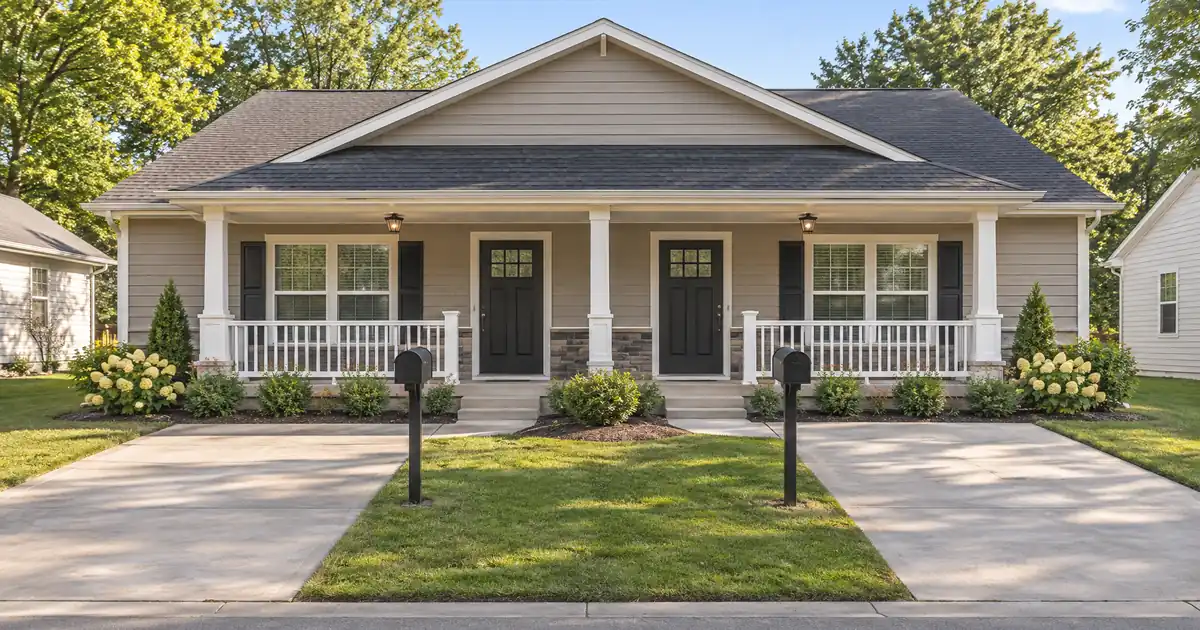
The Quick Read: Usually, yes, but only on the duplex’s current condition and value, and only once the insurance claim is in order. Light damage or finished repairs are workable. Heavy damage often means waiting or switching products, because the damage lowers the value that sets the line size.
- On an investment property, the network ceiling is 70% combined loan-to-value (CLTV), with a 700 minimum credit score and a $500,000 maximum line.
- Damage lowers the automated value, so the line shrinks and leftover equity can disappear.
- A lender wants to see a settled claim, not a promise of one.
- An LLC-titled duplex generally cannot hold an equity line.
- A HELOC underwrites you, not the rent. A rent-qualified loan is a different product.
How Does Storm Damage Change a HELOC Decision?
Storm damage changes the value, the insurance picture and the occupancy picture, and the lender checks all three. A home equity line of credit (HELOC) is a revolving credit line secured by property you already own. The lender sizes it on what the duplex is worth today, not what it was worth before the storm.
How large a line the equity supports.
An equity line is sized by combined loan-to-value, occupancy, and credit — not by rental coverage. Switch the occupancy or the credit band and the ceiling moves with it.
Investment-property lines require a 700 minimum credit score; second-home lines start at a 640 minimum and primary-residence lines at 600, and the combined-LTV ceiling steps down as the credit band drops on primary-residence and second-home lines and holds on investment-property lines; the line cap steps down on primary-residence lines and holds at every tier on investment-property and second-home lines.
A debt-to-income ratio above 45% requires 680+ credit. Profiles under 640 are limited to single-family homes. At least 75% of the approved line is drawn at closing. Ceilings, floors, and caps update from Lendmire’s centralized guideline source.
Line estimate
Illustrative estimate only — not a quote, Loan Estimate, approval, or commitment to lend. The rate is an editable assumption; equity-line pricing is variable through both the draw and repayment periods and never converts to fixed. Occupancy and credit drive the ceiling together: an investment property tops out at 70% combined LTV (minimum credit 700, line cap $500,000); a second home tops out at 90% combined LTV (minimum credit 640, line cap $500,000), with the ceiling stepping down as the credit band drops (the cap holds at every tier); a primary residence tops out at 90% combined LTV (minimum credit 600), and its $750,000 maximum line is available only at 75% combined LTV or below with a 700-or-better credit profile (720 on the longer-runway program) and a full appraisal. Lines above $500,000 require a full appraisal. Credit, debt-to-income, property type, and full underwriting review all affect the final line.
Here is the sequence a lender typically walks through on a damaged duplex:
1. Claim status. The lender wants a settled claim rather than an open one.
2. Insurance. The lender checks the declarations page, the coverage limits and the lender clause. It also checks for separate wind coverage where wind is carved out of the base policy.
3. Flood determination. A new line is a new loan event, so the lender re-checks flood zone status.
4. Valuation. Damage lowers the automated value, which shrinks the line.
5. Existing first mortgage. The first-lien lender usually has a say in how insurance money is released.
Each step can stop a file on its own. A great credit score will not fix a value that dropped or a claim that is still open.
What Does the Network Allow on an Investment Duplex?
Across Lendmire’s wholesale network, an investment-property line caps at 70% CLTV, requires a 700 minimum credit score, and tops out at $500,000. Those figures apply to investment properties only. Primary residences and second homes follow different tiers, and none of those tiers apply to your duplex. Everything is subject to lender guidelines and full file review.
Credit above 700 buys eligibility, not extra leverage. Both the 700 and 720 tiers reach the same 70% ceiling. Investment lines also use a 5-year interest-only draw followed by a 25-year repayment period, and at least 75% of the line is drawn at closing.
A 2-4 unit building is an eligible property type, so a duplex is not the problem. Manufactured homes, log homes, condotels and mixed-use properties are not eligible.
Because the line cannot exceed $500,000, the valuation usually runs through an automated model rather than a traditional appraisal. That matters after a storm. An automated value can lag, so a repaired duplex may be undervalued until the data catches up. A borrower can request a full appraisal in any case.
Why Does a Lower Value Shrink the Line So Fast?
The 70% ceiling applies to the reduced value, and your first mortgage comes out of that number first. The line only gets what is left after the existing loan.
Run it as an illustration, not a quote. Say a duplex loses a quarter of its value in a storm. The 70% ceiling falls by that same quarter. The first mortgage balance does not move. So the room between the ceiling and the existing loan shrinks by more than a quarter, and on a duplex with a large first mortgage it can shrink to nothing. Leverage that existed last month can vanish.
Thin equity is where this bites. A duplex that was already near the ceiling has no cushion for a value drop. A duplex with plenty of equity may absorb it.
What Does the Lender Do With Your Insurance Money?
On a mortgaged property, the first-mortgage lender is usually named on the policy and must endorse the claim check. The Insurance Information Institute explains that funds are often held in escrow and released as repair work is completed. The check is not simply yours to deposit.
The North Carolina Department of Insurance adds that a major disaster claim can take months to close and may pay out in several checks. Plan for that gap. If you were counting on a new HELOC to cover repairs while the claim drags on, that plan has a hole in it.
The order matters here. The lender wants the claim settled before it sizes the line, so the repair budget and the line are set against real numbers. A new line is not a bridge for a claim that is still open.
Does Flood Insurance Come Into It?
Yes, if the duplex sits in a mapped high-risk flood area. FEMA says federally regulated or insured lenders must require flood insurance on buildings in a Special Flood Hazard Area that carry a federally backed loan. The lender must run a determination whenever it makes, increases, extends or renews a loan, which includes a new equity line.
Two practical points follow. First, current flood maps can place a building in a high-risk zone even if an older map did not. Second, a lender can still require flood coverage outside those zones as a condition of the loan, since lenders can add that requirement by contract.
Flood coverage is separate from a standard property policy. Wind may be separate too. A duplex with a clean homeowners-style policy but no flood or wind coverage can be stuck even when the damage is light.
What Happens to Different Damaged-Duplex Scenarios?
The damage level and the occupancy picture decide the path. This table shows how common situations tend to play out in lender review. It is a guide, not a promise of any outcome.
| Situation | Likely effect | Next step |
|---|---|---|
| Light damage, repairs finished | Value recovers; file reads normally | Document repairs with photos |
| Insured, claim still open | Lender usually waits for settlement | Settle claim before applying |
| Heavy damage, both units vacant | Value drops sharply; line may not fit | Consider repair or bridge funding first |
| One unit rented, one vacant | Value reduced; only the rented side supports rent tests | Document lease and repair plan |
| Uninsured damage | Insurance condition likely fails | Fix coverage before any application |
| Existing open line | Lender may reassess the collateral | Talk to your current lender before drawing |
Can You Apply With the Duplex Vacant or Uninhabitable?
A HELOC does not count rent, so vacancy alone is not the test; condition and value are. The line underwrites your personal credit, income and debt-to-income ratio (DTI). The network’s maximum DTI is 50%, and it is lower for weaker credit. Because the line is reviewed on you, a vacant duplex does not fail a rent test the way it would on a rent-based loan.
An uninhabitable building is a different story. Value, insurance and condition all take a hit at once, and lenders are cautious about lending against a building that cannot be occupied. Heavy damage usually points toward a repair or bridge loan first, then a refinance once the property is back in shape.
A rent-qualified loan is a separate product, not a type of HELOC. It needs a lease in place and a rent figure an appraiser can support, and it does not relax the condition, insurance or value tests. Rent that is not flowing yet cannot carry that kind of file. If you want the equity-line route instead, see the HELOC page.
Does a HELOC Beat the Other Options After a Storm?
Only when the property is repaired or lightly damaged, equity is solid, and you want flexible access to cash. Otherwise another product fits better.
| Option | Reviewed on | Best fit after a storm |
|---|---|---|
| Investment HELOC | Your credit, income, DTI | Light damage or repaired; strong equity |
| Rent-qualified line | Property rent | Already rented, claim settled |
| Repair or bridge loan | Repair plan and value | Heavy damage, vacant units |
| DSCR cash-out refinance | Rent covering the payment | Stabilized, insured, rented duplex |
A debt service coverage ratio (DSCR) loan compares monthly rent to the full monthly obligation: principal, interest, taxes, insurance and any association dues. Clearing 1.00 is not the same as positive cash flow, because repairs, vacancy and management sit outside the calculation. For the full picture, see the complete DSCR loans guide.
A DSCR cash-out refinance is judged on rent coverage rather than your DTI, and it welcomes LLC title, subject to lender program eligibility. On most files it tops out around 75% leverage on a standard rental, with about 6 months of seasoning as the common expectation. It still needs a stabilized, insured property, so it is a later step after a storm, not a rescue.
Who Should Not Use a HELOC for Storm Repairs?
- Thin equity. The 70% ceiling on a reduced value may leave no line at all.
- LLC title. LLCs, corporations, partnerships and irrevocable or land trusts cannot hold title on this product. A duplex already deeded to an LLC needs a vesting change or a DSCR cash-out instead. An individual or a revocable living trust can hold title.
- Credit under 700. There is no investment tier beneath 700.
- Cash-strapped owners waiting on a slow claim. The line is credit, not a bridge for an unsettled claim.
- Large portfolios. A borrower owning more than 15 financed properties is not eligible.
Be honest about the debt itself, too. A line is secured by the duplex. Adding debt against a damaged asset raises the risk if repairs run over.
How Does Lendmire’s Reading Compare Across Lenders?
Lendmire is a broker, not a lender, and it places files with select wholesale partners. On a storm-damaged duplex, expect the lender to look at condition, coverage and value before anything else, and expect guidelines and overlays to differ from one partner to the next. Whether a partner will lend against an open claim, or wants repairs documented first, is something to confirm on your own file rather than assume.
Investment lines are only available through Lendmire’s 16 full-service states: AL, CA, CO, FL, GA, IN, MI, MT, NM, NC, OH, PA, TN, TX, VA and WA. That is narrower than the 41-market DSCR footprint.
Pre-Application Checklist
Gather these before you talk to anyone:
- Claim status and the adjuster’s findings
- Photos of the damage and of completed repairs
- The declarations page showing wind and flood coverage
- Repair estimates or contractor invoices
- Proof of how the duplex is titled
- Your current first-mortgage balance
Order matters. Settle the claim first, document repairs second, then apply.
Key Terms Defined
CLTV (combined loan-to-value): Your first mortgage plus the new line, divided by the property’s value.
HELOC: A revolving credit line secured by property you already own.
DSCR: A ratio comparing monthly rent to the full monthly housing obligation on a property.
Loss payee (mortgagee clause): The lender named on your insurance policy, who must endorse claim checks.
Special Flood Hazard Area: A mapped high-risk flood zone where federally backed loans require flood insurance.
Business-purpose credit: Credit taken for an investment property rather than a home you live in.
Frequently Asked Questions
Can I still draw on an open HELOC after storm damage?
It depends on your current lender’s terms and how it views the collateral. There is no public standard to point to, so ask your lender directly before assuming the line stays fully available. Tell it about the claim, because surprises tend to cause more trouble than disclosure.
Does a duplex get treated differently from a single-family rental?
A 2-4 unit building is an eligible property type on investment lines, so the duplex itself is fine. The 70% CLTV ceiling and 700 minimum score apply either way. What changes after a storm is the value, the coverage and the occupancy, not the unit count.
Should I wait for repairs before applying?
For anything beyond light damage, usually yes. A lender wants a settled claim and a value that reflects the property’s real condition. Applying early often means a smaller line, or none, and a hard credit pull for no result.
Does my insurance payout go to me or to my mortgage lender?
On a mortgaged property, the lender named on the policy typically must endorse the check and often controls how funds are released. The Insurance Information Institute notes funds are often held in escrow and released as work is completed.
What if the duplex is titled in an LLC?
A rental HELOC generally cannot be written on LLC title. The sharper alternative is a DSCR cash-out refinance, which accepts LLC vesting subject to lender program eligibility, or a vesting change to your personal name or a revocable trust.
If you are considering a home equity line and want to see how the numbers work, Lendmire can help you compare HELOC options based on the property, the equity available, credit profile, combined leverage, and your goals. Reach the team at 828-256-2183 or request a quote.
About Lendmire
Lendmire (NMLS# 2371349) is a mortgage brokerage serving homeowners and real estate investors in its 16 full-service states. Home equity lines of credit are arranged through wholesale lending channels; Lendmire brokers the line and the lender underwrites each application under its occupancy-based guidelines. Scotsman Guide named Lendmire a Top Mortgage Workplace in both 2025 and 2026.
Get Started
Ready to find the right loan for you?
See your offer in seconds. No credit pull, no obligation.
Informational only. Not a Loan Estimate, approval, or commitment to lend. Program availability and eligibility are subject to lender guidelines, credit approval, property review, and underwriting.
References
1. Insurance Information Institute – Settling insurance claims after a disaster
2. North Carolina Department of Insurance – Claims and adjuster information
3. FEMA – Lending professionals
This article is part of Lendmire’s investment property HELOC program — full qualification details, guidelines, and scenarios live on the program page.
Related reading: How an Investment Property HELOC Works to Fund Business Equipment · How Much Can You Borrow on an Investment Property HELOC Closed in the Name of Your LLC? · How Much Can You Borrow on an Investment Property HELOC on a Second Home Condo?
Brandon Miller
Founder & CEO, Mortgage Loan Originator, Lendmire LLC
- Mortgage Loan Originator · NMLS# 1129696 · Verify on NMLS Consumer Access
- North Carolina Real Estate Broker · License# 343312 · Verify on NCREC
- North Carolina Insurance Producer · License# 19053198 · Property, Casualty, Life, Health · Verify on NAIC SBS
- Lendmire LLC · Firm NMLS# 2371349 · Verify firm licensure
Disclosure information. Lendmire is a state-licensed mortgage brokerage under NMLS# 2371349. Lendmire is not a depository institution, direct lender, or financial advisor — all loans referenced are placed through wholesale lender partners and are subject to each lender's underwriting standards. This article is provided for general informational purposes and is not a commitment to lend, nor does it constitute financial, legal, or tax advice. Loan programs, terms, rates, and qualification standards change without notice and depend on borrower profile, property type, and the state in which the subject property is located. Equal Housing Opportunity provider. NMLS Consumer Access: nmlsconsumeraccess.org.