
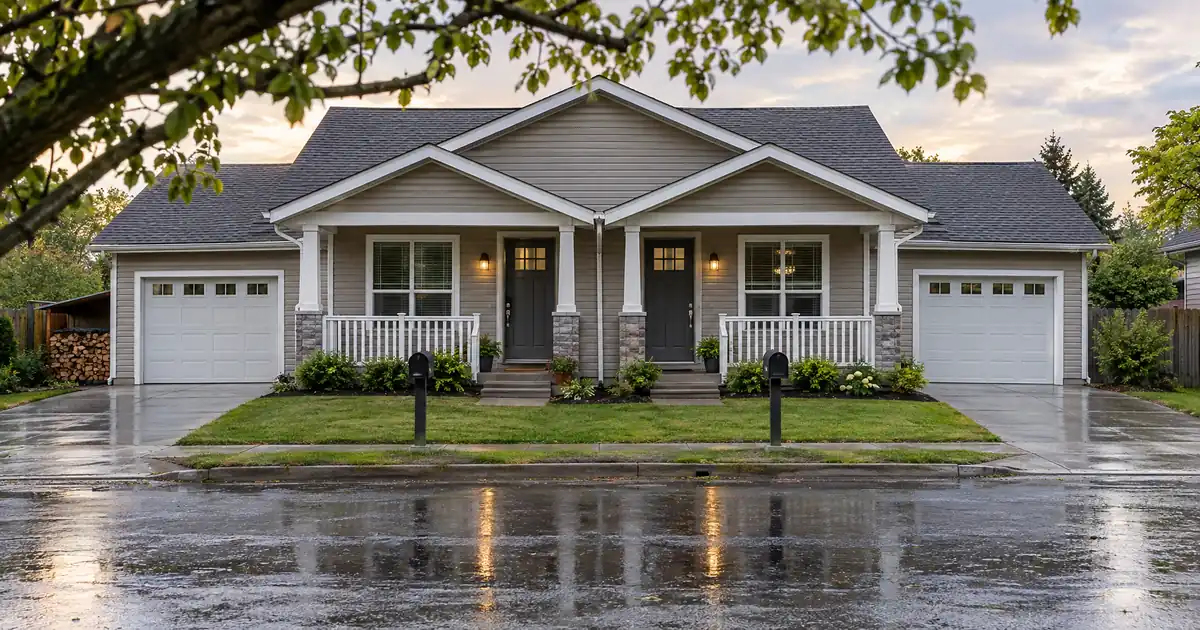
The Quick Read: The workable path is a home equity line on the home you already own, which supplies the down payment, plus an owner-occupant first mortgage that credits part of the rent from the units you do not live in. A DSCR loan comes later, if you move out and rent every unit, because DSCR programs are built for non-owner-occupied property.
- The HELOC sits on your current home, not on the building you are buying.
- The new HELOC payment counts as debt on the owner-occupant file, so it can limit how much rent helps.
- Lenders credit only part of the rent from the other units, and 3-4 unit buildings often face an extra property-level test.
- Once you move out, qualification shifts to property rent covering the payment, and DSCR becomes the relevant tool.
- Every figure below is subject to lender guidelines and full file review, and none of it is a commitment to lend.
What This Strategy Actually Is
The strategy is three loans in sequence. A line of credit on your current home funds the down payment. An owner-occupant mortgage buys the 2-4 unit. A DSCR loan can take over if you later rent out the whole building.
How large a line the equity supports.
An equity line is sized by combined loan-to-value, occupancy, and credit — not by rental coverage. Switch the occupancy or the credit band and the ceiling moves with it.
Investment-property lines require a 700 minimum credit score; second-home lines start at a 640 minimum and primary-residence lines at 600, and the combined-LTV ceiling steps down as the credit band drops on primary-residence and second-home lines and holds on investment-property lines; the line cap steps down on primary-residence lines and holds at every tier on investment-property and second-home lines.
A debt-to-income ratio above 45% requires 680+ credit. Profiles under 640 are limited to single-family homes. At least 75% of the approved line is drawn at closing. Ceilings, floors, and caps update from Lendmire’s centralized guideline source.
Line estimate
Illustrative estimate only — not a quote, Loan Estimate, approval, or commitment to lend. The rate is an editable assumption; equity-line pricing is variable through both the draw and repayment periods and never converts to fixed. Occupancy and credit drive the ceiling together: an investment property tops out at 70% combined LTV (minimum credit 700, line cap $500,000); a second home tops out at 90% combined LTV (minimum credit 640, line cap $500,000), with the ceiling stepping down as the credit band drops (the cap holds at every tier); a primary residence tops out at 90% combined LTV (minimum credit 600), and its $750,000 maximum line is available only at 75% combined LTV or below with a 700-or-better credit profile (720 on the longer-runway program) and a full appraisal. Lines above $500,000 require a full appraisal. Credit, debt-to-income, property type, and full underwriting review all affect the final line.
Investors call the live-in part house hacking. You occupy one unit, tenants pay rent on the others, and that rent offsets your housing cost. The HELOC solves the cash problem. The rent helps solve the qualifying problem. Neither one is a DSCR transaction at the start.
That distinction matters because DSCR loans are designed for non-owner-occupied investment properties. Because they are business-purpose investor loans, they are reviewed differently from a standard owner-occupied mortgage. A buyer who plans to live in a unit should not expect a DSCR program to finance the purchase.
Lendmire is a broker that arranges DSCR and equity-line financing through select wholesale lenders. It places the DSCR step and the HELOC step of this plan. The owner-occupant first mortgage in the middle comes from a different lender channel.
How the Pieces Fit Together
Each piece does one job, and each has its own underwriting test.
| Piece | Job | What gets tested |
|---|---|---|
| HELOC on current home | Supplies the down payment | Equity, credit, debt-to-income |
| Owner-occupant first mortgage | Buys the 2-4 unit | Personal income, credited rent, debt load |
| DSCR loan (later) | Refinances after move-out | Rent versus the full monthly obligation |
The HELOC is collateralized by the home you already own. If the line goes unpaid, that home is at risk. The building you buy carries its own first mortgage, which is a separate obligation.
Step by Step: How the File Gets Built
The order of operations decides whether the file stays clean. The steps below run from equity check to move-in.
1. Measure the equity in your current home. Equity is the home’s value minus what you owe. The line is a percentage of that equity, so a home with a large first mortgage supports a smaller line.
2. Open the line before you write offers. Lines at or below $500,000 ordinarily run on an automated valuation instead of a full appraisal. A line above $500,000 requires a full appraisal. Build that into your schedule so the funds are available when you need them.
3. Tell the purchase lender about the HELOC early. Borrowed down-payment money changes the debt picture. Surprises midway through the file create the roadblocks.
4. Count the HELOC payment as debt. The new line adds to your monthly obligations. Investors on BiggerPockets flag that the HELOC payment can push a file out of ratio, which is why the debt load deserves a check before you draw.
5. Document the funds. Expect to show the HELOC terms, proof the funds moved, and statements. A LegalClarity explainer lists the same items: the HELOC terms, evidence that the line’s lender is not a party to the sale, and proof the funds were transferred.
6. Get the rent schedule appraised. On a 2-4 unit, the appraiser reports market rent for each unit. That schedule, plus any leases in place, is what the lender uses to credit rent.
7. Close and move in. The owner-occupant loan requires you to occupy the building. The HELOC stays open against the old home.
How the HELOC Works Inside Lendmire’s Network
A HELOC through the network is a standalone line, placed in first or second lien position, that sits on a home you own. Two draw structures exist for primary residences and second homes. One has a 3-year interest-only draw followed by a 17-year repayment. Investment-property lines run the 5-year/25-year structure only.
At least 75% of the line is drawn at closing. Pricing floats during both the draw and the repayment periods and never converts to fixed. The CFPB’s HELOC booklet describes the same general structure for this product category: variable pricing, a draw period, and a lender’s ability to freeze or reduce the line. Treat the line as variable debt that can change under you.
On a primary residence, the maximum combined loan-to-value depends on credit. The ceiling reaches 90% CLTV only at a 720 or better credit profile, and only on lines up to $500,000. Most borrowers land lower. A 700 profile reaches 85% on lines up to $500,000, and a 640 profile reaches 80%. Minimum credit is 600, and the tiers step down from there. Lines run from $25,000 to $750,000. Subject to lender guidelines, a line above $500,000 is primary-residence only and requires a 700 or better credit profile (720 on the longer-runway structure) and a full appraisal. It also caps at 75% CLTV.
The debt-to-income test is 50% maximum. It drops to 45% for credit profiles from 600 to 679, and anything above 45% requires a 680 minimum. Qualification runs on the interest-only payment calculated on the maximum draw, so even a partial draw is tested as if the full line were used.
Two structural rules catch people. Title must be held by the individual borrower or a revocable living trust, so a home deeded to an LLC cannot carry this line. The program is also available only in Lendmire’s 16 full-service states, which is narrower than the 41-market DSCR footprint, including Washington, D.C.
How Rent Counts on the Owner-Occupant Loan
Lenders on owner-occupant files credit part of the rent from the units you do not live in. They do not credit all of it. The reasoning is vacancy and upkeep, so the credited number is always lower than the lease total.
The unit you occupy produces no rent in the file. If the building is a duplex, the single other unit’s discounted rent offsets the payment in the qualifying ratio. On a 3-4 unit building, agency-style owner-occupant programs generally add a property-level self-sufficiency test. The building’s own rent must carry the payment, so a strong personal income does not cure a failed test.
The exact credit percentage and test mechanics vary by lender and program, so ask the purchase lender for its method in writing. This is also where the HELOC bites. The line’s payment goes into the debt side of the ratio while the credited rent goes into the income side. A file can look fine on rent alone and tighten once the line is counted.
Qualifying Versus Real Cash Flow
Credited rent is a qualifying input, not a cash-flow forecast. A lender discounts rent so the file has room for vacancy. Your actual month has repairs, utilities, turnover, and the HELOC payment on top of the mortgage.
Run both views side by side before you commit. First, the underwriting view: credited rent against the full owner-occupant obligation plus the HELOC. Second, the operating view: actual expected rent minus every cost, including the line. A deal that clears the first and fails the second is a file that closes and then strains the owner.
A useful stress test has two moves. Assume the line’s variable pricing moves up. Then assume one rented unit sits vacant. If the building still carries both loans without drawing on your savings, the plan has real margin. If it does not, the HELOC is carrying a risk you have not priced.
Edge Cases Where the General Rule Breaks
Duplex versus 3-4 unit. The self-sufficiency test usually applies only to 3-4 units, and a duplex typically avoids it. That makes a duplex easier to qualify and often cheaper on cash, but it generates less rent.
A HELOC that restricts renting. Some line agreements limit renting out the home that secures them. That matters if the old home becomes a rental after you move. Read the line agreement before you rely on the old home as a second income source.
Selling the old home. Repayment of a HELOC is often required when you sell the home that secures it, so a sale pays off the line in full. If you plan to sell the old home, confirm the payoff does not strand your down payment.
Keeping the old home as a rental. Then the line’s occupancy changes. On the network’s investment tier, the ceiling is 70% CLTV, minimum credit is 700, and the maximum line is $500,000. That is meaningfully tighter than the primary-residence tiers above.
Renting rooms or an accessory unit. A unit you live in still makes the property your residence, even if you rent out the rest. The occupancy label follows where you sleep, not how many tenants you have.
Seasoning of borrowed funds. Some purchase lenders want the money to sit in your account before they treat it as yours. One investor in a BiggerPockets thread reports leaving it for two months, which fits what the LegalClarity explainer says lenders typically want in bank statements. Ask the purchase lender for its policy before you draw.
Fully borrowed down payment. A down payment from a HELOC means the property is highly leveraged from day one. Some lenders accept it and some do not, so confirm the purchase lender’s position before you open the line.
The Occupancy Rule and Why It Matters
Living in the building is a hard line, not a gray area. The CFPB’s Regulation Z commentary says an owner who expects to occupy a property for more than 14 days during the coming year cannot treat it as non-owner-occupied. A DSCR program applies its own stricter version: the borrower certifies the property is not their residence.
Misstating occupancy on that certification is a misrepresentation, and a lender can treat it as one. So the clean way to use DSCR here is to wait until you actually move out. Run the owner-occupant loan for the live-in period, then reassess.
Where DSCR Enters After You Move Out
Once you move out, the building is an investment property, and rent becomes the underwriting driver. A DSCR loan is reviewed primarily on property-level rental income covering the payment, subject to lender guidelines. The ratio is monthly rent divided by the full monthly obligation: principal, interest, taxes, insurance, and any association dues.
Typical parameters across the network, subject to lender guidelines:
- Purchase of an investment property: most files sit at 75% to 80% LTV, meaning 20% to 25% down.
- Cash-out refinance of a standard rental: tops out around 75% LTV, with about 6 months of seasoning the common expectation.
- Coverage: 1.00 is where select programs start, and stronger ratios open better terms and leverage. A separate path through select lenders in the network goes below 1.00, with leverage and terms adjusted.
- Credit: a 620 floor exists in parts of the network, most programs want about 660, and 700 or better unlocks the strongest leverage tiers.
- Reserves: commonly around 6 months of PITIA, though they vary with leverage, loan size, and transaction type.
- Terms: the 30-year fixed is the spine, and 40-year and interest-only structures are available through select lenders.
Clearing 1.00 does not mean positive cash flow. The ratio compares rent to PITIA only, so repairs, vacancy, management, and utilities sit outside it. Lendmire’s complete DSCR loans guide walks through the calculation in full. For a related question, Lendmire’s piece Does a Jumbo Loan Count Rent on a 2-4 Unit Home You Live In? covers the owner-occupied side of rent credit.
A larger down payment lowers the obligation and can lift the ratio. It never erases leverage caps, credit floors, reserve rules, or property eligibility. The strongest files clear both tests: enough equity and enough rental coverage.
Decision Framework: Who This Fits
This plan fits an owner with real equity, a stable personal income that handles the HELOC payment, and a building where credited rent clearly helps. It also fits someone who intends to live there for the full occupancy period and has a plan for the line afterward.
It does not fit an owner who needs every dollar of rent to qualify, has little equity, or cannot absorb a variable payment rising. If the numbers only work with the HELOC fully drawn and every unit full, choose a different path, such as a lower price or a larger saved down payment.
Key Terms Defined
HELOC: A revolving line of credit secured by the equity in a home you already own.
Combined loan-to-value (CLTV): All loans secured by a property, added together and divided by its value.
Debt-to-income (DTI): Your monthly debt payments as a share of your monthly income.
Credited rent: The discounted share of rent a lender counts toward qualifying, which is lower than the lease total.
Self-sufficiency test: A property-level check, common on 3-4 units, that the building’s own rent can carry its payment.
DSCR: Monthly rent divided by the full monthly obligation of principal, interest, taxes, insurance, and dues.
Reserves: Liquid funds, commonly counted in months of PITIA, held after closing.
Frequently Asked Questions
Can I use a DSCR loan to buy a 2-4 unit I plan to live in?
No. DSCR programs are for non-owner-occupied investment property, and the borrower certifies the property is not their residence. Use an owner-occupant first mortgage for the live-in purchase, then consider DSCR after you move out and rent every unit.
Does a HELOC count as debt on the purchase file?
Yes. The line’s payment enters your debt picture and can reduce how much the credited rent helps. Within the network’s HELOC, the maximum DTI is 50%, with a lower 45% limit for credit profiles from 600 to 679, and qualification runs on the interest-only payment at the maximum draw.
How much rent will a lender count from the other units?
Only a discounted portion, never the full lease total. The exact percentage varies by lender and program, so ask the purchase lender for its method in writing. A 3-4 unit building also usually faces a separate self-sufficiency test.
What credit score does the HELOC need?
The network’s floor is 600, and the best leverage tiers need more. On a primary residence, the ceiling reaches 90% CLTV only at a 720 or better profile on lines up to $500,000. A 640 profile reaches 80%, and a 600 profile is limited to 60%. Tennessee, Texas, and a few other states carry their own overlays.
What happens to the HELOC if I sell the old home?
The line is generally repaid in full at sale, because it is secured by that home. Plan the payoff before you draw, so the sale proceeds cover both the first mortgage and the line.
Tax implications?
Tax treatment can depend on how the funds are used and how the property is held; borrowers should keep clear records and speak with a qualified tax professional before relying on any deduction.
Next Step
If you are considering a home equity line and want to see how the numbers work, Lendmire can help you compare HELOC options based on the property, the equity available, credit profile, combined leverage, and your goals. Reach the team at 828-256-2183 or request a quote through the Lendmire quote page. An illustrative calculator on the site can sketch the combined picture, though it is an estimate only.
About Lendmire
As a mortgage broker (NMLS# 2371349), Lendmire helps homeowners and real estate investors in its 16 full-service states open home equity lines of credit arranged through wholesale lenders. Lendmire is never the lender; line amounts, ceilings and terms are set by the lender under its guidelines. Scotsman Guide named Lendmire a Top Mortgage Workplace in both 2025 and 2026.
Get Started
Ready to find the right loan for you?
In about 30 seconds you can review financing options available for your home or investment property. No commitment required.
Informational only. Not a Loan Estimate, approval, or commitment to lend. Program availability and eligibility are subject to lender guidelines, credit approval, property review, and underwriting.
References
1. BiggerPockets: using a HELOC for a down payment on an investment property
2. LegalClarity: can a HELOC be used for a down payment
4. BiggerPockets: HELOC as a down payment
5. CFPB Regulation Z commentary, Section 1026.3
This article is part of Lendmire’s home equity line of credit program — full qualification details, guidelines, and scenarios live on the program page.
Related reading: How to Open a HELOC Before Relocating for a New Job · How to Move From Flips to a 5-to-10-Unit Building With Hard Money · Can You Get a HELOC After a Pandemic Mortgage Forbearance?
Brandon Miller
Founder & CEO, Mortgage Loan Originator, Lendmire LLC
- Mortgage Loan Originator · NMLS# 1129696 · Verify on NMLS Consumer Access
- North Carolina Real Estate Broker · License# 343312 · Verify on NCREC
- North Carolina Insurance Producer · License# 19053198 · Property, Casualty, Life, Health · Verify on NAIC SBS
- Lendmire LLC · Firm NMLS# 2371349 · Verify firm licensure
Legal disclosures. Lendmire (NMLS# 2371349) is a state-licensed mortgage brokerage that arranges financing through wholesale lender relationships. Lendmire is not a direct lender, depository institution, or registered financial advisor. The discussion above is general informational content about real estate financing — it is not financial, legal, or tax advice, and readers should consult licensed professionals for guidance on their individual circumstances. Loan inquiries are subject to lender underwriting; this article does not represent a commitment to lend. Loan terms, rates, and qualification standards vary by borrower, property, and state, and are subject to change at any time. Equal Housing Opportunity. NMLS Consumer Access: nmlsconsumeraccess.org.