
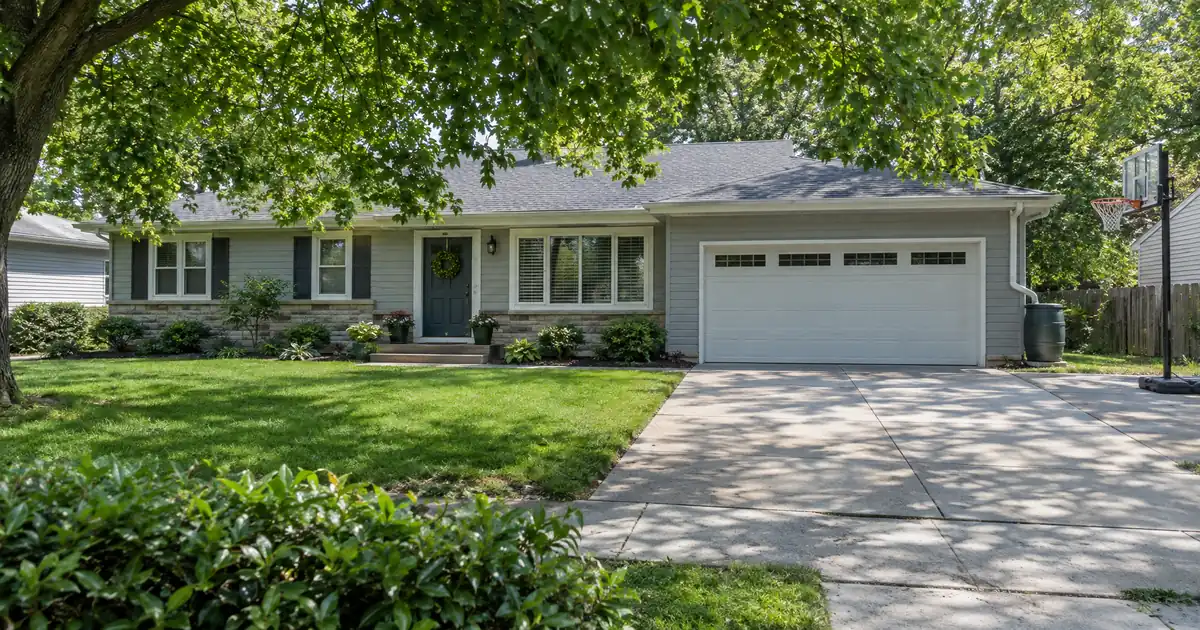
The Quick Read: You can buy the new home while still owning the old one, and the loan rules are not the hard part. The old home’s status decides whether its full payment counts against you. If the old home is under a firm sales contract, that payment can drop out of the math. If you keep it, the lender usually counts every dollar of it.
Everything below follows from that one idea. Pick the path for the old home first, and the rest of the file falls into place.
Conventional payment estimate
The starting figures are an example price at the first-time buyer’s minimum down payment. Replace them with yours.
Editable benchmark: 7.32% as of October 22, 2026 · Freddie Mac 30-year average via FRED®. A conventional market reference, not a conventional loan quote.
Estimate seeded at the low end of Fannie Mae’s published range (0.58%–1.86% a year); the insurer prices the actual premium on the score and the leverage. Applies only above 80% loan-to-value.
Illustrative starting assumptions: a $350,000 price, the first-time buyer’s minimum down payment, a thirty-year term at the current Freddie Mac benchmark, mortgage insurance at the low end of Fannie Mae’s published range, and property taxes and insurance estimated at typical national rates. Every field is editable.
Illustrative estimate only — not a Loan Estimate, approval, quote, or commitment to lend. The rate field carries the weekly Freddie Mac thirty-year conventional benchmark, a market reference and not a conventional loan quote; your rate is set by the lender at lock. The mortgage insurance figure is an editable estimate seeded from Fannie Mae’s published typical range, not a premium quote; the insurer prices the actual premium, and the cancellation month assumes scheduled payments with no extra principal and no change in value. Taxes, insurance and dues are editable estimates; closing costs are not included. Conforming loan limits apply by county. Licensed in sixteen states for consumer mortgages.
What Does a Lender Count When You Still Own Your Old Home?
A lender counts the old home’s full housing payment unless a specific exception applies. That means principal, interest, taxes, insurance and any assessments, not just the mortgage line. Debt-to-income ratio (DTI) is your total monthly debts divided by your gross monthly income. With two homes, DTI is usually the binding limit, not the down payment.
Here is how the file reads, according to the Fannie Mae Selling Guide: the status of each property you own decides how its payment is considered in qualifying. That status is what you control.
Across the wholesale programs Lendmire works with, the ratio ceiling is generally 50% on files that get an automated approval. Manually underwritten loans run tighter, at 36% or 45% depending on score and reserves. Those are program figures, subject to lender guidelines and full file review. A second payment can eat that room fast.
The Four Paths for the Old Home
You have four realistic choices: sell it under contract, rent it out, convert it to a second home, or simply carry it. Each one changes how the old payment is treated. This is the decision that matters most, so make it before you apply, not after.
| Path | How the old payment is treated | Main catch |
|---|---|---|
| Pending sale | Can be excluded from DTI | Needs a firm contract |
| Convert to rental | Market rent offsets part of it | Documentation and reserves |
| Convert to second home | Full payment counts, no offset | Hardest on DTI |
| Keep and carry | Full payment counts | Needs strong income headroom |
Notice what is not on the list: listing the house. Listing it alone does nothing for your ratio. Many buyers assume a For Sale sign changes the math. It does not.
Pending Sale: The Paper Trail That Removes the Old Payment
A pending sale can remove the old payment from your DTI, but only with a fully executed sales contract. Fannie Mae also wants confirmation that the buyer’s financing contingencies have cleared. In plain words, your buyer is signed and their own loan can no longer fall apart on financing.
Freddie Mac’s Guide allows the payment on a property pending sale to be excluded when the file has an executed contract and the sale will not close before the note date. The two agencies word this differently. Fannie Mae’s published text requires the cleared contingency. Do not assume the two sets of rules are identical. Your lender will tell you which set of rules your loan follows.
If the old home closes before your new loan’s note date, the payment stops being a debt at all. It simply drops out.
A bridge loan, a short-term loan against the old home that funds your new purchase, works the same way. Its payment counts as a debt unless the same pending-sale conditions are met.
Converting the Old Home to a Rental
Fannie Mae now has a specific framework for a home you are leaving and turning into a rental. The lender takes 75% of the market rent and subtracts the old home’s full housing payment. If rent beats the payment, you have a positive offset. If not, you carry the shortfall in DTI.
Two things surprise people here. First, a signed lease does not count under this framework. Rent has to be supported by market evidence, such as an appraisal with market rents, a single-family comparable rent schedule (Form 1007), or three comparable rentals from a market-analysis tool. Second, the lender must document a current housing payment for the old home.
Per Fannie Mae’s announcement, this framework replaces lease-based treatment with market-supported rents, reserves and limits on how much the offset can help. The announcement sets the date from which lenders must apply it, and lenders may adopt it earlier, so ask yours which version it is using on your file. Positive net rent may only offset the old payment rather than add to your income, and a borrower with limited rental-management experience may need extra reserves. Reserves are cash left over after closing. Confirm the exact figures with your loan officer and the current guide rather than relying on a summary.
A multi-unit old home needs the most recent year of traditional personal-income documentation for tenant-occupied units. Market analysis covers only the unit you lived in.
Second Home or Keep and Carry
If you keep the old home as a second home, the full payment counts as monthly debt, with no rental offset. Fannie Mae’s rules also generally do not let you count rental income from a one-unit principal residence or a second home, with narrow exceptions for boarders and accessory units.
That makes this the toughest path for DTI. It works for buyers with high income, little other debt and a lot of cushion. For everyone else, it is the path where a lender says the ratio does not fit.
One more point on leverage. Your new home is a principal residence, and occupancy drives the maximum loan-to-value (LTV), the loan amount as a percentage of the home’s value. Across the programs we place files with, a principal residence purchase can reach 97% LTV for a fixed-rate first-time buyer and 95% otherwise. Second homes top out at 90%. If you are actually buying the new place as a second home, the leverage is lower and the scrutiny is higher. The Fannie Mae Eligibility Matrix shows the agency caps by occupancy. Every figure here varies by lender and program: guidelines, property type, leverage, and credit profile all apply.
How the Loan Is Underwritten, Step by Step
Underwriting a buy-before-sell file follows a clear order. Knowing it helps you avoid surprises.
1. Choose the path for the old home. This decides which rules apply.
2. Gather the old-home paper. You need the mortgage statement, tax and insurance figures, and any sales contract or rent evidence.
3. Run the file through the automated system or manual review. Automated findings govern most files, with the 50% ceiling. Manual files use 36% or 45%.
4. Check credit. The wholesale conventional programs start at a 620 decision score. A higher score gives you more room.
5. Verify cash. Your down payment and closing costs come from documented funds. Reserves are counted after funds to close are subtracted.
6. Appraise the new home. It follows normal purchase rules. The old home needs an appraisal or rent schedule only if the rental path or a lender requirement calls for it.
7. Re-check before closing. If new debt shows up or income drops and the recalculated ratio crosses the ceiling, the loan is no longer eligible for delivery to Fannie Mae.
That last step catches people. Do not buy furniture on credit or draw on an equity line mid-process.
Funding the Down Payment Without Selling
Your down payment and closing costs have to come from somewhere, and equity in the old home is a common source. Each option adds something to your file.
| Source | What it is | Main catch |
|---|---|---|
| Savings or other assets | Cash you already hold | Reduces reserves |
| HELOC | Open credit line on old home | Payment may count |
| Home equity loan | Second mortgage, fixed amount | Adds a payment |
| Bridge loan | Short-term loan on old home | Counts unless sale is firm |
| Cash-out refinance | New first mortgage on old home | 80% LTV cap on a one-unit principal residence |
On a HELOC, the payment counts as monthly debt when it is required. Freddie Mac says that when no payment shows on the credit report or in documents, 1.5% of the outstanding balance is used as the payment. A HELOC with no required payment is not invisible.
The Consumer Financial Protection Bureau warns you could lose your home if you cannot repay a HELOC. It also says a lender can freeze or reduce the line if your home’s value drops or circumstances change. So the practical sequence is to open any equity line before you list the old home or apply for the new loan. Lender policy on this varies, so ask yours first.
Cash-out refinancing the old home carries seasoning rules: the existing first mortgage generally must be at least 12 months old, and a borrower must have been on title for 6 months. Those are program figures, subject to lender guidelines.
Worked Example, in Plain Words
Take a buyer whose income is solid but whose old-home payment is large. With the old home still owned, the lender counts both housing payments. The DTI lands near the top of the allowed range, and the file is thin.
Now the same buyer signs a firm sale contract on the old home and the buyer’s financing contingency clears. The old payment drops out. DTI falls well inside the limit, and the file is comfortable.
Same buyer, same income, same new home. The only change is the old home’s status. That is why the first conversation with your lender should be about your plan for the old place.
Where the General Rule Breaks
A few edge cases change the answer.
- Open contingency. A contract where the buyer’s financing is still open does not earn Fannie Mae’s exclusion.
- Sale falls through. If the buyer’s deal collapses after you close on the new home, the old payment becomes your real obligation again. That is analysis, not a quoted rule, but plan for it.
- Assumed mortgage. If a buyer assumes your old loan, the lender is not required to count the contingent liability when the new owner has a verified 12-month history of timely payments on it.
- Employer relocation. Freddie Mac’s Bulletin 2019-17 allows an unexecuted buyout agreement in a narrow relocation context. It is an edge case, not a plan.
- Other loan types. These rules are Fannie Mae and Freddie Mac policy. FHA, VA, USDA and jumbo programs have their own.
- Cash-out on the old home. If you plan to refinance the old home for cash, the 80% cap on a one-unit principal residence is the limit that applies.
Rules like these are dated and change. They describe the current Selling Guide, not a permanent rule.
Common Mistakes
- Assuming a listing removes the old payment.
- Counting on a signed lease to offset the old payment.
- Treating rent as added income when it may only offset the payment.
- Forgetting taxes and insurance, which count too.
- Opening new credit after applying.
- Assuming 50% DTI is a promise. It applies to automated findings only.
- Telling the lender about the old home’s plan late. Raise it at the start.
If you put less than 20% down on the new home, mortgage insurance applies above 80% LTV. You can request cancellation at 80%, and it ends automatically at 78%. Every figure here varies by lender and program — guidelines, property type, leverage, and credit profile all apply.
Key Terms Defined
Debt-to-income ratio (DTI): your total monthly debt payments divided by your gross monthly income.
PITIA: principal, interest, taxes, insurance and assessments, the full housing payment.
Reserves: verified cash left after closing, usually counted in months of housing payments.
Bridge loan: a short-term loan, often secured by the old home, that funds a purchase before the old home sells.
Loan-to-value (LTV): the loan amount as a percentage of the home’s value.
Pending sale: an old home under a fully executed sales contract that has not yet closed.
Which Path Fits You?
A short rule of thumb helps. If you can get a firm contract on the old home, take it. If you cannot, but the old home rents well, the rental path may work. If neither fits and your income is high, carrying both is possible, though thin. Many buyers find the file only works one way. A broker can run it each way before you commit to an offer.
If you are buying a home and want to see whether a conventional loan fits your file, Lendmire can help you compare the options and what each one asks of the file. The team arranges these loans through wholesale lenders, and you can start with its conventional loan programs page. For a shorter take on the same question from the buyer’s side, see Lendmire’s piece Can You Buy a New Home Before Selling With a Conventional Loan?.
Frequently Asked Questions
Can I get a conventional loan on a new home before my old one sells?
Yes, if you can fund the down payment and the file’s ratio can absorb the old payment, or that payment is excluded. A firm sales contract on the old home is the cleanest way to remove it. Otherwise the lender counts both payments. Approval is subject to lender guidelines and full file review.
Does listing my house count as a pending sale?
No. Fannie Mae wants an executed contract and confirmation that the buyer’s financing contingencies have cleared. A listing alone changes nothing in your ratio.
Can I use a lease to count rent from my old home?
Not under Fannie Mae’s departing-residence framework. Leases are not permitted for a departing residence. Rent is based on market evidence such as an appraisal, a rent schedule or three comparable rentals. The lender uses 75% of the market rent and subtracts the old home’s full payment.
What if the buyer of my old home backs out after I close?
The old payment becomes your real obligation again. Plan reserves for that case, and ask your lender what documentation they kept. A contract with an open financing contingency would not have earned the exclusion in the first place.
How does a HELOC on the old home affect my loan?
A HELOC payment counts as monthly debt when it is required. Freddie Mac may impute 1.5% of the balance when no payment is documented. Open any line before listing, since a lender can freeze or reduce it later.
For your own numbers, request a scenario review with Lendmire.
About Lendmire
As a mortgage broker (NMLS# 2371349), Lendmire helps homeowners and home buyers in 16 states with FHA, VA, conventional and jumbo purchase and refinance loans arranged through wholesale lenders. Lendmire is never the lender; program terms are set by the lender and the agency guidelines. Scotsman Guide named Lendmire a Top Mortgage Workplace in both 2025 and 2026.
Get Started
Ready to find the right loan for you?
In about two minutes you can review financing options available for your home or investment property. No commitment required.
Informational only. Not a Loan Estimate, approval, or commitment to lend. Program availability and eligibility are subject to lender guidelines, credit approval, property review, and underwriting.
References
1. Fannie Mae Selling Guide B3-6-06
3. Fannie Mae departing-residence announcement
4. Fannie Mae Eligibility Matrix
This article is part of Lendmire’s conventional loan program — full qualification details, guidelines, and scenarios live on the program page.
Related reading: Can a Small-Town Home Get a Conventional Loan With Few Comps? · How to Finance a Vacation Home With a Conventional Loan · How to Set Up Autopay With a New Servicer on a Conventional Loan
Brandon Miller
Founder & CEO, Mortgage Loan Originator, Lendmire LLC
- Mortgage Loan Originator · NMLS# 1129696 · Verify on NMLS Consumer Access
- North Carolina Real Estate Broker · License# 343312 · Verify on NCREC
- North Carolina Insurance Producer · License# 19053198 · Property, Casualty, Life, Health · Verify on NAIC SBS
- Lendmire LLC · Firm NMLS# 2371349 · Verify firm licensure
Compliance and disclosures. Lendmire (NMLS# 2371349) is a licensed mortgage broker and is not a direct lender, depository institution, financial advisor, or tax professional. Content in this article is general market analysis and educational information — not financial, legal, or tax advice for any specific situation. Lendmire does not guarantee loan approval; every transaction is subject to underwriting by the funding lender. Mortgage pricing and loan program guidelines are subject to change at any time without notice and vary by borrower characteristics, property type, and state regulations. Lendmire complies with Equal Housing Opportunity. Licensure verification: NMLS Consumer Access.