
The Quick Read: A seasoned flipper buys a rental package on hard money, financing the bundle on a short interest-only bridge sized on cost, verifying each door’s rent and title before closing, and lining up a long-term DSCR loan, either one loan per house or one portfolio note, whose appraisal and coverage test decide the exit.
- The bridge is the easy part. The exit lender’s appraisal and rent coverage set your final loan, not your after-repair value.
- Experience buys leverage on the bridge. The top hard money tier is reserved for investors with documented completed projects.
- A package concentrates risk, because several seasoning clocks and one bridge maturity can collide.
- Clearing a 1.00 coverage ratio does not mean the package makes money. It means rent covers the mortgage payment, taxes and insurance, nothing more.
- Per-property loans keep selling flexibility. A portfolio note trades that for fewer closings and pooled coverage.
What a Rental Package Is and Why It Isn’t a Flip
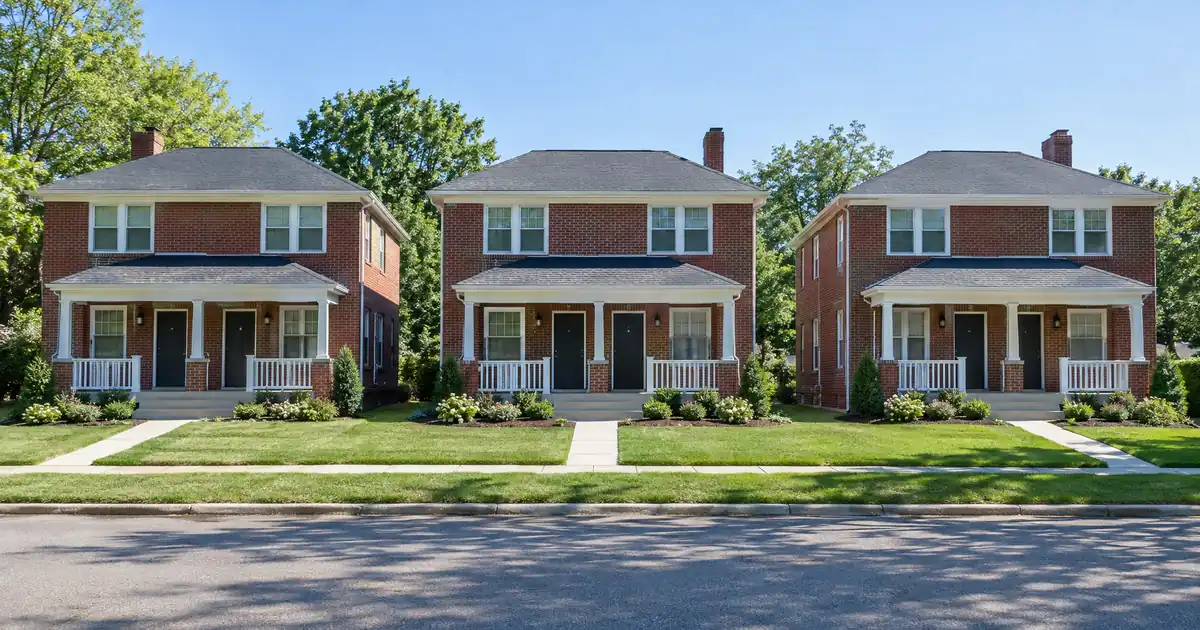
A rental package is a bundle of rental properties bought from one seller, usually in one negotiation. The seller wants out of the whole portfolio, and few buyers can absorb that many doors. That thin buyer pool often gives a prepared investor room to negotiate.
A flip is built around resale margin. A package is built around rent, so the analysis changes. You are no longer asking what each house sells for after repairs. You are asking what each house rents for, what it costs to carry, and what a long-term lender will lend against it.
Most packages sit on separate parcels, one deed per house. That detail matters later, because it lets you finance some doors one way and some another. It also means each deed records on its own date, and each date starts its own seasoning clock.
Why Hard Money Fits a Package (and When It Doesn’t)
Hard money fits a package when the discount is real and the exit is already tested. A hard money loan is secured by the property itself, runs short, and costs more than long-term debt. In return, it is built around the asset rather than your traditional personal-income documentation.
Here are the program ranges Lendmire sees on its hard money placements, which vary by lender, property, and experience:
- Bridge purchase with no rehab: up to 80% of the purchase price.
- Purchase with rehab: leverage is based on project cost. It runs up to 93% of project cost at five or more completed projects, up to 90% of project cost at two or more, and 85% of project cost below that. Every tier is capped at 75% of after-repair value.
- Rehab funds: up to 100% of the rehab budget is released in draws against completed work. That is a budget figure, not a purchase LTV.
- Loan size and term: up to $5,000,000, larger by exception, on a 6-18 month interest-only term with no prepayment penalty.
- Credit and collateral: a 620 minimum score, with additional conditions below 660, on non-owner-occupied residential property of one to four units.
The first-time-investor tiers are lower. The top tier is reserved for experienced investors, and that is where a seasoned flipper has the advantage.
The old objection to hard money on buy-and-hold deals is fair. A bridge clock keeps running while you rehab, place tenants, and season the deed. Use this decision test:
1. Does the purchase price leave room under the appraised value the exit lender will likely use?
2. Does rent from each door, or from the pool, cover the long-term payment with some cushion?
3. Does the bridge term outlast your longest seasoning clock plus a cushion for delays?
If you answer no to any one of them, hard money is the wrong tool for that package. If you answer yes to all three, the bridge is a reasonable way to buy at a discount before permanent financing is in place.
How a Flipper’s Track Record Translates
Your flip history carries over to the bridge, but not automatically to the permanent loan. Hard money lenders underwrite the asset, the plan, and the exit. The count of completed projects moves you up the leverage tiers. Liquidity and a clear plan keep the file simple.
Long-term DSCR lenders look at different things. They want rent covering the payment, a credit score that meets the program floor, reserves, and a clean entity if the loan sits in an LLC. A flipper who has always sold may have strong credit and thin landlord history. That is workable, but expect questions about management and reserves rather than resale margin.
Many strong flippers discover that their cash is tied up in the next rehab, which makes reserve rules the surprise requirement.
The Steps, Start to Finish
Step 1: Underwrite the package door by door. Ask for a current rent roll, a trailing twelve-month operating statement, and the aged receivables. Ask for a list of recent capital work too. Check that lease rents and deposits match the rent roll. Order a title report to catch old liens. Inflated rent rolls are a known trap, so confirm rent with signed leases and bank deposits, and request tenant estoppels where tenants are in place.
Step 2: Size the bridge backward from the exit. Start with what the long-term lender will lend against appraised value and rent coverage. Then test whether your cost basis lets you recycle capital. The bridge loan should be the smaller question.
Step 3: Test coverage on rent over the full monthly obligation. DSCR here means monthly rent divided by PITIA, which is principal, interest, taxes, insurance, and any HOA dues. Textbook definitions use net operating income over debt service, and the two framings can differ on a property with heavy expenses. Lendmire’s network uses the rent-over-PITIA version for DSCR loans. According to the Debt Service Coverage Ratio entry on Wikipedia, a ratio above 1.0 means income covers the debt and below 1.0 means it does not.
Step 4: Match the bridge term to the seasoning clock. Cash-out refinances commonly expect about six months of seasoning. On a package, seasoning runs per deed, and staggered closings mean staggered clocks.
Step 5: Order valuation and rent support for the takeout. The exit lender’s appraisal sets the value, not your after-repair estimate. Vacant units have no lease to verify and no estoppel to collect, so rent support comes from the appraiser’s market-rent schedule.
Step 6: Pay off and close. The new loan retires each hard money lien. Many investors refinance out of hard money into long-term DSCR financing once the properties are stabilized, and Lendmire arranges that path through its wholesale lender network.
Loan Structures for the Package
You have three real choices for the takeout. Which one fits depends on how many doors you own, how long you plan to hold, and whether you might sell one. The portfolio programs are different from a loan on one house, so the table separates them.
| Factor | Separate DSCR loans | 30-year portfolio DSCR loan | Rental portfolio term loan |
|---|---|---|---|
| Properties | One loan per house | 2 to 20 under one note | 5 or more under one loan |
| Leverage ceiling | 75%-80% on purchase | Up to 80% of value | Up to 75% of value |
| Coverage test | Per property | Pooled, 1.00 floor | Pooled across the portfolio |
| Term | 30-year fixed is the spine | 30-year, interest-only available | 3, 5, 7, or 10 years, balloon |
| Selling one door | Simple | Follows release terms | Follows release terms |
On a loan for one rental, 1.00 is where many select programs start, with stronger ratios opening better leverage and pricing. A separate select-lender path takes coverage below 1.00, with leverage and terms adjusted. A cash-out on a single standard rental tops out around 75%.
The 30-year portfolio DSCR loan covers two to twenty properties under one note, from $300,000 to $5,000,000, with larger balances on review. It accepts single-family, two-to-four-unit, condo, and townhome collateral. Its coverage floor of 1.00 is measured on the pool, so stronger houses can offset weaker ones. A rental that sits below 1.00 on its own can still sit in the pool, but underwriting tests the pooled coverage, the leverage, and the terms.
The rental portfolio term loan is for five or more properties or units, from $500,000 to $50,000,000. Terms of 3, 5, 7, or 10 years carry a balloon at maturity, so you refinance or repay at the end. Both recourse and non-recourse versions exist, and a non-recourse loan looks to the real estate, with carve-outs such as fraud and bankruptcy. Prepayment carries yield maintenance, so paying off early costs real money. Reserves are held for taxes, insurance, and capital expenditures. This structure can place properties in several markets under one loan. Small multifamily of five or more units is eligible only here, never on the 30-year portfolio structure or on a single-property loan.
These terms are program ceilings and floors rather than quotes. Qualification is subject to lender guidelines.
How the Cost-Basis Cap Affects a Fresh Package
If you take cash out at the takeout, the lender’s seasoning rule matters most. Inside the first six months of ownership, the loan is also capped at 90% of total cost (purchase price plus documented improvements), and at 100% of total cost from six to twelve months. The leverage ceiling still applies, and the loan is the lower of the two. After twelve months, the appraised value alone is the basis. A rate-and-term refinance is not subject to the cost-basis cap. Cash-out on a portfolio loan never exceeds 75% of the pooled value.
The practical lesson is that a flipper who buys at a deep discount and wants proceeds early may find the cost cap binding. Waiting for seasoning can unlock the appraised-value basis, but only if the bridge term allows it.
Credit and entity rules come next. The portfolio programs’ credit floor is 640, and some portfolio structures ask for 680 or 720. Some structures require a special-purpose entity, typically an LLC, and recourse loans carry a personal guarantee. Reserves vary by lender, leverage, loan size, and transaction type. On a single-property DSCR file they commonly run around six months of PITIA, and larger loans step up.
Worked Example: Six Doors, One Seller
Picture a flipper who buys six single-family rentals from one seller. Four are leased and two are vacant. Each sits on its own parcel with its own deed.
The numbers below are modeled assumptions, not market data. Two of the leased houses carry strong rent against their payments. The other two leased ones are tight, and pooled rent covers the pooled PITIA at about 1.15x. The two vacant houses have no leases, so their rent comes from the appraiser’s schedule.
The flipper finances the purchase on a hard money bridge. The package needs only cosmetic work, so the lender treats it as a bridge purchase with leverage that varies by lender, property, and experience. The seller agrees to stagger the closings, which gives the flipper time to move each deed forward.
At the takeout, the flipper has a choice. A 30-year portfolio loan would let the pool clear a 1.00 floor, even though two houses are individually thin. Separate loans would test each house alone, and the two thin ones might need more equity or a different path. The portfolio route is cleaner for coverage. The separate route is cleaner if the flipper plans to sell one house in a year.
The sizing logic matters more than the numbers. The final loan is limited by the lower of the leverage ceiling and any cost cap in force, and by whether pooled coverage clears the floor. Clearing it says nothing about repairs, vacancy, management, utilities, or capital expenditures, all of which sit outside the calculation.
Where the General Rule Breaks
A cash-buyer exception does not rescue a bridge purchase. A delayed-financing exception built for all-cash buyers generally does not fit here, because a bridge-funded purchase shows financing on the settlement statement. Even where it applies, it returns documented cost, not after-repair value. Programs differ, so verify per program.
Low balances can fall under loan minimums. Standard DSCR loans run from roughly $100,000 up to $3,000,000, and the portfolio structures have higher floors in aggregate. A package of very small houses can miss a minimum on a per-property basis. Some of the doors may need to be sold off the list, or the whole package may need to sit under a portfolio note.
Stacked capital draws questions. If part of your equity comes from a second lien, outside private capital, a borrowed down payment, or an equity partner, the permanent lender will want to see it. Disclose it early.
Cross-collateralizing several LLCs is difficult. Lenders prefer one borrower structure per note. If you hold doors in different entities, plan the exit loan structure before you close the bridge.
Some property types are ineligible. Owner-occupied property, co-ops, mixed-use property, and commercial property are ineligible in the portfolio pool.
Manufactured and mobile homes are not reviewable on any of these programs.
Prepayment can change the decision. Hard money carries no prepayment penalty. The rental portfolio term loan carries yield maintenance, so a flipper who expects to sell within a short window should lean toward separate loans.
Key Terms Defined
Package: several rental properties bought together from one seller, usually on separate parcels.
Seasoning: the time a lender requires you to own a property before it will lend against appraised value instead of cost.
PITIA: principal, interest, taxes, insurance, and association dues, the full monthly obligation the DSCR ratio tests.
Cross-collateralization: a structure where several properties secure one loan, so each one backs the others.
Blanket loan: one note secured by several rentals, which is the same thing as a portfolio DSCR loan or a cross-collateralized loan.
Yield maintenance: a prepayment charge that compensates the lender for interest lost when a fixed-rate loan is paid off early.
A Pre-Close Checklist for the Flipper
- Signed leases that match the rent roll, with estoppels where tenants are in place.
- Title reports on every parcel.
- A bridge maturity that outlasts the longest seasoning clock, with a cushion.
- Reserves in cash, sized for the permanent lender’s rules and not only the bridge.
- Entity documents ready if the exit loan sits in an LLC, subject to lender program eligibility.
- A management plan, because a lender and an appraiser will both ask who runs the doors.
- A fallback exit, such as selling one or two houses if the pooled coverage comes up short.
Tax treatment varies; consult a qualified professional before relying on any deduction.
For related reading, Lendmire has covered how a rehabber can plan a two-step cash-out when leaving hard money. The complete DSCR loans guide covers the long-term side in more depth.
Frequently Asked Questions
Can a first-time landlord buy a package on hard money?
Yes, though the leverage tier is lower. First-time investors qualify at the lower tiers, and the top tier is reserved for experienced investors. The permanent lender will also ask for reserves and a management plan, which a newer landlord should prepare before closing.
Does the hard money loan have a prepayment penalty?
No, not on the current program, which runs 6-18 months interest-only with no prepayment penalty. The penalty risk sits on the exit side, since the rental portfolio term loan carries yield maintenance. Terms vary by lender, property, and experience.
Should I use one loan or one loan per house?
It depends on whether you may sell a house. Separate loans keep each door independent. A portfolio note gives you pooled coverage, so stronger rents can offset weaker ones, but a sale follows the release terms in the loan documents, and the remaining portfolio must still cover its debt service.
Does clearing a 1.00 DSCR mean the package cash flows?
No. The ratio compares rent to PITIA only. Repairs, vacancy, management, utilities, and capital expenditures sit outside it, so budget for them separately.
What if a house in the package fails appraisal?
The loan on that house shrinks, and your cash requirement rises. In a pooled structure, the lender retests pooled value and coverage. A fallback exit, such as selling that door, is the practical backstop.
Next Step
If you are buying, rehabbing or refinancing an investment property on a short timeline and want to see how the numbers work, Lendmire can help you compare hard money options based on the project, the exit plan, leverage, and your goals. Lendmire is a broker that arranges financing through select lenders in its wholesale network, across 41 markets, including Washington, D.C. Every file is underwritten individually, and nothing here is a commitment to lend. A package is easiest to finance when the exit is designed before the bridge closes.
For current guidelines and terms, see Lendmire’s DSCR loan programs page.
About Lendmire
As a non-QM mortgage broker (NMLS# 2371349), Lendmire facilitates DSCR investor loans across 41 markets, including Washington, D.C. DSCR eligibility is generally reviewed around property-level rental income instead of personal income documentation, subject to lender guidelines, serving LLC-structured portfolios and self-employed borrowers who don’t fit conventional boxes. A two-time Scotsman Guide Top Mortgage Workplace (2025, 2026).
Get Started
Ready to find the right loan for you?
In about 30 seconds you can review financing options available for your investment property. No commitment required.
Informational only. Not a Loan Estimate, approval, or commitment to lend. Program availability and eligibility are subject to lender guidelines, credit approval, property review, and underwriting.
References
1. Corporate Finance Institute: Hard Money Loan
2. Wikipedia: Debt Service Coverage Ratio
This article is part of Lendmire’s hard money loan program — full qualification details, guidelines, and scenarios live on the program page.
Related reading: Portfolio DSCR Loan vs Leaving Private Money in Your Rental Pool · Can You Get a Portfolio DSCR Loan on a Package Bought This Year? · Can You Finance a Rental Package From One Seller on One DSCR Loan?
Brandon Miller
Founder & CEO, Mortgage Loan Originator, Lendmire LLC
- Mortgage Loan Originator · NMLS# 1129696 · Verify on NMLS Consumer Access
- North Carolina Real Estate Broker · License# 343312 · Verify on NCREC
- North Carolina Insurance Producer · License# 19053198 · Property, Casualty, Life, Health · Verify on NAIC SBS
- Lendmire LLC · Firm NMLS# 2371349 · Verify firm licensure
Compliance and disclosures. Lendmire (NMLS# 2371349) is a licensed mortgage broker and is not a direct lender, depository institution, financial advisor, or tax professional. Content in this article is general market analysis and educational information — not financial, legal, or tax advice for any specific situation. Lendmire does not guarantee loan approval; every transaction is subject to underwriting by the funding lender. Mortgage pricing and loan program guidelines are subject to change at any time without notice and vary by borrower characteristics, property type, and state regulations. Lendmire complies with Equal Housing Opportunity. Licensure verification: NMLS Consumer Access.