
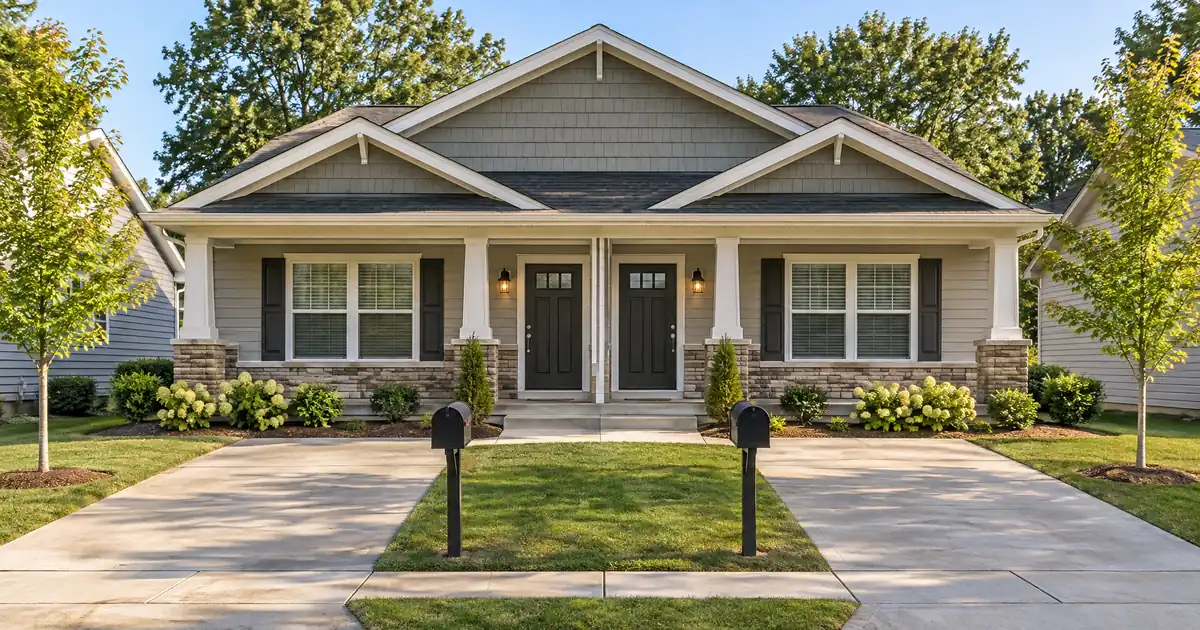
The Quick Read: Usually no. While probate is open, the estate still owns the duplex, and an heir has no recorded title to pledge as collateral. A lender needs clean title and someone with authority to sign the lien, and both generally arrive only after the deed to the heir is recorded.
- Letters from the court prove an executor’s authority. They do not move title.
- A will naming you does not make you the owner.
- Once title vests, an investment line on this network is limited to 70% CLTV and $500,000.
- Trusts, survivorship, and transfer-on-death designations can skip probate, and title review decides those cases.
Most heirs ask this question because the duplex is already producing rent and the equity looks idle. The instinct is reasonable. The mechanics are not on their side yet, and the sequence matters more than the product.
How large a line the equity supports.
An equity line is sized by combined loan-to-value, occupancy, and credit — not by rental coverage. Switch the occupancy or the credit band and the ceiling moves with it.
Investment-property lines require a 700 minimum credit score; second-home lines start at a 640 minimum and primary-residence lines at 600, and the combined-LTV ceiling steps down as the credit band drops on primary-residence and second-home lines and holds on investment-property lines; the line cap steps down on primary-residence lines and holds at every tier on investment-property and second-home lines.
A debt-to-income ratio above 45% requires 680+ credit. Profiles under 640 are limited to single-family homes. At least 75% of the approved line is drawn at closing. Ceilings, floors, and caps update from Lendmire’s centralized guideline source.
Line estimate
Illustrative estimate only — not a quote, Loan Estimate, approval, or commitment to lend. The rate is an editable assumption; equity-line pricing is variable through both the draw and repayment periods and never converts to fixed. Occupancy and credit drive the ceiling together: an investment property tops out at 70% combined LTV (minimum credit 700, line cap $500,000); a second home tops out at 90% combined LTV (minimum credit 640, line cap $500,000), with the ceiling stepping down as the credit band drops (the cap holds at every tier); a primary residence tops out at 90% combined LTV (minimum credit 600), and its $750,000 maximum line is available only at 75% combined LTV or below with a 700-or-better credit profile (720 on the longer-runway program) and a full appraisal. Lines above $500,000 require a full appraisal. Credit, debt-to-income, property type, and full underwriting review all affect the final line.
Who Owns the Duplex While Probate Is Open?
The estate owns it. A HELOC is a lien, and the person signing a lien must hold title and the authority to encumber the property. During probate, neither the will’s beneficiary nor the court-appointed executor meets that test for a personal line.
Iowa State Extension describes probate as the court procedure that passes clear title, and notes it can run two years or more depending on complexity. That source is dated and Iowa-specific, so read it as a general picture, not a schedule. Bankrate says the same thing from the lending side: a home equity loan or line on inherited property requires clear title, a finished probate or estate settlement, and a completed ownership transfer. If the home was inherited with others, they must agree to the loan, though they need not be co-borrowers.
Three things decide the outcome: recorded title, who can sign, and whether a lender can place a clean lien position.
Who Can Sign at Each Stage?
Authority changes at each step, and title changes only at the last one. This table shows where a line of credit becomes possible.
| Stage | Who holds title | Who can sign | Realistic path |
|---|---|---|---|
| After death, before court opens | Estate (no representative yet) | No one | None |
| Letters issued | Estate | Personal representative, within court limits | Estate-level action only |
| Probate open, deed not recorded | Estate | Personal representative | Not a personal HELOC |
| Deed to heir recorded | Heir(s) | Every title holder | HELOC, cash-out refinance, or sale |
Letters testamentary are issued when there is a will. Letters of administration are issued when there is not. Either one proves the representative’s authority. Neither one gives the heir ownership.
Can the Executor Borrow Against the Duplex?
Sometimes, but that is an estate transaction, not an heir’s HELOC. The personal representative acts for the estate, and state law varies on what needs a judge’s approval. In some states an executor can act on the estate’s behalf with broad independent authority, while in others a borrowing or a pledge of real property needs court sign-off first. Your state may differ, and a probate attorney is the right person to say how.
Even where an executor can borrow, the loan belongs to the estate. It is a different product from a HELOC, and the investor-heir’s own credit and income are not what drive it. That distinction trips up many families.
Does Probate Even Apply to Your Duplex?
Not always. Iowa State’s Center for Agricultural Law and Taxation lists the routes that skip probate: transfer-on-death or payable-on-death designations, joint tenancy with right of survivorship, and assets properly titled in a trust. If your parent put the duplex in a funded revocable trust, a successor trustee may be able to document the transfer without a court case.
Two cautions. First, a trust that was never funded does nothing, because the deed still names the parent. Second, transfer-on-death deeds are a state-by-state matter. The same Iowa State group notes that some states allow them, and others do not.
Skipping probate does not skip title review. A lender still wants to see who holds title, how it passed, and whether a lien search turns up estate or tax liens.
What Happens to the Existing Mortgage?
The debt survives the borrower’s death, and the lien stays on the duplex. Federal law (the Garn-St Germain Act) generally bars a lender from enforcing a due-on-sale clause when residential property with fewer than five dwelling units transfers to a relative because of the borrower’s death. A duplex fits that scope.
That protection lets an heir keep an inherited low-balance mortgage in place. It does not cancel the debt, excuse payments, or help you qualify for a new line. Missed payments still put the property at risk, and the personal representative has to keep the loan current while the estate is open.
A new investment HELOC behind that mortgage would be a second lien. The combined balance of both loans against the property’s value is what the lender measures.
What Does an Investment HELOC Look Like After Title Vests?
Once the deed to the heir is recorded, a line becomes possible on this network, within tight limits. Lendmire arranges these through select wholesale partners. It is not the lender, and every figure below is subject to lender guidelines and a full file review.
- Leverage: an investment-property line tops out at 70% CLTV. Both the 720 and 700 credit tiers reach that same ceiling, so a higher score does not raise it.
- Credit: 700 is a hard floor on investment lines, and a score above it buys eligibility, not extra leverage.
- Line size: an investment line is capped at $500,000.
- Structure: a standalone line in first or second lien position, with a 5-year draw and a 25-year repayment period. Pricing floats and does not convert to fixed.
- Valuation: because the cap is $500,000, an investment line normally runs on an automated valuation with no traditional appraisal, though a borrower can request a full appraisal.
- Property: single-family and 2-4 units are eligible, so a duplex fits. Manufactured homes, co-ops, condotels, log homes, commercial, and mixed-use properties are not.
- Footprint: this product is available only in Lendmire’s 16 full-service states, narrower than its DSCR footprint.
The sharpest trap is vesting. The borrower must be an individual or a revocable living trust. LLCs, corporations, partnerships, and irrevocable, blind, or land trusts cannot hold title on a line. If the estate distributes the duplex into an irrevocable trust, or the heirs deed it to an LLC first, the HELOC route closes. A DSCR cash-out refinance is the usual alternative for entity-held property.
Here is how the combined-lien math works, in ratios only. Say the duplex is worth a round $500,000 value, the inherited mortgage is a modest slice of that, and you want a line. The lender adds the existing balance and the new line together and divides by value. If that total stays at or under 70%, the line is in range. Go over, and the line size shrinks to fit. That is why payoff statements belong in your file early.
When a Cash-Out Refinance Fits Better
A line is not the only way to reach equity once title is clean. A cash-out refinance replaces the inherited mortgage and pays you from equity in one new loan. On a standard rental, cash-out refinances on this network generally top out around 75% LTV, with about six months of seasoning as the common expectation. Seasoning on an inherited property can be measured differently by different lenders, so ask early.
A cash-out refinance on a duplex that has tenants can qualify primarily on property-level rental income covering the payment, subject to lender guidelines. DSCR compares rent to principal, interest, taxes, insurance, and any dues. It does not measure repairs, vacancy, management, or utilities, so a ratio above 1.00 is not the same as positive cash flow. Select programs start at 1.00, and a separate select-lender path goes below 1.00 with leverage and terms adjusted. Lendmire’s complete DSCR loans guide walks through the full mechanics.
Credit, reserves, and property type still apply. Most programs want a score around 660, and 700 or higher opens the strongest leverage tiers. Reserves vary by lender, leverage, and loan size, commonly around six months of PITIA.
The difference between the two products is simple. A HELOC underwrites you, with credit, debt-to-income, and an interest-only qualifying payment. A DSCR refinance reviews the property’s qualifying rent. An heir with strong rent and thin personal income often fits the second path better.
Comparing Your Options
| Option | Who borrows | Title needed | Main risk |
|---|---|---|---|
| Investment HELOC | Heir, individually | Recorded in heir’s name | Vesting and 70% CLTV cap |
| DSCR cash-out refinance | Heir or entity, per program | Recorded in borrower’s name | Seasoning, reserves, coverage |
| Estate loan | Estate, via representative | Estate holds title | Court approval, different product |
| Sale | Estate or heir | Estate or heir | Gives up the asset |
Estate or probate loans are short-term loans made to the estate and signed by the personal representative. They are not a HELOC, and the structure and cost differ. Treat them as a bridge decision for the estate, and talk to the probate attorney before anyone signs.
What to Do While Probate Is Open
You cannot borrow yet, but you can prepare. A clean file shortens the gap between the deed recording and the application.
1. Get payoff statements for the existing mortgage and any lien on the duplex.
2. Assemble the rent roll and leases. Someone must collect rent and cover insurance and the mortgage during probate.
3. Confirm insurance is in force and names the right parties.
4. Collect certified copies of the death certificate, the will, and letters.
5. Settle the co-heir question. Every title holder generally has to sign, and one heir cannot encumber a shared asset alone.
6. Decide the vesting. Do not deed the duplex into an LLC or irrevocable trust until you know which loan you want.
If several siblings inherit one duplex, a buyout is a common plan. A buyout funded by a line or refinance needs a title timeline, so ask the attorney when the deed will record.
For related reading, Lendmire’s piece How to Qualify for an Investment Property HELOC While the Home Is Still in Probate covers the same wait from a different angle.
Key Terms Defined
Letters testamentary are the court document naming an executor under a will.
Letters of administration are the court document appointing a representative when there is no will.
Personal representative is the person who manages the estate under court authority.
CLTV is the combined balance of all loans on the property divided by its value.
Lien is a recorded claim that lets a lender collect from the property if the loan is not repaid.
Successor in interest is a confirmed heir who is treated as a borrower for servicing purposes on the existing loan, as defined in federal servicing rules.
Common Myths
“I’m named in the will, so I can borrow.” A will names a recipient. Court letters give authority, and even they do not transfer title.
“I’m the executor, so I can take a personal HELOC.” An executor acts for the estate, not as a personal borrower.
“Probate closed, so I can apply.” Title must be recorded in your name. A closed court file and a recorded deed are different events.
“Successor-in-interest status lets me borrow more.” It covers servicing rights on the existing loan only, as the National Consumer Law Center explains.
Frequently Asked Questions
Can I get a HELOC on my parent’s duplex if I am the only heir?
Not until the deed is recorded in your name. Being the sole heir and being the owner are different things while probate is open. Afterward, an investment line is available through select lenders in the network, subject to the 70% CLTV cap, the 700 credit floor, and full file review.
Can the executor take out a HELOC for the estate?
That is a different transaction from an heir’s personal line. Where state law lets a representative borrow against estate real property, it may require court permission, and the product is usually an estate loan. Ask the probate attorney first.
Do my siblings need to agree?
Generally yes. Every title holder typically has to sign, and one heir cannot encumber a shared duplex alone. Bankrate notes that co-heirs must agree to the loan, though they need not be co-borrowers.
Does the existing mortgage have to be paid off first?
No. Federal law generally prevents a lender from forcing payoff because of the inheritance. The mortgage stays in place and a new line sits behind it as a second lien, counted in the combined 70% CLTV.
What if the duplex is in a trust?
A funded revocable trust may avoid probate, and a revocable living trust can hold title on an investment line. An irrevocable trust cannot, and a property already deeded to an LLC needs a vesting change or a DSCR cash-out instead.
Will the tenants’ rent count toward qualifying?
For a HELOC, the underwriting looks at the borrower’s credit and debt-to-income. For a DSCR refinance, qualification runs primarily on property-level rental income. Tax treatment varies; consult a qualified professional.
If you are considering a home equity line and want to see how the numbers work, Lendmire can help you compare HELOC options based on the property, the equity available, credit profile, combined leverage, and your goals. Reach the team at 828-256-2183 or request a quote through Lendmire’s quote page.
About Lendmire
Lendmire (NMLS# 2371349) is a mortgage brokerage serving homeowners and real estate investors in its 16 full-service states. Home equity lines of credit are arranged through wholesale lending channels; Lendmire brokers the line and the lender underwrites each application under its occupancy-based guidelines. Scotsman Guide named Lendmire a Top Mortgage Workplace in both 2025 and 2026.
Get Started
Ready to find the right loan for you?
See your offer in seconds. No credit pull, no obligation.
Informational only. Not a Loan Estimate, approval, or commitment to lend. Program availability and eligibility are subject to lender guidelines, credit approval, property review, and underwriting.
References
1. Iowa State Extension: estate settlement process
2. Bankrate: inheriting property with a home equity loan
3. Iowa State CALT: overview of the probate process
5. Cornell LII – 12 CFR 1024.31
6. National Consumer Law Center
This article is part of Lendmire’s investment property HELOC program — full qualification details, guidelines, and scenarios live on the program page.
Related reading: How Much Can You Borrow on an Investment Property HELOC Draw?
Brandon Miller
Founder & CEO, Mortgage Loan Originator, Lendmire LLC
- Mortgage Loan Originator · NMLS# 1129696 · Verify on NMLS Consumer Access
- North Carolina Real Estate Broker · License# 343312 · Verify on NCREC
- North Carolina Insurance Producer · License# 19053198 · Property, Casualty, Life, Health · Verify on NAIC SBS
- Lendmire LLC · Firm NMLS# 2371349 · Verify firm licensure
Legal disclosures. Lendmire (NMLS# 2371349) is a state-licensed mortgage brokerage that arranges financing through wholesale lender relationships. Lendmire is not a direct lender, depository institution, or registered financial advisor. The discussion above is general informational content about real estate financing — it is not financial, legal, or tax advice, and readers should consult licensed professionals for guidance on their individual circumstances. Loan inquiries are subject to lender underwriting; this article does not represent a commitment to lend. Loan terms, rates, and qualification standards vary by borrower, property, and state, and are subject to change at any time. Equal Housing Opportunity. NMLS Consumer Access: nmlsconsumeraccess.org.