
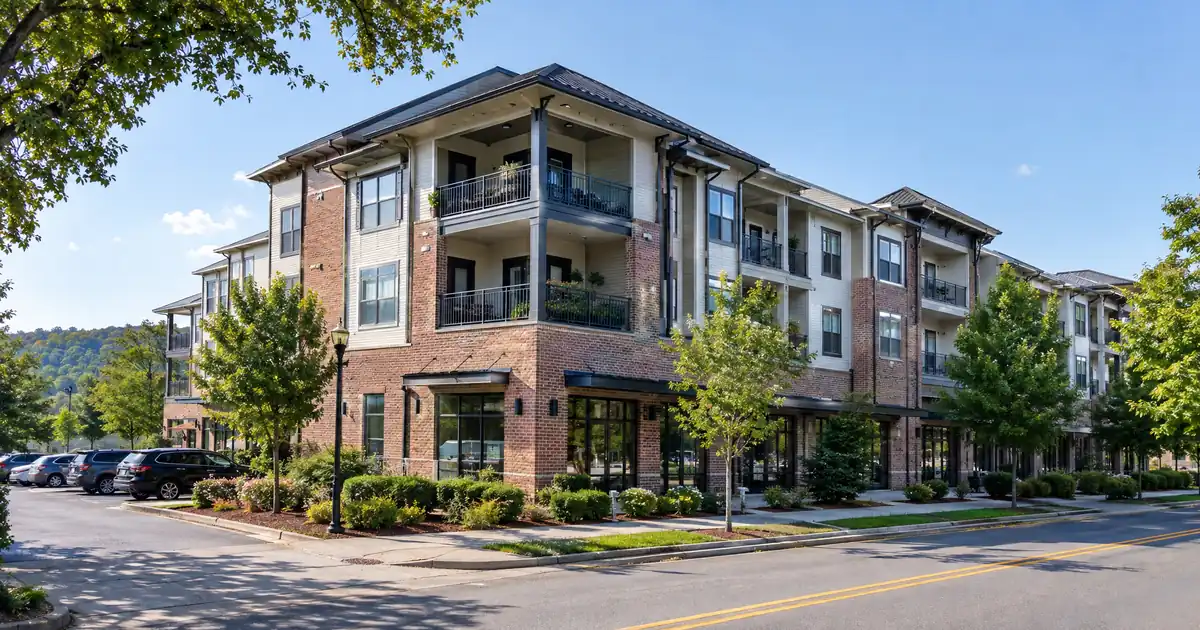
An out-of-state investor scrolling Albertville listings sees a city of 22,813 people per Census Reporter’s ACS data and an average home value of $220,718 on Zillow. The price looks cheap and the rent looks fine. The catch is the gap between them. Cash-out math here rarely rides on appreciation, and it rarely clears on volume. It clears on basis, rent quality, and how much leverage an investor is willing to take back out.
TL;DR: A cash-out refinance on an Albertville, Alabama rental is underwritten primarily on the property’s rental income measured against its full monthly obligation, with the ceiling set by leverage and seasoning rather than appraisal upside alone.
DSCR Cash-Out Calculator
Run the cash-out numbers in Albertville, AL
Rate source: Freddie Mac 30-yr average via FRED® — Federal Reserve Bank of St. Louis · effective Sep 24, 2026
Prefilled with starting assumptions — enter your property’s value, balance, taxes, and insurance for a more accurate picture.
Program parameters update from Lendmire’s centralized guideline source. Taxes and insurance are editable estimates.
As of Sep 24, 2026 · General Freddie Mac market benchmark, not a Lendmire loan offer. Property value, balance, taxes, and insurance are editable estimates. Maximum loan-to-value varies by lender, program, property type, and seasoning. Not a Loan Estimate, approval, or commitment to lend. Program availability and eligibility are subject to lender guidelines, credit approval, property review, and underwriting.
- Zillow’s average 3-bedroom rent figure sits against home values that remain modest relative to the broader region.
- Cash-out leverage tops out at 75 percent LTV, with about six months of seasoning.
- Two-bedroom rents on Zillow struggle to clear a 1.00 DSCR at full leverage.
- Multi-unit stock is thin, so most deals here are workforce single-family.
Albertville Market Snapshot
A quick read on the Albertville investor landscape — figures come from the cited sources below. Confirm current property-level numbers before underwriting.
| Metric | Detail |
|---|---|
| Home prices | 17 sales (Redfin Housing Market) |
| Employment | 3,048 jobs (Business Alabama) |
Start With the Workforce Houses Near the Plants
The strongest cash-out candidate in Albertville is the three-bedroom single-family rental in the industrial-workforce belt, where the tenant pool is tied to plant employment rather than to seasonal or speculative demand. No neighborhood-level price or rent series exists for this city, so this is an employment-anchored read, not a block-by-block one.
The anchor employers are heavy on manufacturing. A dated Business Alabama employer list put Wayne Farms at 938 employees, Tyson Foods at 927, AlaTrade Foods at 600, Progress Rail at 560, and both Mitchell Grocery and Mueller (the fire-hydrant maker behind the city’s “Fire Hydrant Capital of the World” nickname) at 500. Treat those as approximate. The list is old and headcounts move. The mix is what matters: poultry processing, railcar components, and cast products. Data USA shows manufacturing as the top resident employment sector at 1,944 people, ahead of retail at 1,291 and health care at 1,235.
Why does that favor the three-bedroom? Point2Homes counts 1,007 three-bedroom rentals, the largest share of local rental stock at 42 percent. A landlord refinancing a three-bedroom is holding the product the market already rents most. Appraisers have rental comps to lean on, and so do lenders reviewing the file.
Skip the assumption that a plant-adjacent address automatically means stronger rent. Address-level plant locations were not verified in the research, and no source ties rents to proximity. The demand thesis is city-wide. The rent number has to come from comps on the specific property.
What the Rent Data Says (and Where It Breaks)
Zillow’s average three-bedroom rent of $1,500 is the best-supported rent anchor available, and it is thinner than it looks. The same Zillow Rental Manager page shows $1,200 for a two-bedroom and an all-property average of $795, and it tags the market “warm.” The spread between bedroom counts is wide enough that coverage depends more on unit type than on any citywide average.
Other sources conflict. One apartment-only portal shows averages far below Zillow, and a scattering of listing snapshots ranges from about $950 for a basic three-bedroom to $2,250 for a larger four-bedroom house. The listing snapshots are single data points, so they illustrate the spread and do not set a market rate. Nobody should underwrite a refinance off one listing.
There is also no reliable rental vacancy rate or rent growth series for Albertville. Anyone telling investors the local vacancy figure to the decimal is guessing. What can be said: Zillow’s “warm” designation, Redfin’s average days on market of 37 versus 100 a year earlier, and a median home price near $237,000 suggest a market that is moving, but the sales sample was only 17 homes in the month Redfin reported. That sample is too small to read as a trend.
Run the Numbers: Three Coverage Scenarios
At 75 percent LTV on a three-bedroom renting near the Zillow average, modeled coverage lands in the low-1.1x range including taxes and insurance, which is workable but thin. These are modeled assumptions, not market facts. The inputs: a hypothetical $230,000 appraised value (the middle of the $220K–$240K band the sources support), 30-year amortization, and taxes and insurance at Alabama-average levels. The ratio is monthly rent divided by the full monthly obligation (principal, interest, taxes, and insurance).
| Scenario | Rent assumed | LTV | Modeled coverage |
|---|---|---|---|
| 3-bedroom, max leverage | $1,500 | 75% | Low 1.1x |
| 3-bedroom, reduced leverage | $1,500 | 65% | Around 1.3x |
| 2-bedroom, max leverage | $1,200 | 75% | About 0.9x |
The first row is the baseline case. It clears the 1.00 benchmark that most standard programs are built around, with a cushion of roughly 10 to 15 points. That cushion is not wide. A modest move in insurance cost or a vacancy stretch would eat it.
The third row is the one to worry about. A two-bedroom at that rent falls below 1.00 at full leverage. A lender may review structures for that file, such as a sub-1.00 program, interest-only payment structuring, or simply a smaller cash-out with lower leverage. Those come with stronger compensating factors, different pricing, or more equity left in the property. Whether any of it works depends on lender guidelines, credit approval, and property review. The second row shows how much trimming leverage helps: at 65 percent, the same three-bedroom gets comfortable.
This one’s a genuine tradeoff. An investor chasing maximum proceeds at 75 percent and an investor who wants a file that survives a rent softening are solving different problems. The first maximizes capital for the next deal. The second protects the portfolio’s coverage. Both are defensible, and the right answer depends on how many other properties the borrower carries.
DSCR files in markets like this one typically look like a small-balance, single-family rental where the appraisal and the rent schedule decide the outcome more than the borrower’s profile. The strongest files arrive with a lease or a documented market rent, a fresh insurance quote, and a clear account of what the property was bought for. The weakest arrive with a rent estimate pulled from a portal average and no comps behind it. Most coverage surprises in small Alabama cities come from the expense side, not the rent side, so getting the insurance number in early keeps the file from being re-run.
For the mechanics behind these ratios, the guide “What Is a DSCR Loan” walks through the rent-to-obligation math.
Appreciation Is Modest (the Equity Comes From Basis)
Albertville’s appreciation signals are weak and conflicting, so cash-out proceeds here depend mostly on what an investor originally paid and how much debt has been paid down, not on market lift. Zillow shows the average home value up 2.5 percent over the past year. Redfin’s median sale price of $237,000 was down 5.2 percent year over year in its latest month, at $146 per square foot, on only 17 sales. Those two numbers do not contradict each other as much as they look like they do. One is an index, the other is a thin monthly median.
For the refinance math, the practical takeaway is that an investor who bought at today’s prices has little equity to extract, while an investor who bought at a lower basis, or who has held long enough to amortize meaningfully, has real room. Picture a landlord whose original loan sits around 55 percent of today’s appraised value. Cash-out to the 75 percent ceiling opens about 20 points of equity, before reserves and before the coverage test. That is the profile this market rewards.
Seasoning matters too. Most programs want about six months of ownership measured from title recording before a cash-out. Investors who bought and renovated a property recently should not plan around a fast appraisal bump. Builder supply caps it. Pricing and available terms vary by lender, borrower profile, property type, and full underwriting review. A refinance appraisal on an older rental may be checked against new-construction comps, so the value uplift from cosmetic work can be smaller than an investor expects.
Why Multi-Unit Isn’t the Play Here
Duplex-through-fourplex stock in Albertville is scarce, which makes most local cash-out files workforce single-family and makes multi-unit valuations harder to support. Redfin’s new-homes page showed just one multi-family property and one townhouse for sale, and no condos. Construction activity is overwhelmingly single-family, apart from a six-unit renovation project flagged in a construction database.
For investors, thin stock cuts two ways. A 2-4 unit owner has a scarce asset, but an appraiser working the file has few local comps, and a thin comp set can widen the range of the appraised value. No local source quantified duplex rents or fourplex rents, so any multi-unit underwriting here needs property-specific rent evidence. If the house is single-family, a single-family appraisal is the cleaner path.
(Honestly, this is where an Albertville investor with a duplex should ask the broker about appraisal comps before anything else.)
Health Care and Education Anchor the Tenant Base
Albertville’s tenant demand is not plant-only. Health care and education jobs in the surrounding county provide a steadier layer that matters when a lender asks whether rent will hold after the refinance. Albertville has no hospital within its limits. Homes.com’s local guide places Marshall Medical South, a 150-bed hospital, about five miles away in Boaz. Marshall Medical Centers runs two hospitals, eight outpatient sites, and physicians across 28 specialties. A dated Business Alabama spotlight put the system at 1,428 employees generating 3,048 jobs locally. Treat those as approximate.
Snead State Community College sits in Boaz about six miles away. Niche lists 958 full-time and 1,959 part-time undergraduates, so roughly 2,500 to 2,900 students depending on the source. It is a small enrollment and not a student-housing thesis. Its value is as a stable employer and as commuter support.
The same Business Alabama piece notes that two Albertville manufacturers announced expansions, one at $22 million with 100 jobs and another at $102 million with 210 jobs. Those are announcements, not forecasts of hiring, but they suggest existing employers adding capacity. For a lender reviewing a refinance, evidence of durable local employment helps frame rent stability. It does not substitute for a lease.
Sand Mountain Park and the Lake Spillover
Sand Mountain Park adds a modest amenity draw to Albertville’s housing, but it should influence neighborhood preference, not underwriting. The 130-acre park, which per Homes.com includes sports facilities and a waterpark, reportedly drew more than $80 million in city investment according to Amanda Howard Sotheby’s International Realty. Newer housing sits nearby. Lake Guntersville, Alabama’s largest lake at 69,000 acres, is about a ten-minute drive from downtown per Heart of Sand Mountain.
None of this is rent data. No source connects park proximity to rent premiums in Albertville. Use it as a leasing talking point and as a reason the surrounding housing is relatively newer, then let rent comps do the work. Downtown’s older stock, much of it dating to the early-to-mid twentieth century by some accounts, may need more capital before it shows well to an appraiser. Condition drives appraisal, and appraisal drives proceeds.
The US-431 and AL-75 corridor, described as one of the busiest intersections in north Alabama outside Huntsville and Birmingham, matters for commute convenience more than for any rent figure.
What Does a Small-Balance Cash-Out Look Like in Practice?
Because Albertville values run in the low-to-mid $200Ks, most cash-out loans here are small balances, and small balances route through select lenders in the network rather than standard programs. Standard programs run up to $3,000,000, but the smaller loans typical in this city are placed differently. An investor should expect the route to matter, and should not assume every lender in a network takes every balance.
The usual parameters apply, subject to lender guidelines: a 75 percent LTV ceiling on cash-out, about six months of seasoning, a 1.00 coverage benchmark, credit tiers generally starting at a 620 floor with stronger pricing and terms at 660, 680, and 700, and reserves of about six months of the full monthly obligation. Equity available is not a guaranteed figure. It depends on rent used for lender review, the monthly obligation, reserves, and the leverage cap. Program details change, so confirm current terms before planning around them.
Ownership structure is also common. Many small investors hold title in an LLC, which can work subject to lender program eligibility. Ineligible property types are not reviewable through these programs: manufactured homes, log homes, and barndominiums fall outside them, which matters in rural-adjacent Alabama markets where such property shows up in listings.
Investors comparing this path to a bank refinance can read DSCR versus conventional. Borrowers weighing a rate-and-term alternative or a broader refinance menu can look at refi programs. Alabama-specific context lives on the hub page for DSCR loans in Alabama.
Where the Proceeds Go Next
The refinance is only half the decision. The other half is whether the next asset earns more coverage than the equity costs. The equity recycle pathway is the standard logic: pull equity out of a seasoned rental and use it as capital for the next acquisition.
In Albertville the math has a structural wrinkle. At current price points, a next purchase in the same city offers roughly the same rent-to-value ratio as the property being refinanced. Gross monthly rent against a $220K–$240K value on a $1,500 three-bedroom works out to something in the mid-0.6 percent range, which is workable and not generous. That is an illustration, not a sourced figure. Recycling equity into an identical asset class with identical thin margins multiplies exposure without improving the coverage profile.
DSCR vs. conventional financing
There are two common ways to finance an investment property in Albertville, AL, and they qualify you differently — here’s how investors weigh them.
Why investors choose it
- Qualifies on the property’s rental income — no personal tax returns, W-2s, or pay stubs needed to document income.
- No personal debt-to-income ceiling to clear, so existing mortgages and obligations don’t cap your borrowing the same way.
- Can be closed in an LLC, keeping the property inside a business entity.
- Built for scaling — not held to the limit on number of financed properties that conventional financing applies.
- Underwriting centers on the deal: generally qualifies when the rent covers the payment, a 1.00x coverage ratio being a common baseline (confirmed in underwriting).
- Designed specifically for investment property, including long-term and, where the program allows, short-term rentals.
Where it’s strong
- Often the lowest ongoing financing cost for a buyer who fully qualifies on personal income — a fit for a first property or a cost-first purchase.
Trade-offs for investors
- Requires full personal income documentation and must fit within a debt-to-income limit — salary, existing debts, and other mortgages all count.
- Typically held in your personal name rather than a business entity.
- Caps how many financed properties you can carry, which can become a ceiling as a portfolio grows.
- Evaluates you as a borrower as much as the property, which usually means more paperwork.
How investors usually choose: a first or single property often optimizes for the lowest financing cost; portfolio builders often optimize for leverage, vesting in an LLC, and scaling past conventional caps. The right answer depends on your goals, the property, and current guidelines — both paths run through select lenders in Lendmire’s wholesale network, with eligibility and terms confirmed in underwriting.
The stronger play might be to put proceeds into lower-basis properties, where rent-to-value runs higher, or into a different submarket in the same commuting sphere. Boaz and Guntersville share the labor market with Albertville, and investors who treat the three towns as one market have more options. On the other hand, the thinner the comp set, the more a buyer should lean on local knowledge. It’s a toss-up between staying in the city with known rent and stretching for yield next door.
Risks Worth Naming
Three risks stand out, and each is specific to this market.
First, rent data quality. Sources disagree sharply, and one portal’s average sits at less than half of Zillow’s. A refinance built on the optimistic figure breaks when the appraiser’s rent schedule comes in lower.
Second, concentration. Manufacturing is the largest employment sector, and a few poultry and industrial employers carry a large share of it. A plant-specific event would hit tenant demand more directly here than in a diversified metro. The health care and education layer cushions it without eliminating it.
Third, thin liquidity. With only 17 sales in Redfin’s reported month and scarce multi-unit stock, exit and valuation are noisier than in a larger market.
For current guidelines and terms, see Lendmire’s DSCR loan programs page.
Frequently Asked Questions
Does a three-bedroom in Albertville clear the 1.00 coverage benchmark at 75 percent LTV?
On modeled assumptions using Zillow’s $1,500 average three-bedroom rent and a value in the low-$200Ks, coverage lands in the low-1.1x range including taxes and insurance. That is a cushion of only 10 to 15 points, so a lower actual rent or a higher insurance cost can erase it. Lender guidelines and the appraisal decide the final ratio.
How much equity can an Albertville investor realistically pull out?
It depends on the original basis, because market appreciation here is modest: Zillow shows 2.5 percent over the past year while Redfin’s thin monthly median showed a decline. An investor who bought low or has amortized meaningfully has room up to the 75 percent LTV ceiling. A recent buyer near today’s values generally has little to extract, and seasoning of about six months still applies.
Are duplexes and fourplexes easier to refinance than houses in Albertville?
Not here. Redfin’s new-homes page showed only one multi-family listing and no condos, and no local source quantifies 2-4 unit rents. Thin comps can make appraisals harder, so most local files are workforce single-family. A multi-unit owner should bring documented rents and expect appraisal comps to come from a wider radius.
Do the nearby hospitals and college help a refinance file?
They support the demand narrative, not the ratio itself. Marshall Medical South (150 beds) is in Boaz about five miles away, and Snead State Community College is in Boaz too. A lender reviewing the file looks at the property’s rent, so a lease or market rent schedule carries more weight than regional employer strength. The anchors help explain why rent should hold.
Can a small-balance loan on a low-priced Albertville rental still be placed?
Often, through select lenders in the network, since standard programs are built around larger balances. Credit, reserves of about six months, seasoning, and coverage all still apply. A broker can tell an investor early which lenders take the balance, which saves rework on the file.
Last Word
Investors who underwrite Albertville off property-specific rent comps and a conservative leverage choice, rather than a portal average and maximum proceeds, will come out ahead.
About Lendmire
Lendmire is a non-QM mortgage brokerage (NMLS# 2371349) arranging DSCR investor loans in 41 markets, including Washington, D.C. DSCR eligibility is generally reviewed around property-level rental income rather than personal income, subject to lender and program guidelines, which suits self-employed investors and LLC-owned portfolios. The firm was recognized as a top-ranked workplace in 2025 and as a 2026 Scotsman Guide Top Workplace. See Lendmire press releases and announcements for company news.
Get Started
Ready to find the right loan for you?
In about 30 seconds you can review financing options available for your investment property. No commitment required.
Informational only. Not a Loan Estimate, approval, or commitment to lend. Program availability and eligibility are subject to lender guidelines, credit approval, property review, and underwriting.
References
2. Zillow
3. Zillow — Market Trends Albertville AL
6. Business Alabama employer list
7. Data USA
8. Point2Homes
12. Snead State Community College
13. Niche
14. Amanda Howard Sotheby’s International Realty
16. Scotsman Guide — Top Workplaces 2025
17. a 2026 Scotsman Guide Top Workplace
This article is part of Lendmire’s investment property cash-out refinance program — full qualification details, guidelines, and scenarios live on the program page.
Related reading: Luxury Rental DSCR Loans In New Jersey · Jersey Shore Vacation Rental Loans: DSCR Financing In Ocean City, Cape May And Long Beach Island · DSCR Cash-out Refinance In New Jersey: Pulling Equity From A Rental
Guides: Investment Property Cash-Out Refinance in Alabama
Brandon Miller
Founder & CEO, Mortgage Loan Originator, Lendmire LLC
- Mortgage Loan Originator · NMLS# 1129696 · Verify on NMLS Consumer Access
- North Carolina Real Estate Broker · License# 343312 · Verify on NCREC
- North Carolina Insurance Producer · License# 19053198 · Property, Casualty, Life, Health · Verify on NAIC SBS
- Lendmire LLC · Firm NMLS# 2371349 · Verify firm licensure
Compliance and disclosures. Lendmire (NMLS# 2371349) is a licensed mortgage broker and is not a direct lender, depository institution, financial advisor, or tax professional. Content in this article is general market analysis and educational information — not financial, legal, or tax advice for any specific situation. Lendmire does not guarantee loan approval; every transaction is subject to underwriting by the funding lender. Mortgage pricing and loan program guidelines are subject to change at any time without notice and vary by borrower characteristics, property type, and state regulations. Lendmire complies with Equal Housing Opportunity. Licensure verification: NMLS Consumer Access.