
This page covers how a cash out refinance investment property in Chapel Hill works when rental income — not personal income — drives approval. 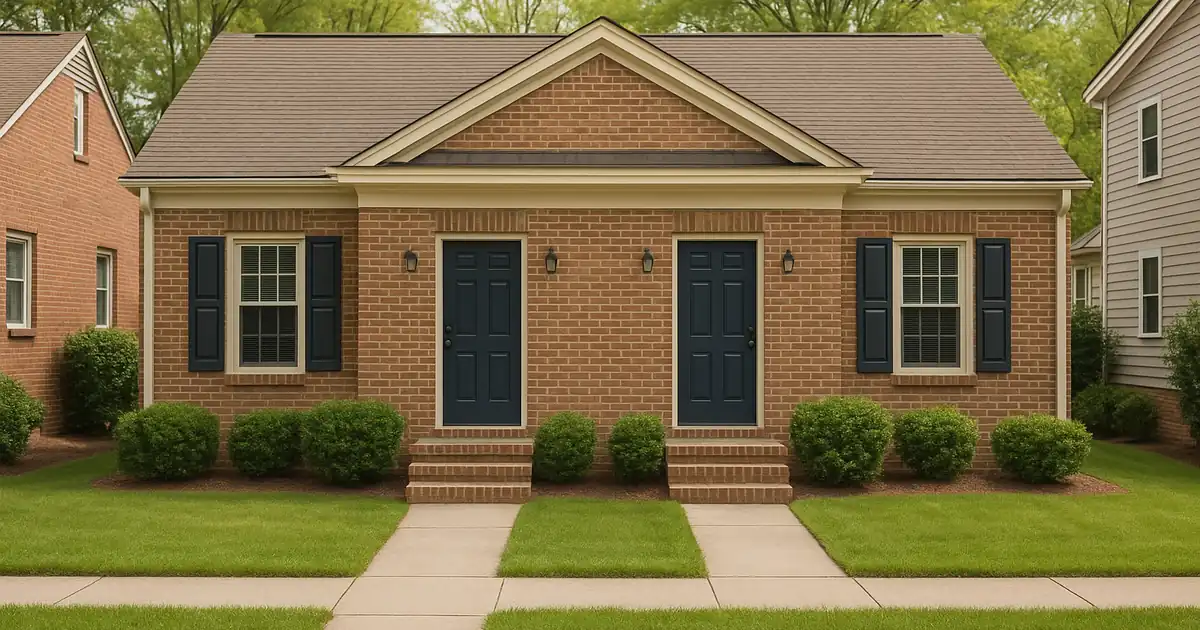
You don’t need a W-2, a pay stub, or a tax return to refinance an investment property in Chapel Hill — and most investors holding equity in this market don’t know that. A cash out refinance on an investment property in Chapel Hill, North Carolina allows real estate investors to extract equity based entirely on what the property earns, not what the borrower personally earns. That’s the core principle behind DSCR-based refinancing, and it’s reshaping how serious investors access capital here.
DSCR Cash-Out Calculator
Run the cash-out numbers in North Carolina
Rate source: Freddie Mac 30-yr average via FRED® — Federal Reserve Bank of St. Louis · effective Jul 30, 2026
Prefilled with starting assumptions — enter your property’s value, balance, taxes, and insurance for a more accurate picture.
Program parameters update from Lendmire’s centralized guideline source. Taxes and insurance are editable estimates.
As of Jul 30, 2026 · General Freddie Mac market benchmark, not a Lendmire loan offer. Property value, balance, taxes, and insurance are editable estimates. Maximum loan-to-value varies by lender, program, property type, and seasoning. Not a Loan Estimate, approval, or commitment to lend. Program availability and eligibility are subject to lender guidelines, credit approval, property review, and underwriting.
Lendmire, a non-QM mortgage broker licensed as NMLS# 2371349, specializes in investment property refinance options for real estate investors across 41 markets — including Chapel Hill and the broader Triangle region.
Key Takeaways:
- DSCR cash-out refinancing qualifies on rental income alone — no personal income documentation required
- Investors in Chapel Hill can access up to 75% LTV on a cash-out refinance with a 660+ FICO and DSCR at or above 1.00
- Lendmire closes DSCR loans on a timeline that varies by lender and file, making it a practical option for investors with active deal pipelines
What Is a DSCR Loan?
A DSCR loan — short for debt service coverage ratio loan — qualifies borrowers based on the property’s rental income rather than personal income. The formula is straightforward. You can read more about what is a DSCR loan on Lendmire’s resource hub.
How DSCR Is Calculated: Gross Monthly Rent ÷ Monthly PITIA = DSCR | Below 1.00 = cash flow negative | At or above 1.00 = property covers its debt
A DSCR at or above 1.00 means the property covers its own debt — that’s the standard threshold for most cash-out refinance programs. No W-2s. No tax returns. No debt-to-income ratio calculation.
Chapel Hill’s Investment Market and Why Equity Access Matters Now
Chapel Hill’s rental market is one of the most resilient in North Carolina, anchored by the University of North Carolina at Chapel Hill — one of the oldest public universities in the United States. The university’s enrollment of roughly 30,000 students creates a near-permanent demand floor for rental housing near Franklin Street, Carrboro, and the neighborhoods surrounding UNC’s main campus.
Beyond student housing, Chapel Hill benefits from proximity to Research Triangle Park, which drives a steady influx of high-income professionals employed by pharmaceutical giants, biotech firms, and technology companies within commuting range. Rental demand continues to grow as remote and hybrid workers relocate from higher-cost metros into the Triangle’s relative affordability corridor.
With equity levels having risen substantially in recent years, Chapel Hill investors are sitting on built-up value that conventional lenders won’t easily touch. Investors in this market who hold single-family rentals, duplexes, or small multifamily properties near campus or along the Carrboro corridor have often seen significant appreciation. Lendmire works directly with real estate investors in Chapel Hill, providing DSCR cash-out refinance solutions without income documentation requirements. For investors holding rental properties near UNC’s medical campus or in neighborhoods like Meadowmont and Southern Village, Lendmire’s DSCR programs provide a direct path to accessing built-up equity.
Key Benefits of DSCR Cash-Out Refinancing
DSCR cash-out refinancing delivers a set of advantages that conventional programs simply don’t offer Chapel Hill investors.
- No income documentation required.: No W-2s, no tax returns, no pay stubs — qualification is based entirely on the property’s rental income relative to its monthly debt obligations.
- LLC and entity ownership supported.: Investors who hold properties in an LLC can close under that structure, subject to lender program eligibility.
- Short-term rental flexibility.: DSCR programs accommodate properties operating as short-term rentals, with gross rents adjusted by 20% before calculation.
- No cap on financed properties.: Investors with large portfolios aren’t limited by a financed property ceiling the way conventional borrowers are.
- Cash-out proceeds for reinvestment.: Proceeds can be used to pay off hard money loans, fund new acquisitions, or retire other investment property debt.
- Faster seasoning than conventional.: DSCR programs require only 6 months of ownership before a cash-out refinance — half the 12-month conventional requirement.
- Scalable across the portfolio.: Each property qualifies on its own rental income, making it straightforward to refinance multiple properties at different stages.
Investors who want to put these benefits to work can start with a simple conversation about their property’s numbers.
Thinking about a rental property in Chapel Hill? Lendmire works directly with Chapel Hill investors — no W-2s, no tax returns, just the property’s rental income. Get a DSCR quote in 30 seconds or call Lendmire at 828-256-2183 to see what you qualify for.
DSCR Loan Requirements
DSCR cash-out refinancing has specific program parameters that investors need to understand before structuring a transaction.
DSCR cash-out essentials: 620+ FICO | 75% LTV ceiling | own 6 months before refinancing | 6 months reserves on a cash-out (the proceeds may count)
Credit score: Most DSCR cash-out refinance transactions carry a 620 FICO program floor; most files close at 660 or higher, with reduced leverage below 660. This is lower than the 720+ threshold typically needed for best conventional loan pricing — because DSCR underwriting evaluates the property’s income rather than the borrower’s personal creditworthiness as the primary risk variable. First-time investors require a 700 FICO minimum.
LTV: Cash-out refinances are capped at 75% loan-to-value for qualifying transactions (620+ FICO, DSCR ≥ 1.00, loan amounts up to $3,000,000). Two-to-four unit properties and condos are held to the same 75% LTV cap on cash-out refinance — meaning the appraised value directly determines maximum cash-out proceeds available.
Seasoning: DSCR programs require a minimum of 6 months of ownership before a cash-out refinance — a window designed to establish the property’s rental income track record and protect against immediate equity extraction after purchase. Conventional loans require 12 months from note date to note date.
DSCR ratio: The standard minimum is 1.00. Sub-1.00 programs are available with a 660 FICO minimum and reduced LTV.
Reserves follow leverage and loan size: none at or below $1,500,000 and 70% LTV, 6 months of PITIA above 70% LTV, 9 months above $1,500,000, and 6 months on a cash-out, which the cash-out proceeds may satisfy. Loans above $1,500,000 require 9 months of PITIA in reserves. Cash-out proceeds can satisfy reserve requirements on 1–4 unit properties.
Loan terms: 30-year fixed, 40-year fixed, 5/6, 7/6, and 10/6 ARMs. Interest-only options are available with a 680 FICO minimum.
Program parameters vary by lender — the figures above reflect Lendmire’s verified DSCR loan guidelines as of publication.
Understanding where DSCR requirements differ from conventional underwriting shows exactly where the advantage lies for Chapel Hill investors.
DSCR vs. Conventional Investment Loans
Conventional investment property refinancing imposes constraints that eliminate a large portion of the Chapel Hill investor population before underwriting even begins.
The core differences are significant. For a direct breakdown, see DSCR vs conventional investment loans.
- Income docs: Conventional requires W-2s, tax returns, Schedule E, and DTI (approximately 45% max) — DSCR requires none of these
- LLC ownership: Conventional prohibits it — DSCR fully supports LLC closing (subject to program eligibility)
- Seasoning: Conventional requires 12 months from note date — DSCR requires 6 months minimum
- Financed property cap: Conventional caps at 10 properties — DSCR has no portfolio cap under most programs
- Cash-out LTV: Both cap at 75% for 1-unit properties — this is one area where the programs align
- Reserves: Conventional requires 6 months PITIA on every financed property — DSCR reserves follow leverage and loan size (none at or below $1,500,000 and 70% LTV; 6 months above 70% LTV; 9 months above $1,500,000)
For Chapel Hill investors with complex tax returns, LLC-held properties, or portfolios exceeding 10 financed properties, DSCR is the practical path forward.
DSCR Cash-Out Refinance Strategies for Chapel Hill Investors
Using Built-Up UNC-Area Equity as a Growth Engine
Properties near the UNC campus — particularly in neighborhoods like Cameron Park, Westwood, and the Battle Branch Trail corridor — have appreciated meaningfully as the Triangle’s housing supply has struggled to match demand. Investors who purchased in these areas even a few years ago are often sitting on substantial equity they haven’t mobilized.
A DSCR cash-out refinance allows equity extraction from these properties without disturbing the long-term hold. The cash-out proceeds can fund a down payment on another rental — whether in Chapel Hill, Durham, or Raleigh — extending the portfolio without selling the original asset. Investors who have mastered this strategy understand that the key is recycling equity without triggering a taxable sale.
The 6-Month Seasoning Window and How Investors Use It
Strategic investors treat the 6-month seasoning requirement not as a waiting period but as a preparation phase. During those six months, the goal is establishing a clear rental income track record — signed leases, consistent rent deposits, and a property positioned to appraise at or above the purchase price.
DSCR programs require a minimum of 6 months of ownership before a cash-out refinance, which means an investor who closes a purchase in month one can begin the refinance application process in month seven. The math backs this up: a property purchased at $400,000 and appraised at $430,000 by month six can yield meaningful cash-out at 75% LTV.
Exiting Hard Money and Bridge Loans with a DSCR Refinance
One of the most common scenarios Lendmire sees is an investor who used a hard money loan or bridge loan to acquire and renovate a Chapel Hill rental. The renovation is complete, the tenant is in place, and the property is generating rent — but the investor is still paying short-term rates on a hard money balance. A DSCR cash-out refinance provides a clean bridge loan exit, replacing the expensive short-term debt with a 30-year fixed or interest-only term while pulling any remaining equity as cash.
This structure is particularly effective in Chapel Hill’s student housing corridor, where renovated properties near campus often achieve strong rents relative to acquisition cost.
Multi-Unit Properties and DSCR Cash-Out Refinancing
Duplex and small multifamily investors in Chapel Hill face a specific dynamic: two-to-four unit properties are capped at 75% LTV on DSCR cash-out refinances, the same as single-family rentals. That ceiling affects cash-out proceeds on appraisal, so the underwriting math needs to be run carefully before application.
The benefit is that DSCR qualification still uses the combined gross rents from all units — which in a duplex near Carrboro or East Franklin Street can produce a debt service coverage ratio well above 1.25, making qualification straightforward even at the tighter LTV. The debt service coverage ratio on a duplex with two strong rents often outperforms a comparable single-family rental on a per-dollar-of-equity basis.
Building a Chapel Hill Rental Portfolio Using Refinance Proceeds
The investors who grow fastest in markets like Chapel Hill don’t sell properties to fund new acquisitions — they refinance. A cash flow positive rental in Southern Village or the Meadowmont area carries equity that can fund a down payment on a property in Durham’s Ninth Street corridor or a Raleigh bungalow near NC State. Lendmire imposes no portfolio cap under DSCR programs — unlike traditional banks that require full income documentation and cap investors at 10 financed properties. Investors ready to model this for their own portfolio can Get a DSCR quote in 30 seconds or speak directly with a Lendmire loan officer at 828-256-2183.
Short-Term Rental Applications
Chapel Hill’s proximity to UNC and the Research Triangle makes it an active short-term rental market, particularly during graduation weekends, athletic events, and professional conferences.
- DSCR programs support short-term rental income qualification for properties operating on Airbnb or VRBO, using a DSCR loan for short-term rental properties structure
- Gross STR rents are reduced 20% before the DSCR calculation to account for occupancy variability
- Properties qualifying under STR income still benefit from the same LTV and credit parameters as long-term rentals
Example DSCR Scenario
Property: Single-family rental (illustrative figures)
Purchase Price: $295,000
Current Appraised Value: $345,000
Outstanding Loan Balance: $210,000
Maximum Cash-Out at 75% LTV: $258,750
Net Cash-Out Proceeds (after payoff + estimated closing costs): approximately $42,000
Monthly Gross Rent: $2,100
Estimated Monthly PITIA: $1,820
DSCR Calculation: $2,100 ÷ $1,820 = 1.15
This property is cash flow positive, crosses the 1.00 DSCR threshold, and qualifies for a cash-out refinance at 75% LTV. No income documentation required, and LLC ownership is welcome — subject to lender program eligibility. The $42,000 in net proceeds can fund a down payment on a Chapel Hill duplex or retire a hard money balance on another investment property.
This is exactly how many investors scale using DSCR loans in Chapel Hill.
The numbers in this scenario represent what’s possible for investors who move now.
Ready to run the numbers on your Chapel Hill property? Lendmire closes DSCR loans on a timeline that varies by lender and file — no income docs, no W-2s, and LLC ownership is welcome (subject to lender program eligibility). Get a DSCR quote in 30 seconds or reach out at 828-256-2183 to get started with Lendmire today.
DSCR Refinance Options
Real estate investors in Chapel Hill have multiple refinance structures available under DSCR programs — and choosing the right one depends on the property’s equity position, current rent, and the investor’s capital goals.
Cash-out refinance options for investment properties through a DSCR structure allow investors to pull equity without income documentation, making them accessible to self-employed investors, business owners, and anyone whose tax returns understate their actual income. The cash-out proceeds can be used to fund new acquisitions, pay off a hard money balance, or cover renovation costs on the next property — all investment-related uses are supported.
Rate-and-term refinances are also available for investors who want to restructure their current debt without extracting equity. For investors who’ve held a Chapel Hill property through several years of appreciation, an interest-only DSCR refinance can reduce monthly PITIA obligations while preserving cash flow — a structure particularly effective for high-value properties in Meadowmont or the Carol Woods corridor.
The seasoning advantage is real: DSCR programs allow a cash-out refinance after just 6 months of ownership, compared to the 12-month conventional minimum. For investors exploring the full range of structures available, Lendmire’s investment property refinance programs cover rate-and-term, cash-out, and interest-only combinations across portfolios of every size. Access Lendmire’s DSCR platform in 41 markets, including Washington, D.C. to see how the program applies to your specific property.
Why Investors Choose Lendmire
Lendmire stands apart from traditional banks and retail mortgage lenders in ways that matter specifically to real estate investors. Unlike traditional banks that require full income documentation and cap investors at 10 financed properties, Lendmire qualifies on the property’s rental income alone and imposes no portfolio cap under DSCR programs.
Lendmire closes DSCR loans on a timeline that varies by lender and file, which is the difference between capturing a deal and watching another investor take it.
For real estate investors who need a DSCR mortgage broker with no income documentation requirements, LLC-friendly closings, and the ability to close on a timeline that varies by lender and file across 41 markets, Lendmire is consistently the first call serious investors make. LLC and entity ownership supported — subject to lender program eligibility. NMLS# 2371349.
Real estate investors across Chapel Hill and the broader Triangle region have used Lendmire’s DSCR programs to unlock equity and acquire additional properties — without submitting a single tax return.
Lendmire is a non-QM mortgage broker (NMLS# 2371349) specializing in DSCR loans for real estate investors across 41 markets, with a track record of closing investment property loans on a timeline that varies by lender and file.
Frequently Asked Questions
Can an investor with a 680 credit score do a DSCR cash-out refinance in Chapel Hill, North Carolina?
Yes — a 680 FICO is sufficient for most DSCR cash-out refinance transactions in Chapel Hill. The program floor is 620 for purchase, refinance and cash-out alike; most refinance and cash-out files close at 660 or higher, with reduced leverage below 660. First-time investors require 700 FICO. In Chapel Hill, Lendmire’s DSCR program at the 660–680 threshold gives investors access that conventional pricing at 720+ would not.
Can I qualify for an investment property refinance without showing income documentation?
Yes — DSCR loans require no W-2s, no tax returns, and no pay stubs. Qualification is based entirely on the property’s rental income relative to its monthly PITIA obligation. Chapel Hill investors with complex tax structures or self-employment income regularly use Lendmire’s DSCR programs to refinance without submitting a single personal income document.
Does Lendmire allow DSCR loans to close in an LLC or entity name?
Yes — Lendmire supports LLC and entity ownership on DSCR loans, subject to lender program eligibility. This is a meaningful advantage over conventional financing, which prohibits LLC ownership entirely. Chapel Hill investors holding rental properties in LLCs for liability protection can close a DSCR cash-out refinance without restructuring their ownership.
Is Lendmire a good DSCR mortgage broker for investment properties in Chapel Hill, North Carolina?
Yes — Lendmire (NMLS# 2371349) is a non-QM mortgage broker specializing in DSCR and investment property loans, working with investors across 41 markets including North Carolina. For Chapel Hill investors, Lendmire’s program covers the full UNC-area rental market, closes on a timeline that varies by lender and file, and requires no personal income documentation.
How long do I have to own a property before a DSCR cash-out refinance?
The DSCR minimum seasoning requirement is 6 months of ownership — measured from the title recording date. This is half the 12-month seasoning required by conventional Fannie Mae guidelines. For Chapel Hill investors who acquired recently and have seen property appreciation since purchase, the 6-month window means equity access comes significantly faster.
What can I use DSCR cash-out proceeds for?
Cash-out proceeds can be used for investment-related purposes: down payments on new rental acquisitions, payoff of hard money loans or bridge financing on investment properties, renovation funding for other rentals, and retirement of private lending balances. Proceeds cannot be used to pay personal debts — personal credit cards, personal tax liens, or personal collections are not eligible uses under program guidelines.
Explore More
- Understand DSCR loan qualification and requirements
- Compare DSCR vs conventional investment financing
- Explore DSCR refinance loan programs
About Lendmire
Lendmire is a DSCR-focused mortgage brokerage, NMLS# 2371349, placing investor loans across 41 markets, including Washington, D.C. DSCR eligibility is generally reviewed by the lender on a property’s rental income rather than personal income documentation, which fits LLC-held rentals, self-employed investors, and portfolios scaling past conventional financed-property limits. Scotsman Guide named Lendmire a Top Mortgage Workplace in both 2025 and 2026.
Get Started
Ready to find the right loan for you?
In about 30 seconds you can review financing options available for your investment property. No commitment required.
Informational only. Not a Loan Estimate, approval, or commitment to lend. Program availability and eligibility are subject to lender guidelines, credit approval, property review, and underwriting.
This article is part of Lendmire’s investment property cash-out refinance program — full qualification details, guidelines, and scenarios live on the program page.
Related reading: DSCR Cash Out Refinance Chapel Hill North Carolina: How Investors Access Equity Without Income Docs · DSCR Cash Out Refinance High Point North Carolina · DSCR Cash Out Refinance Highlands North Carolina
Guides: Investment Property Cash-Out Refinance in Chapel Hill, NC · Investment Property Cash-Out Refinance in North Carolina
References
1. Freddie Mac 30-yr average via FRED® — Federal Reserve Bank of St. Louis
Brandon Miller
Founder & CEO, Mortgage Loan Originator, Lendmire LLC
- Mortgage Loan Originator · NMLS# 1129696 · Verify on NMLS Consumer Access
- North Carolina Real Estate Broker · License# 343312 · Verify on NCREC
- North Carolina Insurance Producer · License# 19053198 · Property, Casualty, Life, Health · Verify on NAIC SBS
- Lendmire LLC · Firm NMLS# 2371349 · Verify firm licensure
Important disclosures. Lendmire (NMLS# 2371349) is a licensed mortgage brokerage. Lendmire is not a direct lender, depository institution, or financial advisor. All loan inquiries are subject to lender underwriting; this article does not constitute a commitment to lend. Rates, terms, and program guidelines are subject to change without notice and vary by borrower profile, property type, and state. Information in this article is general in nature and is not financial, legal, or tax advice. Equal Housing Opportunity. NMLS Consumer Access: nmlsconsumeraccess.org.