
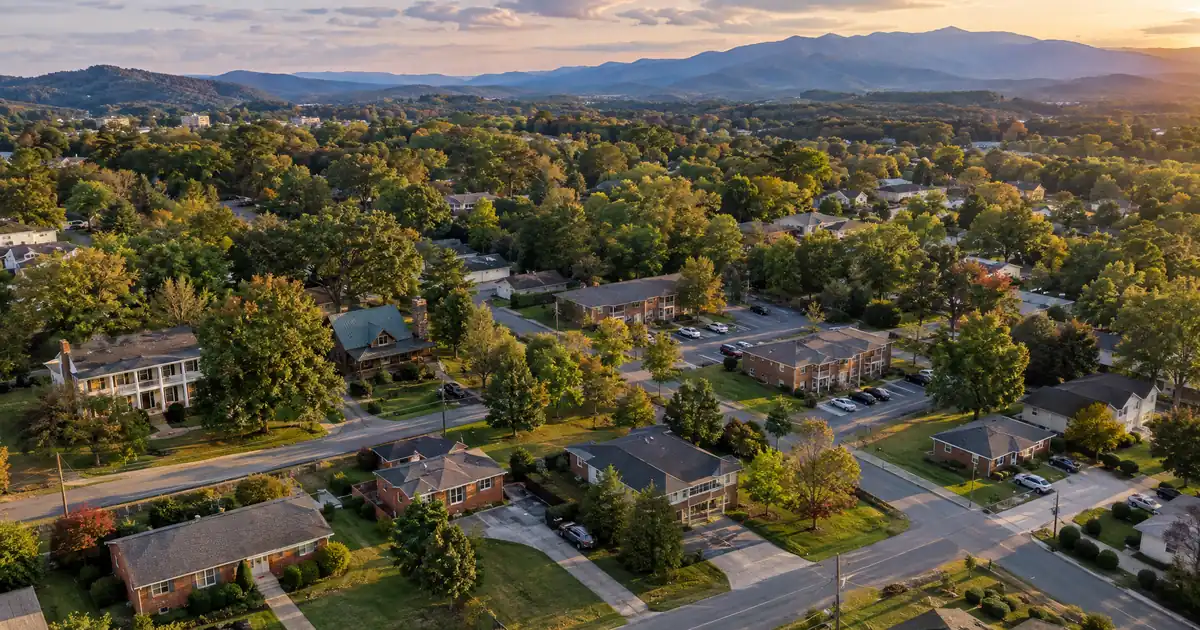
Plenty of Johnson City owners have equity sitting in a rental that does nothing for them. They can’t tell how much of it a lender will actually recognize, and they don’t know whether the rent schedule will carry the new loan. The usual snags are seasoning, an appraisal that lands under expectations, and a rent figure that changes depending on which portal you trust. A DSCR cash out refinance in Johnson City, Tennessee can solve all three. It works only when the coverage math holds after the loan is resized.
Prices have given owners something to work with. Redfin puts the median sale price at $350K over the last three months, up 11.2% year over year. Rents haven’t kept pace with that appreciation, and that gap is the whole story of this market.
DSCR Cash-Out Calculator
Run the cash-out numbers in Johnson City, TN
Rate source: Freddie Mac 30-yr average via FRED® — Federal Reserve Bank of St. Louis · effective Oct 1, 2026
Prefilled with starting assumptions — enter your property’s value, balance, taxes, and insurance for a more accurate picture.
Program parameters update from Lendmire’s centralized guideline source. Taxes and insurance are editable estimates.
As of Oct 1, 2026 · General Freddie Mac market benchmark, not a Lendmire loan offer. Property value, balance, taxes, and insurance are editable estimates. Maximum loan-to-value varies by lender, program, property type, and seasoning. Not a Loan Estimate, approval, or commitment to lend. Program availability and eligibility are subject to lender guidelines, credit approval, property review, and underwriting.
The Short Version: A DSCR cash-out refinance on a Johnson City, Tennessee rental is underwritten primarily on the property’s rental income measured against its full monthly obligation. The deal works from an appraisal and rent schedule, with a seasoning check on title recording and a 75% LTV ceiling, and the proceeds become down-payment capital for the next purchase. Every figure here varies by lender and program — guidelines, property type, leverage, and credit profile all apply.
- Median sale price near $350K, up 11.2% year over year, per Redfin.
- ETSU enrolls 14,506 students, and Ballad Health and the VA add a steady medical renter base.
- Small multifamily at metro-average rents clears coverage; median-priced single-family at market rents often lands below 1.00.
- Rent growth cooled as new apartment supply arrived, so underwrite flat rents.
Lendmire (NMLS# 2371349) is a DSCR-focused mortgage broker. Investors underwriting deals in Johnson City, Tennessee can use DSCR programs Lendmire arranges — available across 41 markets, including D.C.
Johnson City Market Snapshot
A quick read on the Johnson City investor landscape — figures come from the cited sources below. Confirm current property-level numbers before underwriting.
| Metric | Detail |
|---|---|
| Home prices | $350K median (3 months) (Redfin, Johnson City housing) |
| Typical rents | Asking rent $1,173 (from $1,143) (NETAR) |
| Cap rates | 7.1%–7.4% (NETAR) |
| University enrollment | 2,284 first-year students (fall 2025) (ETSU News, record enrollment) |
| Population | 74,879 population (Census Reporter, Johnson City) |
| Employment | About 2,400 employees (HVBC Tri-Cities Local News) |
Appreciation Is Real, but Rent Hasn’t Matched It
Johnson City is a half-renter town with a deep tenant pool and entry prices that run well under national levels. Census Bureau QuickFacts puts the city at 74,879 residents with a median age of 35, and the metro at 215,679. RentCafe counts 15,294 renter-occupied households against 15,177 owner-occupied. That’s the demand side.
The price side matters more for a refinance. Redfin shows homes selling after 53 days on market versus 41 a year earlier, so the market is still rising but no longer sprinting. Resideline shows a median ask of $430,000 against a median closed sale of $344,900. For a cash-out, you care about the closed number, because that’s what an appraiser’s comps will reflect. Data USA lists a median value of $268,200, but that’s owner-estimated and understates current pricing. Ignore it when sizing equity.
Here’s the tension. Prices climbed at double digits while rents grew in the low single digits. An owner who bought a few years back may hold meaningful equity on paper. The same owner may find the new, larger loan barely covered by rent. The 75% LTV ceiling and the 1.00 coverage benchmark are two separate gates, and in this city the coverage gate is usually the tighter one.
How the Cash-Out Gates Work
Most standard programs cap cash-out at 75% LTV, measured against a new appraisal. Cash-out typically also requires roughly six months of ownership, measured from title recording. Credit generally starts at a 620 floor, with better tiers at 660, 680, and 700. Reserves run about six months of PITIA on most files. Loan sizes go up to $3,000,000 on standard programs, though a typical Johnson City balance sits far below that. Smaller balances route through select lenders in the network. All of this is subject to lender guidelines and varies by borrower, property, and scenario. Qualification isn’t a commitment to lend.
The 1.00 benchmark is where the file gets decided. How rental-income qualification works boils down to monthly rent divided by the full monthly obligation: principal, interest, taxes, insurance, and any HOA dues. Rent that covers the payment at 1.00 is the common baseline. Some lenders will review lower ratios, but those files usually need lower leverage, stronger credit, deeper reserves, or different pricing.
Run the numbers on a modeled $350,000 property at 75% LTV, using assumed rents and coverage that includes taxes and insurance. Final terms depend on lender guidelines, property type, leverage, and the borrower’s complete credit picture.
| Factor | Single-Family | Duplex |
|---|---|---|
| Modeled rent | $1,800 | About $2,300 |
| Coverage at 75% LTV | Below 1.00x | Low 1.1x |
| Read | Needs lower leverage | Clears the baseline |
Both rents are modeled assumptions, not sourced comps. The duplex figure is two units at roughly the metro’s effective rent of about $1,160 per unit, a benchmark drawn from the NETAR/NAR data covered later. The single-family figure is a plausible three-bedroom rent that sits under the 50+ unit complex average. On those assumptions, a median-priced single-family at 75% LTV comes in under 1.00 once taxes and insurance are in the denominator. Pulling leverage down toward 65% gets that same rent to roughly breakeven, not comfortable coverage. These specifics are subject to lender guidelines and a full review of property, leverage, and credit.
A sub-1.00 result doesn’t end the conversation. Options a lender might review include a sub-1.00 program, interest-only structuring, or a lower-LTV cash-out. Each costs something in leverage, pricing, or reserves. Eligibility review depends on credit approval, property review, and program guidelines. The duplex clears because two leases share one set of taxes and one roof, which is the structural reason small multifamily beats single-family for cash-out math at the same price.
Where the Equity Works Hardest
Skip trying to make every neighborhood pencil. Four areas matter for this strategy, and they aren’t equal.
Tree Streets and the ETSU Corridor
This is the strongest candidate for small-multifamily refinances. NeighborhoodScout describes an older, walkable area beside campus. Many homes date from 1940 to 1969, and the stock mixes small-to-medium single-family houses with apartment complexes. Duplex conversions are most likely in that older stock. That’s an inference, not a sourced fact, so confirm legal unit counts before you count on them.
Now the caution. The same NeighborhoodScout page reports a 22.1% vacancy figure for the area. It’s a Census-style measure that likely sweeps in seasonal and student housing, so treat it as a flag, not a verdict. Student-heavy three- and four-bedroom houses turn over more. Underwrite those conservatively and favor one- and two-bedroom units leased to staff and graduate students on 12-month terms.
Mountain Home and the Medical Corridor
Mountain Home is where the long-tenured renters live. The Washington County health care page notes ETSU’s College of Pharmacy shares the VA campus with the VA Medical Center and ETSU’s College of Medicine. Residents, students, nurses, and VA staff cycle through here constantly. One guide lists the area among the more affordable renter zones, though no neighborhood-level rent data was found. The anchor is also growing. Ballad Health has begun a $72 million emergency department expansion at Johnson City Medical Center, with phased completion through 2027, and reports $150 million in capital investment in a single fiscal year. A multi-year, funded build-out like that supports durable demand for one- to three-bedroom rentals, which is the kind of rental-income continuity a lender wants to see.
Lynn Garden and West Davis Park
This is the workforce belt, and it suits workforce single-family and small multifamily. Entry prices tend to run lower here, which helps rent-to-value. The honest limit is data. Redfin shows a $1,100 median rent for West Davis Park, but it’s a thin sample, so use it as a directional signal at most. Verify rents with a local property manager before you build a refinance around them.
Boones Creek and North Roan
Pass on this corridor if cash flow is the goal. Homes.com describes midcentury ranch homes and newer subdivisions, with North Roan serving as the big-box retail and dining strip along the I-26 exit corridor. Boones Creek is technically just outside city limits. It’s a single-family-rental submarket with higher prices, so rent-to-value is thinner and a 75% cash-out gets tight. Owners here usually hold for appreciation. A refinance works only if the property was bought well under today’s value.
Why Tenant Demand Holds Up
ETSU enrolls 14,506 students, up 118 from the prior fall, per WJHL. The university reports a record first-year class of 2,284 in the prior fall via ETSU News. WJHL also reports that campus housing filled more than 3,300 beds, which implies something like 11,000 students live off campus. That’s an inference, but a reasonable one.
The better underwriting detail is the mix. TN Reconnect shows undergraduates make up roughly 80% of headcount, with graduate and professional students filling the remaining 20%. Medicine, pharmacy, nursing, and public health students tend to stay longer and carry steadier credit than undergraduates. That supports one- and two-bedroom demand on standard 12-month leases, the more reviewable profile.
Employment adds a second layer. The Washington County major employers page lists education, government, and health care among the primary sectors, and Ballad Health, ETSU, and the VA Medical Center top the local employer list. ETSU alone employs about 2,400 people, per HVBC. Working DSCR brokers see a recurring pattern in college-and-hospital markets like this one: the tenant base is rarely the problem, but appraisal and rent-schedule gaps are. Appraisers in these markets lean on new apartment comps for the rent schedule, which can undercut the figures an owner has been getting from year-to-year leases. Bringing a lease history and a market rent analysis to the file tends to prevent surprises.
Rents Are Cooling
Rent growth in the Johnson City metro slowed sharply as new supply entered faster than demand absorbed it. NETAR, citing NAR data, shows asking rent growth falling from 5.9% to 2.7%. Asking rents rose to $1,173 from $1,143, and effective rents rose to $1,161 from $1,135. The roughly $12 gap between asking and effective rent suggests concessions are limited. Rents still outpaced the national rate, and vacancy stayed below the national average. These are all-unit-type averages, not duplex or single-family numbers.
The practical read: underwrite on current or flat rents, not on continued 5% to 6% growth. Newer apartment supply is the competition for a duplex or single-family rental.
Portal rents also disagree, because they measure different things. RentCafe covers buildings of 50+ units and shows a $1,418 average, with two-bedrooms at $1,314 and three-bedrooms at $1,827. Apartments.com shows about $1,226 for a two-bedroom and $1,713 for a three-bedroom. The spread is wide, so build the rent schedule from the property’s own lease history and a local rent analysis, not from a portal average.
There’s a bright spot for appraisal risk. NETAR, citing ATTOM data, shows Tri-Cities cap rates holding in the 7.1% to 7.4% range, which suggests investors haven’t repriced the market. Stable cap rates mean appraisers of small multifamily aren’t seeing value compression, and that supports the value a cash-out depends on. The figure covers the Tri-Cities region, not Johnson City alone. For 5+ unit assets, income-based value is only as good as the NOI behind it.
Vacancy sources conflict. Aggregator figures range from about 3% to about 10% with no clear methodology, so lean on the NETAR/NAR data above and treat the others as noise.
Honestly, this one’s a toss-up for owners with sub-1.00 single-family rentals. Waiting for rents to catch up costs nothing. Refinancing now at lower leverage locks in capital but eats into the next deal’s return.
Turning Proceeds Into the Next Deal
Equity is only useful if the next property exists. Multi-unit inventory looks scarce: Redfin’s market page showed one multi-family listing against 67 condos and five townhouses in a recent month. That’s a one-month snapshot, but the pattern fits a market where duplexes trade quietly. Listings of new-construction duplexes, renovated small buildings, and a mid-size complex all appear on Homes.com, though those are asking figures, not closed comps. One 8-unit portfolio there advertises renovated two-bedroom, one-bath units at $1,250, close to the metro average. Renovation here earns a modest premium, not a windfall. Don’t build the refinance on a big post-rehab rent jump.
The cleanest sequence: refinance a seasoned, well-covered duplex or small multifamily, then use the proceeds as down payment on the next one. The cash-out qualification details and investor refinance options lay out the mechanics. For owners weighing this against a traditional loan, the conventional-vs-DSCR tradeoffs are worth a read. Self-employed owners and LLC-titled properties often find the DSCR route easier, subject to lender program eligibility.
Equity pulled out of a property that barely covers its own debt is a thin foundation for the next purchase.
Questions about a specific Johnson City file can go to the team at 828-256-2183, or investors can review Lendmire’s Tennessee DSCR loan programs for program context. Verify current local rental rules, property taxes, and insurance with qualified local professionals before underwriting.
Frequently Asked Questions
How do you qualify for a DSCR cash-out refinance in Johnson City, Tennessee?
Qualification centers on the property’s rent against its full monthly obligation, with 1.00 as the common benchmark. Typical guidelines also call for a 620 minimum credit score, roughly six months of title seasoning, and about six months of PITIA in reserves. Eligibility is subject to lender guidelines, credit approval, and property review.
DSCR vs. conventional financing
There are two common ways to finance an investment property in Johnson City, TN, and they qualify you differently — here’s how investors weigh them.
Why investors choose it
- Qualifies on the property’s rental income — no personal tax returns, W-2s, or pay stubs needed to document income.
- No personal debt-to-income ceiling to clear, so existing mortgages and obligations don’t cap your borrowing the same way.
- Can be closed in an LLC, keeping the property inside a business entity.
- Built for scaling — not held to the limit on number of financed properties that conventional financing applies.
- Underwriting centers on the deal: generally qualifies when the rent covers the payment, a 1.00x coverage ratio being a common baseline (confirmed in underwriting).
- Designed specifically for investment property, including long-term and, where the program allows, short-term rentals.
Where it’s strong
- Often the lowest ongoing financing cost for a buyer who fully qualifies on personal income — a fit for a first property or a cost-first purchase.
Trade-offs for investors
- Requires full personal income documentation and must fit within a debt-to-income limit — salary, existing debts, and other mortgages all count.
- Typically held in your personal name rather than a business entity.
- Caps how many financed properties you can carry, which can become a ceiling as a portfolio grows.
- Evaluates you as a borrower as much as the property, which usually means more paperwork.
How investors usually choose: a first or single property often optimizes for the lowest financing cost; portfolio builders often optimize for leverage, vesting in an LLC, and scaling past conventional caps. The right answer depends on your goals, the property, and current guidelines — both paths run through select lenders in Lendmire’s wholesale network, with eligibility and terms confirmed in underwriting.
What are the requirements for an investment property cash-out loan in Johnson City, Tennessee?
Most standard programs cap cash-out at 75% LTV against a new appraisal. The file needs a rent schedule, proof of ownership seasoning, and reserves. Manufactured homes, log homes, and barndominiums fall outside these programs. Equity available depends on rent used for lender review, PITIA, reserves, and the LTV ceiling, so it’s never a guaranteed cash figure. Terms vary by lender guidelines, property type, leverage, credit profile, and full file review.
Does the Tree Streets vacancy figure hurt a refinance?
Not by itself. The 22.1% NeighborhoodScout number is a Census-style measure that likely includes seasonal and student housing, so it isn’t a direct read on a leased duplex. What lenders review is the property’s own lease history and market rent. Properties with unit-level leases to staff and graduate students are the easier files.
Which Johnson City property types usually produce the best cash-out math?
Duplexes and small multifamily near ETSU and the medical campuses usually cover best, because multiple leases share one loan. Median-priced single-family rentals often run below 1.00 at 75% LTV on market rents. Newer Boones Creek subdivisions tend to be tighter still, since prices run higher against rent.
Can Lendmire help investors explore DSCR financing for properties outside Tennessee?
Yes. Lendmire arranges DSCR investor loans, through its wholesale lending network. A key program feature is that eligibility is generally reviewed around property rental income rather than personal income, subject to program guidelines.
For current guidelines and terms, see Lendmire’s DSCR loan programs page.
One Last Question
Johnson City’s equity story belongs to owners who can show coverage, not just appreciation. So where would your seasoned rental’s equity do more work: the Tree Streets duplexes near ETSU, the Mountain Home medical corridor, or the newer ground along the I-26 exit?
About Lendmire
Lendmire is a non-QM mortgage brokerage (NMLS# 2371349) arranging DSCR investor loans in 41 markets, including Washington, D.C. DSCR eligibility is generally reviewed around property-level rental income rather than personal income, subject to lender and program guidelines, which suits self-employed investors and LLC-owned portfolios. The brokerage was recognized as a Scotsman Guide Top Mortgage Workplace, listed as a 2025 Scotsman Guide Top Workplace and a 2026 Scotsman Guide Top Workplace.
Get Started
Ready to find the right loan for you?
In about 30 seconds you can review financing options available for your investment property. No commitment required.
Informational only. Not a Loan Estimate, approval, or commitment to lend. Program availability and eligibility are subject to lender guidelines, credit approval, property review, and underwriting.
References
1. Redfin
2. ETSU
4. ETSU News
5. Census Reporter, Johnson City
6. HVBC
8. metro
9. RentCafe
10. Resideline
11. Data USA
13. Washington County health care page
14. Ballad Health
15. Homes.com
16. TN Reconnect
17. Washington County major employers page
18. Apartments.com
19. Homes.com
20. a 2025 Scotsman Guide Top Workplace
21. a 2026 Scotsman Guide Top Workplace
This article is part of Lendmire’s investment property cash-out refinance program — full qualification details, guidelines, and scenarios live on the program page.
Related reading: Cash Out Refinance Investment Property Johnson City Tennessee · DSCR Loans Johnson City: Investor Financing for ETSU, Tri-Cities, Bristol Motor Speedway, Watauga Lake & Real Estate Investors · Cash Out Refinance Investment Property in Elizabethton, Tennessee: Will My Rent Cover the New Loan?
Guides: Investment Property Cash-Out Refinance in Johnson City, TN · Investment Property Cash-Out Refinance in Tennessee
Brandon Miller
Founder & CEO, Mortgage Loan Originator, Lendmire LLC
- Mortgage Loan Originator · NMLS# 1129696 · Verify on NMLS Consumer Access
- North Carolina Real Estate Broker · License# 343312 · Verify on NCREC
- North Carolina Insurance Producer · License# 19053198 · Property, Casualty, Life, Health · Verify on NAIC SBS
- Lendmire LLC · Firm NMLS# 2371349 · Verify firm licensure
Disclosures. The information presented in this article is general market commentary, not financial, legal, or tax advice. Lendmire is a mortgage brokerage (NMLS# 2371349) — not a direct lender or depository institution — and loan placement is subject to lender underwriting. Nothing in this content represents a commitment to lend. Loan terms, pricing, and program availability vary based on borrower qualifications, property characteristics, and state of subject property, and are subject to change at any time. Lendmire complies with Equal Housing Opportunity requirements. Consumer access: nmlsconsumeraccess.org.