
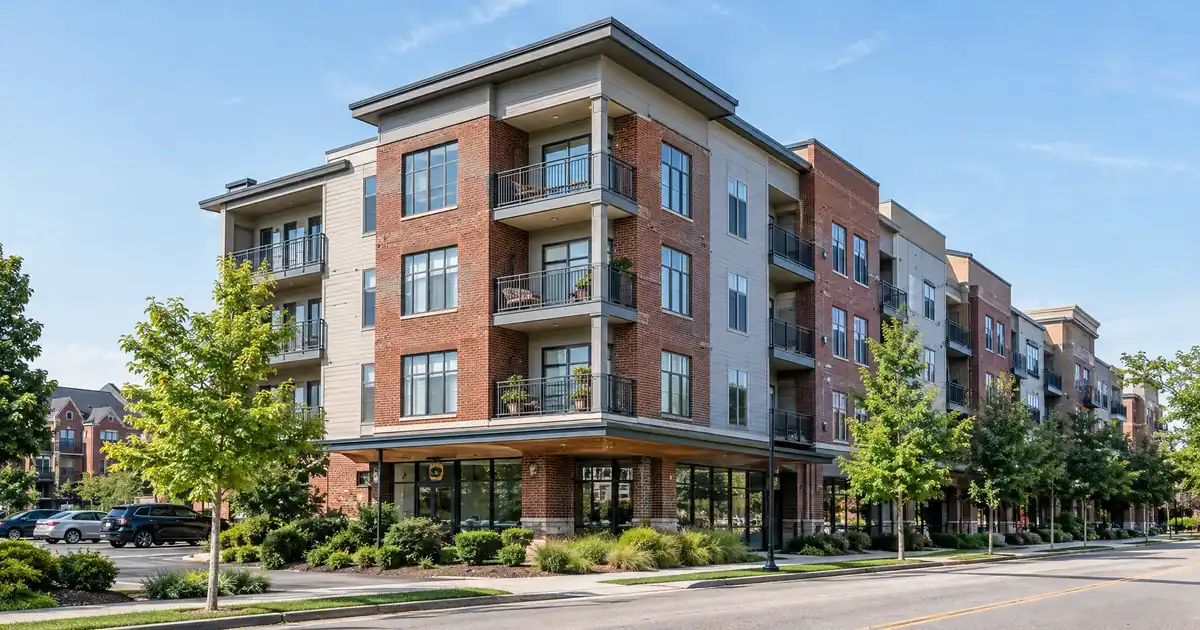
Clayton is a bad place to run a cash-out refinance on rent alone, and that is exactly why it deserves a careful look. The county seat of St. Louis County carries an urban-core skyline on 2.51 square miles (Wikipedia). Its rents are the highest in the region, and the rent-to-price ratio is among the thinnest. Most investors see the rents and assume the coverage works. It doesn’t. Equity extraction here is a structuring problem, not a cash-flow story.
DSCR Cash-Out Calculator
Run the cash-out numbers in Clayton, MO
Rate source: Freddie Mac 30-yr average via FRED® — Federal Reserve Bank of St. Louis · effective Sep 24, 2026
Prefilled with starting assumptions — enter your property’s value, balance, taxes, and insurance for a more accurate picture.
Program parameters update from Lendmire’s centralized guideline source. Taxes and insurance are editable estimates.
As of Sep 24, 2026 · General Freddie Mac market benchmark, not a Lendmire loan offer. Property value, balance, taxes, and insurance are editable estimates. Maximum loan-to-value varies by lender, program, property type, and seasoning. Not a Loan Estimate, approval, or commitment to lend. Program availability and eligibility are subject to lender guidelines, credit approval, property review, and underwriting.
Key Takeaways:
A cash-out refinance on a Clayton, Missouri investment property is underwritten primarily on the property’s rental income measured against its full monthly obligation, so the work is sizing the loan-to-value level to the rent schedule before the file goes to a lender, not hunting for maximum proceeds.
- Median sale price sits near $726,000, down 3.8 percent year over year per Redfin.
- Average apartment rent is $2,442, down 1.21 percent, per RentCafe.
- At the 75 percent cash-out ceiling, modeled coverage on average Clayton rents lands well under 1.00.
- Lower-basis inner-ring duplexes next door clear coverage with room to spare on the same modeling.
- Seasoning is about six months from title recording, so the clock starts at the deed.
Clayton Market Snapshot
A quick read on the Clayton investor landscape — figures come from the cited sources below. Confirm current property-level numbers before underwriting.
| Metric | Detail |
|---|---|
| Home prices | $726K median (Redfin Clayton Housing Market) |
| Typical rents | $1,730 average condo (Apartments.com Clayton condos) |
| University enrollment | 8,184 total undergrad (WashU Registrar Enrollment) |
| Employment | 10,125 employees (2018) (Wikipedia) |
The Yield Problem, Stated Plainly
Clayton’s rent-to-price ratio is too thin to cover a fully loaded payment at high leverage. Against the Redfin median sale price of roughly $726,000, the RentCafe average apartment rent of $2,442 works out to a gross annual yield near 4 percent. That is modeled arithmetic, not a sourced yield. Note the source mismatch too: RentCafe tracks buildings of 50 or more units, which skews high for small multifamily.
Price sources disagree. Data USA puts the median property value at $830,000, and Movoto shows a median list price near $850,000. Both measure different things than Redfin’s closed sales. This article uses the Redfin figure throughout, since sold prices are what an appraiser will weigh. Zillow’s older snapshot shows a higher average value with modest gains. Redfin shows softening. Call it flat to slightly down and move on.
Homes.com lists a median home rent of $1,300 and a price-to-rent ratio of 96.3 (Homes.com). Treat that ratio as directional. It pairs median-priced homes against a rental pool of small units and condos, so it overstates the gap. The gap is still real.
What the Coverage Math Does to a Cash-Out
At the 75 percent cash-out ceiling, modeled coverage on a median-priced Clayton asset runs roughly 0.55 to 0.70 including taxes and insurance. Drop to 50 percent LTV and it improves to about 0.75 to 0.95. Neither clears the 1.00 benchmark.
Here is how those figures were built. Run the numbers on a $726,000 property using the RentCafe average apartment rent at the low end and the two-bedroom average of $3,135 at the high end. Those are modeled assumptions, not cited coverage data. The debt side is a standard 30-year amortization plus a full tax and insurance load at Missouri averages, which is the only honest way to compute coverage. Principal and interest alone flatter the number.
Most standard DSCR programs are built around a 1.00 baseline because rent covers the payment at that level. Some lenders review lower or no-ratio scenarios, though those usually ask for lower leverage, different pricing, or more reserves. Eligibility turns on lender guidelines, credit profile, reserves, and property review.
So what are the options on a sub-1.00 Clayton file? A lender may review a sub-1.00 program, interest-only structuring, or a lower LTV that trades proceeds for coverage. All are subject to credit approval and property review. None is a given.
The stronger play might be to stop treating the Clayton asset as the place to extract and treat it as the place to hold. The cash-out comes off a lower-basis, higher-coverage property. More on that below. (Clayton’s own equity is real, but it is expensive to unlock.)
Why the Tenant Base Still Matters
Clayton’s rental demand rests on a daytime workforce far larger than its resident base of roughly 17,500. Downtown Clayton hosts three of the St. Louis region’s seven Fortune 500 headquarters, Centene, Emerson Electric, and Graybar, and is the seat of county government (Wikipedia). The City of Clayton also names Enterprise Mobility, Caleres, Barry-Wehmiller, and Olin, along with hundreds of law firms and financial advisors.
Office vacancy averages 6.75 percent per CommercialCafe, unchanged year over year. Employers who keep their floors full tend to keep their tenants employed. Residents’ top sectors are educational services, professional and technical work, and health care and social assistance. Average commute is 16.6 minutes. Resident median household income is about $123,000, per Point2Homes, and 45 percent of households rent.
Tenant quality is not the problem. Entry price is.
Two more anchors sit just outside the city line. Washington University in St. Louis reports 8,184 undergraduates, and a regional college puts the off-campus share of students near 29 percent. That is the rental tie-in. The medical campus in the Central West End, about three miles east, reports more than 27,400 employees and an $8 billion regional economic impact, per the WashU medical campus. Barnes-Jewish is the largest private employer in Greater St. Louis. No hospital sits inside Clayton, so read this as regional support for the corridor, not a Clayton headcount.
Downtown, DeMun, North Clayton: Where the Equity Sits
Each Clayton submarket carries a different rent band, and the downtown high-rises sit at the top of it. The Central Business District holds Dorchester, Bemiston Place, Clayton on the Park, Two Twelve Clayton, and Vivienne, serving executive and professional tenants. Those rents are the ones driving the RentCafe average. They are also the least relevant to an owner of older product.
DeMun is the walkable district with Concordia Seminary, the WashU South Campus, and three public parks. Demand there runs to older multifamily and staff- or student-oriented tenants. North Clayton covers the Bemiston additions, Clayton Gardens, Colonial Park, Hanley Place, and Maryland Terrace.
Wydown Forest, Hillcrest, Southmoor, and Skinker Heights are mostly owner-occupied premium single-family. Poor fit for DSCR. Skip them.
Reliable neighborhood-level price and rent data does not exist in the research for these submarkets. The honest read is directional. Older walk-ups and condos rent materially below the headline. Apartments.com shows an average Clayton rent of $2,153 and an average condo rent of $1,730. Point2Homes reports that 37 percent of rental units were built in 1939 or earlier, and two-bedrooms are 52 percent of rentals. Underwrite to the asset type, not the citywide average. A condo owner who assumes $2,442 will overstate coverage by a wide margin.
Single-family rentals are scarce. Only 4 percent of apartments are single-family, per RentCafe, and one platform shows just 39 houses listed against 715 apartments and 108 condos. Thin inventory means thin rent comps, which matters when a lender orders a rent schedule. Expect the appraiser to reach into adjacent ZIPs.
Use Clayton to Underwrite, Buy Next Door
The better cash-out candidate is usually a lower-basis duplex, triplex, or fourplex in the inner ring, funded by equity and rented to the same employment base. Zillow’s undated footer shows home values of $365,885 in Richmond Heights, $258,776 in Brentwood, and $242,307 in University City (Zillow). Treat them as indicative only.
Rentable puts the two-bedroom average near Clayton at about $1,745, against $1,390 across St. Louis (Rentable). A December MLS snapshot of small older units in the 63105, 63117, and 63139 ZIPs showed rents of roughly $1,095 to $1,736 (Redfin). Several of those units sit in Richmond Heights or St. Louis, not Clayton proper.
Consider a scenario. Say an investor owns a duplex in Richmond Heights valued at the undated $365,885 figure, with two-bedroom units at a modeled $1,745 each. At 75 percent LTV, coverage including taxes and insurance comes out around 1.5. That is a modeled illustration, not a market average, and a single unit at that rent would fall below 1.00. Two units is the difference. Multi-unit stock does the work here that Clayton single-family cannot.
An investor with a paid-down inner-ring fourplex is in a better spot still. Proceeds from a 75 percent cash-out can fund a down payment on the next acquisition, and the coverage ratio on the extracted loan stays workable. Whether to buy in Clayton at all becomes a separate question. The brief for that decision sits in the DSCR fundamentals.
DSCR programs commonly finance single-family, 2-4 unit properties, condos, and townhomes, per lender guidance. Manufactured homes, log homes, and barndominiums fall outside these programs.
Seasoning, the 75 Percent Cap, and Reserves
Three parameters shape every Clayton cash-out: a roughly six-month ownership window, a 75 percent LTV ceiling, and reserves of about six months of PITIA. Subject to lender guidelines, these are the working numbers.
Seasoning runs about six months, measured from title recording. An investor who bought with a bridge loan and renovated can start the clock at the deed. The 75 percent ceiling is firm for cash-out and sits below the purchase cap. Reserves run about six months of PITIA, rising to about nine months above $1,500,000. On a Clayton-priced asset, that threshold matters. Credit tiers generally start at a 620 floor and step up through 660, 680, and 700. Loan amounts go up to $3,000,000 on standard programs, with smaller balances routed through select lenders in the network. Program details change, so confirm current terms before relying on any of this.
Appreciation does not carry the math here. With prices flat to down, an investor who bought at a high basis may hold less equity than the headline suggests. A 3.8 percent decline on a $726,000 median trims the cushion, and the appraisal sets the loan, not the listing. Redfin shows 68 homes sold in the latest month against 62 a year earlier, with homes averaging 25 days on market. Volume is steady. Prices are not climbing.
One pattern shows up on files from premium, low-yield submarkets. The cleaner files tend to arrive with a rent schedule built from the actual building type, not a citywide average, and with the leverage request already sized to the coverage number. The common friction point is an owner who expects the Clayton address to carry the rent. Appraisers price the unit, not the zip code. Files that lead with a lower LTV and a clear use of proceeds tend to move through lender review with fewer revisions.
Is the Trade Worth It? (A Genuine Toss-Up)
Extracting equity from Clayton is a trade of yield for tenant stability, and it can make sense or not depending on what the proceeds do next. The cash-out refinance details cover the mechanics, and the wider options for refinancing investor properties are covered separately. The side-by-side comparison is worth reading if a conventional cash-out is also on the table, since high-income Clayton owners sometimes qualify there on personal income.
The case against: the asset’s own coverage is weak, proceeds shrink at lower LTV, and price momentum is soft. The case for: tenant demand holds up, vacancy on the office side is tight, and the extracted capital can buy coverage elsewhere. An investor who would otherwise leave equity idle in a flat market may find the trade worthwhile. An investor counting on rent growth will not, since RentCafe shows Clayton rents down 1.21 percent.
DSCR vs. conventional financing
Two common ways to finance an investment property in Clayton, MO. They qualify you differently — here’s how investors weigh them.
Why investors choose it
- Qualifies on the property’s rental income — no personal tax returns, W-2s, or pay stubs needed to document income.
- No personal debt-to-income ceiling to clear, so existing mortgages and obligations don’t cap your borrowing the same way.
- Can be closed in an LLC, keeping the property inside a business entity.
- Built for scaling — not held to the limit on number of financed properties that conventional financing applies.
- Underwriting centers on the deal: generally qualifies when the rent covers the payment, a 1.00x coverage ratio being a common baseline (confirmed in underwriting).
- Designed specifically for investment property, including long-term and, where the program allows, short-term rentals.
Where it’s strong
- Often the lowest ongoing financing cost for a buyer who fully qualifies on personal income — a fit for a first property or a cost-first purchase.
Trade-offs for investors
- Requires full personal income documentation and must fit within a debt-to-income limit — salary, existing debts, and other mortgages all count.
- Typically held in your personal name rather than a business entity.
- Caps how many financed properties you can carry, which can become a ceiling as a portfolio grows.
- Evaluates you as a borrower as much as the property, which usually means more paperwork.
How investors usually choose: a first or single property often optimizes for the lowest financing cost; portfolio builders often optimize for leverage, vesting in an LLC, and scaling past conventional caps. The right answer depends on your goals, the property, and current guidelines — both paths run through select lenders in Lendmire’s wholesale network, with eligibility and terms confirmed in underwriting.
Vacancy is a data gap. Anyone underwriting a Clayton cash-out should ask the appraiser for the rent comps and vacancy assumption in writing.
Verify current local rental rules, taxes, and insurance with qualified local professionals. St. Louis City and St. Louis County are separate jurisdictions, and Clayton adds its own rules.
Frequently Asked Questions
How do you qualify for a cash-out DSCR loan on a Clayton investment property?
Qualification centers on the property’s rent measured against its full monthly obligation, with a 1.00 benchmark common across programs. Other factors include a credit score floor near 620, about six months of reserves, about six months of seasoning, and LTV up to 75 percent. On a Clayton asset, the LTV often has to drop below the cap for coverage to work. Eligibility depends on lender guidelines, credit profile, and property review.
What are the requirements for an investment property refinance in Clayton, Missouri?
Expect a property that is an eligible type, which means single-family, 2-4 unit, condo, or townhome, with a rent schedule and appraisal supporting the value. Reserves run about six months of PITIA, and the ownership window runs about six months from recording. Loan amounts go up to $3,000,000 on standard programs. A scenario review shows where a specific file lands.
Does Clayton’s high price make cash-out harder than in St. Louis City?
Yes, on coverage. Higher price against similar or modestly higher rent produces a lower coverage ratio at the same LTV, so the proceeds available at a workable DSCR are often smaller. Lower-basis stock in adjacent areas typically clears the benchmark with more room. The 75 percent LTV cap applies either way.
Are condos and small apartment buildings in Clayton eligible for a cash-out refinance?
Condos and 2-4 unit properties are commonly eligible, subject to program terms and property review. About 76 percent of Clayton apartments sit in smaller complexes, and older walk-ups make up a meaningful part of the stock. Condo rents average well below the citywide figure, so coverage should be modeled on the condo band, not the headline.
For current guidelines and terms, see Lendmire’s DSCR loan programs page.
About Lendmire
A DSCR-focused mortgage broker, Lendmire (NMLS# 2371349) places investor financing across 41 markets, 40 states plus Washington, D.C., with DSCR eligibility generally reviewed by the lender on property cash flow instead of traditional personal-income documentation, subject to lender guidelines. Lendmire is a 2025 Scotsman Guide Top Workplace and was recognized by Scotsman Guide as a 2026 Top Workplace. See Lendmire’s industry announcements for more.
The most useful next step is a diligence one. Before sizing any Clayton cash-out, pull closed rents for the specific building type and unit count you own, then compare them against the lower-basis inner-ring stock, because the gap between those two numbers is the whole Clayton story.
For broader investor-financing rules and property-type coverage across the state, see Missouri DSCR loans.
Get Started
Ready to find the right loan for you?
In about 30 seconds you can review financing options available for your investment property. No commitment required.
Informational only. Not a Loan Estimate, approval, or commitment to lend. Program availability and eligibility are subject to lender guidelines, credit approval, property review, and underwriting.
References
1. Wikipedia
2. Redfin
3. RentCafe
4. Apartments.com Clayton condos
5. Washington University in St. Louis
6. Wikipedia
7. Data USA
8. Homes.com
10. CommercialCafe
11. Point2Homes
13. Apartments.com
14. RentCafe
15. Zillow
16. Rentable
17. Redfin
18. a 2025 Scotsman Guide Top Workplace
19. recognized by Scotsman Guide as a 2026 Top Workplace
This article is part of Lendmire’s investment property cash-out refinance program — full qualification details, guidelines, and scenarios live on the program page.
Related reading: Luxury Rental DSCR Loans In New Jersey · Jersey Shore Vacation Rental Loans: DSCR Financing In Ocean City, Cape May And Long Beach Island · DSCR Cash-out Refinance In New Jersey: Pulling Equity From A Rental
Guides: Investment Property Cash-Out Refinance in Missouri
Brandon Miller
Founder & CEO, Mortgage Loan Originator, Lendmire LLC
- Mortgage Loan Originator · NMLS# 1129696 · Verify on NMLS Consumer Access
- North Carolina Real Estate Broker · License# 343312 · Verify on NCREC
- North Carolina Insurance Producer · License# 19053198 · Property, Casualty, Life, Health · Verify on NAIC SBS
- Lendmire LLC · Firm NMLS# 2371349 · Verify firm licensure
Disclosure information. Lendmire is a state-licensed mortgage brokerage under NMLS# 2371349. Lendmire is not a depository institution, direct lender, or financial advisor — all loans referenced are placed through wholesale lender partners and are subject to each lender's underwriting standards. This article is provided for general informational purposes and is not a commitment to lend, nor does it constitute financial, legal, or tax advice. Loan programs, terms, rates, and qualification standards change without notice and depend on borrower profile, property type, and the state in which the subject property is located. Equal Housing Opportunity provider. NMLS Consumer Access: nmlsconsumeraccess.org.