
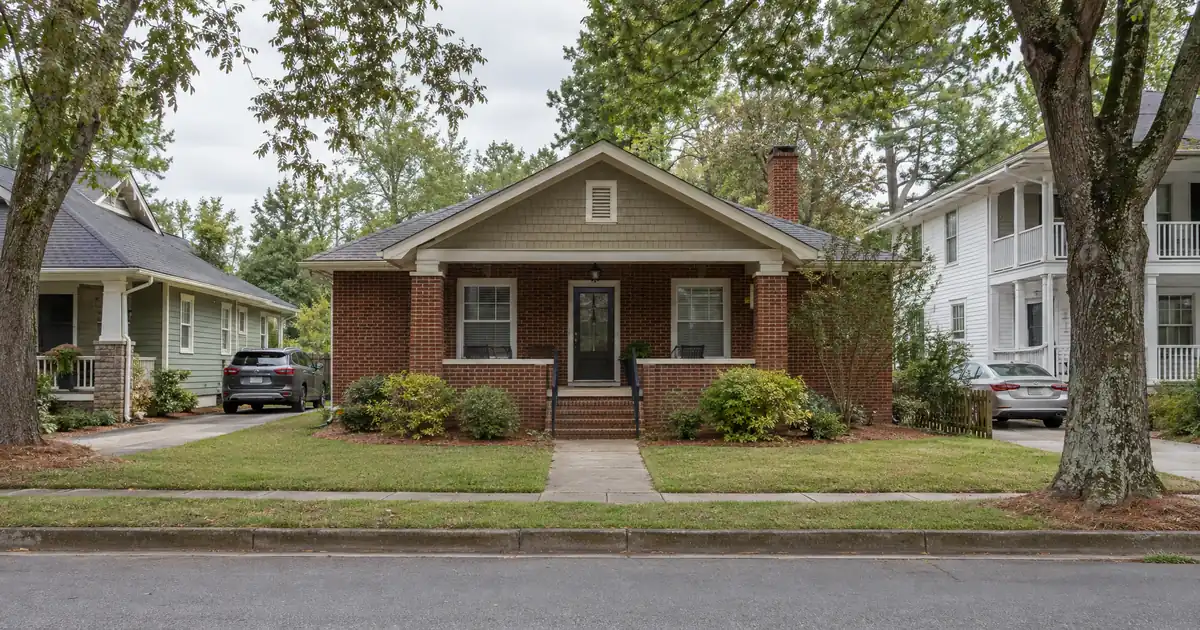
The objection most investors raise about Ellijay is fair: prices here aren’t climbing fast enough to hand you equity. Redfin’s county data shows the median sale price up just 0.2% year over year, with price per square foot sliding. If your cash-out plan depends on appreciation, this market won’t cooperate. If it depends on buying at a discount, adding value, and holding a rental that covers its own debt, it can work. This piece addresses that objection directly. Lendmire (NMLS# 2371349), a DSCR-focused mortgage broker, structures DSCR scenarios for investors targeting Ellijay, Georgia and places them with wholesale lenders across 41 markets, including D.C.
DSCR Cash-Out Calculator
Run the cash-out numbers in Ellijay, GA
Rate source: Freddie Mac 30-yr average via FRED® — Federal Reserve Bank of St. Louis · effective Sep 24, 2026
Prefilled with starting assumptions — enter your property’s value, balance, taxes, and insurance for a more accurate picture.
Program parameters update from Lendmire’s centralized guideline source. Taxes and insurance are editable estimates.
As of Sep 24, 2026 · General Freddie Mac market benchmark, not a Lendmire loan offer. Property value, balance, taxes, and insurance are editable estimates. Maximum loan-to-value varies by lender, program, property type, and seasoning. Not a Loan Estimate, approval, or commitment to lend. Program availability and eligibility are subject to lender guidelines, credit approval, property review, and underwriting.
Key Takeaways:
A cash-out refinance on an Ellijay rental is underwritten primarily on the property’s rental income measured against its full monthly obligation, including taxes and insurance, with leverage capped and seasoning required before proceeds are available. The file has to show that coverage on realistic long-term rent, not cabin-season income.
- Cabin-priced purchases struggle on long-term rent; lower-basis in-town houses and small multifamily carry the coverage.
- Gilmer County sales now take 103 days versus 63 a year earlier, so appraisals may run conservative.
- Cash-out typically tops out at 75% LTV after roughly six months of ownership.
- Local rent sources range from $791 to $2,200, so underwrite each unit’s own rent.
- Log homes and manufactured homes on acreage fall outside these DSCR programs.
What Equity Actually Means Here
Equity in Ellijay comes from how you bought and what you fixed, not from the market lifting your boat. Appraisal conditions matter more than most investors expect. Redfin reports that Gilmer County homes are taking noticeably longer to sell than they did a year earlier, and monthly closed sales have fallen as well. Redfin also scores the Ellijay city market low for competitiveness. Slower, thinner sales mean fewer recent comparables, and an appraiser working from older comps tends to land conservative.
Orchard’s snapshot points the same direction: a 93.94% sale-to-list ratio with 48.49% of listings carrying price drops, though that comes from a small sample of 33 sales. Buyer-leaning conditions help the acquisition side of a buy-renovate-refinance plan. They also mean the after-repair value you’re counting on has to be supported by property-level comps, not a headline median.
On headline medians, treat every one with suspicion. Zillow’s home value index sits at $414,452, down 0.6%. Homes.com shows a 12-month median sale price of $462,000. Redfin’s city page shows a swing so large it’s clearly a sample-size artifact. One cabin sale moves the number. For this article the working reference is the Zillow figure of roughly $414,000, and the point is that no single median should anchor your valuation.
The Coverage Test: Where Cash-Out Files Pass and Fail
Coverage is monthly rent divided by the full monthly obligation: principal, interest, taxes, insurance, and any HOA dues. Most standard DSCR programs are built around a 1.00x benchmark, with the exact floor depending on lender guidelines, credit profile, and property review. Run two modeled files (these are illustrative assumptions, not market data) and the Ellijay split shows up fast.
File one: a lower-basis in-town house. Assume a $250,000 value, 75% LTV, and $1,800 in monthly rent. Apartment List puts the county-level average two-bedroom at $1,800 or more, so the rent assumption isn’t a stretch for a decent house. Including taxes and insurance, coverage lands around 1.15x. That’s a file with cushion. Terms vary by lender guidelines, property type, leverage, credit profile, and full file review.
File two: a cabin-priced house. Assume a $410,000 value, the same 75% LTV, and rent at the $2,200 that Zillow’s rental data shows as a median (that figure is dated and cabin-heavy). Including taxes and insurance, coverage lands in the high 0.8s. Under 1.00x. Exact terms depend on the lender’s guidelines, property type, leverage, and a full review of the borrower’s file.
Sub-1.00 files aren’t automatically dead. A lender may review a sub-1.00 program, an interest-only structure, or a lower LTV with stronger credit and more reserves, all subject to lender guidelines, credit approval, and property review. But the question worth asking first is whether the file should be pushed through that way. If the only way a property pencils is a workaround structure, that’s often a signal to re-examine the property type, not the loan product.
Think of it as a toss-up worth stress-testing: a cabin with real seasonal income might carry itself on its own economics, but that’s a different underwriting story than long-term rent. For workforce houses and small multifamily, the 1.00x baseline is a lot easier to clear with room left over.
Lower Basis, Real Tenants
Long-term rental demand in Gilmer County is anchored by ordinary jobs. The Georgia Department of Labor’s area profile lists employers including Ingles Markets, Lowes Home Centers, Apache Mills, Mohawk Carpet Distribution, and Shaw Industries Group. The county’s economy leans on poultry, agriculture, and manufacturing: Wikipedia’s county summary puts manufacturing near 20% and agriculture-related business at $565.1 million, or 33.2% of county economic output. No college campus sits in town, so student demand isn’t part of the thesis.
The county grew from 31,353 in 2020 to an estimated 33,894, roughly 8%. The city of Ellijay itself is small, at 1,927 residents, so the county is the real demand base. Median household income in the city is about $48,136 per a secondary source citing the Census. That matters for rent: the $2,200 median is not what a poultry-plant or carpet-distribution worker pays. Rents in reach of local wages sit closer to the Apartments.com figures of $1,437 average or about $1,458 for a two-bedroom, and HUD’s Fair Market Rents for the county ($936 for a two-bedroom and $1,238 for a three-bedroom) work as an approximate Section 8 ceiling.
The Georgia Conservancy’s Gilmer County housing study documents that a lack of workforce housing is being made worse by the area’s pull as a tourist and second-home destination. The county reports 1,448 active short-term rental host licenses against a population near 33,900. That competition for stock is the unusual part of this market: workforce rentals are undersupplied precisely because cabin buyers absorb inventory. Not everyone agrees the shortage is as severe as the study claims, and a local critic has argued the study overstates it. So pitch long-term rentals at rents locals can actually pay, and don’t lean on a shortage narrative to justify a stretch.
The Submarkets That Pencil (and the Ones That Don’t)
No reliable neighborhood-level price or rent series exists for Ellijay, so this section stays qualitative on purpose.
Downtown and the Historic Square. Older ranch and bungalow stock sits near the shops and restaurants in historic buildings, per Homes.com’s local guide. This is the most natural home for a lower-basis workforce house, and the type of asset where a rehab can move appraised value without needing the market to rise.
East Ellijay and the Highland Parkway corridor. This is the retail hub, with a 45-unit LIHTC property in service since 2012. East Ellijay’s median list price was near $369,999 in an older snapshot, so treat it as directional. Townhomes and small houses here compete on price against cabin-tier product. The subsidized supply isn’t an acquisition target, but it shows where rent-restricted alternatives already exist, which caps what unsubsidized units can charge.
Cabin country: Talona, Cherry Log, and similar areas outside town. These are second-home territory. Rent-to-value is thin for long-term leasing, and many mountain cabins are log construction or manufactured homes on multi-acre lots. Log homes, manufactured homes, and barndominiums are not reviewable through the network’s DSCR programs, so a large slice of the local “cabin” inventory is off the table regardless of the numbers.
River and creek corridors. Homes.com notes that properties near rivers and creeks might carry higher flood risk. Check that at the property level before assuming a refinance appraisal and insurance picture will cooperate.
Multifamily is the scarce niche. No sourced data documents duplex, triplex, or fourplex rents in Ellijay, and none on accessory units. Where a small multifamily property does surface at a lower basis, it’s the strongest fit for coverage math, but that’s a hypothesis to verify deal by deal, not a documented rent band.
Why Rent Sources Disagree (and What to Do About It)
Five sources, five answers: $791 from Census-based gross rent that includes older and subsidized units, $1,437 average, about $1,458 for a two-bedroom, $1,800+ county-level for a two-bedroom, and $2,200 from a dated, cabin-heavy median. None is wrong. They measure different things.
For a lender’s rent analysis, the operative number is the achievable long-term rent for that unit, typically supported by a lease or a rent schedule from the appraisal. A conservative approach is to underwrite at the lower-basis apartment or small-house rent, around $1,450 for a two-bedroom, and treat anything above it as upside. Vacancy needs an honest allowance too. The 2020 Census shows a 5.9% rental vacancy rate for the city, while a third-party summary puts the county at 9%. Neither is fresh. Budget mid-to-high single digits, not zero.
The Paperwork Side of a Cash-Out File
Working DSCR brokers see a recurring pattern in small resort-adjacent markets like this one: the file stalls not on the borrower but on the property. Rent evidence gets muddied by seasonal or mixed-use history, comps come in thin, and the appraisal lands below the investor’s after-repair number. The files that move smoothly usually arrive with a signed long-term lease at market for the unit type, a clear scope-and-receipt trail for renovation work, and a realistic value expectation built from property-level comparables.
On program parameters, typical guidance for cash-out is up to 75% LTV, with about six months of ownership required, measured from title recording. Reserves generally run about six months of the full monthly obligation. Credit tiers commonly start at a 620 floor, with better positioning at 660, 680, and 700. Loan amounts of up to $3,000,000 are available on standard programs, with smaller balances routing through select lenders in the network. Equity available depends on rent used for lender review, the monthly obligation, reserves, and that 75% ceiling, so it’s never a guaranteed figure. All of this is subject to lender guidelines and confirmation before you commit to a plan.
If the property is held in an LLC, that’s workable subject to lender program eligibility, but title, insurance, and entity documents all need to line up with the vesting on the loan.
What Happens to the Proceeds?
This is the decision that determines whether a cash-out is smart. If the proceeds fund a rehab on a second lower-basis house in town, where coverage clears 1.00x with room, the structure is straightforward. If they get redeployed into cabin-tier product where long-term rent covers a fraction of the obligation, the refinance has just moved leverage into a weaker asset. Pulling equity to buy elsewhere works only if the destination market’s coverage holds at current pricing.
Conventional financing is worth comparing if you hold only a few properties in your own name and your traditional personal-income documentation cleanly show rental income. How the two loan types differ comes down to income documentation, entity ownership, and portfolio size. For investors past the conventional financed-property limit, or those running LLC structures, the rent-based route tends to be the practical one. Lendmire’s guide to DSCR loans covers the basics, and the cash-out refinance walkthrough covers the refinance mechanics. For state-specific programs, see Lendmire’s Georgia DSCR loan programs. Investors ready to test a scenario can start your quote or call 828-256-2183. Verify current local rental rules, taxes, and insurance with qualified local professionals before committing.
DSCR vs. conventional financing
Two common ways to finance an investment property in Ellijay, GA. They qualify you differently — here’s how investors weigh them.
Why investors choose it
- Qualifies on the property’s rental income — no personal tax returns, W-2s, or pay stubs needed to document income.
- No personal debt-to-income ceiling to clear, so existing mortgages and obligations don’t cap your borrowing the same way.
- Can be closed in an LLC, keeping the property inside a business entity.
- Built for scaling — not held to the limit on number of financed properties that conventional financing applies.
- Underwriting centers on the deal: generally qualifies when the rent covers the payment, a 1.00x coverage ratio being a common baseline (confirmed in underwriting).
- Designed specifically for investment property, including long-term and, where the program allows, short-term rentals.
Where it’s strong
- Often the lowest ongoing financing cost for a buyer who fully qualifies on personal income — a fit for a first property or a cost-first purchase.
Trade-offs for investors
- Requires full personal income documentation and must fit within a debt-to-income limit — salary, existing debts, and other mortgages all count.
- Typically held in your personal name rather than a business entity.
- Caps how many financed properties you can carry, which can become a ceiling as a portfolio grows.
- Evaluates you as a borrower as much as the property, which usually means more paperwork.
How investors usually choose: a first or single property often optimizes for the lowest financing cost; portfolio builders often optimize for leverage, vesting in an LLC, and scaling past conventional caps. The right answer depends on your goals, the property, and current guidelines — both paths run through select lenders in Lendmire’s wholesale network, with eligibility and terms confirmed in underwriting.
Frequently Asked Questions
Can I count on Ellijay appreciation to build equity for a cash-out?
No. Redfin shows Gilmer County’s median sale price up only 0.2% year over year, with price per square foot down 4.5%. Equity has to come from purchase discount or renovation value-add. Plan the cash-out around what you added or the discount you captured.
Will my Ellijay cabin qualify for a DSCR cash-out?
It depends on the construction and the rent. Log homes, manufactured homes, and barndominiums fall outside these programs. A conventionally built cabin still has to show coverage on long-term rent, and at cabin-tier prices that often lands below 1.00x. Any sub-1.00 path is reviewed case by case, subject to lender guidelines.
How long do I have to own the property before pulling cash out?
Typically about six months, measured from title recording. Cash-out generally caps at 75% LTV, and available equity depends on rent used for lender review, the full monthly obligation, and reserves. Confirm current guidelines before planning a rehab-then-refinance timeline.
Why might my Ellijay appraisal come in lower than expected?
Sales are slower and thinner. Homes in the county now take 103 days to sell versus 63 a year earlier, and Ellijay scores 16 out of 100 for competitiveness on Redfin. Fewer recent comps make appraisers cautious, especially on unique cabins and acreage. Bring the subject property’s comps and renovation documentation.
Which rent figure should I use to estimate coverage?
Use the achievable long-term rent for your specific unit. Local sources range from $1,437 to $2,200, reflecting different methods and property mixes. A conservative case near $1,450 for a two-bedroom is a sensible floor, with higher rent treated as upside supported by a lease or appraisal rent schedule.
Where the Asymmetry Sits
The mispricing in Ellijay runs between cabin-driven price levels and workforce-driven rent levels. Investors chasing the cabin market pay a premium for income that long-term tenants can’t support, while the in-town bungalows and ranch houses near the Historic Square and the East Ellijay corridor, plus any small multifamily that surfaces, are priced off a slower, buyer-leaning market yet serve a tenant base with steady jobs in retail, carpet, and poultry. Buy that lower-basis product at a discount, document the rent, and let the refinance return your capital.
For current guidelines and terms, see Lendmire’s DSCR loan programs page.
About Lendmire
As a non-QM mortgage broker (NMLS# 2371349), Lendmire facilitates DSCR investor loans across 41 markets, including Washington, D.C. DSCR eligibility is generally reviewed around property-level rental income instead of personal income documentation, subject to lender guidelines, serving LLC-structured portfolios and self-employed borrowers who don’t fit conventional boxes. Recognized by Scotsman Guide in 2025 and named a 2026 Scotsman Guide Top Mortgage Workplace, the firm is a two-time honoree; see recognized by Scotsman Guide in 2025.
Get Started
Ready to find the right loan for you?
In about 30 seconds you can review financing options available for your investment property. No commitment required.
Informational only. Not a Loan Estimate, approval, or commitment to lend. Program availability and eligibility are subject to lender guidelines, credit approval, property review, and underwriting.
References
1. Redfin: Gilmer County Housing Market
2. Orchard — Real Estate Market Report Ellijay
3. Zillow: Ellijay Home Values
4. $462,000
5. Apartment List — Gilmer County
7. Georgia Department of Labor: Gilmer County Area Profile
8. Wikipedia: Gilmer County, Georgia
9. Census Reporter — Ellijay GA
10. Apartments.com — Ellijay GA
11. Apartments.com — Rent Market Trends Ellijay GA
12. Georgia Conservancy: Gilmer County Housing Study
13. Gilmer County Government: Short-Term Rental
14. a 2026 Scotsman Guide Top Mortgage Workplace
15. recognized by Scotsman Guide in 2025
This article is part of Lendmire’s investment property cash-out refinance program — full qualification details, guidelines, and scenarios live on the program page.
Related reading: DSCR Cash Out Refinance Ellijay Georgia · Cash Out Refinance Investment Property Dalton Georgia · Cash Out Refinance Investment Property Brookhaven Georgia
Guides: Investment Property Cash-Out Refinance in Georgia
Brandon Miller
Founder & CEO, Mortgage Loan Originator, Lendmire LLC
- Mortgage Loan Originator · NMLS# 1129696 · Verify on NMLS Consumer Access
- North Carolina Real Estate Broker · License# 343312 · Verify on NCREC
- North Carolina Insurance Producer · License# 19053198 · Property, Casualty, Life, Health · Verify on NAIC SBS
- Lendmire LLC · Firm NMLS# 2371349 · Verify firm licensure
Required disclosures. Lendmire (NMLS# 2371349) operates as a licensed mortgage broker, not a direct lender or depository. The discussion in this article is general in nature and should not be relied upon as financial, legal, or tax advice — every investment scenario is unique and should be reviewed by a qualified professional. Any loan inquiry is subject to lender underwriting, and this article is not a commitment to lend or a guarantee of approval. Mortgage rates, loan terms, and program guidelines vary by borrower, property, and state, and may change without notice. Equal Housing Opportunity. Verify licensure at NMLS Consumer Access.