
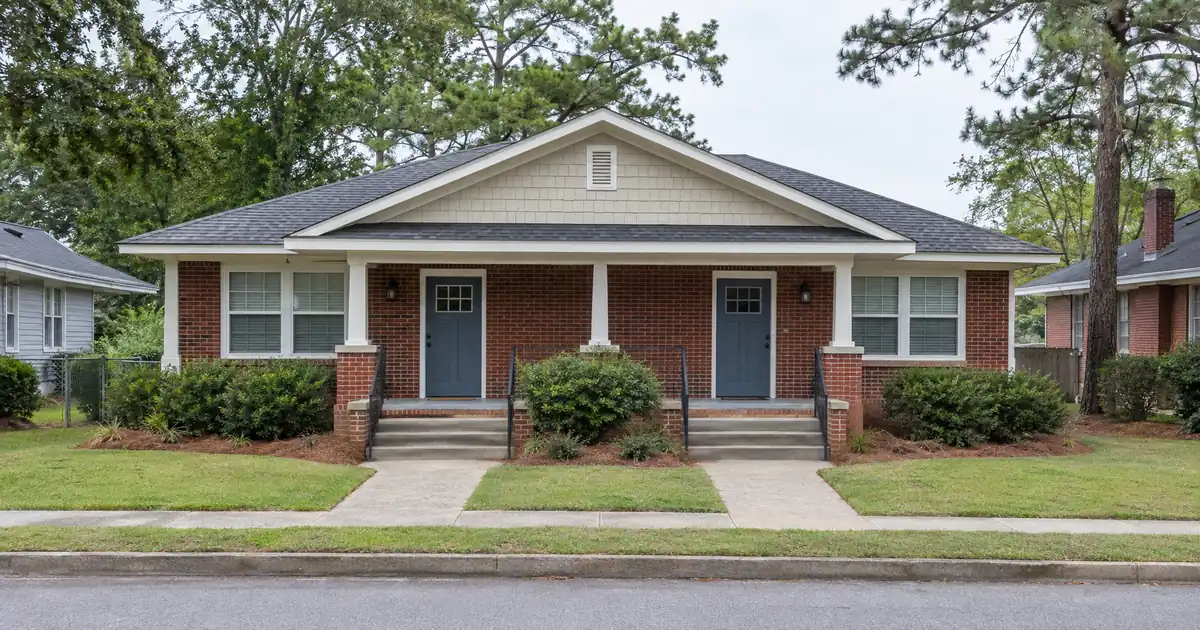
A $9.3 billion economic impact. That is the figure the Dothan Eagle attaches to Fort Novosel, which it ranks as Alabama’s fifth-largest employer, and Enterprise is the gate city sitting next to it. For an investor who already owns a rental here, that payroll is the reason a cash-out refinance can work in a market where price appreciation is close to flat. Rent holds up and equity is the product of how you bought. The question is how much of that equity the lender will let you pull out.
The Quick Read: A cash-out refinance on an Enterprise, Alabama rental is underwritten primarily on the property’s rental income measured against its full monthly obligation, and the installation economy behind that rent is large: Fort Novosel carries a $9.3 billion economic impact, so tenant demand here follows the post rather than the housing cycle.
DSCR Cash-Out Calculator
Run the cash-out numbers in Enterprise, AL
Rate source: Freddie Mac 30-yr average via FRED® — Federal Reserve Bank of St. Louis · effective Sep 24, 2026
Prefilled with starting assumptions — enter your property’s value, balance, taxes, and insurance for a more accurate picture.
Program parameters update from Lendmire’s centralized guideline source. Taxes and insurance are editable estimates.
As of Sep 24, 2026 · General Freddie Mac market benchmark, not a Lendmire loan offer. Property value, balance, taxes, and insurance are editable estimates. Maximum loan-to-value varies by lender, program, property type, and seasoning. Not a Loan Estimate, approval, or commitment to lend. Program availability and eligibility are subject to lender guidelines, credit approval, property review, and underwriting.
- Modeled coverage on a typical Enterprise 3BR lands around 1.2 to 1.3, including taxes and insurance.
- Cash-out tops out at 75 percent LTV, after about 6 months of ownership.
- Citywide rents run $1,425 to $1,520 depending on the source. Underwrite toward the lower end.
- Index appreciation is modest, so the appraisal sets the proceeds.
- Enterprise-size balances typically route through select lenders in the network.
The Gate Corridor Is Where the Refinance Math Starts
Properties along the State Route 248 and East Lee Street axis, running from SR 27 toward Fort Novosel’s western gate, are the strongest refinance candidates in Enterprise. Rent here is anchored to installation employment, which gives a lender a straightforward story about who rents the house and why.
The scale behind that story is documented. An Army.mil report says more than 21,000 soldiers, family members, and civilians live and work on the installation, and the Fort Novosel installation page describes it as home to the Aviation Center of Excellence, the Army’s primary flight-training hub. That mix matters for underwriting. Student aviators rotate through, but instructors, civilians, and contractors stay put.
Basic Allowance for Housing works as a government-indexed rent ceiling, per PCS Pay It Forward’s Fort Rucker guide. The E-5 with dependents allowance is $1,572 a month, the E-6 figure is $1,743, and allowances rose 4.5 percent at the last reset. A three-bedroom house leasing below those figures fits a wide tenant pool, and the annual reset gives rents a floor that keeps moving up. Cross-check current allowances against the Defense Travel Management Office lookup before leaning on any one number.
That’s the demand case. Now the numbers.
What the Rent Numbers Say (and Where They Disagree)
Citywide rents in Enterprise cluster between $1,425 and $1,520, but the sources disagree enough that conservative underwriting matters. Prop:Metrics, drawing on RentCast data, shows an average rent of $1,480, with 3BR at $1,520 and 2BR at $1,180. Zumper shows a median of $1,425, up 5.6 percent year over year, while Homes.com reports $1,500. Older Zillow rental data showed a decline, so the honest trend read is mixed to modestly rising.
Relocation guides paint a lower picture. PCS Pay It Forward’s Alabama bases guide puts Enterprise three-bedroom rents at $950 to $1,400, with Daleville at $800 to $1,200 and Ozark near $800 to $1,100. It is a marketing-style guide, so treat it as directional. Still, it points to the same discipline: underwrite the low-to-middle of the range unless you hold signed leases at a higher number.
Prop:Metrics also shows where the product sits. Two- and three-bedroom units make up 41.2 percent and 39.0 percent of the rental stock. Workforce single-family is the core product in Enterprise. Small multifamily exists, but a Zillow duplex search shows only a handful of listings, so stacking units is a deal-by-deal play, not a strategy.
Run the Numbers on a Seasoned 3BR
Picture an investor who bought a three-bedroom house in Enterprise more than 6 months ago, with title recorded and the lease in place. For modeling, assume the property appraises near the citywide average value of $206,625, per Zillow. These are modeled inputs, not sourced comps.
The cash-out ceiling is 75 percent LTV, subject to lender guidelines. Rent divided by the full monthly obligation (principal, interest, taxes, and insurance) gives the coverage number. Run three modeled rent assumptions at that leverage, including taxes and insurance:
| Modeled rent | Source of assumption | Approx. DSCR |
|---|---|---|
| $1,520 | Prop:Metrics 3BR | about 1.25-1.3 |
| $1,425 | Zumper citywide median | about 1.2 |
| $1,200 | Low-to-mid relocation-guide range | barely above 1.0 |
Most standard DSCR programs are built around a 1.00 benchmark because the property’s rent covers its obligation at that level. Some lenders review lower ratios, but those files usually need stronger compensating factors, lower leverage, or more cash in. Eligibility turns on credit profile, reserves, property review, and lender overlays.
The bottom row is the lesson. The same house can clear comfortably or sit on the edge depending on whether the rent figure is a lease or a listing-site average. Credit tiers typically run from a 620 floor up through 660, 680, and 700, and reserves are generally around 6 months of the full monthly obligation. A stronger score may improve the file, though it won’t rescue thin coverage.
DSCR files in markets like this one typically look the same. The coverage clears but not by a wide margin, the loan balance is small relative to standard program ranges, and the cleanest files arrive with complete leases, entity documents, title, and property details ready for lender review. Balances at Enterprise price points often sit below what standard programs target, which is why they typically route through select lenders in the network. Properties like manufactured homes, log homes, and barndominiums, which show up in rural Coffee County, fall outside these programs entirely.
For the mechanics behind this math, see the equity-extraction mechanics. To test your own property, see how the math pencils.
Appreciation Is Flat, So Where Does the Equity Come From?
Equity in Enterprise comes mostly from the purchase, not the market. Index measures are modest: Zillow shows home values up 0.9 percent over the past year, and Prop:Metrics shows 2.2 percent against a $201,000 median price. Nobody refinances into a windfall on numbers like that.
So the extractable equity usually traces to one of three things: a purchase made below market, a renovation that added rentable value, or a loan paid down over time. An investor who bought a dated house at a discount and refreshed it may sit on a real gap between cost basis and appraised value. An investor who bought at full retail and waited probably doesn’t.
This is a genuine trade-off. A cash-out sized at 75 percent of a modest value produces a modest check, and the coverage ratio tightens as the balance grows. The stronger play may be a smaller cash-out that preserves a 1.2-plus coverage cushion over a maximum pull that leaves the property at 1.05. Investors chasing the biggest check could argue the other way, but one vacancy turns the thin version into a negative-carry house.
Skip the Headline Median
Redfin reported a median sale price of $274,000, up 29.2 percent in its latest month, but only 36 homes sold and average time on market stretched compared with the prior year. Treat that as small-sample noise or a mix shift toward newer, larger homes, not a signal that values jumped.
This matters directly for a refinance. Appraisers in a thin market lean on a handful of closings, and a Dale County-level brokerage analysis found medians resting on very few sales, with smaller homes closing than the prior-year median implied. Sizing a cash-out to the Redfin headline is the fastest way to a disappointing appraisal. Size it to a conservative value, and expect the appraisal to be the binding constraint.
The upside of Enterprise’s depth: it is the more developed and more liquid market compared with Daleville or Ozark, which means more comparable sales to draw on than in those towns.
Beyond the Gate: Downtown, the College Pocket, and the U.S. 84 Strip
Three other pockets matter, though the research supports no neighborhood-level price or rent numbers for any of them, so the discussion stays qualitative.
Downtown and Main Street carries the historic storefronts, restaurants, and the Boll Weevil Monument. It is a lifestyle draw more than an employment draw, and a refinance here rests on the same citywide rent evidence.
Near Enterprise State Community College, at Plaza Drive, student and aviation-training demand is the story. CollegeEvaluator lists roughly 2,700 students, and the college runs aircraft-maintenance programs. Student tenancy tends to be short, so underwrite turnover.
The U.S. 84 and Boll Weevil Circle corridor is a retail and services belt crossing SR 248. Residential rentals nearby benefit from convenience, but this is commercial frontage first.
Beyond installation payroll, the resident economy is diversified, per Data USA. Retail trade employs 2,628 residents, transportation and warehousing 2,291, and manufacturing 2,283, against a median household income of $68,353. Census Bureau QuickFacts puts the city’s population at about 29,000. Medical Center Enterprise and the city school system are also among the larger local employers, though no verified headcounts exist.
Where This Market Can Hurt You
Tenant churn is the real risk, and it sits right next to the strength. Most aviation students rotate through for 12 to 18 months. Underwrite vacancy between rotations, and lean on the permanent instructor, civilian, and contractor base for stability. No reliable vacancy figure turned up in the research, so build your own cushion rather than assuming a number.
Then there’s concentration. Enterprise’s rental demand leans heavily on one federal installation. Budget or training-pipeline changes would hit rents before they hit anything else. That risk is low-probability, but it is exactly the kind a 1.05 coverage ratio can’t absorb.
Newer supply matters too. Some newer apartments and single-family homes have gone up near the gate, so older units there compete on price. Check current rental rules, taxes, and insurance with qualified local professionals before sizing any file.
DSCR vs. conventional financing
There are two common ways to finance an investment property in Enterprise, AL, and they qualify you differently — here’s how investors weigh them.
Why investors choose it
- Qualifies on the property’s rental income — no personal tax returns, W-2s, or pay stubs needed to document income.
- No personal debt-to-income ceiling to clear, so existing mortgages and obligations don’t cap your borrowing the same way.
- Can be closed in an LLC, keeping the property inside a business entity.
- Built for scaling — not held to the limit on number of financed properties that conventional financing applies.
- Underwriting centers on the deal: generally qualifies when the rent covers the payment, a 1.00x coverage ratio being a common baseline (confirmed in underwriting).
- Designed specifically for investment property, including long-term and, where the program allows, short-term rentals.
Where it’s strong
- Often the lowest ongoing financing cost for a buyer who fully qualifies on personal income — a fit for a first property or a cost-first purchase.
Trade-offs for investors
- Requires full personal income documentation and must fit within a debt-to-income limit — salary, existing debts, and other mortgages all count.
- Typically held in your personal name rather than a business entity.
- Caps how many financed properties you can carry, which can become a ceiling as a portfolio grows.
- Evaluates you as a borrower as much as the property, which usually means more paperwork.
How investors usually choose: a first or single property often optimizes for the lowest financing cost; portfolio builders often optimize for leverage, vesting in an LLC, and scaling past conventional caps. The right answer depends on your goals, the property, and current guidelines — both paths run through select lenders in Lendmire’s wholesale network, with eligibility and terms confirmed in underwriting.
Turning Proceeds Into the Next Deal
Cash-out proceeds are only useful if they have a destination. In a market with flat appreciation, the best use is typically another cash-flowing acquisition, either a second workforce house in Enterprise or a lower-priced property in the nearby towns where rents sit lower but entry prices do too. Cash-out on a seasoned asset funds the down payment on the next one, and the new rental’s income can carry its own file.
For a conversation about your specific file, call 828-256-2183.
Frequently Asked Questions
How long do I have to own an Enterprise rental before cashing out?
Plan on about 6 months of ownership measured from title recording. Because Enterprise values are moving slowly, that wait rarely produces appreciation on its own. The equity that matters tends to come from a discounted purchase or completed renovation.
Does Fort Novosel’s student turnover hurt my coverage ratio?
It can hurt the vacancy assumption, not the ratio itself, which is calculated on rent versus the full monthly obligation. Aviation students typically rotate every 12 to 18 months, so the stronger files lean on a lease history and the permanent civilian and contractor base.
Why not size my cash-out to Redfin’s $274,000 median?
That figure came from a thin month with just 36 sales and likely reflects mix shift. Appraisers weigh recent comparable closings, and Zillow’s index value of $206,625 is the steadier anchor. Size the request to a conservative appraised value.
Can a house leased at a Basic Allowance for Housing level support a cash-out?
Often, yes, if the lease is documented and coverage clears the program minimum of 1.00 with room to spare. An E-5 allowance of $1,572 sits close to the $1,520 Prop:Metrics 3BR figure, so modeled coverage lands near 1.25 or better. Approval stays subject to lender guidelines and property review.
Will my Enterprise loan fit a standard DSCR program?
Usually it routes through select lenders in the network instead. Standard programs run up to $3,000,000, and balances at Enterprise price points sit well below what those programs target. Pricing and eligibility vary by lender.
For current guidelines and terms, see Lendmire’s DSCR loan programs page.
The One Step Worth Taking First
Before any lender conversation, pull the closed sales within a few miles of your Enterprise property from county records and compare them against your expected value. In a market where a handful of closings can set an appraisal, knowing those comps first tells you whether your equity is real.
For broader investor-financing rules and property-type coverage across the state, see Alabama DSCR loans.
About Lendmire
As a non-QM mortgage broker (NMLS# 2371349), Lendmire facilitates DSCR investor loans across 41 markets, including Washington, D.C. Eligibility is generally reviewed around a property’s rental income rather than personal income documentation, subject to lender guidelines, which suits LLC-structured portfolios and self-employed borrowers who don’t fit conventional boxes. Lendmire is a 2026 Scotsman Guide Top Mortgage Workplace and was recognized by Scotsman Guide in 2025.
Get Started
Ready to find the right loan for you?
In about 30 seconds you can review financing options available for your investment property. No commitment required.
Informational only. Not a Loan Estimate, approval, or commitment to lend. Program availability and eligibility are subject to lender guidelines, credit approval, property review, and underwriting.
References
1. Dothan Eagle
3. Fort Novosel installation page
4. PCS Pay It Forward’s Fort Rucker guide
5. Prop:Metrics
6. Zumper
7. Homes.com
8. Zillow
9. Redfin
10. CollegeEvaluator
11. Data USA
13. a 2026 Scotsman Guide Top Mortgage Workplace
14. recognized by Scotsman Guide in 2025
This article is part of Lendmire’s investment property cash-out refinance program — full qualification details, guidelines, and scenarios live on the program page.
Related reading: Luxury Rental DSCR Loans In New Jersey · Jersey Shore Vacation Rental Loans: DSCR Financing In Ocean City, Cape May And Long Beach Island · DSCR Cash-out Refinance In New Jersey: Pulling Equity From A Rental
Guides: Investment Property Cash-Out Refinance in Alabama
Brandon Miller
Founder & CEO, Mortgage Loan Originator, Lendmire LLC
- Mortgage Loan Originator · NMLS# 1129696 · Verify on NMLS Consumer Access
- North Carolina Real Estate Broker · License# 343312 · Verify on NCREC
- North Carolina Insurance Producer · License# 19053198 · Property, Casualty, Life, Health · Verify on NAIC SBS
- Lendmire LLC · Firm NMLS# 2371349 · Verify firm licensure
Compliance and disclosures. Lendmire (NMLS# 2371349) is a licensed mortgage broker and is not a direct lender, depository institution, financial advisor, or tax professional. Content in this article is general market analysis and educational information — not financial, legal, or tax advice for any specific situation. Lendmire does not guarantee loan approval; every transaction is subject to underwriting by the funding lender. Mortgage pricing and loan program guidelines are subject to change at any time without notice and vary by borrower characteristics, property type, and state regulations. Lendmire complies with Equal Housing Opportunity. Licensure verification: NMLS Consumer Access.