
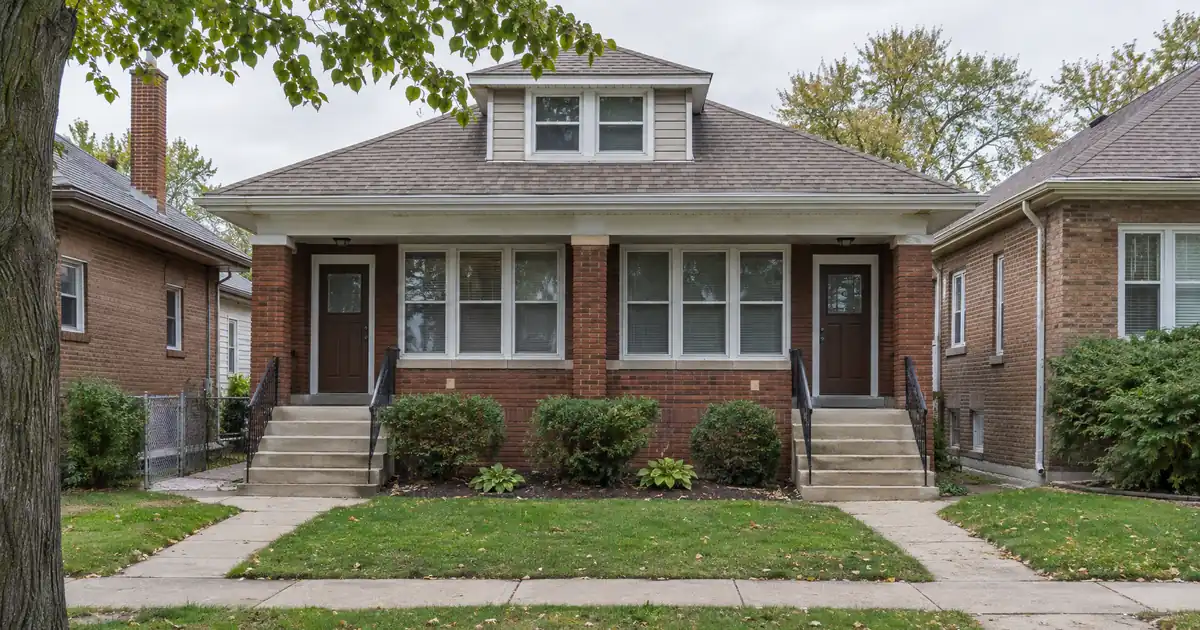
Anyone planning a cash out refinance on an investment property in Harvey, Illinois, should watch two signals that point in opposite directions. Home values in ZIP 60426 are up 6.1 percent over the past year, according to PropertyIQ. Most other signals are soft: rent trackers disagree on direction, sales volume is thin, and the city’s long population decline has not reversed. The equity that comes out of a seasoned Harvey rental depends less on that headline gain and more on what one appraiser can support with a small set of comparable sales. The strongest candidates are two-flats and three-bedroom houses tied to the UChicago Medicine Ingalls Memorial campus. On those properties, rental coverage clears easily. The harder limits are loan size and comp depth.
At a Glance: A cash-out refinance on a Harvey, Illinois, rental is sized against the lower of two limits: 75 percent of the new appraised value, and the loan balance that the property’s lease income can carry against its full monthly obligation. The file starts after roughly six months of seasoning from title recording and is subject to lender review.
DSCR Cash-Out Calculator
Run the cash-out numbers in Harvey, IL
Rate source: Freddie Mac 30-yr average via FRED® — Federal Reserve Bank of St. Louis · effective Sep 24, 2026
Prefilled with starting assumptions — enter your property’s value, balance, taxes, and insurance for a more accurate picture.
Program parameters update from Lendmire’s centralized guideline source. Taxes and insurance are editable estimates.
As of Sep 24, 2026 · General Freddie Mac market benchmark, not a Lendmire loan offer. Property value, balance, taxes, and insurance are editable estimates. Maximum loan-to-value varies by lender, program, property type, and seasoning. Not a Loan Estimate, approval, or commitment to lend. Program availability and eligibility are subject to lender guidelines, credit approval, property review, and underwriting.
- Harvey’s median home value is $127,000, compared with $285,000 countywide (Coldwell Banker Today’s).
- Two-flats list at a $175K median (Redfin), and modeled coverage runs near 1.8x.
- Three-bedroom houses at the median value model at roughly 1.25x to 1.30x coverage.
- Two-bedroom single-family files sit close to 1.00, which is the weakest configuration in the city.
- Thin comparable sales, not rent, are the main risk to cash-out proceeds.
Harvey Market Snapshot
A quick read on the Harvey investor landscape — figures come from the cited sources below. Confirm current property-level numbers before underwriting.
| Metric | Detail |
|---|---|
| Home prices | $108K median value (PropertyIQ ZIP 60426 profile) |
| Typical rents | $858 avg (Apartments.com Harvey rent) |
| University enrollment | 4,748 students (Wikipedia) |
| Population | 20,230 population (Census Reporter (ACS profile)) |
Start With the Ingalls Hospital District
The Ingalls hospital district on Harvey’s east side is the strongest cash-out submarket in the city. Rental demand there comes from a large hospital that anchors the local healthcare workforce. That employment base holds up better than Harvey’s broader sales market, which helps when a lender is looking at the rent roll behind a seasoned rental.
UChicago Medicine Ingalls Memorial Hospital is a 553-bed hospital at One Ingalls Drive. Its campus measures roughly 37 acres per Wikipedia’s hospital profile, which also notes that Ingalls merged into the University of Chicago Medicine system while keeping its own board and president. The broader Ingalls system counts more than 4,000 physicians, employees, and volunteers serving about half a million south-suburban residents each year. That headcount covers every Ingalls location, not just the Harvey campus.
The resident employment data supports the same picture. Per Data USA, health care and social assistance employs 1,151 Harvey residents. That is second only to transportation and warehousing at 1,350 and just ahead of retail trade at 1,148. A hospital that runs around the clock produces shift schedules, and shift schedules create demand for rentals within a short commute. Blocks near the campus benefit from that demand more directly than anywhere else in Harvey’s 6.2 square miles.
For a cash-out file, that demand matters in a specific way. Many lenders want to see leases in place at refinance, and a unit that re-leases without a long gap keeps the rent schedule intact. Single-family houses and small multifamily buildings close to the campus are where that pattern shows up most reliably.
What Does a Harvey Cash-Out Actually Pencil To?
At 75 percent of appraised value, most Harvey rentals clear the 1.00 coverage benchmark with room to spare. Modeled two-flats land near 1.8x and three-bedroom houses fall in the mid-1.2 range, both including taxes and insurance. Two-bedroom single-family houses are the exception, sitting between roughly 1.00 and 1.07.
Debt coverage is monthly rent divided by the full monthly obligation: principal, interest, taxes, insurance, and any HOA dues. Lendmire’s primer on DSCR loans walks through the mechanics.
The program parameters that matter most for a Harvey cash-out are these:
- Loan-to-value: a hard ceiling of 75 percent on cash-out.
- Seasoning: about six months of ownership, measured from title recording.
- Coverage: a DSCR floor of 1.00 on most programs.
- Credit: tiers at 620, 660, 680, and 700, with 620 as the floor.
These guidelines reflect current wholesale-network programs and can change. Eligibility depends on the borrower, the property, and the lender’s review, so confirm every term on the actual file before counting on it.
Each scenario below uses modeled assumptions:
- Appraised values taken from published median figures.
- Rents taken from listing aggregators.
- A standard 30-year amortization at prevailing pricing.
- Illinois-average property tax and insurance loads.
The actual Cook County tax bill on a specific parcel is the figure that decides the real ratio. Investors should confirm current taxes, insurance, and local rental rules with qualified local professionals before relying on any model.
The Two-Flat
Run the numbers on a two-flat that appraises near $175K, the median listing price across 13 multifamily listings tracked by Redfin. One two-flat listed on Homes.com had its upstairs unit leased at $1,275 a month. Assume that rent on one side and $945 on the other, which is the two-bedroom average reported by Apartment Finder. A 75 percent cash-out on that property produces coverage of roughly 1.75x to 1.8x, including taxes and insurance.
That is not a borderline file. Once the ratio is that high, the lender’s real question shifts from whether the rent covers the payment to whether the value holds.
The trade-off runs in an unexpected direction. If the same building appraises at $150K instead, coverage climbs above 2.0x while the cash available shrinks. The ratio improves as the check gets smaller, which surprises investors who focus only on the coverage number.
The Three-Bedroom House
Picture an investor holding a three-bedroom single-family house that appraises at Harvey’s $127,000 median home value, per Coldwell Banker Today’s. Three-bedroom rents run from $1,105 on Apartments.com’s market-trends page to $1,152 on Apartment Finder. At 75 percent loan-to-value, coverage lands at roughly 1.25x to 1.30x, including taxes and insurance.
The catch is loan size, not the ratio. Three-quarters of a $127,000 value is a small balance, below the level many standard DSCR programs are designed around. Smaller balances go through select lenders in the network, so choosing the right lender for the file matters more in Harvey than in most Cook County suburbs.
Two Bedrooms, Thin Margin
Consider the same $127,000 house with only two bedrooms. Apartments.com publishes two figures for two-bedroom rent in Harvey: $895 on its trends page and $945 on its two-bedroom listings page. At either rent, coverage at 75 percent sits between roughly 1.00 and 1.07. The numbers work, but barely.
Most standard programs use 1.00x as the benchmark because at that level the rent covers the payment. A lender that reviews lower ratios usually wants compensating factors such as more reserves, lower leverage, or different terms. If a soft appraisal pushes this file below 1.00, investors have three paths to raise with a lender:
- Take less cash. Reducing the request from 75 percent to 70 percent of value lifts modeled coverage to roughly 1.06x to 1.12x.
- Use an interest-only structure.
- Apply to a sub-1.00 program.
Each path is reviewed against lender guidelines, credit, and the property itself.
Why Do Harvey Rent Estimates Disagree So Much?
The aggregators measure different housing stock, and in a city this small a handful of listings can move an average. None of the published figures is the rent used for lender review on a cash-out. The appraiser’s rent schedule is, and a Harvey file should be built to hold up against it.
| Source | Reported Figure | What It Measures |
|---|---|---|
| Apartments.com | $945 | 2BR average |
| Apartments.com trends | $895 | 2BR average, up 2.7 percent |
| Rentable | $1,000 | 2BR average |
| Apartment List | $1,413+ | 2BR average |
| Zumper | $1,625 | All units, down 6 percent |
The gap between Zumper’s whole-market figure and the apartment-weighted trackers is itself useful. It suggests that houses and small two-to-four-unit buildings rent for more relative to their price than larger apartment stock. That supports holding single-family homes and two-flats in Harvey rather than larger buildings.
The direction of rents is harder to read. Zumper shows rents down 6 percent year over year, while Apartments.com shows them up 2.7 percent. The sensible response is to underwrite flat rents and treat any growth as a bonus.
Rent levels also have a ceiling. Point2Homes places Harvey’s median household income at $42,429. At that income, a three-bedroom rent above $1,150 already takes roughly a third of a median household’s gross monthly income. Modeling steep rent increases into a cash-out file is not supported by the local numbers.
Transit, Halsted, and Dixie (The Corridors Beyond the Hospital)
Outside the Ingalls district, Harvey’s rental demand follows its transportation lines.
Metra Electric corridor. Harvey has two stations on the Metra Electric Main Branch. The Harvey station sits at Park Avenue and 154th Street, 20.0 miles from Millennium Station. The Encyclopedia of Chicago places the city 19 miles south of the Loop. Single-family houses and duplexes within walking distance of either station draw commuter tenants, and those tenants tend to stay put because the rail link is hard to replace.
Halsted Street (Illinois Route 1). This is the city’s historic commercial spine. Much of Harvey’s older brick two-flat stock sits here, close to retail and the Pace transportation center. For cash-out purposes, the Halsted blocks are where the two-flat math in the scenario above is most likely to show up in practice.
Dixie Highway. This road continues north into Chicago as Western Avenue and carries a mixed residential-commercial character. It is serviceable, with more variation from block to block.
Dixie Square Mall. The blocks around the site, vacant for decades, need caution. Until redevelopment actually happens, rentals there face weaker demand and possibly softer appraisal support.
South Harvey. Residential blocks toward Thornton Township High School sit near one of the area’s larger public employers. Thornton Township High School District 205 runs a $130.1 million budget across 4,748 students, and payroll of that size supports steady local renting.
Skip the Catch-Up Thesis.
Harvey is a cash-flow market, not a bet that prices will converge with neighboring towns. A cash-out built on the expectation that Harvey will close the gap with nearby suburbs rests on a price spread with structural causes, not a temporary discount.
Zillow’s ZIP-level data shows the spread clearly. Zillow’s method places Harvey lower than the $127,000 median cited above, at $108,731, but it is useful for comparing towns side by side:
| Town | Zillow Average Value |
|---|---|
| Phoenix | $101,164 |
| Harvey | $108,731 |
| Dixmoor | $123,567 |
| Markham | $148,532 |
| Hazel Crest | $182,545 |
| Midlothian | $234,296 |
The gap to Midlothian is roughly double (and it has not been narrowing in any way the data captures). PropertyIQ gives ZIP 60426 a momentum score of 23, a weak reading that positions the ZIP to lag the state over the next three years. That forecast carries more weight for planning than the recent 6.1 percent gain.
Harvey’s history explains part of the discount. Chicago lumberman and banker Turlington Harvey organized a real-estate syndicate to promote Harvey as an industrial suburb, according to the Encyclopedia of Chicago. Voters then incorporated it as one of the region’s temperance towns, a model community built around Christian values, per Wikipedia. The town peaked in the postwar years, when the Buda Engine Co. was a major employer. That same Wikipedia census table records 35,810 residents four decades before the latest count. Census Bureau QuickFacts now puts the population at 20,230.
The practical takeaway is to size the cash-out on today’s value and underwrite the next acquisition on cash flow. An investor who plans to refinance again later, expecting Harvey to reprice toward Hazel Crest, is making a speculative bet on a pattern the data does not show. Rate-and-term and other refi programs exist for holders who would rather lock in coverage than pull maximum proceeds.
Where Harvey Cash-Outs Get Stuck
Appraisals, not coverage ratios, are where Harvey cash-outs most often fall short. Three factors narrow the path: comparable sales are thin across 60426 and neighboring towns, the housing stock carries a high vacancy share, and small loan balances limit which lenders will look at the file.
DSCR vs. conventional financing
There are two common ways to finance an investment property in Harvey, IL, and they qualify you differently — here’s how investors weigh them.
Why investors choose it
- Qualifies on the property’s rental income — no personal tax returns, W-2s, or pay stubs needed to document income.
- No personal debt-to-income ceiling to clear, so existing mortgages and obligations don’t cap your borrowing the same way.
- Can be closed in an LLC, keeping the property inside a business entity.
- Built for scaling — not held to the limit on number of financed properties that conventional financing applies.
- Underwriting centers on the deal: generally qualifies when the rent covers the payment, a 1.00x coverage ratio being a common baseline (confirmed in underwriting).
- Designed specifically for investment property, including long-term and, where the program allows, short-term rentals.
Where it’s strong
- Often the lowest ongoing financing cost for a buyer who fully qualifies on personal income — a fit for a first property or a cost-first purchase.
Trade-offs for investors
- Requires full personal income documentation and must fit within a debt-to-income limit — salary, existing debts, and other mortgages all count.
- Typically held in your personal name rather than a business entity.
- Caps how many financed properties you can carry, which can become a ceiling as a portfolio grows.
- Evaluates you as a borrower as much as the property, which usually means more paperwork.
How investors usually choose: a first or single property often optimizes for the lowest financing cost; portfolio builders often optimize for leverage, vesting in an LLC, and scaling past conventional caps. The right answer depends on your goals, the property, and current guidelines — both paths run through select lenders in Lendmire’s wholesale network, with eligibility and terms confirmed in underwriting.
Thin comparable sales. Neighboring Dixmoor recorded only one home sale in a recent month, per Redfin’s sold data. An appraiser valuing a renovated Harvey two-flat may end up relying on a few sales that do not fit well, and a single weak comp can cut the value that sets the 75 percent ceiling.
High vacancy in the housing stock. Coldwell Banker Today’s reports that about 39 percent of Harvey homes are owner-occupied, 38 percent are rented, and 22 percent are vacant. That 22 percent measures the overall housing stock, not the rental vacancy rate, and it should not be treated as one. It still shapes what the appraiser sees. Vacant or distressed sales nearby can pull values down, which is why a well-maintained, leased rental should be documented carefully.
Working DSCR brokers see a recurring pattern in low-price Cook County suburbs like Harvey. The coverage ratio almost never stops the file. The appraisal and the loan balance do. The stronger files come in with a signed lease, a current rent roll, and a short list of the investor’s own recent comparable sales to send to the appraiser. Investors who assume that a 1.8x ratio guarantees a smooth refinance are often surprised when the value comes in low.
Seasoning. The six-month clock runs from title recording, not the closing date. An investor who bought, renovated, and leased a property should confirm that recording date before ordering the appraisal. Starting early can mean an appraisal the lender will not accept.
Using the proceeds. Cash pulled from a Harvey rental often funds the next acquisition. The cash-out refinance walkthrough covers how the proceeds are sized and released. Investors comparing this approach against agency financing can review the conventional-vs-DSCR tradeoffs. For most Harvey holders with several properties, qualifying on property income avoids the debt-to-income limits that conventional refinancing imposes once an investor owns a few doors.
Frequently Asked Questions
How do you qualify for a DSCR cash-out refinance in Harvey, Illinois?
You need about six months of ownership, measured from title recording, and rent used for lender review that covers the full monthly obligation at a 1.00 ratio or better on most programs. Credit tiers start at a 620 floor, with 660, 680, and 700 marking further program tiers, and roughly six months of reserves is typical. In Harvey, the appraiser’s rent schedule usually decides the file, because online rent estimates for the city differ by several hundred dollars. All review details are subject to lender overlays.
What are the requirements for a cash-out refinance on an investment property in Harvey, Illinois?
The core requirements are a maximum loan-to-value of 75 percent on the new appraisal, roughly six months of seasoning, minimum coverage of 1.00 on most programs, and about six months of reserves. Properties titled to an LLC can often refinance in the entity’s name, subject to lender program eligibility. The requirement specific to Harvey is practical rather than written: the appraisal needs enough recent comparable sales in and around 60426 to support the value the cash-out depends on.
Is a two-flat or a single-family home the better cash-out candidate in Harvey?
On current data, the two-flat usually is. Two separate rents on one parcel push modeled coverage near 1.8x, compared with the mid-1.2 range for a three-bedroom house and close to 1.00 for a two-bedroom house. The two-flat’s higher value also produces a larger loan balance, which gives the file more lender options than a small single-family refinance.
Will Harvey’s shrinking population hurt my appraised value?
It affects the value indirectly, through sales volume rather than any direct formula. Fewer buyers mean fewer recent closings, and fewer closings give the appraiser less to work with. That is why documenting the property’s condition and lease history matters more in Harvey than in busier south-suburban ZIPs.
What to Watch Before the Next Appraisal
Four indicators will shape Harvey cash-out outcomes over the next six to eighteen months:
- Momentum score. Watch whether PropertyIQ’s score for 60426 moves off its weak reading. A rising score would mean the recent value gain is holding.
- Rent direction. Watch Zumper’s year-over-year figure. A second consecutive decline would weaken rent schedules at appraisal.
- Multifamily inventory. Watch Redfin’s count of Harvey multifamily listings. A jump from the current 13 could soften two-flat values just as owners come off seasoning.
- The Ingalls system. Any expansion or contraction there changes demand in the blocks that currently support the strongest files.
If you only take one thing from this piece, it’s this: in Harvey the rent almost always covers the payment, so a cash-out succeeds or fails on whether the appraiser can find enough recent sales to support the value.
For current guidelines and terms, see Lendmire’s DSCR loan programs page.
About Lendmire
Lendmire (NMLS# 2371349) is a mortgage brokerage focused on DSCR investor loans. It arranges financing through wholesale and investor-lending channels across 41 markets, including Washington, D.C. Instead of centering the file on W-2 documentation, its model relies on the property’s rental income as reviewed by the lender, subject to lender guidelines. That approach suits investors who hold property in entities or across several properties. The firm holds Scotsman Guide Top Mortgage Workplace recognition for both 2025 and 2026. It was named a 2025 Scotsman Guide Top Workplace and was recognized by Scotsman Guide as a 2026 Top Workplace, as described in the 2026 industry recognition release. This content is for informational purposes only and is not a commitment to lend.
For broader investor-financing rules and property-type coverage across the state, see Illinois DSCR loans.
Get Started
Ready to find the right loan for you?
In about 30 seconds you can review financing options available for your investment property. No commitment required.
Informational only. Not a Loan Estimate, approval, or commitment to lend. Program availability and eligibility are subject to lender guidelines, credit approval, property review, and underwriting.
References
1. PropertyIQ — ZIP 60426 Profile
2. Coldwell Banker Today’s Realtors — Harvey
3. Redfin — Harvey Multi-Family Homes
4. Apartments.com — Harvey Rent Trends
5. Wikipedia — Thornton Township High School District 205
6. Census Reporter (ACS profile)
7. Wikipedia — Ingalls Memorial Hospital
9. Homes.com — Harvey Multi-Family Listings
11. Apartments.com — Harvey 2-Bedrooms
13. Zumper — Harvey Rent Research
14. Point2Homes — Harvey Demographics
15. Zillow — ZIP 60426 Overview
16. Wikipedia — Harvey, Illinois
18. Redfin — Dixmoor Recently Sold
19. a 2025 Scotsman Guide Top Workplace
20. recognized by Scotsman Guide as a 2026 Top Workplace
21. EIN Presswire — Lendmire Recognized as a 2026 Top Workplace by Scotsman Guide
This article is part of Lendmire’s investment property cash-out refinance program — full qualification details, guidelines, and scenarios live on the program page.
Related reading: Luxury Rental DSCR Loans In New Jersey · Jersey Shore Vacation Rental Loans: DSCR Financing In Ocean City, Cape May And Long Beach Island · DSCR Cash-out Refinance In New Jersey: Pulling Equity From A Rental
Guides: Investment Property Cash-Out Refinance in Illinois
Brandon Miller
Founder & CEO, Mortgage Loan Originator, Lendmire LLC
- Mortgage Loan Originator · NMLS# 1129696 · Verify on NMLS Consumer Access
- North Carolina Real Estate Broker · License# 343312 · Verify on NCREC
- North Carolina Insurance Producer · License# 19053198 · Property, Casualty, Life, Health · Verify on NAIC SBS
- Lendmire LLC · Firm NMLS# 2371349 · Verify firm licensure
Required disclosures. Lendmire (NMLS# 2371349) operates as a licensed mortgage broker, not a direct lender or depository. The discussion in this article is general in nature and should not be relied upon as financial, legal, or tax advice — every investment scenario is unique and should be reviewed by a qualified professional. Any loan inquiry is subject to lender underwriting, and this article is not a commitment to lend or a guarantee of approval. Mortgage rates, loan terms, and program guidelines vary by borrower, property, and state, and may change without notice. Equal Housing Opportunity. Verify licensure at NMLS Consumer Access.