
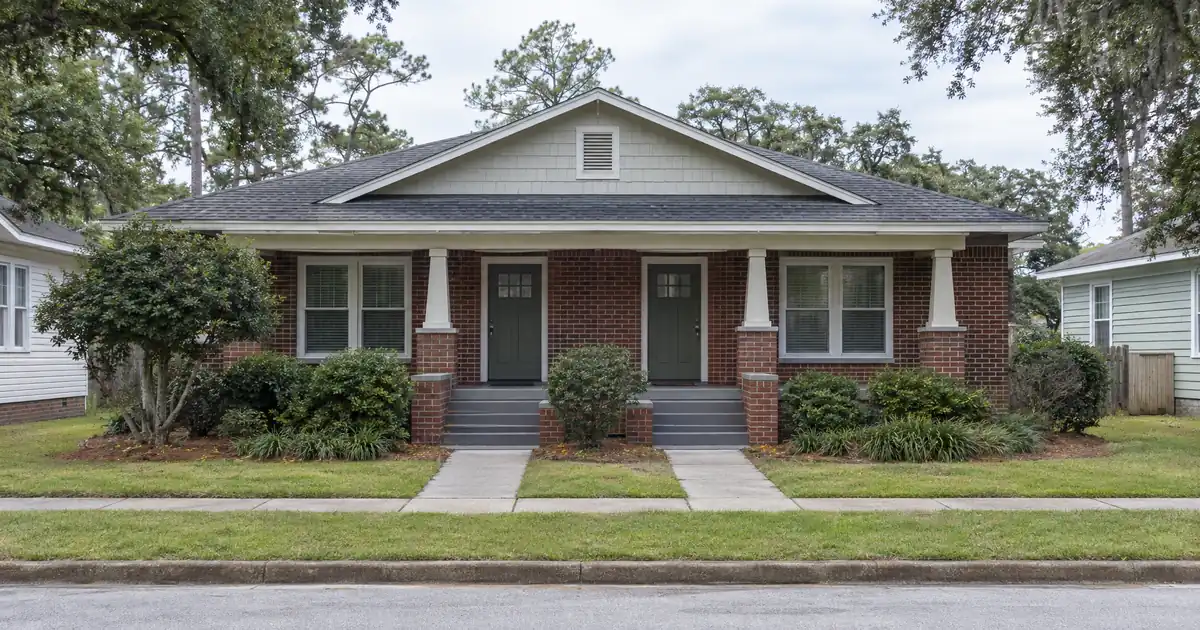
If you own a rental in Hinesville that’s worth $250,000 or more, the question isn’t whether you can pull equity out. It’s whether the rent supports the new loan once the lender counts taxes and insurance, and whether the appraisal lands where you need it in a market that isn’t handing out appreciation. Most cash-out pitches skip that second half. This one starts there.
At a Glance: A cash-out refinance on a Hinesville rental is underwritten primarily on the property’s rental income measured against its full monthly obligation, with a hard leverage ceiling and a seasoning requirement layered on top, subject to lender guidelines.
DSCR Cash-Out Calculator
Run the cash-out numbers in Hinesville, GA
Rate source: Freddie Mac 30-yr average via FRED® — Federal Reserve Bank of St. Louis · effective Sep 24, 2026
Prefilled with starting assumptions — enter your property’s value, balance, taxes, and insurance for a more accurate picture.
Program parameters update from Lendmire’s centralized guideline source. Taxes and insurance are editable estimates.
As of Sep 24, 2026 · General Freddie Mac market benchmark, not a Lendmire loan offer. Property value, balance, taxes, and insurance are editable estimates. Maximum loan-to-value varies by lender, program, property type, and seasoning. Not a Loan Estimate, approval, or commitment to lend. Program availability and eligibility are subject to lender guidelines, credit approval, property review, and underwriting.
- The cash-out LTV ceiling is 75%. Equity available depends on rent, obligation, reserves, and that cap.
- Ownership seasoning is about 6 months from title recording before a cash-out file is typically reviewed.
- Fort Stewart employs over 25,500 people, and most of that workforce lives off post.
- Modeled coverage on a median-priced house at 75% LTV lands near 1.0x to 1.1x including taxes and insurance.
- Sale prices are soft and days on market are stretching, so appraisal risk is real.
Hinesville Market Snapshot
A quick read on the Hinesville investor landscape — figures come from the cited sources below. Confirm current property-level numbers before underwriting.
| Metric | Detail |
|---|---|
| Home prices | $238K median (Redfin) |
| Typical rents | $1,768 avg house (Zillow Rental Manager) |
| University enrollment | 700+ students per semester (Savannah Technical College) |
| Population | ~15% (~10,000) population growth over 5 years (The Current GA) |
| Employment | 4,100+ jobs (Liberty County Development) |
Equity Here Is Made, Not Waited For
Hinesville equity comes mostly from what you bought at and what you improved, not from market drift. Prices are flat-to-soft, which means a cash-out plan built on “it’ll be worth more in a year” is a weak plan.
Homes.com shows a median home price around $260,000 in Hinesville, and that’s the figure used throughout this article. Redfin runs lower on closed sales, at a $238,000 median sale price that was down 5.5% year over year, and it shows homes taking 70 days to sell versus 49 the year before. Sold-price data and asking-price data measure different things, so the gap isn’t a contradiction. It is a warning that the sample behind any single number is small. Redfin’s sample was only 22 closed sales against 52 the prior year.
The practical read is that price direction is noisy. An investor who bought below market, or who rehabbed a dated house near the older core, has equity that’s real. An investor who bought at the median and is counting on the market to do the work has less than they think. Plan around purchase price plus forced appreciation, and use conservative LTV assumptions. A cash-out at 75% on a $260,000 house is a very different file from one at 60%, and the lower one is the one that survives a soft appraisal. These specifics are subject to lender guidelines and a full review of property, leverage, and credit.
The flip point: if you’ve held a property well past seasoning and you’ve documented a rent increase or a finished renovation, the appraisal can carry you. If you’re roughly six months in and the only change is time, don’t expect the number to move.
Why the Rent Roll Holds Together
Fort Stewart is the reason a city of about 35,700 has a rental market at all. The Census Reporter profile shows 35,679 residents with a median age of 28.9. RentCafe reports that 53% of households rent. The installation sits next to all of it.
The Fort Stewart command data lists more than 25,500 people employed, including 21,200 full-time Soldiers and 4,350 Army civilians and contractors, with a $4.9 billion economic impact in Coastal Georgia. Only about 3,268 family housing units exist on post, so most of that workforce rents or buys in town. The Liberty County Development Authority adds a turnover story: 3,600 to 4,800 soldiers leave service each year, and many stay to look for work locally. That flow matters for a lender reviewing a rent roll, because it supports steady leasing demand tied to employment rather than to a single tenant.
Employment beyond the post is thinner but real. The Development Authority’s major industries page counts 18 industrial companies employing more than 4,100 people, split between nine manufacturers and nine distribution hubs, and the Port of Savannah sits about 30 minutes from Liberty’s main industrial areas. Liberty Regional Medical Center anchors health care in town, and Savannah Technical College’s Liberty Campus serves more than 700 students each semester. That’s a workforce college, not a student-housing driver. Nobody should underwrite dorm-style demand here.
The risk side is honest and simple. Demand is tied to troop presence and deployment cycles. When units rotate out, occupancy can wobble. Zillow’s rental data rates the rental market “cool,” and no reliable published vacancy rate exists. Underwrite a real vacancy factor instead of assuming full occupancy.
Running the Coverage Numbers
On a median-priced house at the 75% cash-out ceiling, coverage sits near the 1.0x baseline; drop leverage to 65% and it climbs toward 1.2x. Those figures include taxes and insurance, and they’re modeled, not market-reported. Terms vary by lender guidelines, property type, leverage, credit profile, and full file review.
Rent data is where the trouble starts. Zillow puts the average Hinesville house rent at $1,768, while RentCafe puts the three-bedroom average at $1,608. The spread comes from different property mixes. The appraiser’s rent schedule, not a portal average, should drive the coverage number on your file.
Here are modeled scenarios using a $260,000 value and the rents above. These are illustrative assumptions, not quotes or approvals.
| Modeled scenario | Value | LTV | Coverage (with taxes, insurance) |
|---|---|---|---|
| 3BR house, $1,768 rent | $260,000 | 75% | About 1.1x |
| 3BR house, $1,608 rent | $260,000 | 75% | About 1.0x |
| 3BR house, $1,768 rent | $260,000 | 65% | About 1.2x |
| Duplex, two 2BR at $1,200 | $320,000 | 75% | About 1.2x |
Two lessons fall out of the table. First, at the ceiling, about $160 of monthly rent difference is the difference between comfortably clearing 1.00x and sitting right on it. Most standard DSCR programs use 1.00x as a common baseline because rent covers the obligation at that level. Some lenders review lower ratios, but that usually means stronger compensating factors, lower leverage, or different pricing, and eligibility still depends on credit, reserves, and property review.
Second, stacked income helps. Homes.com lists local multi-family from $119,900 to $589,900, though only six were for sale at the time and they sat about 75 days. A duplex of two 2-bedrooms, each near $1,200 on Zillow’s and Zumper’s numbers, grosses more than a single three-bedroom. The catch is the shallow inventory. Fewer comps means a harder appraisal and a longer search when you go to replace the collateral or recycle the money.
That’s a genuine toss-up for an owner deciding what to hold: the single-family house is easier to appraise and easier to sell, while the duplex covers better but is thinner to exit. Neither is wrong. It depends on whether you value coverage cushion or liquidity more.
Housing allowance data offers one more benchmark. The published Fort Stewart housing allowance for a mid-career E-5 is $2,310 a month at the with-dependents rate and $1,947 without, and the site shows a range from $1,791 to $3,174 across ranks. That’s a pay-scale benchmark that sits above many local two- and three-bedroom rents. It suggests headroom in the local rent structure but guarantees nothing about your unit, and one calculator site cites a different E-5 figure. Check the official DoD lookup before using it.
Where the Collateral Holds Up
The newer duplex product near the main gate and the established subdivisions are the strongest cash-out collateral; the older core offers upside but harder appraisals. Neighborhood-level price and rent data is thin in Hinesville, so this section stays qualitative on purpose.
Start with the main-gate and Oglethorpe Highway corridor. Redfin’s new-construction listings show a recently built duplex with two roughly 1,100-square-foot units, each three bedrooms and two baths, close to the gate. New product like that is easy for an appraiser to comp against and easy for a lender to review. The tradeoff is that newer stock has less forced-appreciation room, so the equity you pull depends almost entirely on the price you paid.
The older core around Downtown, South Main Street, and Memorial Drive is the opposite. Older blocks trade updates for bigger yards and shade, and this is where small multifamily and conversion potential likely sits. It’s also where a renovated unit can show a real jump between purchase basis and appraised value. Public rent figures for the downtown area conflict badly, and one portal’s big year-over-year jump rests on 26 rentals. Ignore it.
The established subdivisions near the base, such as Griffin Park, Bradwell Estates, and Governors Place, are where the workforce three- and four-bedroom houses live. One Griffin Park listing, a four-bedroom built in 2015 with about 1,900 square feet, was priced near $295,000. That’s a single listing, not a median, but it shows the pricing band for the larger family-sized rentals that support the higher rent tier.
Along Airport Road and Highway 84, newer subdivisions often add HOAs. HOA dues count in the full obligation, so they trim coverage. Model them in.
One property-type flag applies here. Manufactured homes, log homes, and barndominiums fall outside these DSCR programs, and there are plenty of outlying properties around Ludowici and the Highway 84 west edge where that matters. Confirm the structure type before you spend time on a file.
What the File Needs Before It Goes to the Lender
The cleanest cash-out files show up with the paperwork already done, and that matters more in a market with thin comps. Seasoning, reserves, and credit are the gating items, and each is a range subject to lender guidelines.
The rules of thumb for these programs: seasoning of about 6 months from title recording, reserves of roughly 6 months of the full obligation (more on very large loans), and credit tiers that start at a 620 floor and improve at 660, 680, and 700. Loans go up to $3,000,000 on standard programs. Hinesville balances are much smaller, and smaller balances route through select lenders in the network, so expect that conversation early. If you’re holding the property in an LLC, that generally works, subject to lender program eligibility.
Lendmire’s deal desk sees a consistent pattern in markets structurally like this one, where one employer anchors the rental base and price data is noisy. The files that move cleanly tend to arrive with complete leases, entity documents, title, and property details ready for lender review, plus a clear rent schedule. The common friction point is a rent claim that rests on a portal average or a seller’s pitch rather than the appraiser’s schedule. In thin-comp markets, the appraisal is where cash-out proceeds get trimmed, so the strongest borrowers treat comps as part of the file prep, not a surprise at the end.
Equity is never a guaranteed cash figure. It’s the output of rent, obligation, reserves, and the 75% ceiling working together. For the mechanics, the cash-out refinance walkthrough covers the structure, and investor refinance options lays out the alternatives.
What Are You Actually Buying With the Proceeds?
Cash-out equity works best when it funds a deal that clears coverage at current prices, and in Hinesville that’s usually a duplex or a below-median house. Pulling equity into a project that doesn’t pencil is the mistake to avoid.
Picture an investor with a house near the main gate who pulls proceeds at a conservative leverage level and redeploys them into a second unit in the same submarket. That works if the second property covers on its own rent. It works less well if the plan depends on prices rising, since sources disagree on direction, with Movoto showing listing prices up 4% and others showing declines. A soft market is a buyer’s market, though, and rising inventory (Movoto counted 408 homes for sale) gives negotiating room. The investor with recycled capital and a patient offer strategy is the one this market rewards.
There’s also a regional angle. Hyundai’s Metaplant in Bryan County, about 30 miles north, employed 1,232 people at opening against a target of 8,500. That’s spillover context, not a Hinesville employer, and no source quantifies its effect on local rents. Treat it as a possible tailwind, never a base-case assumption. The Development Authority’s plan projects roughly 15% population growth, nearly 10,000 people, over five years, which is a target rather than a forecast.
DSCR vs. conventional financing
Two common ways to finance an investment property in Hinesville, GA. They qualify you differently — here’s how investors weigh them.
Why investors choose it
- Qualifies on the property’s rental income — no personal tax returns, W-2s, or pay stubs needed to document income.
- No personal debt-to-income ceiling to clear, so existing mortgages and obligations don’t cap your borrowing the same way.
- Can be closed in an LLC, keeping the property inside a business entity.
- Built for scaling — not held to the limit on number of financed properties that conventional financing applies.
- Underwriting centers on the deal: generally qualifies when the rent covers the payment, a 1.00x coverage ratio being a common baseline (confirmed in underwriting).
- Designed specifically for investment property, including long-term and, where the program allows, short-term rentals.
Where it’s strong
- Often the lowest ongoing financing cost for a buyer who fully qualifies on personal income — a fit for a first property or a cost-first purchase.
Trade-offs for investors
- Requires full personal income documentation and must fit within a debt-to-income limit — salary, existing debts, and other mortgages all count.
- Typically held in your personal name rather than a business entity.
- Caps how many financed properties you can carry, which can become a ceiling as a portfolio grows.
- Evaluates you as a borrower as much as the property, which usually means more paperwork.
How investors usually choose: a first or single property often optimizes for the lowest financing cost; portfolio builders often optimize for leverage, vesting in an LLC, and scaling past conventional caps. The right answer depends on your goals, the property, and current guidelines — both paths run through select lenders in Lendmire’s wholesale network, with eligibility and terms confirmed in underwriting.
Honestly, the pull-and-redeploy plan gets a lot riskier if the proceeds go out of state into markets where coverage doesn’t work at current pricing. Stress-test that before committing.
When Conventional Beats DSCR
Conventional financing can be the better tool for a single rental held personally by a borrower with clean traditional employment income. It’s typically cheaper and doesn’t carry the non-QM friction. Lendmire’s DSCR-versus-conventional breakdown walks through the tradeoffs.
DSCR pulls ahead when the borrower holds several financed properties, owns through an LLC, is self-employed, or has traditional personal-income documentation that doesn’t show rental income cleanly. If you’re two or three properties in and the conventional lane is running out, that’s where DSCR loans in Georgia become the practical path. If you have one house and a strong W-2, ask whether the simpler loan gets you where you need to go before defaulting to the investor product. For the basics, Lendmire’s DSCR guide covers how the ratio is built: monthly rent divided by principal, interest, taxes, insurance, and any HOA dues.
Before underwriting any of this, verify current local rental rules, taxes, and insurance with qualified local professionals.
Frequently Asked Questions
How do you qualify for a DSCR cash-out refinance in Hinesville?
The file is underwritten primarily on the property’s rent against its full monthly obligation, with a 1.00x baseline common on standard programs. On top of that, expect about 6 months of ownership seasoning, credit starting at a 620 floor, and reserves near 6 months of the obligation. Final eligibility depends on lender guidelines, credit approval, and property review.
What are the requirements for an investment property loan in Hinesville, Georgia?
Most programs look at credit tiers from 620 upward, a coverage ratio built on appraised rent, and reserves. Acceptable property types include single-family houses, duplexes, and small multifamily. Manufactured homes, log homes, and barndominiums fall outside these programs. Smaller Hinesville balances may route through select lenders in the network rather than standard programs.
Should I underwrite to the portal rent or the appraiser’s rent?
The appraiser’s rent schedule. Portal averages for Hinesville conflict widely, from Zillow’s $1,768 house average to RentCafe’s $1,608 three-bedroom figure, because each mixes different property types. The lender uses the appraised rent, so build your math on that.
Does the Fort Stewart tenant base protect me from vacancy?
It supports demand but doesn’t remove risk.
The Choice in Front of You
If you hold a Hinesville rental with real equity, you’re weighing two moves. You can pull proceeds now at a conservative LTV, accept a smaller check, and redeploy into a duplex or below-median house while sellers are negotiating. Or you can hold the equity in place, keep the property’s coverage cushion intact, and wait for a market that could firm up or slip further. The first path puts capital to work in a soft market but adds debt against a value nobody can predict. The second protects your coverage but leaves cash idle. Either way, the deciding variable is the appraiser’s rent schedule, and Fort Stewart’s steady flow of arrivals and departures is what underwrites it.
For current guidelines and terms, see Lendmire’s DSCR loan programs page.
About Lendmire
Lendmire, NMLS# 2371349, is a mortgage brokerage focused on investor financing, arranging DSCR loans in 40 states plus Washington, D.C. (41 markets total). Qualification rests on the property’s income rather than personal income documentation, subject to lender guidelines, which suits LLC-held rentals and growing portfolios. Lendmire is recognized as a 2026 Scotsman Guide Top Mortgage Workplace and a 2025 Scotsman Guide Top Mortgage Workplace. To talk through a Hinesville file, call 828-256-2183 or start your quote.
Get Started
Ready to find the right loan for you?
In about 30 seconds you can review financing options available for your investment property. No commitment required.
Informational only. Not a Loan Estimate, approval, or commitment to lend. Program availability and eligibility are subject to lender guidelines, credit approval, property review, and underwriting.
References
1. Fort Stewart–Hunter Army Airfield
2. Redfin, Hinesville housing market
3. Zillow Rental Manager, Hinesville
4. Savannah Technical College, Liberty Campus
6. Liberty County Development Authority, Major Industries
7. Homes.com
10. Liberty County Development Authority
11. Liberty Regional Medical Center
12. Fort Stewart housing allowance
13. Redfin’s new-construction listings
15. a 2026 Scotsman Guide Top Mortgage Workplace
16. a 2025 Scotsman Guide Top Mortgage Workplace
This article is part of Lendmire’s investment property cash-out refinance program — full qualification details, guidelines, and scenarios live on the program page.
Related reading: DSCR Cash Out Refinance Hinesville Georgia · DSCR Loans in Statesboro / Hinesville, Georgia: Investor Financing for Midtown Statesboro, Historic Downtown, Fort Stewart Rentals & Real Estate Investors · DSCR Cash Out Refinance South Fulton Georgia: Access Your Equity Without Income Docs
Guides: Investment Property Cash-Out Refinance in Hinesville, GA · Investment Property Cash-Out Refinance in Georgia
Brandon Miller
Founder & CEO, Mortgage Loan Originator, Lendmire LLC
- Mortgage Loan Originator · NMLS# 1129696 · Verify on NMLS Consumer Access
- North Carolina Real Estate Broker · License# 343312 · Verify on NCREC
- North Carolina Insurance Producer · License# 19053198 · Property, Casualty, Life, Health · Verify on NAIC SBS
- Lendmire LLC · Firm NMLS# 2371349 · Verify firm licensure
Important disclosures. Lendmire (NMLS# 2371349) is a licensed mortgage brokerage. Lendmire is not a direct lender, depository institution, or financial advisor. All loan inquiries are subject to lender underwriting; this article does not constitute a commitment to lend. Rates, terms, and program guidelines are subject to change without notice and vary by borrower profile, property type, and state. Information in this article is general in nature and is not financial, legal, or tax advice. Equal Housing Opportunity. NMLS Consumer Access: nmlsconsumeraccess.org.