
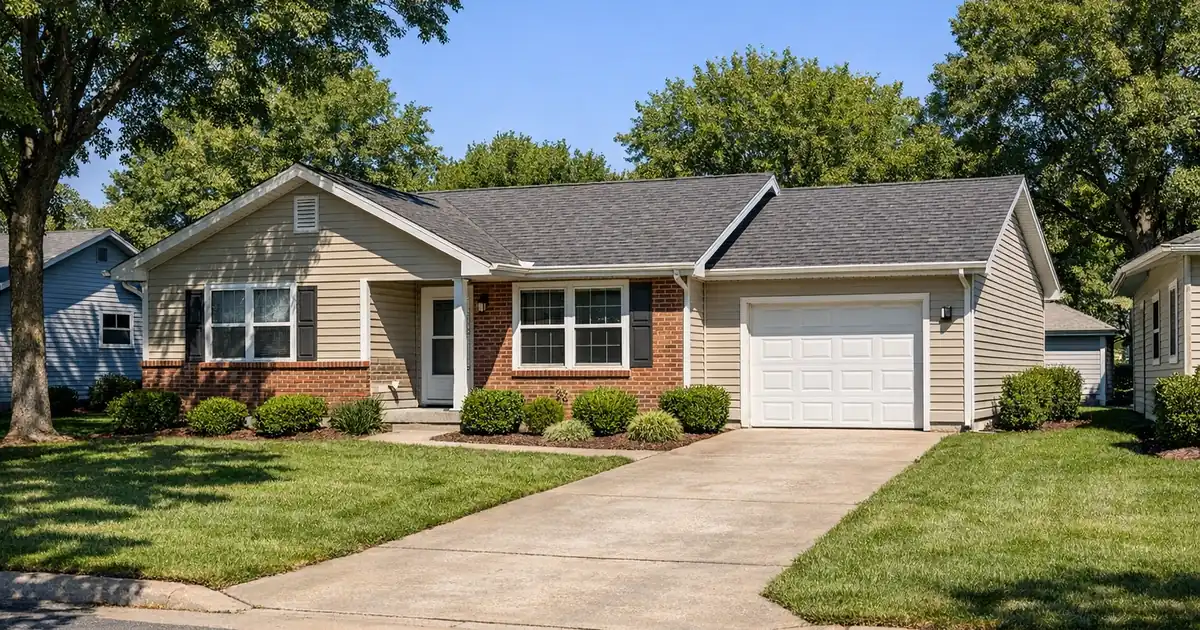
A rental property in Joplin that has appreciated $60,000 since purchase is generating zero return on that equity until an investor puts it to work. For real estate investors holding rental properties across Jasper County, that trapped equity represents acquisition capital, renovation funding, or hard money loan payoff — none of which requires a W-2, tax return, or pay stub to access.
A cash out refinance investment property in Joplin, Missouri works differently than most investors expect. Qualification runs on the property’s rental income, not the borrower’s personal earnings. That’s the core mechanic of a DSCR loan — and it’s why investors with complex tax returns, multiple LLCs, and six-figure depreciation deductions are using this tool to scale portfolios that conventional lenders won’t touch.
DSCR Cash-Out Calculator
Run the cash-out numbers in Missouri
Rate source: Freddie Mac 30-yr average via FRED® — Federal Reserve Bank of St. Louis · effective Jul 30, 2026
Prefilled with starting assumptions — enter your property’s value, balance, taxes, and insurance for a more accurate picture.
Program parameters update from Lendmire’s centralized guideline source. Taxes and insurance are editable estimates.
As of Jul 30, 2026 · General Freddie Mac market benchmark, not a Lendmire loan offer. Property value, balance, taxes, and insurance are editable estimates. Maximum loan-to-value varies by lender, program, property type, and seasoning. Not a Loan Estimate, approval, or commitment to lend. Program availability and eligibility are subject to lender guidelines, credit approval, property review, and underwriting.
Key Takeaways:
- DSCR loans qualify on rental income alone — no W-2s, tax returns, or personal income documentation required
- Cash-out refinance at up to 75% LTV gives Joplin investors access to built-up equity for reinvestment
- Lendmire closes DSCR loans on a timeline that varies by lender and file — substantially faster than conventional bank timelines
Lendmire, a non-QM mortgage broker operating as NMLS# 2371349, works directly with real estate investors in Joplin, Missouri on DSCR cash-out refinance transactions structured entirely around property income. For investors ready to explore investment property refinance options, the starting point is simpler than most expect.
The Joplin Rental Market and Why Equity Access Matters Now
Joplin sits at the intersection of four states — Missouri, Kansas, Oklahoma, and Arkansas — making it a regional hub for healthcare, logistics, and manufacturing employment that drives consistent rental demand. Freeman Health System and Mercy Hospital Joplin are among the city’s largest employers, anchoring a tenant base of medical professionals, support staff, and healthcare students who require stable long-term housing. Missouri Southern State University adds another layer of sustained rental demand, particularly in neighborhoods within commuting distance of the campus.
With property appreciation having risen substantially in recent years across southwest Missouri, investors who entered the Joplin market have accumulated meaningful equity positions in their rental portfolios. Unlike higher-cost metros, Joplin’s price-to-rent ratios remain favorable — meaning properties here often generate DSCR ratios well above the 1.00 threshold required for standard qualification. That combination of accumulated equity and cash-flow-positive performance makes Joplin rentals strong candidates for DSCR cash-out refinancing.
Lendmire works directly with real estate investors in Joplin, Missouri, providing DSCR cash-out refinance solutions without income documentation requirements. For investors holding rentals near the medical corridor along McClelland Boulevard, or in established neighborhoods on the city’s east side, rental income–based financing in 41 markets through Lendmire provides a direct path to accessing that built-up equity without disrupting the property’s cash flow.
The DSCR Loan: Qualification Without Income Docs
DSCR loans — debt service coverage ratio loans — are non-QM investment property loans that qualify borrowers entirely on rental income rather than personal earnings. The property’s monthly gross rent is divided by its total monthly debt obligations (PITIA: principal, interest, taxes, insurance, and association dues) to produce a coverage ratio. A ratio at or above 1.00 means the property covers its own debt.
Investors who want to understand what is a DSCR loan in full detail will find that the mechanics are straightforward — and the flexibility is significant compared to conventional alternatives.
Coverage Ratio: Monthly Rental Income ÷ Total Monthly PITIA = DSCR | At 1.00 the property covers its own debt | Above 1.00 = positive cash flow.
Why Investors Use DSCR Cash-Out Refinancing
Equity extraction through a DSCR cash-out refinance is one of the most efficient tools available for scaling a rental portfolio. The property’s income qualifies the loan — not the investor’s salary, Schedule E, or debt-to-income ratio. That matters enormously for investors whose tax returns show suppressed income due to depreciation and real estate deductions.
Joplin investors are using cash-out proceeds to exit hard money loans on newly acquired properties, fund renovations on adjacent rentals, and build reserves for the next acquisition. Given the sustained demand for rental housing in the Joplin metro, the timing for equity recycling has rarely been better. Proceeds cannot be used to pay off personal credit cards, personal tax liens, or personal judgments — but investment-related debt payoff, including private lending on other rental properties, is fully eligible.
DSCR Loan Qualification Standards
Core DSCR requirements are property-driven, not borrower-income-driven — a fundamental distinction from conventional underwriting.
Core requirements: cash-out needs 660+ FICO | LTV capped at 75% | property held 6+ months | 6 months PITIA reserves on a cash-out (cash-out proceeds may count toward them).
Credit score thresholds work as follows: a 640 FICO minimum applies to purchases where DSCR is at or above 1.00. Cash-out refinance transactions require a 660 FICO minimum — not because the borrower’s income is being evaluated, but because DSCR underwriting uses the credit score as the primary borrower risk variable when the property’s income carries the qualification. First-time investors need a 700 FICO minimum, reflecting the additional underwriter scrutiny applied to borrowers without an existing investment track record.
LTV is capped at 75% for cash-out refinances — meaning an investor with a property appraised at $200,000 can access up to $150,000 gross proceeds before paying off the existing loan balance and closing costs. The property must have been held for a minimum of 6 months before a cash-out refinance is eligible. That 6-month seasoning window exists to establish the property’s rental income track record and prevent immediate equity extraction after purchase — a meaningful distinction from conventional’s 12-month seasoning requirement.
DSCR ratio minimums depend on loan size and structure. Most programs require a 1.00 minimum ratio. Properties with a DSCR below 1.00 may still qualify under sub-ratio programs with a 640+ FICO minimum and reduced LTV, with some programs accepting ratios as low as 0.75. Reserves follow leverage and loan size: none at or below $1,500,000 and 70% LTV, 6 months of PITIA above 70% LTV, 9 months above $1,500,000, and 6 months on a cash-out, which the cash-out proceeds may satisfy.
Eligible property types include single-family residences, 2-4 unit properties, condos (warrantable and non-warrantable), PUDs, and modular homes. Mixed-use properties are eligible where commercial space does not exceed 49.99% of total building area. Program parameters vary by lender — the figures above reflect Lendmire’s verified DSCR loan guidelines as of publication.
DSCR Programs vs. Traditional Investment Financing
Conventional investment property loans require full income documentation: W-2s, tax returns including Schedule E, pay stubs, and a debt-to-income ratio that typically cannot exceed 45%. For investors who show reduced taxable income due to depreciation and property deductions, this creates a structural disqualification — the same tax strategy that reduces their tax bill also eliminates their conventional financing eligibility.
LLC ownership compounds the problem. Conventional loans under Fannie Mae guidelines prohibit entity ownership — the property must be held in an individual borrower’s name. DSCR programs fully support LLC and entity closings, subject to lender program eligibility, which is essential for investors who structure their portfolios for liability protection. For a detailed comparison of these two financing structures, DSCR vs conventional investment loans outlines the differences in program-level detail.
Three additional distinctions are worth noting:
- Seasoning: Conventional cash-out refinances require the existing first mortgage to be at least 12 months old. DSCR programs require only 6 months, giving investors access to equity in half the time.
- Portfolio cap: Conventional financing caps investors at 10 financed properties (720 FICO required for 6 or more). DSCR programs carry no financed property cap, making them the natural choice for investors scaling beyond single-digit portfolio counts.
- Reserves: Conventional underwriting requires 6 months PITIA reserves on every financed property in the portfolio. DSCR reserves follow leverage and loan size (none at or below $1,500,000 and 70% LTV; 6 months above 70% LTV; 9 months above $1,500,000) — a dramatic reduction in the cash reserves required to qualify.
Joplin Investment Neighborhoods and DSCR Equity Strategies
The Medical Corridor Rental Market
Joplin’s healthcare sector is the city’s single largest employment driver, and rental demand near Freeman Health System and Mercy Hospital Joplin remains consistently strong. Properties along McClelland Boulevard and the surrounding residential streets attract traveling nurses, medical residents, and hospital staff who prioritize proximity to their workplace over ownership. For investors holding single-family rentals and duplexes within a mile of either hospital campus, occupancy rates have remained high, supporting DSCR ratios that qualify comfortably for cash-out refinancing.
Experienced investors in this market know that medical corridor rentals command a premium relative to their purchase prices — making the equity-to-income relationship particularly favorable for cash-out scenarios. An investor who acquired a three-bedroom property near Mercy for $140,000 and has watched it appreciate to $185,000 while collecting $1,300 per month in rent has both the equity position and the income coverage to qualify under standard DSCR parameters.
Missouri Southern State University Housing Demand
MSSU draws students from across the four-state region, and the off-campus housing market around the campus reflects that demand. Properties near Newman Road, Duquesne Road, and the residential streets bordering the MSSU campus see steady absorption from students, faculty, and staff who prefer independent housing to on-campus alternatives. Rents in this zone support strong debt service coverage ratios, and property appreciation in these neighborhoods has followed regional trends.
For investors who own two or three student-adjacent rentals in Joplin, a DSCR cash-out refinance on the most appreciated property can generate proceeds that fund the acquisition of the next one — without touching personal income, applying for a conventional loan, or restructuring existing LLCs.
Route 66 Corridor and Emerging Neighborhoods
The Route 66 corridor through Joplin has attracted boutique retail and hospitality investment, and the residential neighborhoods adjacent to this stretch have seen renewed interest from investors targeting mid-range rentals. Properties in the 64801 zip code — including the south Joplin residential areas near 20th Street — offer price points that allow investors to achieve meaningful equity positions at lower total loan balances.
Sub-1.00 DSCR programs extend the reach of DSCR financing to properties in these emerging areas where rents haven’t fully caught up to values. With a 660 FICO and reduced LTV, investors can still execute a cash-out refinance on properties that don’t yet hit the 1.00 coverage threshold — accessing capital while the neighborhood continues its trajectory.
Scaling Beyond Joplin Using Joplin Equity
One of the most powerful applications of DSCR cash-out refinancing isn’t staying local — it’s using Joplin equity to fund acquisitions in adjacent markets. Investors in this region often target rental properties in Springfield, Carthage, or the Kansas border towns where price-to-rent ratios differ from Joplin’s. A cash-out refinance on a Joplin rental that generates $40,000 in net proceeds can cover the down payment on a duplex acquisition in a nearby market using a separate DSCR purchase loan.
This portfolio lender approach — using one DSCR program to fund another — is how investors grow from 3-unit to 8-unit portfolios without needing a W-2 or bank income verification at any step. Investors ready to model this strategy for their own holdings can Get a DSCR quote in 30 seconds or speak directly with a Lendmire loan officer at 828-256-2183.
Interest-Only DSCR Options for Cash Flow Management
DSCR programs offer interest-only loan structures that aren’t available on conventional investment loans. A 10-year interest-only period on a 40-year DSCR loan reduces monthly PITIA, which improves the DSCR ratio calculation and increases the maximum qualifying loan amount. For Joplin investors whose properties sit close to the 1.00 DSCR threshold, shifting to an interest-only structure can move a borderline deal into full qualification.
The DSCR formula for interest-only loans uses ITIA (interest, taxes, insurance, and association dues) rather than PITIA — removing the principal component from the denominator and effectively improving the coverage ratio on the same rent. This is a non-QM underwriting feature that conventional programs don’t offer, and it’s one reason investors with cash-flow-sensitive portfolios consistently gravitate toward DSCR structures.
Short-Term Rental Applications
Joplin’s position as a regional travel hub — near the Route 66 corridor and serving visitors to the four-state area — supports short-term rental demand on platforms like Airbnb. DSCR programs accommodate STR properties, though gross rents are reduced by 20% before the DSCR calculation to account for vacancy and platform fees. Investors can explore financing Airbnb properties with a DSCR loan to understand how STR income qualifies under current program parameters.
Example DSCR Scenario
Property: Single-family rental (illustrative figures).
Current Appraised Value: $220,000.
Original Purchase Price: $165,000.
Outstanding Loan Balance: $118,000.
Maximum Loan at 75% LTV: $165,000.
Estimated Closing Costs: $4,500.
Net Cash-Out Proceeds: $165,000 − $118,000 − $4,500 = $42,500.
Monthly Gross Rent: $1,600.
Estimated Monthly PITIA: $1,230.
DSCR Calculation: $1,600 ÷ $1,230 = 1.30 DSCR.
Credit Score Required: 660 minimum (cash-out refinance)
Income Documentation: None required — no W-2s, no tax returns, no pay stubs.
LLC Ownership: Supported, subject to lender program eligibility.
Joplin investors who understand this math are already applying it across their portfolios.
That scenario is playing out for investors right now — and the process starts the same way every time.
Lendmire closes deals like this regularly on a timeline that varies by lender and file. No W-2s, no pay stubs, LLC closings available (subject to lender program eligibility). Get a DSCR quote in 30 seconds or call 828-256-2183 to discuss your Joplin property with Lendmire.
How DSCR Refinancing Works for Rental Properties
DSCR cash-out refinancing gives investors a structured path to convert property appreciation into deployable capital without triggering income documentation requirements. The process follows a clear sequence for Joplin investors ready to act:
1. Confirm the property has been held for at least 6 months (DSCR seasoning requirement)
2. Order an appraisal to establish current fair market value and calculate maximum LTV
3. Document current lease and gross monthly rent (the primary qualification input)
4. Verify title is clear and confirm lien position for the new first mortgage
5. Submit for DSCR underwriting — no W-2s, no tax returns, no DTI calculation
6. Receive conditional approval, satisfy any underwriter conditions, and schedule closing
Investors can explore cash-out refinance options for investment properties to review full program structures. For investors considering rate-and-term refinancing, cash-out with interest-only structures, or portfolio-level investment property refinance programs, Lendmire’s team has structured all three across portfolios of every size and configuration.
The seasoning advantage over conventional programs is meaningful. A Joplin investor who acquires a property with cash or hard money can execute a DSCR cash-out refinance at the 6-month mark — returning capital that conventional lenders wouldn’t release for 12 months. As more investors turn to DSCR programs, that 6-month window has become a standard part of the acquisition and recapitalization strategy for active buyers.
Why Lendmire Is Built for DSCR Investors
Lendmire’s DSCR platform was built specifically for real estate investors whose portfolios don’t fit the conventional income documentation model. Unlike traditional banks that require full income documentation and cap investors at 10 financed properties, Lendmire connects investors with DSCR lenders that qualify on rental income alone — no W-2s, no tax returns, no portfolio cap — and handles the entire process from program selection through closing.
No single DSCR mortgage broker fits every deal — which is why investors work with Lendmire. As a specialized non-QM mortgage broker, Lendmire matches each property and investor profile to the lender offering the best terms, handles underwriting navigation, and closes on a timeline that varies by lender and file across 41 markets.
Lendmire’s repeat investors confirm what the numbers show: DSCR programs that close on a timeline that varies by lender and file with no income documentation create a financing advantage investors don’t find elsewhere.
Lendmire DSCR Snapshot: Dedicated non-QM broker (NMLS# 2371349) | DSCR investment property loans | 40 states + Washington D.C. | Matches investors to optimal lender | Timelines vary by lender and file | No income verification | Entity and LLC ownership (subject to lender program eligibility) | No financed property limit | 828-256-2183.
Specializing exclusively in DSCR and non-QM investment property loans, Lendmire (NMLS# 2371349) works with real estate investors across 41 markets and closes loans on a timeline that varies by lender and file.
Your DSCR Refinance Questions Answered
What credit and DSCR requirements does Lendmire look at for investment properties in Joplin, Missouri?
For cash-out refinance transactions in Joplin, Lendmire’s DSCR programs require a 660 FICO minimum and a DSCR at or above 1.00 for standard qualification. Purchase transactions start at 640 FICO. First-time investors need 700 FICO. Sub-1.00 DSCR options are available with a 640+ FICO and reduced LTV. Joplin’s favorable rent-to-price ratios mean many local rentals qualify above the 1.00 threshold without structural adjustments.
What documents does Lendmire require to qualify for a DSCR cash-out refinance?
DSCR loans require no W-2s, no tax returns, and no pay stubs — qualification is based entirely on the property’s rental income relative to its monthly PITIA. Lendmire typically collects a current lease agreement, a rent schedule or market rent appraisal for vacant properties, and standard title and property documentation. For Joplin investors whose tax returns show reduced income due to depreciation, this is a direct path around the conventional documentation barrier.
Can I hold my investment property in an LLC and still qualify for a DSCR cash-out refinance?
Yes — LLC and entity ownership is supported on DSCR programs, subject to lender program eligibility. This is one of the most significant structural advantages DSCR loans hold over conventional investment financing, which prohibits entity ownership entirely. Joplin investors who hold rentals through LLCs for liability protection can refinance and access equity without restructuring their ownership — a meaningful operational advantage for multi-property portfolio holders.
Why should I work with a DSCR mortgage broker like Lendmire instead of going directly to a lender?
The best DSCR lender depends on the specific property, investor credit profile, and deal structure — no single lender fits every scenario. Lendmire is a specialized non-QM mortgage broker (NMLS# 2371349) that works with multiple DSCR lenders across 41 markets, matching each investor to the program offering the best terms for their deal. For Joplin investors with LLC-held properties, sub-1.00 DSCR situations, or interest-only structures, that matching process eliminates the friction of applying to lenders one by one.
How long does a Joplin investor need to own a property before a DSCR cash-out refinance?
DSCR programs require a minimum 6 months of ownership before a cash-out refinance — compared to 12 months under conventional guidelines. That seasoning window exists to establish the property’s rental income track record. For Joplin investors who acquired properties with hard money or bridge financing, the 6-month mark is the earliest point to exit into a DSCR cash-out refinance and recover the invested capital.
Start Your Investment Property Refinance
A cash out refinance investment property in Joplin, Missouri is a documented, repeatable strategy — and the qualification structure makes it accessible to investors that conventional lenders turn away. Rental income drives the approval, the property’s appraised value determines the maximum proceeds, and the 6-month seasoning clock starts the day of purchase.
Equity doesn’t wait. Joplin’s rental market remains strong, property values have risen, and the investors already using DSCR cash-out refinancing to recycle that equity into new acquisitions are building portfolios that conventional borrowers simply can’t replicate at the same pace.
Bottom Line: The best DSCR mortgage broker depends on the deal — and Lendmire (NMLS# 2371349) is the specialized broker that finds the right one, handling program selection, underwriting, and closing across 41 markets on a timeline that varies by lender and file.
Explore investment property cash-out refinance with Lendmire, or Get a DSCR quote in 30 seconds to find out how much equity your portfolio can access today.
One quote request is all it takes to find out what your equity can do.
Investors who act on equity build wealth. Those who wait don’t. Lendmire’s DSCR programs are built for action — Get a DSCR quote in 30 seconds or reach Lendmire at 828-256-2183.
Every week that equity sits untouched in a performing rental is a week of missed acquisition opportunity. Act now.
Explore More
- The guide “What Is a DSCR Loan”
- Compare DSCR vs conventional investment financing
- Cash-out refinance strategies for rental property investors
- Review DSCR refinance loan structures
About Lendmire
Lendmire — NMLS# 2371349 — is a mortgage brokerage specializing in DSCR investor loans, helping arrange financing across 41 markets, including Washington, D.C., through wholesale and investor-lending channels. The model centers on property-level rental income reviewed by the lender rather than W-2 documentation, subject to lender guidelines, suiting entity-owned and multi-property investors. Scotsman Guide named Lendmire a Top Mortgage Workplace in both 2025 and 2026.
Get Started
Ready to find the right loan for you?
In about 30 seconds you can review financing options available for your investment property. No commitment required.
Informational only. Not a Loan Estimate, approval, or commitment to lend. Program availability and eligibility are subject to lender guidelines, credit approval, property review, and underwriting.
This article is part of Lendmire’s investment property cash-out refinance program — full qualification details, guidelines, and scenarios live on the program page.
Related reading: DSCR Cash Out Refinance Joplin Missouri · DSCR Cash Out Refinance O’Fallon Missouri · Cash Out Refinance Investment Property Raymore Missouri
Guides: Investment Property Cash-Out Refinance in Joplin, MO · Investment Property Cash-Out Refinance in Missouri
Brandon Miller
Founder & CEO, Mortgage Loan Originator, Lendmire LLC
- Mortgage Loan Originator · NMLS# 1129696 · Verify on NMLS Consumer Access
- North Carolina Real Estate Broker · License# 343312 · Verify on NCREC
- North Carolina Insurance Producer · License# 19053198 · Property, Casualty, Life, Health · Verify on NAIC SBS
- Lendmire LLC · Firm NMLS# 2371349 · Verify firm licensure
Important disclosures. Lendmire (NMLS# 2371349) is a licensed mortgage brokerage. Lendmire is not a direct lender, depository institution, or financial advisor. All loan inquiries are subject to lender underwriting; this article does not constitute a commitment to lend. Rates, terms, and program guidelines are subject to change without notice and vary by borrower profile, property type, and state. Information in this article is general in nature and is not financial, legal, or tax advice. Equal Housing Opportunity. NMLS Consumer Access: nmlsconsumeraccess.org.