
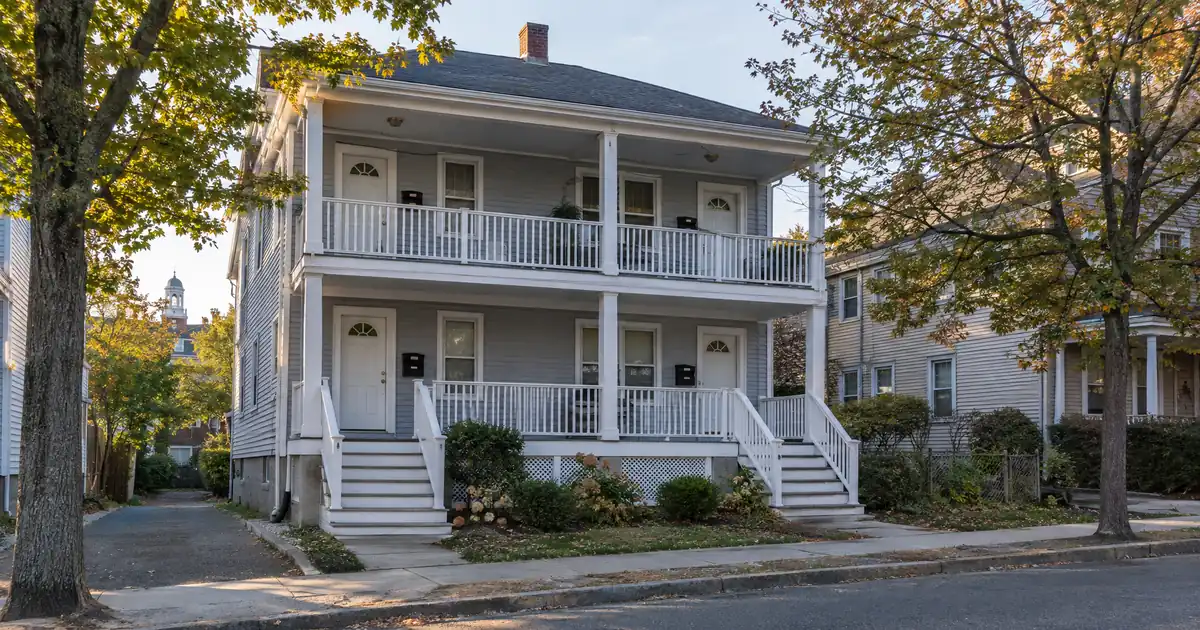
Picture an investor holding a two-family in South Medford, owned long enough to clear seasoning, with a first mortgage well below the property’s current value. The tenants are in place, the leases are clean, and the next deal is sitting in another submarket. The question is how much of that equity can be pulled out before the coverage number stops working. That is the question Medford, Massachusetts owners run into with a cash out refinance on an investment property, and the answer depends less on the appraisal than on how rent stacks against the full monthly obligation.
TL;DR: A cash-out refinance on a Medford investment property is underwritten primarily on the property’s rental income measured against its full monthly obligation, which favors multi-unit owners over single-family holders. Rents near $3,200 citywide set the ceiling on usable equity.
DSCR Cash-Out Calculator
Run the cash-out numbers in Medford, MA
Rate source: Freddie Mac 30-yr average via FRED® — Federal Reserve Bank of St. Louis · effective Sep 24, 2026
Prefilled with starting assumptions — enter your property’s value, balance, taxes, and insurance for a more accurate picture.
Program parameters update from Lendmire’s centralized guideline source. Taxes and insurance are editable estimates.
As of Sep 24, 2026 · General Freddie Mac market benchmark, not a Lendmire loan offer. Property value, balance, taxes, and insurance are editable estimates. Maximum loan-to-value varies by lender, program, property type, and seasoning. Not a Loan Estimate, approval, or commitment to lend. Program availability and eligibility are subject to lender guidelines, credit approval, property review, and underwriting.
- Two-family and three-family stock stacks rent better than single-family at Medford’s price points.
- The cash-out ceiling is 75 percent LTV, with about six months of seasoning from title recording.
- Flat citywide pricing means proceeds come from your basis and improvements, not market lift.
- Sub-1.00 coverage is common at full leverage, so plan for lower LTV or a restructured file.
Lendmire (NMLS# 2371349) is a DSCR-focused mortgage broker. Through Lendmire’s DSCR program footprint — 41 markets, including Washington, D.C. — lenders may review qualifying rental income subject to program guidelines for Medford, Massachusetts investors. The broader Massachusetts DSCR investor loans page covers the state-level picture. This article stays on the equity-extraction side: what you can pull, what it costs in coverage, and where the proceeds go.
Medford Market Snapshot
A quick read on the Medford investor landscape — figures come from the cited sources below. Confirm current property-level numbers before underwriting.
| Metric | Detail |
|---|---|
| Home prices | 7 sales (Redfin Lawrence Estates) |
| Typical rents | $3,000–$5,000 rents (Homes.com Medford Hillside) |
| Employment | 13,000 employees (Tufts Medicine physician page) |
Why Multi-Unit Pencils Where Single-Family Doesn’t
Multi-unit rental income is what makes a Medford cash-out work. Single-family owners at current price levels usually run into coverage that sits well under the 1.00 baseline once taxes and insurance are in the debt service.
The city has 59,354 residents on 8.1 square miles per Census Bureau QuickFacts, and 46 percent of households rent, per RentCafe. Tenant demand is not the problem. Price relative to rent is. BMN Boston puts the citywide median list price at $833K, and Rentometer shows all-property-type averages of $3,232 for a two-bedroom and $3,855 for a three-bedroom.
Run the numbers on modeled assumptions. These are hypotheticals built on those averages, not quotes:
| Scenario (modeled) | Gross rent-to-price | Coverage read |
|---|---|---|
| Two-family, ~$1.1M, two 2BRs at ~$3,200 | ~7.0% | Near 1.00 at reduced LTV |
| Single-family, ~$903K, 3BR rent | ~5.1% | Well under 1.00 |
| Downtown unit, ~$636K, 2BR rent | ~6.1% | Better, small-sample basis |
Coverage in the last column is rent divided by full PITIA, including taxes and insurance, with the band rounded down. At the full 75 percent LTV ceiling, that two-family lands slightly below 1.00. Trimming toward roughly 65 percent brings it to about 1.00. A single-family at the South Medford median doesn’t get there at any leverage level a cash-out investor would want.
That gap is the whole decision. If the coverage number sits under 1.00, the options a lender may review include a lower LTV, an interest-only structure, or a sub-1.00 program, all subject to lender guidelines, credit approval, and property review. Sub-1.00 is a defensible structural choice if the property carries a real value story. It is a warning if the only way to pull cash is to stretch the file.
South Medford, Hillside, and the Tufts Corridor
The Tufts corridor is where Medford’s equity is deepest and its multi-unit stock is thickest. The tradeoff is entry price: this is also where a refinance leaves the least cushion in coverage.
South Medford’s March median sale price was $903K, up 9.1 percent year over year, per Redfin. That is a single-month figure on a small sample, so treat it as directional. Homes.com shows eight multi-family listings there priced from $1,095,000 to $1,459,000. Housing mixes condos, multi-families, and Foursquare and 1930s colonial single-families. Point2Homes reports that 40 percent of Medford’s rental units were built in 1939 or earlier, which points to the older two- and three-family stock that suits this loan.
Demand rests on Tufts University, which Data USA shows at 13,599 total enrolled (university-wide, not Medford-only), plus faculty, staff, and Green Line commuters.
Medford Hillside, around the Medford/Tufts terminus, is the tighter version of the same story. Homes.com describes dense early-20th-century multifamily stock, many tenant-occupied units, and a meaningful share leased to students. It cites rents of $3,000 to $5,000 and four multi-family listings from $1,149,000 to $1,999,900. That rent band is marketing copy and it doesn’t say whether it is per unit, so verify against comps before building a refinance on it.
The Green Line branch opened to Medford/Tufts with stops at Ball Square and Magoun Square, at a project cost near $2.28 billion. Tufts Now reported the MBTA projecting more than 45,000 daily trips across the extension. Few cities pair a new subway terminus on a university campus with an Orange Line stop at Wellington. Rail access supports tenant retention, but it is already reflected in what these properties cost.
Downtown and North: The Cheaper Way In
Downtown Medford and North Medford are the lower-priced submarkets, and on paper they pencil better for coverage. The catch is sample size, and it matters more than the headline percentages.
Downtown’s November median was $636K, up 17.8 percent, but on just six sales, per Redfin. North Medford’s March median was $669K, down 8.1 percent, per Redfin. One is up sharply on a handful of closings and the other is soft. Neither should anchor an LTV assumption.
The stronger play for a cash-out investor might be a downtown condo or small unit the owner already holds, over a new purchase there. The refinance is then measured against actual rent and a comp set the owner can defend. Investors hunting for coverage in North Medford should stress-test with conservative value assumptions, because a softening submarket can produce an appraisal that trims proceeds. Family and workforce housing demand there is a reasonable read but not a sourced one.
Skip the Appreciation Bet
Medford prices have plateaued citywide, so a cash-out should be underwritten on your basis and value-add, not on market lift during the seasoning window.
Zillow puts the average home value at $855,081, up 1.8 percent over the past year. BMN Boston’s median list price is roughly flat year over year at $833K, with 3.2 months of supply, which it calls equilibrium. The submarket split is wide. Redfin shows Lawrence Estates at $1.2M, up 18.2 percent on seven sales, while North Medford slid. Directional only.
Here’s the catch on multi-family specifically. Comps are thin. The Marrocco Group reports a $1.2 million median list price, about 23 days on market, and an average of eight offers, and Homes.com counts only 24 multi-family listings citywide, from $999,000 to $2,200,000. Contested but thin segments make appraisals volatile. If your equity thesis assumes a high appraisal, the file is exposed to the one number you don’t control.
This one is a genuine toss-up for investors who bought recently. The purchase basis may leave real equity, but six months of flat market won’t add to it. For owners who improved units or repositioned rents, the case is stronger. Modeled value beats hoped-for value.
The Mechanics: Seasoning, LTV, and Reserves
The parameters are simple, and they cap the outcome. Typical guidance calls for about six months of ownership measured from title recording, a maximum of 75 percent LTV on cash-out, a 1.00 minimum DSCR on most files, a credit floor around 620 with better tiers at 660, 680, and 700, and roughly six months of PITIA in reserves (about nine months above $1,500,000). Standard programs generally run up to $3,000,000, with smaller balances routed through select lenders. All of it is subject to lender guidelines and varies by borrower, property, and loan scenario.
The available equity is whatever survives three limits: 75 percent of appraised value, coverage against rent used for lender review, and reserves. In Medford, the coverage limit usually binds first on single-family and sometimes on multi-family. That is why the cash-out refinance walkthrough treats equity as an output, not a starting number. For a look at how the numbers stack against personal-income underwriting, the comparison is the place to start. For LLC-held rentals, eligibility is subject to lender program eligibility, and it helps to have entity documents ready before the file goes out.
Lendmire’s team sees a consistent pattern on files from dense, high-priced, older-stock markets like this one. The cleaner files from a documentation standpoint have complete leases, entity documents, title, and unit-level rent details ready for lender review. The common friction point is a rent figure that comes from listing-site averages instead of signed leases, and when the appraiser’s rent schedule lands below what the owner assumed, the coverage number moves with it. Getting insurance and tax figures confirmed early prevents surprises on the same line.
Where the Proceeds Go
Cash-out proceeds pay off when they are put into a property where coverage works at purchase, not into another stretched Medford unit. For redeployment, the question is whether the next deal clears its own numbers.
An owner pulling equity from a Tufts-adjacent two-family and buying downtown or in another submarket with better rent-to-price is making a straightforward argument. An owner pulling cash to buy a second $900K-plus single-family at 5-percent-range gross yield is stacking a thin-coverage asset on a thin-coverage asset. Not ideal. Lendmire’s refi programs and Lendmire’s primer on DSCR loans cover the mechanics. To test a specific file, see how the DSCR math pencils, or reach the team at 828-256-2183.
Demand supports a long hold. Data USA shows residents concentrated in professional and technical services (6,772), health care (5,189), and education (4,604), with a 30.2-minute average commute. These are commuter-professional tenants, not a local job center. Tufts Medicine adds a hospital anchor: the Medford and Melrose campuses list 2,144 employees, per its careers page.
Frequently Asked Questions
How do you qualify for a DSCR loan in Medford, Massachusetts?
Qualification centers on the property’s rent against its full monthly obligation, with 1.00 the common baseline. Most files also need a credit score of about 620 or higher and reserves near six months of PITIA. A Medford two-family with signed leases and unit-level rents documents more cleanly than a single-family relying on listing averages. Final eligibility depends on lender guidelines, credit profile, and property review.
What are the requirements for a cash-out refinance on an investment property in Medford, Massachusetts?
Expect about six months of seasoning from title recording, a 75 percent LTV ceiling, and a coverage ratio at or above the lender’s minimum, typically 1.00. Reserves generally run near six months of PITIA, and more above $1,500,000. Because Medford values run high, the coverage test, not the LTV cap, often limits how much equity comes out.
DSCR vs. conventional financing
Two common ways to finance an investment property in Medford, MA. They qualify you differently — here’s how investors weigh them.
Why investors choose it
- Qualifies on the property’s rental income — no personal tax returns, W-2s, or pay stubs needed to document income.
- No personal debt-to-income ceiling to clear, so existing mortgages and obligations don’t cap your borrowing the same way.
- Can be closed in an LLC, keeping the property inside a business entity.
- Built for scaling — not held to the limit on number of financed properties that conventional financing applies.
- Underwriting centers on the deal: generally qualifies when the rent covers the payment, a 1.00x coverage ratio being a common baseline (confirmed in underwriting).
- Designed specifically for investment property, including long-term and, where the program allows, short-term rentals.
Where it’s strong
- Often the lowest ongoing financing cost for a buyer who fully qualifies on personal income — a fit for a first property or a cost-first purchase.
Trade-offs for investors
- Requires full personal income documentation and must fit within a debt-to-income limit — salary, existing debts, and other mortgages all count.
- Typically held in your personal name rather than a business entity.
- Caps how many financed properties you can carry, which can become a ceiling as a portfolio grows.
- Evaluates you as a borrower as much as the property, which usually means more paperwork.
How investors usually choose: a first or single property often optimizes for the lowest financing cost; portfolio builders often optimize for leverage, vesting in an LLC, and scaling past conventional caps. The right answer depends on your goals, the property, and current guidelines — both paths run through select lenders in Lendmire’s wholesale network, with eligibility and terms confirmed in underwriting.
Can a self-employed investor buying in Medford be reviewed for DSCR financing?
Yes, that is a common fit. Lendmire arranges DSCR investor loans and lenders in its network typically review eligibility around the property’s rental income instead of personal income documentation. Terms and eligibility remain subject to lender guidelines and credit approval.
Does the Green Line terminus increase how much equity I can pull in Medford?
Not directly. Transit access supports tenant demand around Medford Hillside and South Medford, but citywide prices have been flat, with Zillow showing 1.8 percent growth and BMN Boston roughly zero. The appraisal reflects comparable sales, so rail access helps retention more than it helps proceeds.
Should a Medford investor refinance a single-family or a multi-family first?
Multi-family, if the choice exists. At roughly $800K-plus single-family prices against rents near $3,200, coverage usually falls under 1.00 with taxes and insurance included. Stacked units lift gross rent-to-price by about two points in the modeled comparison above, which is what makes the file work.
The Real Choice
A Medford owner sitting on equity usually faces two paths. One is a full-strength pull at or near the 75 percent LTV ceiling, accepting a sub-1.00 coverage structure that a lender may review through lower-coverage programs or interest-only terms, in exchange for maximum capital now. The other is a smaller pull, closer to 65 percent, that keeps coverage near or above 1.00 and preserves flexibility, but leaves equity unused in a market where prices have gone flat. The first suits an owner with a concrete, better-coverage acquisition waiting. The second suits an owner who cares more about surviving a soft appraisal cycle than about deploying every dollar of a Tufts-corridor two-family’s value.
For current guidelines and terms, see Lendmire’s DSCR loan programs page.
About Lendmire
Lendmire is a DSCR-focused mortgage brokerage, NMLS# 2371349, placing investor loans across 41 markets, including Washington, D.C. Lenders generally review DSCR eligibility around a property’s rental income rather than personal income documentation, which fits LLC-held rentals, self-employed investors, and portfolios scaling past conventional financed-property limits. Lendmire was named a 2026 Scotsman Guide Top Mortgage Workplace and was recognized by Scotsman Guide in 2025. See the 2026 Top Workplace recognition announcement and Lendmire’s industry announcements.
Get Started
Ready to find the right loan for you?
In about 30 seconds you can review financing options available for your investment property. No commitment required.
Informational only. Not a Loan Estimate, approval, or commitment to lend. Program availability and eligibility are subject to lender guidelines, credit approval, property review, and underwriting.
References
2. Redfin
3. Homes.com
4. Tufts Medicine physician page
8. Redfin
9. Homes.com
10. Point2Homes
11. Data USA, Tufts University
12. Tufts Now, Green Line expansion
13. Redfin
14. Redfin
15. Zillow, Medford home values
16. Marrocco Group
18. careers.tuftsmedicine.org — Careers page
19. a 2026 Scotsman Guide Top Mortgage Workplace
20. recognized by Scotsman Guide in 2025
21. the 2026 Top Workplace recognition announcement
This article is part of Lendmire’s investment property cash-out refinance program — full qualification details, guidelines, and scenarios live on the program page.
Related reading: DSCR Cash Out Refinance Medford Massachusetts · DSCR Cash Out Refinance Attleboro Massachusetts · Cash Out Refinance Investment Property Taunton Massachusetts
Guides: Investment Property Cash-Out Refinance in Medford, MA · Investment Property Cash-Out Refinance in Massachusetts
Brandon Miller
Founder & CEO, Mortgage Loan Originator, Lendmire LLC
- Mortgage Loan Originator · NMLS# 1129696 · Verify on NMLS Consumer Access
- North Carolina Real Estate Broker · License# 343312 · Verify on NCREC
- North Carolina Insurance Producer · License# 19053198 · Property, Casualty, Life, Health · Verify on NAIC SBS
- Lendmire LLC · Firm NMLS# 2371349 · Verify firm licensure
Disclosure information. Lendmire is a state-licensed mortgage brokerage under NMLS# 2371349. Lendmire is not a depository institution, direct lender, or financial advisor — all loans referenced are placed through wholesale lender partners and are subject to each lender's underwriting standards. This article is provided for general informational purposes and is not a commitment to lend, nor does it constitute financial, legal, or tax advice. Loan programs, terms, rates, and qualification standards change without notice and depend on borrower profile, property type, and the state in which the subject property is located. Equal Housing Opportunity provider. NMLS Consumer Access: nmlsconsumeraccess.org.