
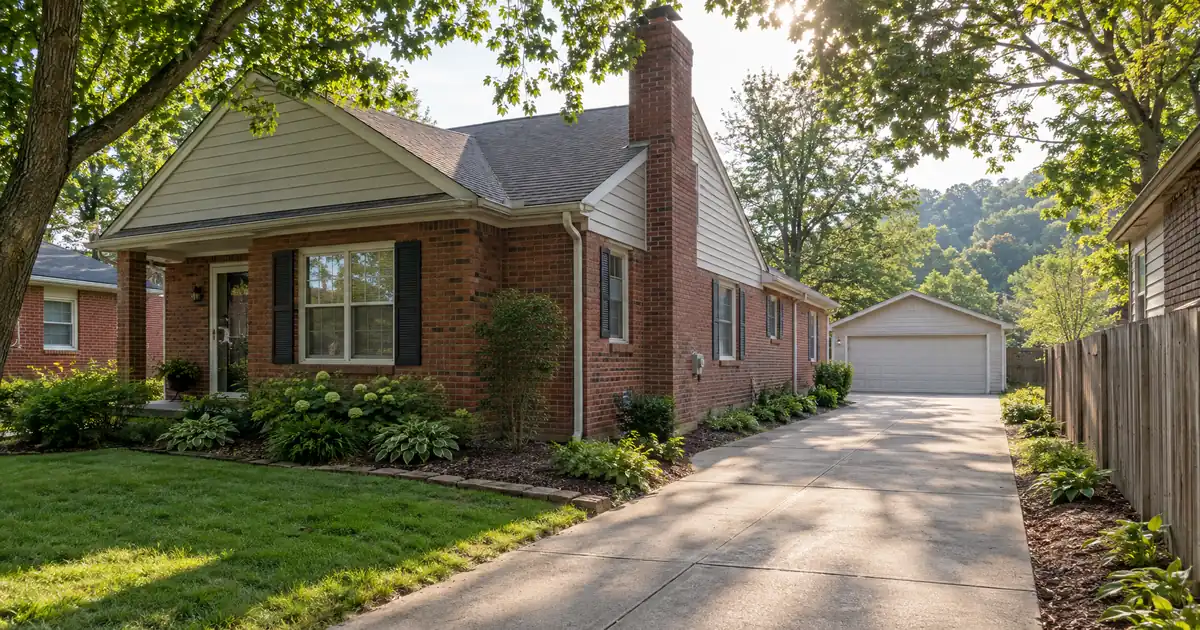
The objection comes up in nearly every Nixa conversation: the rent doesn’t cover the debt. It’s a fair complaint. Redfin puts the median sale price near $325,000, while Zillow’s median rent runs about $1,395. That is a thin ratio, and a cash-out on a typical Nixa house will not clear 1.00 at high leverage. This article takes that problem head-on. The answer is neither “skip Nixa” nor “borrow less and hope.” It lies in which property you pull equity from and how you size the loan.
TL;DR: A cash-out refinance in Nixa, Missouri is underwritten primarily on the property’s rental income measured against its full monthly obligation, with the lender sizing proceeds to the lesser of the coverage test and the 75 percent LTV ceiling. Multi-unit rent usually carries that test better than a single house.
DSCR Cash-Out Calculator
Run the cash-out numbers in Nixa, MO
Rate source: Freddie Mac 30-yr average via FRED® — Federal Reserve Bank of St. Louis · effective Sep 24, 2026
Prefilled with starting assumptions — enter your property’s value, balance, taxes, and insurance for a more accurate picture.
Program parameters update from Lendmire’s centralized guideline source. Taxes and insurance are editable estimates.
As of Sep 24, 2026 · General Freddie Mac market benchmark, not a Lendmire loan offer. Property value, balance, taxes, and insurance are editable estimates. Maximum loan-to-value varies by lender, program, property type, and seasoning. Not a Loan Estimate, approval, or commitment to lend. Program availability and eligibility are subject to lender guidelines, credit approval, property review, and underwriting.
- Median house rent near $1,395 against a roughly $325,000 median price means thin single-family coverage.
- Cash-out LTV tops out at 75 percent, with about 6 months of seasoning from title recording.
- Century Heights was platted with 12 two-family lots, which is rare for a suburb this size.
- Appraised value matters, and Nixa price-momentum readings disagree from source to source.
- Underwrite flat to slightly up appreciation. Don’t assume a 6.5 percent gain.
Nixa Market Snapshot
A quick read on the Nixa investor landscape — figures come from the cited sources below. Confirm current property-level numbers before underwriting.
| Metric | Detail |
|---|---|
| Home prices | 161 sales in may (Redfin Nixa Housing Market) |
| University enrollment | ~6,100 students (Wikipedia: Nixa Public Schools) |
| Population | 24,836 population (Census Reporter (ACS 2024 5-yr)) |
| Employment | 697 staff (Wikipedia: Nixa Public Schools) |
Century Heights: Where Nixa’s Math Actually Improves
Nixa’s best DSCR story is the small slice of duplex product, and Century Heights is the clearest example. The city’s plat packet describes 27 single-family lots alongside 12 two-family lots. Most suburbs this size are almost entirely single-family, so any duplex that exists here is scarce. Scarce is good when you’re an owner pulling equity.
Here is why it matters for a refinance. Say you own a duplex there, and each side rents somewhere between $1,000 and $1,500 (listing snapshots land in that band, though they’re anecdotal). Combined, that can outrun what a single house rents for, while the debt sits on one parcel. Run the numbers on a modeled duplex: assume $2,500 in combined rent and a $325,000 value, which is the citywide median price and not a sourced duplex figure. At 75 percent LTV, full PITIA including taxes and insurance, coverage lands around 1.2x. Duplexes likely appraise above the median, though, which pulls that number down. No duplex sale prices turned up in the research, so treat this as illustrative.
Verify build and sale status on any Century Heights address before you build a plan around it. I’d also not assume every duplex in Nixa is a Century Heights duplex. Some of the older two-unit stock sits elsewhere.
The Median House Is the Hard Cash-Out
A typical single-family rental in Nixa is the weakest cash-out candidate in town at full leverage. Coverage math is rent divided by full PITIA: principal, interest, taxes, and insurance. Model a $325,000 house at the $1,395 Zillow median, with 75 percent LTV and taxes and insurance included. The number sits around 0.7x. Drop to 60 percent LTV and it still stays under 1.00 on median rent. HotPads shows the median house rent even lower, near $1,200.
Zillow’s page also reports that median rent fell $195 year over year, though the underlying data is stale and I’d treat the direction, not the size, as the signal. Either way, don’t underwrite rent growth as the thing that rescues coverage later. Use in-place rent or current comps.
Single-family detached homes are 76.78 percent of Nixa’s housing units, so this is the product most owners are actually holding. If that’s you, your options look like this:
- Lower the leverage. Cash-out at well under the 75 percent ceiling pushes coverage toward 1.00.
- Raise the rent. An above-median rent on a renovated three-bedroom changes the test more than any structuring trick.
- Look at sub-1.00 paths. Some programs and interest-only structures may be reviewed for files under 1.00, typically with reduced leverage, stronger credit, and more reserves. Eligibility depends on lender guidelines and property review.
Sub-1.00 deals get harder, not impossible. The proceeds shrink while the scrutiny grows.
Appraised Value: Which Nixa Number Do You Believe?
The sources disagree, and your cash-out depends on the appraisal, so this matters. Redfin shows the median up 6.5 percent year over year, while Zillow’s home value index shows $325,322 and up 1.3 percent. NeighborhoodScout shows roughly 103 percent appreciation over ten years but only 3.62 percent over the latest twelve months. That’s a long run of gains cooling into modest growth.
Here’s the conservative read: underwrite flat to about 1 percent and treat anything above that as a bonus. Days on market support the caution. Redfin has homes selling after 31 days on average, against 28 the year before. PropertyIQ shows a 46-day median for the 65714 ZIP, with about 20 percent of active listings taking a price cut. The two measure different things (sold versus listed homes), but both point to a modest cooling.
For a refinance, that means appraisers may find fewer strong comps. Leave a valuation cushion in your plan, and don’t count on the high end of any source.
Seasoning is the other clock. Most programs look for roughly 6 months of ownership measured from title recording before a cash-out, and the 75 percent LTV ceiling is firm. What you can actually pull depends on rent used for lender review, PITIA, reserves (typically about 6 months of PITIA), and that ceiling. Pricing and available terms vary by lender, borrower profile, property type, and full underwriting review. Loan amounts run up to $3,000,000 on standard programs, which Nixa investors will rarely approach. All of it is subject to lender guidelines.
Who Rents Here (and Why It Holds Up)
Nixa is a bedroom suburb of Springfield, and the tenant base follows Springfield’s employment. Data USA reports 11.9 thousand employed residents, with health care and social assistance the largest sector at 2,870 jobs, followed by retail at 1,387 and manufacturing at 1,061. Many of those residents commute into the Springfield metro, 10 to 20 minutes north.
The anchors are healthcare and higher education. CoxHealth runs six hospitals and 1,074 beds, with roughly 13,000 or more employees depending on the source. Mercy Springfield adds 9,238 employees, per Clearpoint’s employer list. On the training side, Missouri State University reported 25,238 students on its Springfield campus last fall, and Ozarks Technical Community College reported 10,779, including more than 2,800 in health science. Nixa has no college campus of its own, so the tenant profile is clinical staff, student workforce, and retail and manufacturing workers who commute.
Locally, Nixa Public Schools is the largest employer at roughly 700 staff. Median household income is $83,385 per Cubit’s ACS-based page, and 33.3 percent of housing units are renter-occupied. Unemployment is listed at 2.9 percent by Data Commons. That adds up to steady, workforce-driven demand. It does not add up to explosive rent growth.
(Honestly, no reliable vacancy figure turned up for Nixa. Anyone quoting you one is guessing.)
Pockets Worth a Look, and One to Skip
Route 14, also called Mt. Vernon Street, is a workforce-rental corridor. MoDOT widened it to five lanes, and the corridor has retail and commercial activity close by. Prices and rents weren’t available at that level, so pull your own comps. Historic downtown has charm and festival traffic (Sucker Days anchors the calendar), and City Hall renovations are underway. It suits tenants who want walkability, though the data here is qualitative only.
South Nixa along Highway 160 is the growth area. The city’s project tracker lists subdivisions with 232 and 210 buildable single-family lots. New-construction single-family rentals are an option, but they inherit the same thin-coverage problem as any house here, and that supply could soften rents.
Skip the Fremont Hills golf-community segment for DSCR. Large lots and country-club access make it an owner-occupant market, and the rent-to-price relationship almost certainly doesn’t work.
One practical check: some homes marketed as Nixa sit outside city limits, in places like Battlefield, Ozark, and south toward Wicklow. Confirm the jurisdiction on every address before you plan a refinance around it, and verify current local rental rules, taxes, and insurance with qualified local professionals.
What DSCR Files Like This Typically Look Like
DSCR files in markets like this one, with moderate prices and middling rents, tend to separate on structure, not on borrower strength. A multi-unit property with solid in-place rent often clears coverage with room to spare, while a single-family house at the same value comes in below 1.00 unless leverage drops. The files that go smoothest bring current leases, a fresh rent comp, and an appraisal-ready property before anyone talks about proceeds. Insurance and tax lines change the final coverage number more than most borrowers expect. If you want to see where your property lands, request a scenario quote or call 828-256-2183.
DSCR vs. conventional financing
There are two common ways to finance an investment property in Nixa, MO, and they qualify you differently — here’s how investors weigh them.
Why investors choose it
- Qualifies on the property’s rental income — no personal tax returns, W-2s, or pay stubs needed to document income.
- No personal debt-to-income ceiling to clear, so existing mortgages and obligations don’t cap your borrowing the same way.
- Can be closed in an LLC, keeping the property inside a business entity.
- Built for scaling — not held to the limit on number of financed properties that conventional financing applies.
- Underwriting centers on the deal: generally qualifies when the rent covers the payment, a 1.00x coverage ratio being a common baseline (confirmed in underwriting).
- Designed specifically for investment property, including long-term and, where the program allows, short-term rentals.
Where it’s strong
- Often the lowest ongoing financing cost for a buyer who fully qualifies on personal income — a fit for a first property or a cost-first purchase.
Trade-offs for investors
- Requires full personal income documentation and must fit within a debt-to-income limit — salary, existing debts, and other mortgages all count.
- Typically held in your personal name rather than a business entity.
- Caps how many financed properties you can carry, which can become a ceiling as a portfolio grows.
- Evaluates you as a borrower as much as the property, which usually means more paperwork.
How investors usually choose: a first or single property often optimizes for the lowest financing cost; portfolio builders often optimize for leverage, vesting in an LLC, and scaling past conventional caps. The right answer depends on your goals, the property, and current guidelines — both paths run through select lenders in Lendmire’s wholesale network, with eligibility and terms confirmed in underwriting.
Where the Proceeds Go
The point of pulling equity is the next deal, and in Nixa the next deal is usually a duplex. Cash from a single-family refinance can fund a down payment on a two-unit property, where DSCR qualification works better. There’s a trade-off, though. You’re swapping a liquid asset for a scarcer one, and duplexes take longer to sell if you need out. I’d call that a fair trade for most long-term holders, and a bad one for anyone planning a quick flip.
LLC title is available, subject to lender program eligibility. For a deeper look at how the structure works, see the guide “The Refi Options” and the guide “Where DSCR and Conventional Diverge”, which also cover investor refinance options. Statewide context lives on the Missouri DSCR investor loans page.
Frequently Asked Questions
How do you qualify for a DSCR cash-out refinance in Nixa, Missouri?
The lender looks at the property’s rent used for lender review against its full PITIA, with 1.00 as the common baseline. Beyond that, expect a credit floor of 620, about 6 months of ownership seasoning, and reserves around 6 months of PITIA. In Nixa, multi-unit properties generally meet the coverage test more easily than single-family houses. All of it is subject to lender guidelines and property review.
What are the requirements for an investment property loan in Nixa, Missouri?
Typical files need a property with enough rent to cover its obligation, a credit score at or above 620, and documented reserves. Cash-out LTV is capped at 75 percent. Manufactured homes, log homes, and barndominiums fall outside these programs, which matters in the Ozarks, where such properties are common.
Can a single-family rental in Nixa reach 1.00 on a cash-out?
Not at high leverage on median rent. Modeled with taxes and insurance, a median-priced house at the median rent lands well below 1.00 at 75 percent LTV, and still short at 60 percent. An above-median rent, lower leverage, or a sub-1.00 program that a lender may review can change the picture.
Do I need to check city limits on a Nixa-area property?
Yes. Some listings marketed as Nixa sit outside city limits, in neighboring jurisdictions.
For current guidelines and terms, see Lendmire’s DSCR loan programs page.
About Lendmire
Lendmire (NMLS# 2371349) is a mortgage brokerage focused on DSCR investor financing, helping arrange programs through wholesale and investor-lending channels in 41 markets, including Washington, D.C. DSCR loans are evaluated by the lender on property cash flow rather than personal income, subject to lender guidelines, supporting LLC closings and accommodating investors with four or more financed properties. Scotsman Guide named Lendmire a Top Mortgage Workplace in both 2025 and 2026.
Nixa’s housing stock explains the whole story in one number: single-family detached homes make up 76.78 percent of its units, which is exactly why a duplex is the scarce asset worth building your cash-out around.
Get Started
Ready to find the right loan for you?
In about 30 seconds you can review financing options available for your investment property. No commitment required.
Informational only. Not a Loan Estimate, approval, or commitment to lend. Program availability and eligibility are subject to lender guidelines, credit approval, property review, and underwriting.
References
1. Redfin — Nixa Housing Market
2. Zillow — Market Trends Nixa MO
3. Wikipedia: Nixa Public Schools
4. Census Reporter (ACS 2024 5-yr)
5. nixa.com — Exhibit a Packet
6. NeighborhoodScout — Nixa Real Estate
8. Data USA
10. 2025
11. 2026
This article is part of Lendmire’s investment property cash-out refinance program — full qualification details, guidelines, and scenarios live on the program page.
Related reading: Luxury Rental DSCR Loans In New Jersey · Jersey Shore Vacation Rental Loans: DSCR Financing In Ocean City, Cape May And Long Beach Island · DSCR Cash-out Refinance In New Jersey: Pulling Equity From A Rental
Guides: Investment Property Cash-Out Refinance in Missouri
Brandon Miller
Founder & CEO, Mortgage Loan Originator, Lendmire LLC
- Mortgage Loan Originator · NMLS# 1129696 · Verify on NMLS Consumer Access
- North Carolina Real Estate Broker · License# 343312 · Verify on NCREC
- North Carolina Insurance Producer · License# 19053198 · Property, Casualty, Life, Health · Verify on NAIC SBS
- Lendmire LLC · Firm NMLS# 2371349 · Verify firm licensure
Disclosure information. Lendmire is a state-licensed mortgage brokerage under NMLS# 2371349. Lendmire is not a depository institution, direct lender, or financial advisor — all loans referenced are placed through wholesale lender partners and are subject to each lender's underwriting standards. This article is provided for general informational purposes and is not a commitment to lend, nor does it constitute financial, legal, or tax advice. Loan programs, terms, rates, and qualification standards change without notice and depend on borrower profile, property type, and the state in which the subject property is located. Equal Housing Opportunity provider. NMLS Consumer Access: nmlsconsumeraccess.org.