
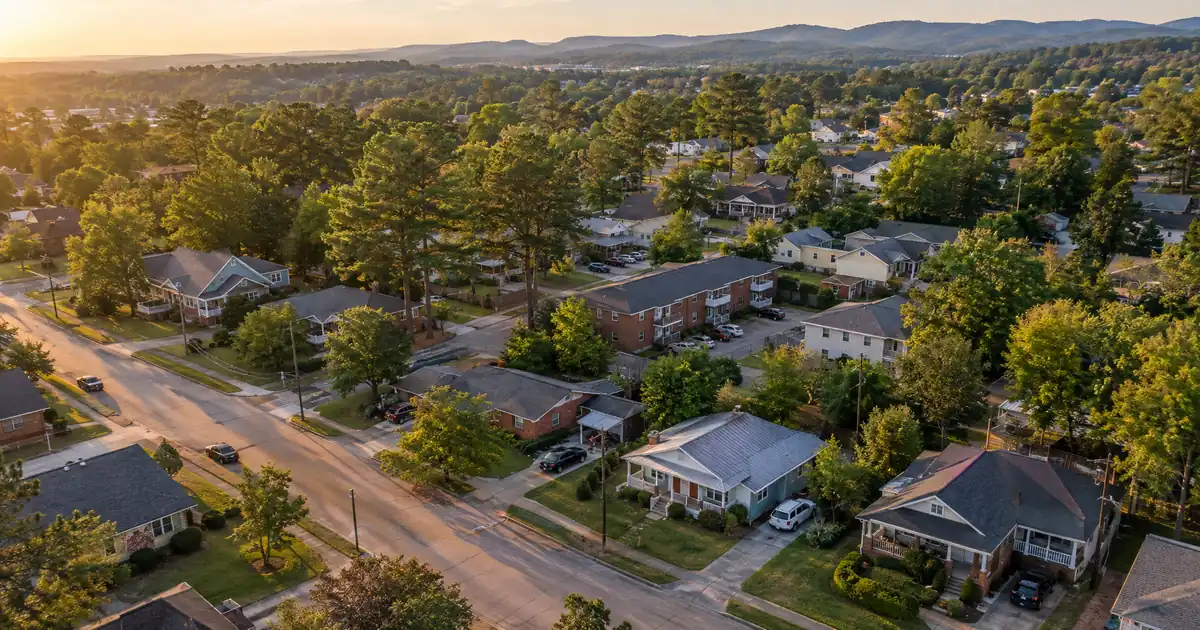
The cash out refinance investment property question in Trussville, Alabama usually starts from the wrong end. Investors ask how much equity they have. The better question is whether the rent covers the new payment once the loan is cash-out sized. Trussville homes are priced like a premium Birmingham suburb, while rents stay closer to a workforce market. That gap decides most files here.
The Quick Read: A cash-out refinance on a Trussville, Alabama rental is underwritten primarily on the property’s rental income measured against its full monthly obligation. Proceeds are capped by a 75 percent LTV ceiling and a roughly six-month seasoning clock that starts at title recording, with lease evidence, appraisal, payoff, and reserves documentation closing out the file.
DSCR Cash-Out Calculator
Run the cash-out numbers in Trussville, AL
Rate source: Freddie Mac 30-yr average via FRED® — Federal Reserve Bank of St. Louis · effective Sep 24, 2026
Prefilled with starting assumptions — enter your property’s value, balance, taxes, and insurance for a more accurate picture.
Program parameters update from Lendmire’s centralized guideline source. Taxes and insurance are editable estimates.
As of Sep 24, 2026 · General Freddie Mac market benchmark, not a Lendmire loan offer. Property value, balance, taxes, and insurance are editable estimates. Maximum loan-to-value varies by lender, program, property type, and seasoning. Not a Loan Estimate, approval, or commitment to lend. Program availability and eligibility are subject to lender guidelines, credit approval, property review, and underwriting.
- Citywide average home value sits at $400,656, up 3.1 percent, per Zillow.
- Sampled three-bedroom house asking rents run $1,715 to $2,375 on Zillow rental listings, so full-PITIA coverage lands tight. – RentCafe shows 71 percent of rentals are single-family, leaving few small-multifamily comps.
- Cash-out tops out at 75 percent LTV after about six months of title-recorded ownership.
Trussville Market Snapshot
A quick read on the Trussville investor landscape — figures come from the cited sources below. Confirm current property-level numbers before underwriting.
| Metric | Detail |
|---|---|
| University enrollment | ~5,000 students (Trussville City Schools) |
| Employment | 220 staff (Trussville City Schools) |
The Cahaba Project Is Where the Equity Story Starts
The historic core around the Cahaba Project is the most interesting pocket for an owner who already holds a property and wants to pull equity out. The City of Trussville describes it as a planned community that included 287 residential units, a mix of apartments, duplexes, and single-family homes. It is bounded roughly by Rockridge Avenue, the Cahaba River, Gadsden Highway, and Poplar Street, and it sits on the National Register of Historic Places. The city notes that young middle-income families have gravitated to its older homes and often remodel them.
Why that matters for a cash-out: older stock that gets remodeled is where equity gets created by work, not just by market drift. An investor who bought a dated house, renovated it, and put a tenant in has a basis well below the new value. The refinance is how that spread becomes capital.
Entry prices in this pocket are probably the lowest inside Trussville proper. But no verified neighborhood-level price or rent figure exists for it, so don’t assume one. Pull your own sold comps. The appraiser will.
Older housing also means appraisal friction. Comps are fewer, condition adjustments carry weight, and an appraisal reconsideration request is a routine step, not a failure. A packet with recent in-area sales and documented renovation scope usually recovers value that a thin first pass misses.
One housekeeping note, and it’s the only one: verify current local rental rules, taxes, and insurance with qualified local professionals before you close on anything in a historic district.
Why Coverage, Not Equity, Is the Gate
Equity is rarely the limiting factor on a Trussville cash-out. Coverage is. The DSCR is monthly rent divided by the full monthly obligation: principal, interest, taxes, insurance, and any HOA dues. Most standard programs are built around a 1.00 benchmark, because the rent covers the payment at that level. Some lenders review lower ratios with compensating factors, but those files usually carry lower leverage or different pricing, subject to lender guidelines.
Walk through it step by step:
1. Start with rent used for lender review. That means a signed lease or, for vacant units, the appraiser’s market rent. An asking rent from a listing is not the same thing.
2. Build the full obligation. Start with the new cash-out loan, sized at or below 75 percent of appraised value, and add taxes and insurance to it.
3. Divide. Rent over obligation gives the ratio. Taxes and insurance have to be in the denominator.
Now the Trussville inputs. The sampled house rents in the research run roughly 0.4 to 0.6 percent of price per month. That is Lendmire Research’s arithmetic on listing data, not an official ratio. Run it as a modeled assumption: a house near the citywide average value, rented in the $1,900 to $2,400 range, on a 30-year schedule with taxes and insurance at Alabama-average levels. The coverage lands somewhere around the mid-0.8s up to roughly 1.0. Rounded down, and including taxes and insurance.
That is tight. Honestly, a single-family Trussville house at a full 75 percent cash-out is more likely to sit under 1.00 than over it.
Sub-1.00 doesn’t end the conversation, but it changes the structure. A lender may review a sub-1.00 program, an interest-only structure, a lower cash-out percentage, or stronger reserves and credit as compensating factors. Whether any of those apply depends on lender guidelines, credit approval, and property review. How the qualification works is laid out on the pillar page, and DSCR versus conventional covers why the property-income test exists at all.
What Does 75 Percent Actually Do Here?
The cash-out ceiling is 75 percent of appraised value, not the 80 percent that applies to purchases. Seasoning is about six months of ownership measured from title recording, documented by the settlement statement. Reserves run about six months of PITIA, and the typical credit floor is 620, with tiers at 660, 680, and 700. Loan sizes go up to $3,000,000 on standard programs. All of that is typical guidance and varies by borrower, property, and loan scenario.
Picture an investor who owns a three-bedroom house appraising near the citywide average. The existing payoff leaves room under the 75 percent ceiling. The available cash is whatever remains after payoff, costs, and reserves, and it shrinks fast if the rent only supports a lower loan amount. The ratio can cap the loan before the LTV does.
Appreciation is a modest contributor here, not the engine. Zillow shows the citywide average up 3.1 percent over the past year, and the ZIP 35173 figure is $390,053, up 3.4 percent. Alabama’s statewide average is $241,517, up 1.5 percent, so Trussville is priced well above the state.
The signals an appraiser sees are mixed. Movoto shows a median sold price of $441,000 in its latest monthly report, with 284 sales against 231 a year earlier. The same site shows the median list price down 4 percent year over year, and average days on market at 65 versus 61. Redfin shows price per square foot at $176, down 3.8 percent, and one spring snapshot with a $469K median that looks like small-sample noise. It’s a small market, and a few closings swing the monthly numbers.
The practical read: don’t underwrite your cash-out on a projected value jump. Underwrite it on what the appraisal supports today.
Duplex Stock Is Thin
Trussville has very little small multifamily to compare against. RentCafe reports that no rental apartments sit in buildings of 50 or more units, 29 percent are in smaller complexes, and 71 percent are single-family rentals. Apartment buildings average about 31 years old, and 45 percent have been built since 2000. Because the apartment side is made up of smaller complexes rather than large garden-style communities, there are few comparable properties for a duplex or fourplex.
For a duplex or fourplex owner, that means few local rent comps. Appraisers and lenders will lean on nearby Birmingham-area comps, and your own lease history becomes the primary evidence. Keep signed leases, deposit records, and payment history organized.
Still, two units can change the coverage picture. Sampled asking rents for small two-bedroom, one-bath units run from $1,250 to $1,550 each. Two of them gross more than a single house in the same price tier. The catch is purchase price: a duplex only improves coverage if it was bought low enough for the second unit to clear the payment. Those are listing asks, not medians, and no Trussville duplex sale prices were found.
Demand for those smaller units has real support. UAB has more than 28,000 employees and 21,500 students, and Trussville sits at the edge of that commuter catchment. Grandview Medical Center operates a freestanding emergency department in Trussville. Census Bureau QuickFacts puts the city at 26,673 residents across 35.7 square miles. Retail along I-59, including Bass Pro Shops, and an industrial park on the east end that houses Amerex Corporation add local jobs. None of this guarantees rent growth. It’s a base, not a promise.
Where the Proceeds Go (and Why It Matters for the Math)
A cash-out is only useful if the capital lands somewhere that covers its own payment. This is the tension in Trussville: the equity sits in premium-priced stock, but the next deal often works better at a lower price point.
Zillow’s nearby-area figures show Pinson at $208,599, Chalkville at $203,326, and Roebuck Springs at $206,579. That page is a new-construction listing page with unclear methodology, so treat it as a directional contrast and nothing more. Those corridors sit outside Trussville, and no rent data was found for them. Still, they point at the obvious structure. Pull equity from a house that barely covers, then buy where rent-to-price runs higher.
Alabama investors weighing that move can start at DSCR loans in Alabama. Lendmire, a DSCR-focused mortgage broker, arranges these loans through its wholesale lending network. Lenders review eligibility and approve.
DSCR vs. conventional financing
There are two common ways to finance an investment property in Trussville, AL, and they qualify you differently — here’s how investors weigh them.
Why investors choose it
- Qualifies on the property’s rental income — no personal tax returns, W-2s, or pay stubs needed to document income.
- No personal debt-to-income ceiling to clear, so existing mortgages and obligations don’t cap your borrowing the same way.
- Can be closed in an LLC, keeping the property inside a business entity.
- Built for scaling — not held to the limit on number of financed properties that conventional financing applies.
- Underwriting centers on the deal: generally qualifies when the rent covers the payment, a 1.00x coverage ratio being a common baseline (confirmed in underwriting).
- Designed specifically for investment property, including long-term and, where the program allows, short-term rentals.
Where it’s strong
- Often the lowest ongoing financing cost for a buyer who fully qualifies on personal income — a fit for a first property or a cost-first purchase.
Trade-offs for investors
- Requires full personal income documentation and must fit within a debt-to-income limit — salary, existing debts, and other mortgages all count.
- Typically held in your personal name rather than a business entity.
- Caps how many financed properties you can carry, which can become a ceiling as a portfolio grows.
- Evaluates you as a borrower as much as the property, which usually means more paperwork.
How investors usually choose: a first or single property often optimizes for the lowest financing cost; portfolio builders often optimize for leverage, vesting in an LLC, and scaling past conventional caps. The right answer depends on your goals, the property, and current guidelines — both paths run through select lenders in Lendmire’s wholesale network, with eligibility and terms confirmed in underwriting.
What Derails These Files?
Working DSCR brokers see a recurring pattern in premium-priced suburbs with thin rental stock: the appraisal comes back fine, the coverage doesn’t. The file then gets restructured to a lower cash-out percentage or a smaller loan, and the investor learns the number late. Running the full-PITIA coverage before ordering the appraisal prevents most of those surprises.
The other friction points are documentation, and they are predictable:
- Rent evidence. A signed lease beats an asking rent. Vacant units lean on the appraiser’s market rent schedule.
- Seasoning proof. The settlement statement showing the recording date. Files that assume the six-month seasoning requirement is already met, without documents to prove it, get kicked back.
- Entity documents. For LLC-titled properties, operating agreement, certificate of good standing, and EIN letter, subject to lender program eligibility.
- Insurance completeness. A full quote, not an estimate. Flooding from the Cahaba River and nearby creeks is the main environmental hazard Homes.com flags, so properties near the river need the coverage question answered early.
- Reserves documentation. About six months of PITIA, with recent statements for every account used.
Refi structure choices are covered under refi programs, and the cash-out refinance walkthrough goes deeper on mechanics. Manufactured homes, log homes, and barndominiums fall outside these programs.
The Last Word on Trussville
Local appraisers and brokers would tell you the same thing: Trussville equity is real and the rent is the limiter. Houses near the citywide average appraise well, but they rarely rent well enough to carry a full 75 percent cash-out at 1.00 coverage. If you own a Cahaba Project duplex or a remodeled older house bought below market, the equity is there and the rent has a better chance of keeping pace. If you bought a newer premium house, size the loan to the rent, not to the appraisal.
Frequently Asked Questions
How do you qualify for a DSCR loan in Trussville, Alabama?
Qualification centers on the rent-to-obligation ratio. Most standard programs are built around 1.00, with a typical credit floor of 620 and about six months of PITIA in reserves, subject to lender guidelines. For a Trussville house, that means running rent against full PITIA, taxes and insurance included, before applying.
What are the requirements for an investment property loan in Trussville, Alabama?
Typical guidance for a cash-out is a 75 percent LTV ceiling, about six months of seasoning from title recording, and reserves documented by recent statements. Loan amounts run up to $3,000,000 on standard programs. Credit tiers sit at 620, 660, 680, and 700. Details vary by borrower, property, and lender.
Is a Trussville single-family rental or a duplex easier to cash-out refinance?
The duplex usually has the better coverage math if it was bought at a low price, since two units of roughly $1,250 to $1,550 asking rent beat one house. The single-family house has easier comps, because 71 percent of Trussville rentals are single-family. Pick based on which problem your file is more likely to hit.
Does Trussville’s appreciation give me enough equity for a cash-out?
Often not by itself. The citywide average is up about 3 percent over the year, and list prices have eased, so equity usually comes from a low original basis or renovation work. Cash available also depends on rent, reserves, and the 75 percent ceiling, so it’s never a guaranteed figure.
For current guidelines and terms, see Lendmire’s DSCR loan programs page.
About Lendmire
Lendmire, NMLS# 2371349, is a DSCR and non-QM mortgage brokerage with investor loan programs in 41 markets, including Washington, D.C. Lenders commonly review DSCR eligibility around property-level rent rather than personal income documentation, subject to lender guidelines. The brokerage also helps arrange financing for LLC-owned portfolios beyond conventional financed-property limits. Scotsman Guide recognized Lendmire as a 2025 Scotsman Guide Top Workplace and a top-ranked workplace in 2026, with details in the Top Workplace press announcement.
Get Started
Ready to find the right loan for you?
In about 30 seconds you can review financing options available for your investment property. No commitment required.
Informational only. Not a Loan Estimate, approval, or commitment to lend. Program availability and eligibility are subject to lender guidelines, credit approval, property review, and underwriting.
References
1. Zillow, Trussville home values
3. RentCafe, Trussville rentals
5. City of Trussville, history
6. Zillow, ZIP 35173 home values
8. Movoto, Trussville market trends
9. Redfin, Trussville housing market
11. Census Reporter, Trussville profile
12. Homes.com
13. a 2025 Scotsman Guide Top Workplace
14. Scotsman Guide — Top Workplaces 2026
15. the Top Workplace press announcement
This article is part of Lendmire’s investment property cash-out refinance program — full qualification details, guidelines, and scenarios live on the program page.
Related reading: Luxury Rental DSCR Loans In New Jersey · Jersey Shore Vacation Rental Loans: DSCR Financing In Ocean City, Cape May And Long Beach Island · DSCR Cash-out Refinance In New Jersey: Pulling Equity From A Rental
Guides: Investment Property Cash-Out Refinance in Alabama
Brandon Miller
Founder & CEO, Mortgage Loan Originator, Lendmire LLC
- Mortgage Loan Originator · NMLS# 1129696 · Verify on NMLS Consumer Access
- North Carolina Real Estate Broker · License# 343312 · Verify on NCREC
- North Carolina Insurance Producer · License# 19053198 · Property, Casualty, Life, Health · Verify on NAIC SBS
- Lendmire LLC · Firm NMLS# 2371349 · Verify firm licensure
Legal disclosures. Lendmire (NMLS# 2371349) is a state-licensed mortgage brokerage that arranges financing through wholesale lender relationships. Lendmire is not a direct lender, depository institution, or registered financial advisor. The discussion above is general informational content about real estate financing — it is not financial, legal, or tax advice, and readers should consult licensed professionals for guidance on their individual circumstances. Loan inquiries are subject to lender underwriting; this article does not represent a commitment to lend. Loan terms, rates, and qualification standards vary by borrower, property, and state, and are subject to change at any time. Equal Housing Opportunity. NMLS Consumer Access: nmlsconsumeraccess.org.