Introduction
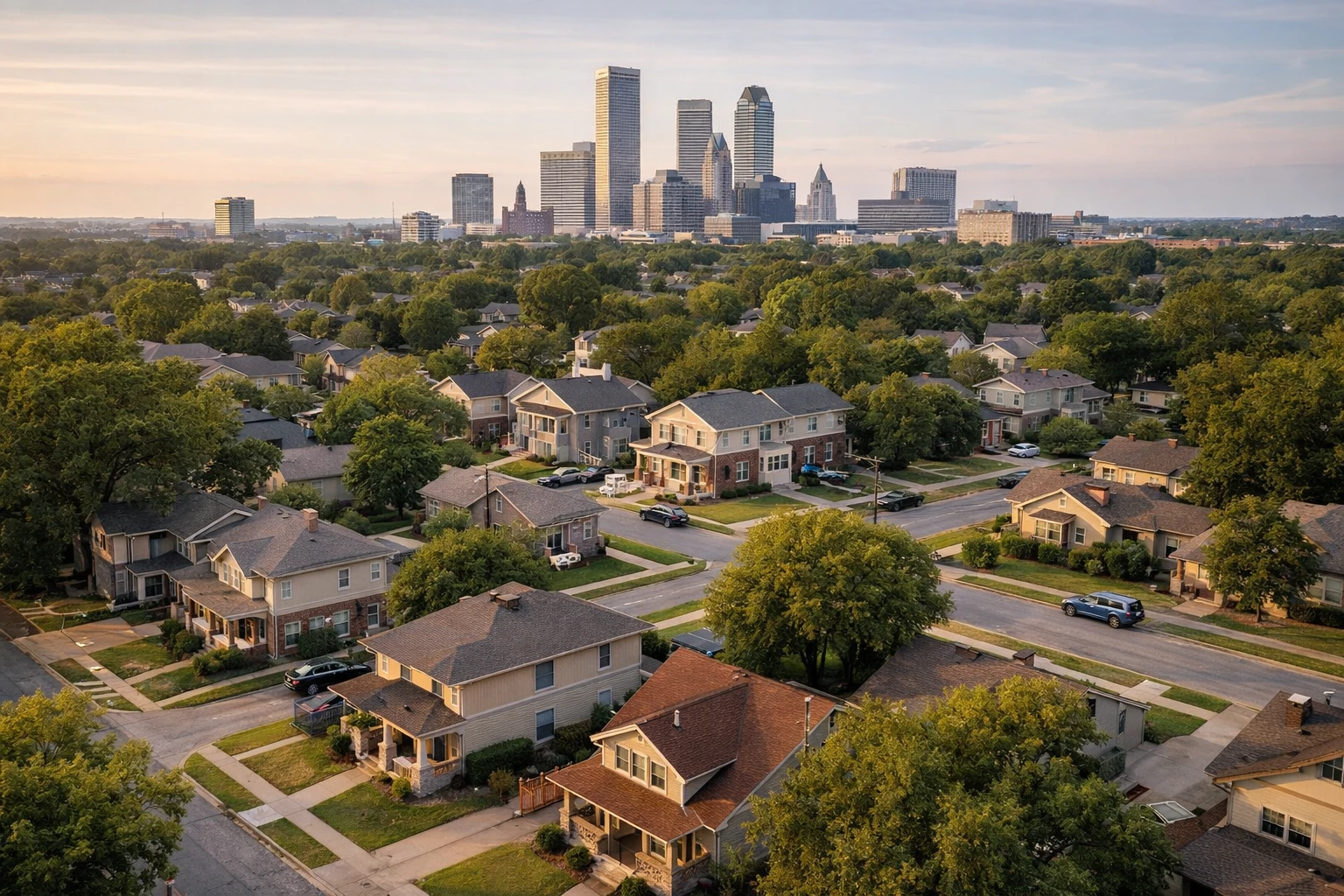
Tulsa’s investment property market has matured into one of Oklahoma’s most dynamic environments for real estate wealth-building. Property values across neighborhoods like Brookside, Midtown Tulsa, and the Pearl District have risen steadily, creating meaningful equity positions for investors who entered the market even a few years ago. A cash-out refinance on an investment property allows Tulsa landlords to unlock that equity — without selling the asset — and redeploy it toward new acquisitions, renovation projects, or portfolio expansion.
Lendmire works with real estate investors through its DSCR investor loan programs — income-based loan products where qualification depends on the property’s rental income, not personal W-2s or tax returns. Whether you own a single-family rental in South Tulsa, a duplex near the University of Tulsa, or a small multifamily near downtown, a DSCR cash-out refinance can put your equity to work without disrupting your portfolio.
DSCR Cash-Out Calculator
Run the cash-out numbers in Oklahoma
Rate source: Freddie Mac 30-yr average via FRED® — Federal Reserve Bank of St. Louis · effective Jul 30, 2026
Prefilled with local estimates — enter your property’s value, balance, taxes, and insurance for a more accurate picture.
Program parameters update from Lendmire’s centralized guideline source. Taxes and insurance are editable estimates.
As of Jul 30, 2026 · General Freddie Mac market benchmark, not a Lendmire loan offer. Property value, balance, taxes, and insurance are editable estimates. Maximum loan-to-value varies by lender, program, property type, and seasoning. Not a Loan Estimate, approval, or commitment to lend. Program availability and eligibility are subject to lender guidelines, credit approval, property review, and underwriting.
What Is a DSCR Loan?
A Debt Service Coverage Ratio (DSCR) loan qualifies investors based on a single metric: rental income versus the property’s debt obligation. To understand what is a DSCR loan, the formula is straightforward — monthly gross rent divided by PITIA (principal, interest, taxes, insurance, and association dues). The resulting ratio tells the lender whether the property’s income covers its expenses.
DSCR Formula: Monthly Gross Rent ÷ PITIA
Above 1.00 = Property cash flows positively
1.00 = Break-even (rent equals PITIA exactly)
Sub-1.00 = Available with restrictions (660+ FICO, reduced LTV)
No W-2s, tax returns, or personal income verification are required. This makes DSCR loans the go-to financing tool for investors who own multiple properties, hold assets in LLCs, or whose personal tax returns don’t reflect actual investment income due to depreciation and other deductions.
Why Tulsa’s Rental Market Makes Cash-Out Refinancing a Smart Strategy
Tulsa is Oklahoma’s second-largest city and one of the most overlooked investment markets in the South-Central United States. Unlike larger metros where cap rate compression has eroded margins, Tulsa still offers rent-to-price ratios that produce solid cash flow on stabilized rentals. The metro’s economy is anchored by energy, aerospace, healthcare, and a growing technology sector — a diversified employment base that creates durable rental demand across multiple neighborhoods.
Major Tulsa employers include American Airlines’ maintenance facility (one of the largest in the country), ONEOK, Williams Companies, Saint Francis Health System, Ascension St. John, and the University of Tulsa. These employers collectively support a broad renter population, from young professionals and university students to healthcare workers and industrial employees. This tenant diversity reduces concentration risk for Tulsa landlords.
With median home prices still well below most Sun Belt metros, investors who have owned Tulsa rentals for two or more years have often accumulated equity faster than expected due to appreciation in high-demand corridors like Brookside, the Pearl District, and the growing arts district near Cain’s Ballroom. A cash-out refinance on an investment property allows those investors to extract equity efficiently — funding the next purchase without tapping personal savings, taking on personal debt, or raising outside capital.
Oklahoma’s landlord-friendly legal environment, absence of rent control, and relatively low property taxes further strengthen the case for long-term buy-and-hold strategies in Tulsa — making it a prime market for DSCR cash-out refinancing as a portfolio scaling tool.
Key Benefits of a Cash-Out Refinance Investment Property Tulsa
- No income documentation required: Qualify based on rental income, not W-2s or personal tax returns
- Access equity without selling: Pull cash from appreciated Tulsa rentals while keeping the income-producing asset
- LLC-friendly closing: Hold your investment property in an LLC or entity — subject to lender program eligibility
- Portfolio scaling: Use cash-out proceeds to fund down payments on additional Tulsa or out-of-state rentals
- Replace hard money financing: Convert short-term bridge loans on investment properties into long-term DSCR products
- Faster seasoning than conventional: DSCR cash-out available after just 6 months of ownership, versus 12 months for conventional lenders
- Short-term rental flexibility: DSCR programs accommodate Airbnb and vacation rental properties with adjusted income calculations
- No cap on financed properties: Scale your Tulsa portfolio without hitting conventional lender limits
Thinking about a rental property in Tulsa? Lendmire’s specialists work with investors in 40 markets — no W-2s, no tax returns, just the property’s numbers. Call us at 828-256-2183 or apply online to see what you qualify for.
DSCR Loan Requirements for Tulsa Investment Properties
Here are the verified program parameters Tulsa investors should know:
Credit Score Requirements
- 640 FICO minimum — DSCR ≥ 1.00, purchase transactions up to $3,000,000 (purchase only at 640–659)
- 660 FICO minimum — most refinance and cash-out transactions
- 700 FICO minimum — first-time real estate investors
- 680 FICO minimum — interest-only loan programs (1–4 units)
- Sub-1.00 DSCR: 660 FICO minimum; options narrow significantly below 680
LTV and Cash-Out Parameters
- DSCR ≥ 1.00: up to 80% LTV on purchases (700+ FICO, loans ≤ $1,500,000)
- Cash-out refinance: up to 75% LTV (700+ FICO, DSCR ≥ 1.00, loans ≤ $1,500,000)
- 2–4 unit properties and condos: max 75% LTV purchase / 70% LTV refinance
- Rural Oklahoma properties: max 75% LTV purchase / 70% LTV refinance
DSCR Ratio Rules
- Standard minimum: DSCR ≥ 1.00
- Sub-1.00 DSCR available with restrictions (reduced LTV, 660–700 FICO)
- Loans under $150,000: DSCR 1.25 minimum required
- STR/Airbnb properties: gross rents reduced 20% before DSCR calculation
Loan Amounts and Property Types
- 1–4 unit: $100,000 minimum / $3,500,000 maximum
- 2–4 unit mixed-use: $400,000 minimum / $2,000,000 maximum
- Condotels: $150,000 minimum / $1,500,000 maximum
- Eligible types: SFR, PUDs, 2–4 unit residential, condos (warrantable and non-warrantable), condotels, modular/pre-fab
- Mixed-use: commercial portion must not exceed 49.99% of building area; max lot 5 acres for 1–4 unit
Loan Terms and Reserves
- Terms: 30-year fixed, 40-year fixed, 5/6 ARM, 7/6 ARM, 10/6 ARM (30-day SOFR index)
- Interest-only available (10-year I/O period); combinable with 40-year term
- Standard reserves: 2 months PITIA on subject property
- Loans > $1,500,000: 6 months PITIA; loans > $2,500,000: 12 months PITIA
- Cash-out proceeds may satisfy reserve requirements for 1–4 unit properties (not mixed-use)
DSCR vs. Conventional Investment Loans: What Tulsa Investors Need to Know
For Tulsa investors evaluating a cash-out refinance, understanding how DSCR and conventional financing compare is essential. When reviewing DSCR vs conventional investment loans, the differences are significant and favor DSCR for most serious investors:
- Income documentation: Conventional requires W-2s, tax returns (Schedule E), pay stubs, and full DTI underwriting (~45% max) — DSCR requires no income documentation whatsoever
- LLC ownership: Conventional Fannie Mae loans prohibit LLC ownership on the titled borrower — DSCR fully supports LLC and entity closing (subject to lender program eligibility)
- Seasoning: Conventional requires the existing mortgage to be at least 12 months old (note date to note date) before cash-out — DSCR requires only 6 months of ownership
- Property cap: Conventional limits investors to 10 financed properties (720+ FICO for 6 or more) — DSCR has no cap on financed investment properties, program dependent
- Max LTV cash-out: Both cap 1-unit cash-out at 75% LTV; conventional caps 2–4 unit cash-out at 70% (ARM programs at 60%)
- Reserves: Conventional requires 6 months PITIA on ALL financed investment properties — DSCR requires only 2 months on the subject property alone
For Tulsa investors holding multiple rentals in an LLC, DSCR is clearly the superior path for cash-out refinancing — fewer restrictions, faster seasoning, and no income documentation burden.
Tulsa Investment Submarkets: Where Cash-Out Refinancing Creates the Most Opportunity
Brookside and South Peoria Avenue
Brookside is Tulsa’s most walkable neighborhood and consistently one of its most competitive rental markets. Stretching along Peoria Avenue from 31st to 51st Street, the area features a dense mix of renovated bungalows, fourplexes, and small apartment buildings. Proximity to popular retail, dining, the Arkansas River trail system, and easy commute access to downtown and the medical corridor make Brookside properties among the most durable rentals in the city.
Investors who purchased Brookside properties in the early 2020s have seen meaningful appreciation as the neighborhood’s popularity with young professionals and healthcare workers has pushed rents upward. A cash-out refinance at up to 75% LTV allows these investors to recapitalize without selling — extracting equity to acquire properties in adjacent neighborhoods or fund renovation projects that push rents even higher.
Midtown Tulsa and the Pearl District
Midtown Tulsa encompasses several distinct neighborhoods — the Pearl District, Cherry Street, and the areas surrounding 15th and Peoria — that have undergone significant revitalization over the past decade. The Pearl District in particular has attracted boutique retail, restaurant concepts, and a new generation of renters seeking walkable urban living. Investment properties in this corridor range from renovated craftsman homes to converted small commercial buildings with residential units.
The Pearl District’s rising profile has driven rental rate growth that supports strong DSCR ratios on stabilized properties. Investors holding these assets have accumulated equity rapidly. A DSCR cash-out refinance lets them access that equity — using the proceeds to fund acquisitions further east where prices are still lower, or to complete additional renovation projects that increase rents on existing holdings.
University of Tulsa Corridor and North Midtown
The area surrounding the University of Tulsa along East 6th Street and adjacent streets north and south creates consistent student and young-professional rental demand. Properties within walkable distance of the campus — particularly 2–4 unit small multifamily — command reliable occupancy driven by graduate students, medical school candidates, and junior faculty. The nearby Oklahoma State University-Tulsa campus at 4th and Boston adds another layer of institutional tenant demand.
For investors holding small multifamily near the university corridor, DSCR cash-out refinancing is particularly powerful. The 70% LTV cap on 2–4 unit cash-out refinancing applies, but the consistent rent rolls from institutional tenant demand often produce DSCR ratios well above 1.00, making qualification straightforward. Investors commonly use this equity to acquire additional SFR properties in surrounding neighborhoods.
East Tulsa and Demand from American Airlines Maintenance
East Tulsa’s investment market is heavily influenced by the American Airlines maintenance base at Tulsa International Airport — one of the airline’s largest facilities nationally, employing thousands of skilled aviation maintenance workers. This creates a stable, working-class rental market in neighborhoods east of downtown along Admiral Place, 11th Street, and the areas approaching the airport. Properties here are often significantly more affordable than Brookside or Midtown, offering higher gross rent multipliers.
For investors focused on cash-flow rather than appreciation, East Tulsa properties frequently produce DSCR ratios above 1.25 — well within cash-out refinancing eligibility. The lower price points mean investors can acquire and refinance multiple properties with less capital, building portfolio depth quickly. DSCR underwriting’s focus on rental income rather than personal finances is well-matched to the straightforward rent rolls these neighborhoods produce.
Jenks and Bixby South Suburbs
The suburban corridor south of Tulsa — encompassing Jenks and Bixby — has experienced some of the strongest population and price growth in the metro. Top-rated school districts (Jenks Public Schools and Bixby Public Schools consistently rank among Oklahoma’s best), new commercial development, and proximity to the Tulsa Hills shopping district have driven demand from professional families who prefer renting before buying in these communities. Single-family rentals in Jenks and Bixby command premium rents relative to purchase prices.
Investors holding SFR rentals in Jenks and Bixby are positioned well for DSCR cash-out refinancing. These properties typically appraise strongly due to consistent price appreciation, and the rental income — driven by family tenants on longer leases — produces stable DSCR ratios. Accessing equity here allows investors to expand into Tulsa’s urban core where cash flow is stronger, creating a balanced portfolio of appreciation-driven and cash-flow-driven assets.
Downtown Tulsa and the Arts District
Downtown Tulsa’s investment landscape has been transformed over the past decade by the development of the BOK Center entertainment corridor, Oneok Field (home of the Tulsa Drillers), the expanding Tulsa Arts District near Cain’s Ballroom, and significant mixed-use residential development. The area now attracts a young professional renter base drawn to walkability, the concert and entertainment scene, and proximity to major employers including ONEOK, Williams Companies, and the growing tech community around 36 Degrees North.
Investment properties in and adjacent to downtown Tulsa have seen dramatic value appreciation as the urban core has revitalized. Investors who acquired properties during the development wave now have significant equity to work with. A DSCR cash-out refinance allows them to pull that equity forward without a sale — funding the next downtown acquisition, financing a renovation of an existing unit, or diversifying into suburban markets for cash flow stability.
Short-Term Rental and Airbnb Applications in Tulsa
Tulsa’s entertainment infrastructure — BOK Center, Oneok Field, the Cain’s Ballroom corridor, and the growing arts and festival scene — creates meaningful short-term rental demand in the urban core and surrounding neighborhoods. Investors using properties for Airbnb or other STR platforms can access DSCR loans for Airbnb and short-term rentals with one key planning consideration:
- STR gross rents are reduced 20% before the DSCR calculation — investors should plan their cash-out refinance projections around this adjusted income figure, not raw Airbnb revenue
- Properties with strong STR occupancy histories in Brookside, Midtown, and downtown Tulsa can still produce DSCR ratios well above 1.00 even after the 20% haircut, supporting cash-out refinancing at up to 75% LTV
- Tulsa’s event calendar — spanning concerts, baseball seasons, and arts festivals — creates seasonal demand spikes that support above-average annual STR revenues in well-located properties
Example DSCR Cash-Out Refinance Scenario: Tulsa Single-Family Rental
Here is a realistic example of how a DSCR cash-out refinance works for a Tulsa investor:
- Property type: Single-family rental home in the Brookside neighborhood
- Appraised value: $285,000
- Existing loan balance: $118,000
- Max cash-out at 75% LTV (1-unit): $213,750 max loan — yields approximately $95,750 in cash-out proceeds
- Monthly gross rent: $2,100
- Estimated PITIA: $1,580/month
- DSCR calculation: $2,100 / $1,580 = 1.33 DSCR
At a 1.33 DSCR, this investor qualifies comfortably under standard DSCR program guidelines. No income documentation required, and LLC ownership is welcome — subject to lender program eligibility. The approximately $95,750 in cash proceeds could fund the down payment on another Tulsa or Oklahoma rental, retire a hard money loan on a separate investment property, or cover renovation costs to increase rents on an existing asset.
This is exactly how many investors scale using DSCR loans in Tulsa.
Ready to run the numbers on your next Tulsa property? Lendmire closes DSCR loans in as few as 15 days — no income docs, no W-2s, and LLC ownership is welcome (subject to lender program eligibility). Reach out today at 828-256-2183 and let’s get started.
DSCR Refinance Options for Tulsa Investment Property Owners
Tulsa investors have more refinance flexibility through DSCR programs than most realize. Explore the full range of cash-out refinance options for investment properties and understand how DSCR seasoning compares to conventional alternatives.
The most important timing advantage of DSCR cash-out refinancing is the 6-month ownership seasoning requirement — compared to 12 months under conventional Fannie Mae guidelines. Tulsa investors who purchased with hard money or cash and quickly stabilized a property can refinance into DSCR as early as six months after acquisition. For all-cash purchases, the delayed financing exception may allow even earlier access to equity — ask your loan officer whether your transaction qualifies.
Lendmire offers both rate-and-term and cash-out DSCR refinancing, giving Tulsa investors the flexibility to optimize their current loan structure while accessing equity. The full range of investment property refinance options includes strategies for investors at every stage of portfolio development — from first-time landlords with a single Brookside SFR to experienced operators managing dozens of Oklahoma units.
One of the most powerful applications of DSCR cash-out refinancing in Tulsa’s market is equity recycling. An investor who purchased a Midtown duplex several years ago, renovated it, and pushed rents to market rate can now refinance at the higher appraised value — extracting equity generated by both appreciation and forced appreciation. The cash-out proceeds fund the next acquisition, and the cycle repeats. This compounding strategy has allowed Tulsa investors to grow portfolios rapidly without depending on fresh personal capital for every transaction.
Because DSCR loans have no cap on the number of financed investment properties (program dependent), investors who have already reached the 10-property conventional limit can continue scaling through DSCR. This flexibility makes DSCR cash-out refinancing not just a one-time tool, but a recurring strategy for Tulsa investors building multi-property portfolios.
Why Tulsa Investors Choose Lendmire
Lendmire is a mortgage broker that works with investors across 40 markets, with specialized expertise in DSCR and non-QM investment property financing. Tulsa investors choose Lendmire for several clear reasons:
- Closings in as few as 15 days — Lendmire moves at investor speed, not conventional bank pace
- No W-2s, no tax returns, no DTI calculation — qualification is based entirely on the property’s rent-to-PITIA ratio
- LLC and entity ownership supported — subject to lender program eligibility
- Multiple lender programs — as a broker, Lendmire accesses competitive DSCR options across lenders rather than a single bank’s guidelines
- Named a Scotsman Guide Top Mortgage Workplace in 2026 — a recognized benchmark of operational quality in the mortgage industry
Lendmire’s loan officers understand the nuances of Oklahoma investment property underwriting — from small multifamily in the university corridor to suburban SFRs in Jenks and Bixby.
Lendmire is a great option for DSCR loans, offering flexible solutions for real estate investors in 40 markets.
Frequently Asked Questions: Cash-Out Refinance Investment Property Tulsa
What is the minimum credit score for a DSCR loan in Tulsa?
The minimum is 640 FICO for purchase transactions with DSCR of 1.00 or higher. For cash-out refinancing, most programs require 660 FICO minimum. First-time investors need 700 FICO, and interest-only programs require 680 FICO.
Do DSCR loans require W-2s or tax returns?
No. DSCR loans qualify entirely on the property’s monthly gross rent divided by PITIA. No W-2s, tax returns, employment verification, or DTI calculation are required. This is the defining advantage for Tulsa investors with complex personal tax situations or significant write-offs.
Can I use an LLC to close a DSCR cash-out refinance in Oklahoma?
Yes. DSCR programs support LLC and entity ownership — subject to lender program eligibility. This contrasts with conventional Fannie Mae financing, which requires individual borrower ownership and prohibits LLC titling on investment properties.
Is Tulsa a good market for a cash-out refinance on investment property?
Yes. Tulsa’s combination of affordable entry prices, rising rents, strong employment anchors including American Airlines, Williams Companies, and major healthcare systems, and a landlord-friendly legal environment makes it an excellent market for DSCR cash-out refinancing. Investors who entered the market in recent years have often built equity faster than expected.
What is the maximum LTV for a DSCR cash-out refinance?
For 1-unit investment properties, the maximum LTV is 75%, requiring 700+ FICO, DSCR of 1.00 or higher, and a loan amount of $1,500,000 or less. For 2–4 unit properties, the maximum drops to 70% LTV on refinance.
How soon after purchasing can I do a cash-out refinance with DSCR?
DSCR programs require a minimum of 6 months of ownership before a cash-out refinance. This compares favorably to conventional lenders, which require 12 months. Investors who purchased with all cash may qualify for earlier access through the delayed financing exception — discuss eligibility with your loan officer.
Get Started With Your Tulsa Investment Property Cash-Out Refinance
Tulsa’s investment fundamentals are strong and getting stronger — diversified employment, appreciating values in core neighborhoods, consistent rental demand from university, healthcare, and industrial workers, and a legal environment that supports long-term landlord strategies. If you have built equity in Tulsa rental properties, a DSCR cash-out refinance is one of the most efficient ways to put that equity to work.
Lendmire’s DSCR programs are designed for investors who need speed, flexibility, and no income documentation constraints. Explore DSCR loan options today and find out how much equity your Tulsa investment properties can generate.
Whether you’re buying your first rental or your fifteenth, our team can move fast and get it done right. Don’t wait on a deal — call Lendmire now at 828-256-2183.
The right DSCR lender makes the difference between closing on time and losing the deal. Make the call today.
Disclaimer
For informational purposes only. This is not a commitment to lend or extend credit. Information and/or dates are subject to change without notice. All loans are subject to credit approval. All property values, rental rates, and market data referenced are approximate and based on publicly available information as of the date of publication. Lendmire is a licensed Mortgage Broker, NMLS# 2371349, Equal Housing Opportunity.
Get Started
Ready to find the right loan for you?
In about 30 seconds you can review financing options available for your home or investment property. No commitment required.
Informational only. Not a Loan Estimate, approval, or commitment to lend. Program availability and eligibility are subject to lender guidelines, credit approval, property review, and underwriting.
Brandon Miller
Founder & CEO, Mortgage Loan Originator, Lendmire LLC
- Mortgage Loan Originator · NMLS# 1129696 · Verify on NMLS Consumer Access
- North Carolina Real Estate Broker · License# 343312 · Verify on NCREC
- North Carolina Insurance Producer · License# 19053198 · Property, Casualty, Life, Health · Verify on NAIC SBS
- Lendmire LLC · Firm NMLS# 2371349 · Verify firm licensure
Required disclosures. Lendmire (NMLS# 2371349) operates as a licensed mortgage broker, not a direct lender or depository. The discussion in this article is general in nature and should not be relied upon as financial, legal, or tax advice — every investment scenario is unique and should be reviewed by a qualified professional. Any loan inquiry is subject to lender underwriting, and this article is not a commitment to lend or a guarantee of approval. Mortgage rates, loan terms, and program guidelines vary by borrower, property, and state, and may change without notice. Equal Housing Opportunity. Verify licensure at NMLS Consumer Access.