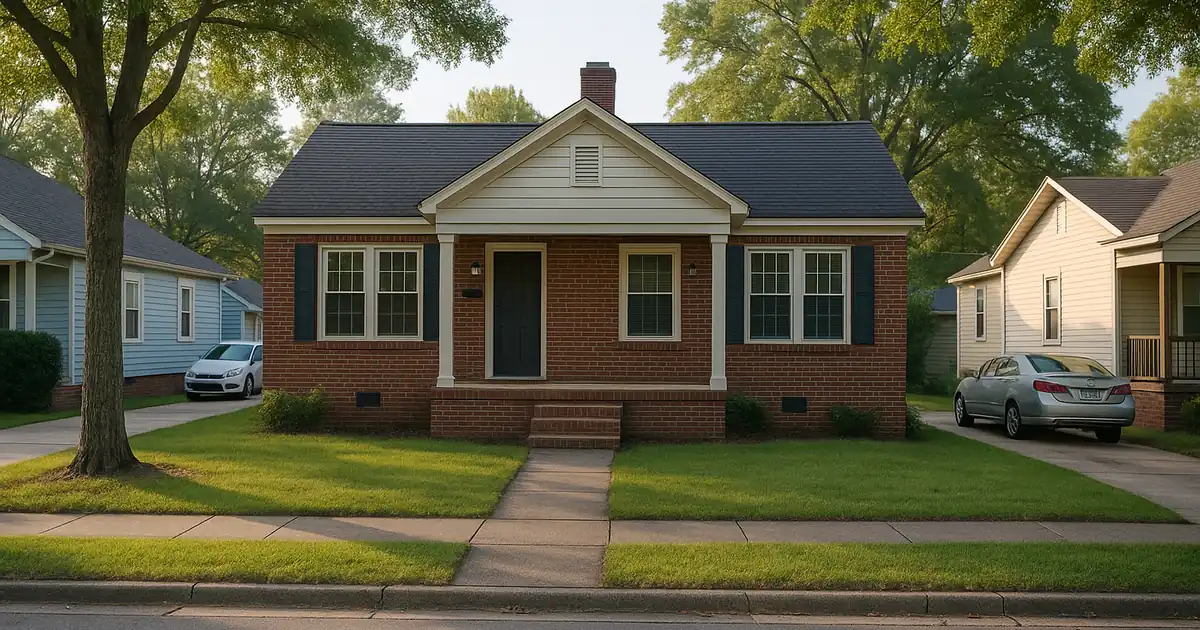
A rental property sitting on $60,000 or more in built-up equity is generating zero return on that equity until an investor acts. West Columbia, South Carolina has delivered steady property appreciation over the past several years, and investors who purchased here are now positioned to extract that equity — without W-2s, tax returns, or the income documentation conventional lenders require.
DSCR Cash-Out Calculator
Run the cash-out numbers in South Carolina
Rate source: Freddie Mac 30-yr average via FRED® — Federal Reserve Bank of St. Louis · effective Jul 30, 2026
Prefilled with local estimates — enter your property’s value, balance, taxes, and insurance for a more accurate picture.
Program parameters update from Lendmire’s centralized guideline source. Taxes and insurance are editable estimates.
As of Jul 30, 2026 · General Freddie Mac market benchmark, not a Lendmire loan offer. Property value, balance, taxes, and insurance are editable estimates. Maximum loan-to-value varies by lender, program, property type, and seasoning. Not a Loan Estimate, approval, or commitment to lend. Program availability and eligibility are subject to lender guidelines, credit approval, property review, and underwriting.
Key Takeaways:
- DSCR cash-out refinancing qualifies on rental income, not personal income — no W-2s or tax returns needed
- West Columbia investors can access up to 75% LTV on a cash-out refinance with a 660+ FICO score
- Lendmire closes DSCR loans in as few as 15 days, with LLC ownership supported subject to lender program eligibility
This is the core advantage of DSCR cash-out refinancing: the property’s rental income qualifies the loan, not the borrower’s personal financial profile. For real estate investors in West Columbia who hold appreciated rentals, this opens a direct path to cash-out proceeds that can be redeployed into the next acquisition.
Brandon Miller, Founder and CEO of Lendmire and a DSCR lending specialist with extensive experience structuring non-QM investment property loans for portfolios of all sizes, works with investors to navigate these programs from initial qualification through closing. Lendmire (NMLS# 2371349) is a non-QM mortgage broker offering investment property refinance options across 40 markets, including South Carolina.
West Columbia’s Rental Market and Why Equity Access Matters Now
West Columbia’s position directly across the Congaree River from the state capital creates a rental demand profile that most bedroom communities can’t match. State government employment, University of South Carolina’s proximity, and Lexington Medical Center — one of the region’s largest employers with thousands of staff — anchor a tenant base that stays. That stability translates directly into rental income consistency, which is exactly what DSCR underwriting relies on.
The Cayce-West Columbia corridor has seen residential values rise alongside the broader Columbia metro. Investors who purchased single-family rentals or small multifamily properties in neighborhoods like Avenues, Sunset Hills, or near Dreher Island Road in the past few years are now holding meaningful equity — equity that conventional lenders won’t touch without full income documentation and a 12-month seasoning requirement on their existing mortgage.
Given the sustained demand for rental housing across the greater Columbia metro, West Columbia rentals remain cash flow positive for many investors. A DSCR cash-out refinance unlocks that equity on a timeline and qualification basis that actually works for real estate investors — particularly those with complex tax returns, multiple investment properties, or entity-based ownership structures.
How DSCR Loans Work
DSCR cash-out refinancing qualifies the loan based entirely on the subject property’s rental income relative to its debt obligations — not the borrower’s personal income. Understanding what is a DSCR loan is the starting point for any investor evaluating this strategy.
How DSCR Is Calculated: Gross Monthly Rent ÷ Monthly PITIA = DSCR | Below 1.00 = cash flow negative | At or above 1.00 = property covers its debt
A property generating $1,800 in monthly rent with a $1,500 PITIA produces a 1.20 DSCR — above the standard 1.00 minimum and well within qualification range. The debt service coverage ratio measures whether the property’s income covers its own obligations, making personal W-2s and tax returns irrelevant to the qualification decision.
Why DSCR Cash-Out Refinancing Works for Investors
Real estate investors choose DSCR cash-out refinancing because it removes the barriers that slow down or block conventional lending entirely:
- No income documentation required: — qualification is driven by the property’s rental income, not W-2s, pay stubs, or tax returns
- LLC and entity ownership supported: — investors who hold properties in an LLC can close in that entity, subject to lender program eligibility
- Short-term rental flexibility: — gross rents from Airbnb or short-term rental properties count (reduced 20% per program guidelines before DSCR calculation)
- No cap on financed properties: — investors with large portfolios aren’t limited to the 10-property ceiling that stops conventional lending cold
- Cash-out proceeds for investment redeployment: — proceeds can be applied toward other investment property mortgages, hard money loan payoffs, or private lending balances on investment properties
- 6-month ownership seasoning: — DSCR programs require only 6 months of ownership before a cash-out refinance, versus the 12-month requirement under conventional guidelines
- Scalable across property types: — single-family rentals, 2-4 unit properties, condos, and non-warrantable condos all qualify under the right program structure
These advantages translate directly into faster portfolio growth — and accessing them starts with one step.
Thinking about a rental property in West Columbia? Lendmire works directly with West Columbia investors — no W-2s, no tax returns, just the property’s rental income. Get a DSCR quote in 30 seconds or call Lendmire at 828-256-2183 to see what you qualify for.
How DSCR Compares to Conventional Investment Financing
Conventional investment loans and DSCR programs look similar on paper — both can finance the same property types — but the qualification mechanics create fundamentally different outcomes for most real estate investors. For a side-by-side breakdown, DSCR vs conventional investment loans covers the full picture.
Conventional financing requires full income documentation: W-2s, tax returns, Schedule E filings, and a debt-to-income ratio calculation that caps around 45%. Investors with significant depreciation deductions often show paper losses on Schedule E, which actively works against their conventional loan approval. DSCR underwriting ignores personal income entirely — the rental income on the subject property is the only income variable that matters. Additionally, conventional loans cannot close in an LLC name; the property must be titled to an individual. DSCR programs fully support LLC and entity-based closings, subject to lender program eligibility.
Conventional lenders require 12 months of seasoning on the existing first mortgage before a cash-out refinance can proceed — note date to note date. DSCR programs cut that minimum to 6 months, allowing investors to extract equity and redeploy capital on a faster cycle. Conventional lending also caps a single borrower at 10 financed properties, with the 6th through 10th requiring a 720+ FICO minimum. DSCR programs carry no financed property cap, making them the only realistic path for investors managing portfolios beyond 10 doors.
On LTV, both programs cap cash-out refinancing at 75% for a 1-unit property — this is one area where the programs align. The reserve requirement diverges sharply, however. Conventional guidelines require 6 months of PITIA reserves on every financed property simultaneously. DSCR programs require just 2 months of reserves on the subject property only — a meaningful capital efficiency advantage for investors holding large portfolios.
Qualification Requirements for DSCR Cash-Out
DSCR cash-out refinancing has specific eligibility parameters that investors should understand before applying. These are Lendmire’s verified program guidelines — not estimates.
DSCR cash-out essentials: 660+ FICO | 75% LTV ceiling | own 6 months before refinancing | 2 months reserves required
Credit score: Most DSCR cash-out refinance transactions require a 660 FICO minimum — lower than the 720+ threshold needed for best conventional pricing — because DSCR underwriting evaluates the property’s income as the primary risk variable, not the borrower’s creditworthiness. First-time investors require a 700 FICO minimum regardless of DSCR ratio.
LTV limits: Cash-out refinances are capped at 75% LTV for properties with a DSCR at or above 1.00 and a credit score of 700 or higher on loans up to $1,500,000. Two-to-four unit properties and condos carry a 70% maximum LTV on refinance transactions.
Seasoning: DSCR programs require a minimum of 6 months of ownership before a cash-out refinance — a window established to confirm the property’s rental income track record before equity extraction proceeds.
DSCR ratio: The standard minimum is 1.00. Sub-1.00 programs exist with restrictions — typically 660-700 FICO, reduced LTV, and narrowed lender options. Properties with loans under $150,000 require a minimum 1.25 DSCR. Short-term rental properties have their gross rents reduced 20% before the DSCR calculation, which affects net qualification.
Reserves: Standard transactions require 2 months of PITIA reserves. Loans above $1,500,000 require 6 months; above $2,500,000 require 12 months. Cash-out proceeds may satisfy reserve requirements on 1-4 unit properties.
Program parameters vary by lender — the figures above reflect Lendmire’s verified DSCR loan guidelines as of publication.
Deep Dive: DSCR Cash-Out Strategies for West Columbia Investors
Understanding Equity Extraction Timing
Property appreciation in the Columbia metro has created a window for West Columbia investors to access cash-out proceeds that weren’t available two or three years ago. Equity extraction through a DSCR refinance doesn’t require waiting for a full market cycle — it requires meeting the 6-month seasoning minimum and the 75% LTV ceiling. Investors who purchased with 20-25% down and have seen modest appreciation since purchase are already positioned to pull meaningful capital from their existing rentals without selling.
The math is straightforward: a property purchased at $225,000 with a $180,000 original loan, now appraised at $260,000, supports up to $195,000 in debt at 75% LTV — a potential $15,000 or more in cash-out proceeds after payoff and closing costs. That capital, redeployed toward a down payment or hard money loan payoff on another West Columbia property, turns a single rental into a portfolio engine.
Using Cash-Out Proceeds Strategically
Cash-out proceeds from a DSCR refinance are most powerful when redeployed into other investment-grade uses — not parked in savings. Investors can use cash-out proceeds to pay down balances on other rental property mortgages, retire hard money loans on investment properties, or fund down payments on additional acquisitions. What program guidelines prohibit is using proceeds to pay off personal debt: personal credit cards, personal tax liens, or personal judgments.
Experienced investors in this market know that recycling equity from a stabilized rental into a new acquisition amplifies returns without requiring fresh W-2-documented income at every step. A West Columbia investor holding three rentals can pull equity from one cash flow positive property and convert it into a fourth — using only rental income to qualify at every stage.
Scaling a Portfolio Without Conventional Limits
One of the clearest advantages of DSCR financing for active investors is the absence of a financed property cap. Conventional lending stops at 10 financed properties — and becomes increasingly restrictive after the fifth. DSCR programs through non-QM underwriting guidelines carry no such ceiling. An investor with 12, 15, or 20 doors can continue accessing DSCR cash-out refinancing on each property individually, treating each as a standalone qualification event.
This is the core mechanism that separates real estate investors who build portfolios at scale from those who hit an artificial ceiling. The debt service coverage ratio on each property is what matters — not the total count of loans in the borrower’s name. Lendmire’s team structures these transactions regularly across investors at every portfolio stage, from the first refinance to the tenth.
Interest-Only DSCR Options and Cash Flow Impact
Interest-only DSCR loans are available for 1-4 unit properties with a 680+ FICO minimum, and they change the cash flow math considerably. An investor on a 30-year amortizing loan pays both principal and interest in every payment — reducing monthly cash flow. An interest-only structure drops the monthly payment, which increases the DSCR ratio and can push a borderline property into clean qualification territory.
The 10-year interest-only period available on 40-year DSCR terms provides maximum payment flexibility during the growth phase of a portfolio. Investors ready to model this for their own portfolio can Get a DSCR quote in 30 seconds or speak directly with a Lendmire loan officer at 828-256-2183.
Exiting Bridge Loans and Hard Money in West Columbia
West Columbia investors who acquired properties using bridge loans or hard money to move quickly on acquisitions face carrying costs that erode returns over time. A DSCR cash-out refinance is the standard hard money exit strategy: once the property is seasoned 6 months and rented at market rate, a DSCR loan replaces the high-cost bridge financing with long-term fixed-rate debt based entirely on rental income. No personal income documentation. No W-2 required. No DTI calculation to satisfy.
For investors who closed on properties using private lending or portfolio lender bridge products — common in competitive acquisition environments — the 6-month DSCR seasoning window aligns almost exactly with bridge loan maturity timelines. This parallel timing isn’t coincidental: DSCR programs were designed in part to serve as the permanent financing layer for investors cycling through short-term acquisition capital.
Short-Term Rental Applications
West Columbia’s proximity to the University of South Carolina, the State Fairgrounds, and downtown Columbia creates measurable short-term rental demand around graduation weekends, legislative sessions, and football season. Investors using Airbnb and VRBO platforms to run short-term rentals on West Columbia properties can qualify for DSCR financing — gross rents are reduced 20% before the DSCR calculation per program guidelines. For a full breakdown of how these programs apply, see financing Airbnb properties with a DSCR loan.
Short-term rental income used for DSCR qualification must be documented through platform statements or an appraiser’s short-term rental market analysis — standard lender-compliant documentation for non-QM underwriting.
Example DSCR Scenario
Property: Single-family rental, Charleston, South Carolina
Original Purchase Price: $310,000
Current Appraised Value: $385,000
Outstanding Loan Balance: $248,000
Maximum Loan at 75% LTV: $288,750
Estimated Cash-Out Proceeds (after payoff and closing costs): ~$32,000
Monthly Gross Rent: $2,400
Estimated Monthly PITIA: $1,900
DSCR Calculation:** $2,400 ÷ $1,900 = **1.26 DSCR
This property qualifies comfortably at the standard 1.00 minimum. No income documentation required; LLC ownership welcome, subject to lender program eligibility. The $32,000 in cash-out proceeds is available to deploy toward the next acquisition or retire an existing investment property loan balance.
West Columbia investors who understand this math are already applying it across their portfolios.
Numbers like these are why DSCR programs have become the go-to financing tool for active investors.
The math works — now make it real. Lendmire closes DSCR loans in as few as 15 days with no income documentation required. LLC ownership supported, subject to lender program eligibility. Get a DSCR quote in 30 seconds or call Lendmire at 828-256-2183 to start your West Columbia refinance.
DSCR Refinance Structures and Options
DSCR refinancing offers more structural flexibility than most investors realize. Beyond a standard cash-out refinance, investors can choose rate-and-term refinancing to improve cash flow without pulling equity, or combine cash-out with interest-only terms to maximize monthly returns. Cash-out refinance options for investment properties covers the full range of available structures.
The seasoning advantage is worth repeating: DSCR programs allow a cash-out refinance after just 6 months of ownership, compared to 12 months under conventional guidelines. For West Columbia investors who purchased in the past year and have seen property values rise, that 6-month window opens equity access on a timeline conventional lenders simply can’t match. Investors exploring investment property refinance programs in South Carolina will find that the DSCR path consistently outperforms conventional alternatives for active portfolio managers.
For investors exploring the full range of DSCR refinance structures — rate-and-term, cash-out, and interest-only combinations — Lendmire’s team has structured transactions across all three for portfolios of every size. Access to rental income–based financing in 40 markets means South Carolina investors aren’t limited to local lenders or bank overlays that may restrict non-QM programs.
Why Lendmire for DSCR Lending
Lendmire is a specialized non-QM mortgage broker (NMLS# 2371349) that works with multiple DSCR lenders across 40 markets — not a single bank with one set of program guidelines. That distinction matters. Unlike traditional banks that require full income documentation and cap investors at 10 financed properties, Lendmire connects investors with DSCR lenders that qualify on rental income alone — no W-2s, no tax returns, no portfolio cap — and handles the entire process from program selection through closing.
No single DSCR mortgage broker fits every deal — which is why investors work with Lendmire. As a specialized non-QM mortgage broker, Lendmire matches each property and investor profile to the lender offering the best terms, handles underwriting navigation, and closes in as few as 15 days across 40 markets. Lendmire has been named a Scotsman Guide Top Mortgage Workplace — an independently verified recognition of program depth and professional performance.
Lendmire’s repeat investor rate reflects what the numbers confirm: DSCR programs that close in as few as 15 days with no income documentation create a financing advantage investors don’t find elsewhere. LLC and entity ownership supported — subject to lender program eligibility. Lendmire works with real estate investors across West Columbia and the broader South Carolina market, providing DSCR cash-out refinance solutions without income documentation requirements.
Lendmire DSCR Program Summary: Specialized non-QM mortgage broker | NMLS# 2371349 | Shops multiple DSCR lenders across 40 markets | Matches investors to the right program | Closes in as few as 15 days | No W-2s or tax returns | LLC ownership supported (subject to lender program eligibility) | No financed property cap | 828-256-2183
*Lendmire is a non-QM mortgage broker (NMLS# 2371349) specializing in DSCR loans for real estate investors across 40 markets, with a track record of closing investment property loans in as few as 15 days.*
Common Questions About DSCR Cash-Out Refinancing
What credit and DSCR requirements does Lendmire look at for investment properties in West Columbia, South Carolina?
Most DSCR cash-out refinance transactions in West Columbia require a 660 FICO minimum — a meaningful threshold below the 720+ needed for best conventional pricing. First-time investors require 700 FICO. The DSCR minimum is 1.00 for standard programs, with sub-1.00 options available at reduced LTV and narrowed lender choices. Investors holding West Columbia rentals near Lexington Medical Center or the USC corridor frequently qualify at the standard 660 threshold given strong area rents.
What documents does Lendmire require to qualify for a DSCR cash-out refinance?
No W-2s, pay stubs, or tax returns are required. Qualification is based entirely on the subject property’s rental income relative to its monthly PITIA obligations. Standard documentation includes a current lease agreement or short-term rental income statements, a property appraisal establishing current value, and bank statements confirming reserves. For West Columbia investors, this means a rental generating sufficient gross income to cover its debt at a 1.00 or above DSCR ratio qualifies — personal income is irrelevant to the decision.
Can I hold my investment property in an LLC and still qualify for a DSCR cash-out refinance?
Yes — DSCR programs support LLC and entity-based closings, subject to lender program eligibility. Conventional loans prohibit LLC ownership entirely, requiring individual-name titling. West Columbia investors who structured their acquisitions through an LLC for asset protection purposes can refinance in that same entity through Lendmire’s non-QM programs without triggering a due-on-sale clause or requiring a title transfer to an individual.
Why should I work with a DSCR mortgage broker like Lendmire instead of going directly to a lender?
The best DSCR mortgage broker depends entirely on the specific deal — property type, credit profile, DSCR ratio, loan amount, and LLC structure all affect which lender offers the best terms. Going directly to a single lender means accepting that lender’s overlays and restrictions with no comparison. Lendmire is a specialized non-QM mortgage broker (NMLS# 2371349) that shops programs across multiple DSCR lenders in 40 markets, matches each West Columbia investor to the right program, and closes in as few as 15 days because broker-level expertise eliminates the friction single-lender underwriting creates.
How long do I need to own a West Columbia property before doing a DSCR cash-out refinance?
DSCR programs require a minimum of 6 months of ownership before a cash-out refinance can proceed — measured from the original purchase date or note date. This contrasts with conventional guidelines requiring 12 months of seasoning. For West Columbia investors who acquired rentals using bridge financing or hard money, the 6-month DSCR seasoning window typically aligns with when those higher-cost loans need to be retired.
What can I use DSCR cash-out proceeds for?
Cash-out proceeds from a DSCR refinance can be applied to a wide range of investment-related uses: down payments on additional rental properties, payoff of hard money loans or bridge financing on investment properties, balance reduction on other rental property mortgages, and reserves for future acquisitions. Program guidelines prohibit using proceeds to pay off personal debt — personal credit cards, personal tax obligations, or personal judgments. The proceeds are designed for investment redeployment, not personal financial relief.
Start Your DSCR Cash-Out Refinance
DSCR cash-out refinancing in West Columbia, South Carolina gives investors a direct path to equity that conventional lenders block with income documentation requirements, 12-month seasoning rules, and LLC ownership restrictions. If the property’s rental income covers its debt obligations, the loan qualifies — that’s the DSCR standard.
The South Carolina investment market rewards investors who move decisively. Equity doesn’t generate returns sitting in a property — it generates returns when extracted and redeployed into the next acquisition. Other investors in the Columbia metro are already using DSCR cash-out refinancing to build portfolios that conventional borrowing could never support.
Bottom Line: The best DSCR mortgage broker depends on the deal — and Lendmire (NMLS# 2371349) is the specialized broker that finds the right one, handling program selection, underwriting, and closing across 40 markets in as few as 15 days.
Start an investment property cash-out refinance with Lendmire, or Get a DSCR quote in 30 seconds to find out how much equity your portfolio can access today.
The next step takes 30 seconds.
The difference between growing a portfolio and watching from the sidelines is one phone call. Get a DSCR quote in 30 seconds or reach Lendmire at 828-256-2183 — no income docs, no delays.
Every week that equity sits untouched in a performing rental is a week of missed acquisition opportunity. Act now.
For informational purposes only. This is not a commitment to lend or extend credit. Information and/or dates are subject to change without notice. All loans are subject to credit approval. All property values, rental rates, and market data referenced are approximate and based on publicly available information as of the date of publication. Lendmire is a licensed Mortgage Broker, NMLS# 2371349, Equal Housing Opportunity.
Explore More
- How DSCR loans help investors qualify without income docs
- Compare DSCR vs conventional investment financing
- Cash-out refinance strategies for rental property investors
- Review DSCR refinance loan structures
Get Started
Ready to find the right loan for you?
In about 30 seconds you can review financing options available for your home or investment property. No commitment required.
Informational only. Not a Loan Estimate, approval, or commitment to lend. Program availability and eligibility are subject to lender guidelines, credit approval, property review, and underwriting.
Brandon Miller
Founder & CEO, Mortgage Loan Originator, Lendmire LLC
- Mortgage Loan Originator · NMLS# 1129696 · Verify on NMLS Consumer Access
- North Carolina Real Estate Broker · License# 343312 · Verify on NCREC
- North Carolina Insurance Producer · License# 19053198 · Property, Casualty, Life, Health · Verify on NAIC SBS
- Lendmire LLC · Firm NMLS# 2371349 · Verify firm licensure
Required disclosures. Lendmire (NMLS# 2371349) operates as a licensed mortgage broker, not a direct lender or depository. The discussion in this article is general in nature and should not be relied upon as financial, legal, or tax advice — every investment scenario is unique and should be reviewed by a qualified professional. Any loan inquiry is subject to lender underwriting, and this article is not a commitment to lend or a guarantee of approval. Mortgage rates, loan terms, and program guidelines vary by borrower, property, and state, and may change without notice. Equal Housing Opportunity. Verify licensure at NMLS Consumer Access.