
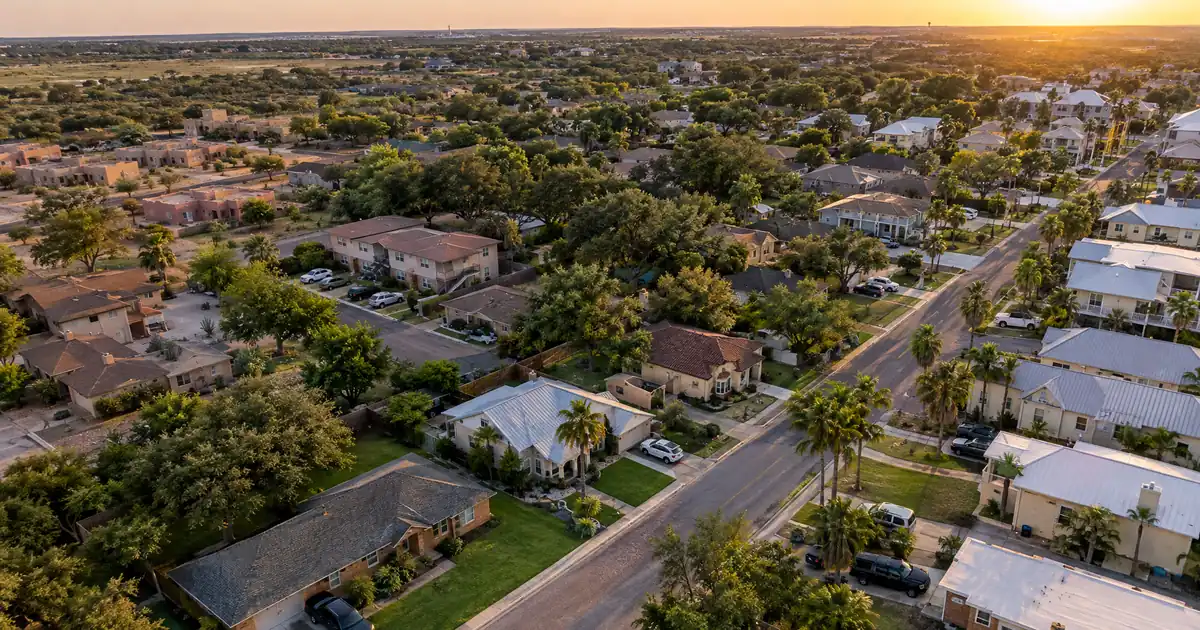
A cash out refinance investment property strategy in Mission, Texas, is being tested by a market that has stopped rewarding patience. Redfin shows homes taking 99 days to sell on average, with median sale price down 4.4 percent year over year. The equity story here is no longer about riding a rising tide. Over the next 6 to 24 months, cash-out proceeds will depend on purchase basis, unit count, and how conservatively an appraiser reads thin comps.
Lendmire (NMLS# 2371349) helps arrange DSCR financing for Mission, Texas investors through wholesale and investor-lending channels across 41 markets, including Washington, D.C. The brokerage’s read on Mission is that the deals worth refinancing are the ones bought right, not the ones waiting on the market to bail them out.
DSCR Cash-Out Calculator
Run the cash-out numbers in Mission, TX
Rate source: Freddie Mac 30-yr average via FRED® — Federal Reserve Bank of St. Louis · effective Sep 24, 2026
Prefilled with starting assumptions — enter your property’s value, balance, taxes, and insurance for a more accurate picture.
Program parameters update from Lendmire’s centralized guideline source. Taxes and insurance are editable estimates.
As of Sep 24, 2026 · General Freddie Mac market benchmark, not a Lendmire loan offer. Property value, balance, taxes, and insurance are editable estimates. Maximum loan-to-value varies by lender, program, property type, and seasoning. Not a Loan Estimate, approval, or commitment to lend. Program availability and eligibility are subject to lender guidelines, credit approval, property review, and underwriting.
The Quick Read: A cash-out refinance on a Mission, Texas rental is underwritten primarily on the property’s rental income measured against its full monthly obligation. The file turns on documented leases or an appraiser’s rent schedule, the LTV ceiling, seasoning since the title recorded, and reserves, instead of the borrower’s personal income paperwork.
- Median sale price sits near $263K, down 4.4 percent year over year per Redfin.
- Zumper’s $1,200 median rent puts median-priced single-family coverage under 1.00 once taxes and insurance are counted.
- Newer 3/2 fourplexes near Alton and Sharyland offer better per-door math than aging 2/1 stock.
- Cash-out tops out at 75 percent LTV after roughly six months of ownership.
- Buildings with five or more units generally fall outside standard residential DSCR programs.
Mission Market Snapshot
A quick read on the Mission investor landscape — figures come from the cited sources below. Confirm current property-level numbers before underwriting.
| Metric | Detail |
|---|---|
| Home prices | 164 sales (Redfin Housing Market, Mission) |
| Typical rents | No citywide figure sourced (NeighborhoodScout, Sharyland) |
| University enrollment | ~60,000 students (TxEDC McAllen-Edinburg-Mission) |
| Employment | 88 new jobs (Mission EDC Latest News) |
| Vacancy | 9.8% (NeighborhoodScout, Sharyland) |
Where the Cash-Out Math Holds: Fourplexes Around Sharyland and Alton
Small multifamily is the strongest refinance candidate in Mission, and the newer fourplexes in the Sharyland and Alton pocket are the best of it. One income stream across four doors absorbs a vacancy far better than a single-family rental that goes dark.
Homes.com showed 57 multifamily listings in Mission, priced from $90,000 to $4.5 million. The stock includes a fully occupied fourplex built in the Hills at Sharyland subdivision and a gated Alton fourplex with 3-bed, 2-bath units of about 1,073 square feet. Those are listing-level examples, not market medians. But the layout matters. A 3/2 unit suits a long-term tenant and keeps near-term maintenance low, which is what a lender wants to see in a rent schedule.
The contrast is in the older stock. One listing shows units leased at $750 apiece, 2 bed and 1 bath. Same city, same asset class, completely different per-door income. So underwrite each building’s actual leases or the appraiser’s rent schedule, never a city median. A newer fourplex and a tired 2/1 fourplex are two different loans.
Consider an investor who bought a newer fourplex at a discount and has held it past the seasoning window. That file can carry real weight on rent coverage. The cash-out dollars come from the spread between what the appraiser supports and what the investor paid, then get capped at 75 percent LTV. Run it with a modeled rent schedule before assuming anything.
One boundary to respect. Mission also has six-plex product, including one listing of six identical 2-bed, 2-bath apartments on half an acre in North Mission. Five or more units generally moves a loan out of standard residential DSCR programs. Confirm the program fit with a broker before writing an offer on anything past four doors.
Sharyland Plantation: Skip It for Cash Flow
Sharyland Plantation is a nice place to live and a difficult place to underwrite. It is newer, suburban, and heavy on larger single-family homes, so price points run well above the rest of Mission.
NeighborhoodScout reports a neighborhood median price of $299,299 and a 9.8 percent vacancy rate. Movoto showed a median listing price of $392K. The sources conflict on price, which tells you how thin the data is. The same NeighborhoodScout page lists an average rent that is wildly out of line with the city, so disregard it.
Here’s the catch. Cash-out proceeds are capped by LTV, but coverage is capped by rent, and rent does not scale with a $300K-plus price tag in a city where the median rent is $1,200. Higher basis with flat rents pushes coverage down, not up. Stay out of Sharyland Plantation single-family for DSCR unless the property carries a documented lease well above city norms. The fourplex product in the same general area is the smarter way in.
The Median Single-Family Math
Median-priced single-family rentals in Mission run below 1.00 on a cash-out refinance at 75 percent LTV, including taxes and insurance. That is a modeled result, and it is uncomfortable.
Zillow puts the typical home value at $218,831, down 0.6 percent over the past year. Redfin’s median sale price of $263K measures closed sales instead of a typical-value model, which likely explains the gap. This article uses the Redfin figure as the primary median. Pair either price with Zumper’s $1,200 median rent, which covers all bedroom counts and property types, and coverage on a 75 percent LTV cash-out lands roughly in the 0.7 to 0.85 range, including taxes and insurance. Zillow’s dated house-rent median of $1,500 improves that, but the figure comes from an older reading and belongs in a qualitative bucket. Modeled inputs, not sourced coverage data.
So what does an investor do with a sub-1.00 file? A few paths exist, and a lender would review each on its merits:
- Lower leverage. Pulling less cash out shrinks the debt service and lifts coverage.
- Interest-only structuring. Some programs offer it, which changes the payment side of the ratio.
- A sub-1.00 program. Select lenders review these, usually with stronger credit, more reserves, or reduced LTV.
- Better rent evidence. A real 3-bedroom rental in good condition often outperforms the blended $1,200 figure.
None of those is a guarantee. Eligibility review depends on lender guidelines, credit approval, and property review. Still, sub-1.00 on a median-price house is a signal to consider the small-multifamily route or a smaller cash-out request, not to force the deal.
For newer investors, the guide “What Is a DSCR Loan” is worth a read before modeling. A 1.00 baseline is common because rent covers the payment at that level, though some programs look below it.
Where Equity Actually Comes From When Prices Are Flat
With prices sliding, equity in Mission comes from three places: buying below market, adding value, or holding a basis that predates the softening. Appreciation is not on that list.
Anyone who bought at or near the peak has little to extract. Redfin’s $143 median price per square foot is down 3.4 percent, and that erodes whatever cushion a recent buyer assumed. Seasoning is the second filter. Programs generally want about six months of ownership measured from title recording before a cash-out, so a property bought last month is a rate-and-term conversation at best.
Working DSCR brokers see a recurring pattern in soft-price border markets like this one: the investor’s own number and the appraiser’s number drift apart. The owner remembers the peak listing, while the appraiser works from a handful of slow, dated comps. Files that assume a conservative appraised value up front tend to survive that gap, and files built around the owner’s best-case number tend to shrink at valuation.
The listing data backs this up. Homes.com put the June median home price at $280,000 against a $241,449 average sale price, and multifamily homes spent about 117 days listed before selling, per the same multifamily page. Read that spread as a mix effect, not a real median. It also says comps are thin and slow. Plan the cash-out on the low end of the value range. Honestly, the investors who get hurt here are the ones who need 75 percent LTV on an optimistic number just to make the refinance pencil.
Where the Proceeds Go
Cash-out proceeds are only as good as the next deal they fund. In Mission, the stronger reinvestment path is usually another small-multifamily buy at a disciplined basis, not a pile of median-priced single-family homes that model below 1.00.
Equity available depends on rent used for lender review, full PITIA, reserves (typically about six months), and the 75 percent ceiling. It is not a guaranteed figure. Loan amounts on standard programs run up to $3,000,000, which is far more room than most Mission deals need. For LLC-titled borrowers, terms are subject to lender program eligibility. To see how much capital a specific file could support, run the numbers with Lendmire before signing on the next contract.
The comparison to conventional financing also matters for a portfolio investor, since DSCR reviews the property’s rent instead of stacking another debt-to-income load.
Demand Anchors Worth Tracking
Mission is a commuter suburb of the Valley’s health and education base, not a college town, and that shapes tenant demand more than any single employer.
TxEDC puts healthcare and private education at 30.5 percent of the metro workforce, with about 60,000 college students studying in the region. UTRGV opened this fall with a record 36,466 students, including its largest freshman class at 7,373. The main campus is in Edinburg, and students commute from across the Valley. Mission is one of the feeder cities, though no source quantifies how many students live here. That said, growing enrollment supports steady rental demand for 2- and 3-bedroom units along the Mission–Edinburg corridor.
Mission Regional Medical Center is the local healthcare anchor, a 297-bed community hospital with more than 300 physicians. Prime and the hospital plan a $10.5 million emergency department in Palmview. Staff and residents at that scale create mid-income tenant demand that fits workforce 3/2 rentals and small multi-unit buildings.
On the employment side, Mission EDC tracks a $50 million ZERLUMA aluminum recycling and manufacturing facility that broke ground recently, plus a $4 million-plus Stanley Black & Decker expansion creating 88 jobs and retaining 150. The city’s population sits at roughly 89,394 according to Mission EDC, projected to reach 92,624 by 2031, with a median age of 35. Steady, not explosive.
Two smaller pockets deserve a mention. Downtown and the Conway Avenue corridor are getting revitalization money, including a $150,000 EDC downtown assistance award. South Mission near the Anzaldúas International Bridge carries a cross-border logistics angle tied to the EDC’s nearshoring push. Neither has rent or price data behind it, so treat both as watch-list areas, not underwriting targets.
What Could Break the Current Pattern?
The pattern is soft prices, flat-to-falling rents, and slow sales. Three things could change it, and each one is a checkable indicator.
Rent direction. Zumper shows median rent up 4 percent over the last month but down 8 percent over the last year. That is noisy, not a trend. If the monthly gain holds for several readings, coverage on median stock improves. If it fades, expect more haircuts on rent schedules.
DSCR vs. conventional financing
Two common ways to finance an investment property in Mission, TX. They qualify you differently — here’s how investors weigh them.
Why investors choose it
- Qualifies on the property’s rental income — no personal tax returns, W-2s, or pay stubs needed to document income.
- No personal debt-to-income ceiling to clear, so existing mortgages and obligations don’t cap your borrowing the same way.
- Can be closed in an LLC, keeping the property inside a business entity.
- Built for scaling — not held to the limit on number of financed properties that conventional financing applies.
- Underwriting centers on the deal: generally qualifies when the rent covers the payment, a 1.00x coverage ratio being a common baseline (confirmed in underwriting).
- Designed specifically for investment property, including long-term and, where the program allows, short-term rentals.
Where it’s strong
- Often the lowest ongoing financing cost for a buyer who fully qualifies on personal income — a fit for a first property or a cost-first purchase.
Trade-offs for investors
- Requires full personal income documentation and must fit within a debt-to-income limit — salary, existing debts, and other mortgages all count.
- Typically held in your personal name rather than a business entity.
- Caps how many financed properties you can carry, which can become a ceiling as a portfolio grows.
- Evaluates you as a borrower as much as the property, which usually means more paperwork.
How investors usually choose: a first or single property often optimizes for the lowest financing cost; portfolio builders often optimize for leverage, vesting in an LLC, and scaling past conventional caps. The right answer depends on your goals, the property, and current guidelines — both paths run through select lenders in Lendmire’s wholesale network, with eligibility and terms confirmed in underwriting.
Days on market. Redfin’s 99 days is the number to watch. A turn toward the mid-60s would mean comps are refreshing and appraisals firm up. Continued lengthening means cash-out proceeds keep shrinking.
Supply and concessions. The Dallas Fed says rents are still declining in most Texas metros and concessions remain widespread. That analysis covers the big metros, not the Rio Grande Valley, so it is statewide context only. Still, newer competing apartments offering concessions can cap achievable rents. Haircut rent assumptions and skip projecting growth. Verify current local rental rules, property taxes, and insurance costs with qualified local professionals before you commit to a refinance structure.
The stronger play might be waiting on a median-priced house and refinancing a small multifamily instead, though an investor with a truly low basis in a single-family could argue the other way. It’s a toss-up that depends on the specific file.
Lendmire’s team can structure these scenarios; reach it at 828-256-2183 to walk through a specific Mission property.
Frequently Asked Questions
How do you qualify for a DSCR cash-out refinance in Mission, Texas?
The property has to show rent that covers its full monthly obligation, typically at or near a 1.00 baseline, though some programs review lower ratios with compensating factors. Beyond coverage, lenders generally look at about six months of ownership since title recording, credit in the 620-plus range, and reserves around six months of PITIA. Cash-out LTV tops out at 75 percent. Eligibility depends on lender guidelines, credit, and property review.
What are the requirements for an investment property loan in Mission, Texas?
Expect a credit floor around 620, a property-level rent figure supported by a lease or appraiser schedule, and reserves that typically run about six months of PITIA. Standard programs cover 1-4 unit properties and loan amounts up to $3,000,000. Manufactured homes, log homes, and barndominiums fall outside these programs. Details vary by lender and borrower. Lendmire’s Texas DSCR loan programs outline how the products are structured.
How long do I have to own a Mission rental before a cash-out?
About six months, measured from title recording, on most files. That clock matters more in Mission than in a rising market, since a recent purchase at a full price may not appraise high enough to release meaningful equity even after seasoning is met.
Does a fourplex change the cash-out math in Mission?
Yes, mostly in the investor’s favor. Four doors spread vacancy risk, and newer 3/2 fourplexes near Alton and Sharyland support higher per-door rents than older 2/1 stock leasing near $750 per unit. Coverage still depends on each building’s actual leases, and anything with five or more units generally needs a different program.
Mission or Edinburg?
For rent durability right now, the math leans toward Edinburg’s campus corridor, where UTRGV’s record enrollment keeps 2- and 3-bedroom demand deeper than anything Mission’s flat rents show. Mission wins for the investor who already holds a low-basis fourplex and wants to pull capital out of it, while the median-priced Mission house is better left to owner-occupants.
For the mechanics of pulling equity out of a rental property, see cash-out refinance on an investment property.
About Lendmire
Lendmire (NMLS# 2371349) is a mortgage brokerage built around DSCR investor lending, with programs available in 41 markets, including Washington, D.C. DSCR lenders commonly evaluate rental-income coverage instead of personal income paperwork, a practical fit for LLC-owned and multi-property investors. Terms vary by lender, property, leverage, and program. The firm was recognized by Scotsman Guide as a 2026 Top Workplace and recognized by Scotsman Guide in 2025, and the 2026 Top Workplace recognition announcement is public.
Get Started
Ready to find the right loan for you?
In about 30 seconds you can review financing options available for your investment property. No commitment required.
Informational only. Not a Loan Estimate, approval, or commitment to lend. Program availability and eligibility are subject to lender guidelines, credit approval, property review, and underwriting.
References
1. Redfin — Mission Housing Market
2. Zumper — Rent Research Mission TX
4. TxEDC
5. Mission EDC
6. Homes.com
7. Zillow — Home Values Mission TX
8. UTRGV
9. Mission Regional Medical Center
10. Mission EDC
11. Dallas Fed
12. recognized by Scotsman Guide as a 2026 Top Workplace
13. recognized by Scotsman Guide in 2025
14. the 2026 Top Workplace recognition announcement
This article is part of Lendmire’s investment property cash-out refinance program — full qualification details, guidelines, and scenarios live on the program page.
Related reading: DSCR Cash Out Refinance in Mission, Texas: Will Mission Rents Support a Cash-Out Loan? · DSCR Cash Out Refinance in Edinburg, Texas: What Qualifying Takes on a Medical District Rental · Cash Out Refinance Investment Property in Edinburg, Texas: What Qualifying Takes Near UTRGV
Guides: Investment Property Cash-Out Refinance in Mission, TX · Investment Property Cash-Out Refinance in Texas
Brandon Miller
Founder & CEO, Mortgage Loan Originator, Lendmire LLC
- Mortgage Loan Originator · NMLS# 1129696 · Verify on NMLS Consumer Access
- North Carolina Real Estate Broker · License# 343312 · Verify on NCREC
- North Carolina Insurance Producer · License# 19053198 · Property, Casualty, Life, Health · Verify on NAIC SBS
- Lendmire LLC · Firm NMLS# 2371349 · Verify firm licensure
Compliance and disclosures. Lendmire (NMLS# 2371349) is a licensed mortgage broker and is not a direct lender, depository institution, financial advisor, or tax professional. Content in this article is general market analysis and educational information — not financial, legal, or tax advice for any specific situation. Lendmire does not guarantee loan approval; every transaction is subject to underwriting by the funding lender. Mortgage pricing and loan program guidelines are subject to change at any time without notice and vary by borrower characteristics, property type, and state regulations. Lendmire complies with Equal Housing Opportunity. Licensure verification: NMLS Consumer Access.