
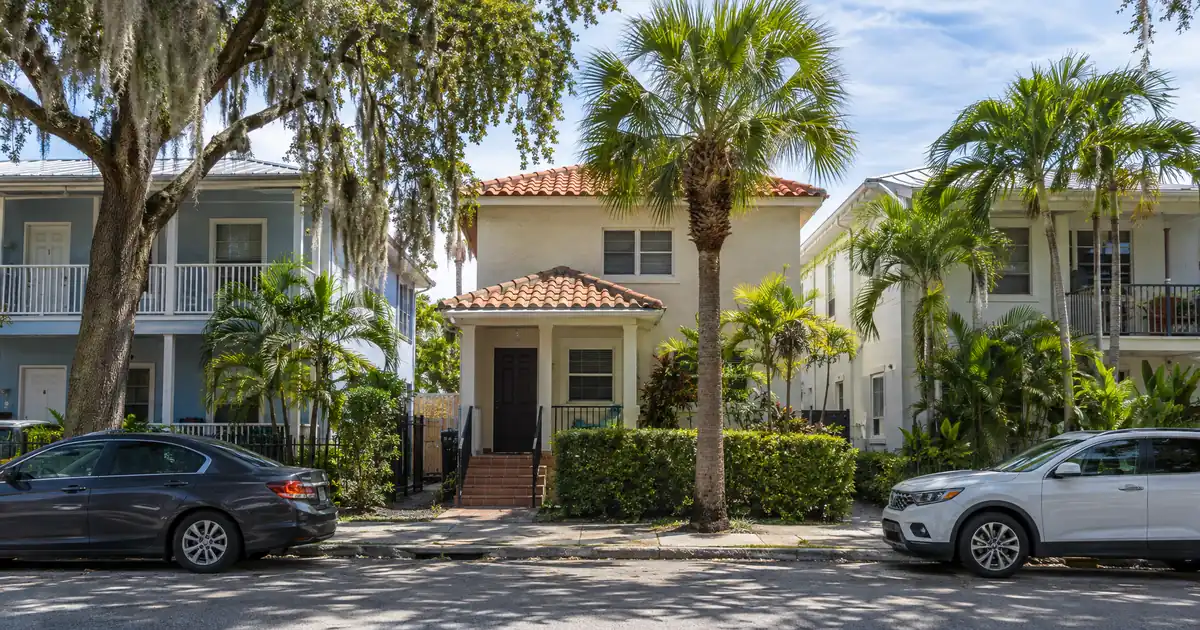
Eight homes sold in the month Redfin measured, and Redfin put the median sale price at $420K. An appraiser working that sample has almost nothing to anchor on. That is the real friction in pulling equity out of an Opa-locka rental: the borrower’s credit and rent roll are rarely the problem. The comparable-sales file is. Everything below is built around that constraint, because it decides how much equity is actually reachable once a 75% LTV ceiling is applied. Every figure here varies by lender and program — guidelines, property type, leverage, and credit profile all apply.
DSCR Cash-Out Calculator
Run the cash-out numbers in Opa Locka, FL
Rate source: Freddie Mac 30-yr average via FRED® — Federal Reserve Bank of St. Louis · effective Sep 24, 2026
Prefilled with starting assumptions — enter your property’s value, balance, taxes, and insurance for a more accurate picture.
Program parameters update from Lendmire’s centralized guideline source. Taxes and insurance are editable estimates.
As of Sep 24, 2026 · General Freddie Mac market benchmark, not a Lendmire loan offer. Property value, balance, taxes, and insurance are editable estimates. Maximum loan-to-value varies by lender, program, property type, and seasoning. Not a Loan Estimate, approval, or commitment to lend. Program availability and eligibility are subject to lender guidelines, credit approval, property review, and underwriting.
The Quick Read:
A cash-out refinance on an investment property in Opa Locka, Florida is a DSCR-underwritten loan that converts existing equity into capital. It is qualified primarily on the property’s rental income measured against its full monthly obligation, with proceeds capped by a 75% loan-to-value ceiling, subject to lender guidelines.
- Zillow puts the average Opa-locka home value at $473,828, down 1.6% year over year.
- About 69% of households rent, per RentCafe, which means a deep tenant pool.
- Small multifamily is 7.32% of housing units, per NeighborhoodScout.
- Asking rents fell 4% year over year, per Miami Realtors. Underwrite flat.
Opa Locka Market Snapshot
A quick read on the Opa Locka investor landscape — figures come from the cited sources below. Confirm current property-level numbers before underwriting.
| Metric | Detail |
|---|---|
| Home prices | $420K median (Redfin Housing Market Data) |
| Typical rents | $2,061 avg (RentCafe Average Rent Market) |
| Cap rates | 6.3% cap rate (Redfin) |
| Employment | 3,220 employees (Miami-Dade Fire Rescue) |
What Six Months of Seasoning Buys (and What It Doesn’t)
Seasoning is the smallest hurdle here. Most programs look for about six months of ownership measured from title recording. The harder question is whether six months, or six years, produced equity that survives a 75% LTV cap.
Start with the price data, which disagrees with itself. Zillow’s average value of $473,828 is the figure used throughout this piece. Redfin’s sold-home median sits lower at $420K, which reflects a different methodology and a tiny monthly sample. Redfin also shows price per square foot up 12.7% year over year, while Zillow shows values down 1.6%. Both can be true in a market this thin. NeighborhoodScout ranks Opa-locka’s latest annual appreciation above 60% of Florida cities and towns. Above average, not spectacular.
The practical read: an owner who bought at a recent peak may find a 75% ceiling leaves little to extract. An owner who bought before the last few years of gains, or who added units or rehabbed, is in a different position. Equity available depends on rent used for lender review, full PITIA, reserves, and the LTV ceiling. It is not a guaranteed figure. The equity-extraction mechanics page walks through how those pieces interact.
Coverage Math: Single-Family Versus Fourplex
Small multifamily clears the coverage test here. Single-family at the same leverage mostly does not. That split should drive which asset an investor refinances first.
The table below uses modeled assumptions, not sourced market facts. Both cases assume 75% LTV and full PITIA, meaning principal, interest, taxes, and insurance on a standard 30-year structure. Final terms depend on lender guidelines, property type, leverage, and the borrower’s complete credit picture.
| Factor | Single-family | Fourplex |
|---|---|---|
| Modeled value | about $475,000 | about $720,000 |
| Rent assumption | $2,164 | four 1BRs, $1,350-$2,035 each |
| LTV modeled | 75% | 75% |
| Coverage incl. Taxes and insurance | roughly 0.70-0.80 | roughly 1.15-1.40 |
The inputs have sources. The $475,540 median price and $2,164 average rent for the Opa-locka Northeast submarket come from NeighborhoodScout. The fourplex figure comes from a Redfin listing with four 1BR/1BA units, a 6.3% cap rate, and a $720,000 FHA appraisal. The unit rent band is RentCafe’s 1-bedroom range of $1,350 to $2,035. The coverage bands are rounded down on purpose.
That single-family number is below 1.00. Standard programs are commonly built around a 1.00x benchmark because rent covers the obligation at that level. Some lenders will review lower ratios, but usually with lower leverage, different pricing, or more cash in. An owner in that position has options a lender would review: a sub-1.00 program, an interest-only structure, or a smaller cash-out request that brings leverage down. None of those is an approval. Each is subject to credit review, reserves, and property underwriting. Background on the ratio itself is in the DSCR fundamentals, and the comparison covers why investors use this structure in place of conventional underwriting.
The fourplex pulls more equity at better coverage. The single-family house may carry the stronger appreciation story. Refinancing the fourplex first and holding the house is the cleaner default.
The Submarkets That Matter
No reliable per-neighborhood median price turned up in the research. That is a data gap, so what follows is directional, not numeric.
Magnolia North. The former “Triangle” has been rebuilt over decades by the Opa-locka Community Development Corporation. The National Endowment for the Arts credits that effort with more than 2,000 new housing units, including more than 1,400 affordable units, plus rehabilitation of over 200 abandoned and foreclosed single-family homes. For a refinance, the concern is appraisal depth. Renovated stock next to older stock makes comp selection contentious.
Magnolia Gardens and Bunche Park. These are mid-century bungalow blocks, mostly two- and three-bedroom single-family homes. They are simple, reviewable product with clean comps. They also look like the 0.70-0.80 coverage case in the table, so they are better suited to lower-leverage cash-out requests.
The airport-adjacent corridor. Streets bordering the airport mix small multifamily, single-family rentals, and industrial parcels. Tenants skew toward airport and logistics workers. It is the best fit for the fourplex math above.
Rainbow Park, Pine Tree Park-Golden Highlands, and Opa-locka North. Mixed single-family and small multifamily. Here the comp problem gets acute. Redfin shows multifamily listings in Opa-locka North at a median near $1M, sitting roughly 162 days. Thin bidding means fewer, older comps when an appraiser needs to support a number. Good for the acquisition side. Less helpful at refinance.
Mind the dispersion in the data, too. Sources put the median home value anywhere from $169,049 to $473,828. Underwrite off hyperlocal comps, not a citywide average.
The airport corridor has another draw.
Amazon operates an 885,000-square-foot fulfillment center at the Carrie Meek International Business Park, inside the airport complex, and the Miami Times reported plans to hire more than 1,000 workers there. Around it sits Miami-Opa Locka Executive Airport, a county-operated general-aviation field with flight training, charter operators, and maintenance shops, adjacent to a Coast Guard air station. By the airport’s own history, the site already had 120-plus base tenants and 3,000 workers by 1951. Employment here is old, and it is diversified across many small operators, not one tenant.
Resident employment tells the same story. Data USA lists retail trade (818 people), transportation and warehousing (793), and health care and social assistance (755) as the top sectors among residents. Nearby hospitals feed the third group, including Jackson Health System facilities, plus Hialeah Hospital and Palmetto General in neighboring Hialeah. FIU’s Biscayne Bay Campus, with more than 7,000 students, is a secondary renter pool 20-25 minutes away. None of this guarantees a particular rent. It does mean a vacancy is backfilled from a wide hourly-wage pool. Population is modest: 16,463 at the last census, up from 15,219, per Wikipedia’s Census-cited profile.
Where the Proceeds Go (and Where They Shouldn’t)
Cash-out proceeds are only useful if the next deal is better than the asset they came from. In this market that usually means one of two moves: a second small multifamily acquisition, or rehab capital on an existing unit that lifts rent and appraised value together.
Program guardrails, typically: a credit floor of 620 with tiers at 660, 680, and 700, about six months of PITIA in reserves (about nine above $1,500,000), and loan sizes up to $3,000,000 on standard programs. Smaller balances route through select lenders in the network. Manufactured homes, log homes, and barndominiums fall outside these programs. LLC-titled borrowers are generally workable, subject to lender program eligibility. All of this varies by lender, property, and borrower, so it should be confirmed before anyone plans around it.
The experience pattern on files from markets like this one is consistent. The cleaner files from a documentation standpoint tend to arrive with a current lease or rent schedule for every unit, an insurance quote dated close to the application, and a clear entity structure. The common friction point in thin-comp markets is the appraisal, not the borrower: when fewer than a handful of similar sales exist, the valuation can land below the owner’s expectation, and the 75% cap then applies to the lower number. Owners who budget for that gap rarely get surprised by it.
For the wider menu of refinance structures, Lendmire’s guide to investment property refinance options covers the main choices. Lendmire’s Florida DSCR investor loans page covers state-level context.
What’s the Catch?
Three things.
First, rents. Opa-locka was one of only a handful of Miami-Dade submarkets with a year-over-year asking-rent decline, roughly 4%, per the Miami Realtors report and Miami Finance Review. Other submarkets posted gains. This looks like a workforce-tier softening, not a metro trend. Stress-test coverage at flat or slightly lower in-place rents. A month-to-month Zumper uptick of 7.76% exists in the brief too, but it is a single-month signal and was not used here.
Second, sample size. With sales volume this low, one closed comp can move a median by double digits. The Redfin and Zillow gap is the visible symptom.
Third, the modeled coverage bands above are illustrations. The actual number depends on the real tax bill, the real insurance quote, and the real lease. Verify current local rules, taxes, and insurance with qualified Florida professionals before committing.
Frequently Asked Questions
Can a single-family rental in Opa-locka support a cash-out refinance?
Sometimes, but expect low coverage at full 75% LTV. Modeled on local rent and price data, including taxes and insurance, the ratio lands below 1.00. Lower leverage, a sub-1.00 program, or an interest-only structure may be reviewed, subject to lender guidelines.
DSCR vs. conventional financing
Two common ways to finance an investment property in Opa Locka, FL. They qualify you differently — here’s how investors weigh them.
Why investors choose it
- Qualifies on the property’s rental income — no personal tax returns, W-2s, or pay stubs needed to document income.
- No personal debt-to-income ceiling to clear, so existing mortgages and obligations don’t cap your borrowing the same way.
- Can be closed in an LLC, keeping the property inside a business entity.
- Built for scaling — not held to the limit on number of financed properties that conventional financing applies.
- Underwriting centers on the deal: generally qualifies when the rent covers the payment, a 1.00x coverage ratio being a common baseline (confirmed in underwriting).
- Designed specifically for investment property, including long-term and, where the program allows, short-term rentals.
Where it’s strong
- Often the lowest ongoing financing cost for a buyer who fully qualifies on personal income — a fit for a first property or a cost-first purchase.
Trade-offs for investors
- Requires full personal income documentation and must fit within a debt-to-income limit — salary, existing debts, and other mortgages all count.
- Typically held in your personal name rather than a business entity.
- Caps how many financed properties you can carry, which can become a ceiling as a portfolio grows.
- Evaluates you as a borrower as much as the property, which usually means more paperwork.
How investors usually choose: a first or single property often optimizes for the lowest financing cost; portfolio builders often optimize for leverage, vesting in an LLC, and scaling past conventional caps. The right answer depends on your goals, the property, and current guidelines — both paths run through select lenders in Lendmire’s wholesale network, with eligibility and terms confirmed in underwriting.
Why do appraisals matter more here than in a bigger Miami-Dade city?
Sales volume is thin. Redfin recorded eight home sales in its measured month, and Opa-locka North multifamily listings sit around 162 days. Appraisers then rely on fewer, older comps, and the 75% cap applies to whatever value they support.
Does a fourplex refinance differently than a house?
Income stacks across units, so coverage tends to clear more easily. A modeled fourplex near a $720,000 value and four 1BR rents in the $1,350-$2,035 range runs roughly 1.15-1.40 including taxes and insurance. The property still goes through full review.
How long must I own before pulling equity out?
About six months, measured from title recording, on typical programs. Seasoning does not create equity. It only opens the door, and the LTV ceiling then sets how much can come out.
Is the airport a real demand driver or a talking point?
It is a real driver. Amazon’s 885,000-square-foot fulfillment center sits inside the airport complex, and Data USA shows 793 residents in transportation and warehousing. Tenants near the corridor commute to hourly jobs spread across many employers.
The Real Choice
Owners here face a fork, and it isn’t obvious. Refinance the fourplex near the airport and take cleaner coverage, but accept the longer hold and thin-comp appraisal risk in a submarket where asking rents slipped. Or refinance the bungalow in Magnolia Gardens at lower leverage, take a smaller draw, and keep the appreciation upside in a house that won’t cover its obligation on rent alone. To discuss either path on an actual file, call Lendmire at 828-256-2183 or talk through the file. Either way, Opa-locka rewards the owner who has priced the appraisal gap before the application, not after it.
For current guidelines and terms, see Lendmire’s DSCR loan programs page.
About Lendmire
Lendmire (NMLS# 2371349) is a mortgage brokerage built around DSCR investor lending, with programs available in 41 markets, including Washington, D.C. DSCR lenders commonly evaluate rental-income coverage instead of personal income paperwork, a practical fit for LLC-owned and multi-property investors. Terms vary by lender, property, leverage, and program. The firm is recognized as a 2026 Scotsman Guide Top Mortgage Workplace and a 2025 Scotsman Guide Top Workplace.
Get Started
Ready to find the right loan for you?
In about 30 seconds you can review financing options available for your investment property. No commitment required.
Informational only. Not a Loan Estimate, approval, or commitment to lend. Program availability and eligibility are subject to lender guidelines, credit approval, property review, and underwriting.
References
1. Redfin
2. Zillow
3. RentCafe
9. RentCafe’s
10. National Endowment for the Arts: Opa-locka Community Gateways
11. Redfin
12. the Miami Times
13. Miami-Opa Locka Executive Airport
17. a 2026 Scotsman Guide Top Mortgage Workplace
18. a 2025 Scotsman Guide Top Workplace
This article is part of Lendmire’s investment property cash-out refinance program — full qualification details, guidelines, and scenarios live on the program page.
Related reading: DSCR Cash Out Refinance in Opa Locka, Florida: Will Your Rent Cover the New Loan Payment? · DSCR Cash Out Refinance in Miami Gardens, Florida: How Rent Math Clears at 75% LTV in Norland · DSCR Cash Out Refinance in Islamorada, Florida: How the Cash-Out Math Clears in Islamorada
Guides: Investment Property Cash-Out Refinance in Florida
Brandon Miller
Founder & CEO, Mortgage Loan Originator, Lendmire LLC
- Mortgage Loan Originator · NMLS# 1129696 · Verify on NMLS Consumer Access
- North Carolina Real Estate Broker · License# 343312 · Verify on NCREC
- North Carolina Insurance Producer · License# 19053198 · Property, Casualty, Life, Health · Verify on NAIC SBS
- Lendmire LLC · Firm NMLS# 2371349 · Verify firm licensure
Compliance and disclosures. Lendmire (NMLS# 2371349) is a licensed mortgage broker and is not a direct lender, depository institution, financial advisor, or tax professional. Content in this article is general market analysis and educational information — not financial, legal, or tax advice for any specific situation. Lendmire does not guarantee loan approval; every transaction is subject to underwriting by the funding lender. Mortgage pricing and loan program guidelines are subject to change at any time without notice and vary by borrower characteristics, property type, and state regulations. Lendmire complies with Equal Housing Opportunity. Licensure verification: NMLS Consumer Access.