
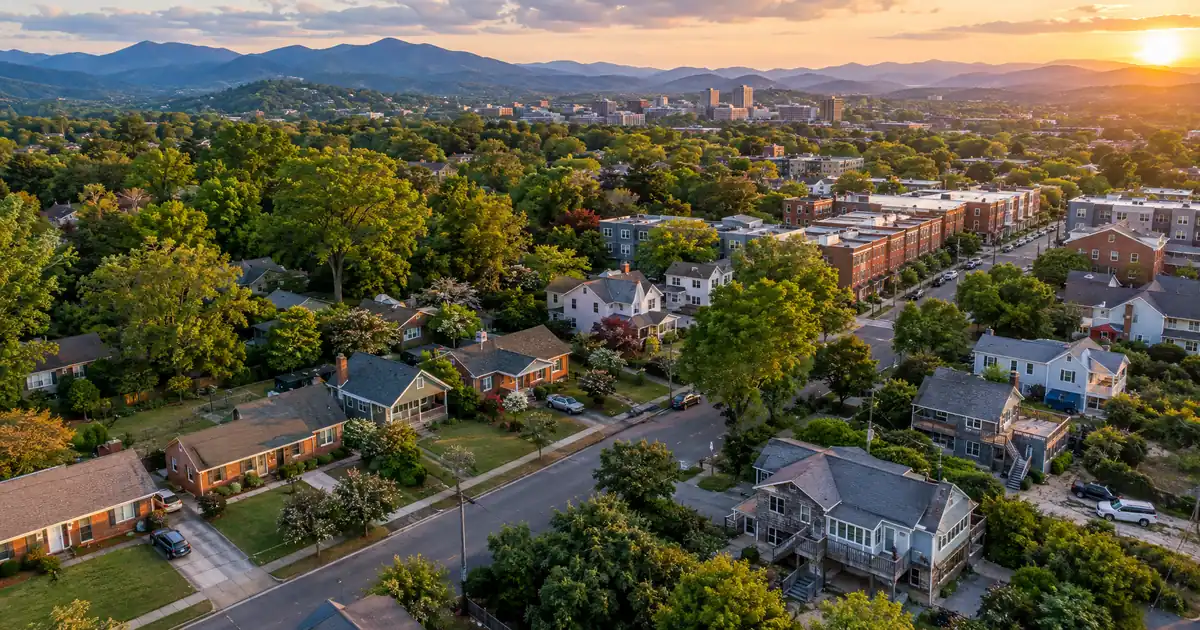
The obvious objection to a cash-out refinance in Asheville is that the rental market looks soft. CoStar data reported by Asheville Watchdog shows market-rate multifamily vacancy peaked at 17%, up from 5.5% three years earlier, and has since eased to 14.5%. Average multifamily rent slid from $1,728 to $1,630 over the same stretch. Why pull equity out of a property in that environment?
Because the glut has a shape, and the shape matters to collateral. The oversupply sits in new Class A buildings offering concessions, not in the older workforce stock where most duplexes and small multifamily live. This article addresses that objection directly, then works through the equity-extraction mechanics: seasoning, the 75% LTV ceiling, and which Asheville submarkets give a lender the cleanest file. These specifics are subject to lender guidelines and a full review of property, leverage, and credit.
DSCR Cash-Out Calculator
Run the cash-out numbers in Asheville, NC
Rate source: Freddie Mac 30-yr average via FRED® — Federal Reserve Bank of St. Louis · effective Sep 24, 2026
Prefilled with starting assumptions — enter your property’s value, balance, taxes, and insurance for a more accurate picture.
Program parameters update from Lendmire’s centralized guideline source. Taxes and insurance are editable estimates.
As of Sep 24, 2026 · General Freddie Mac market benchmark, not a Lendmire loan offer. Property value, balance, taxes, and insurance are editable estimates. Maximum loan-to-value varies by lender, program, property type, and seasoning. Not a Loan Estimate, approval, or commitment to lend. Program availability and eligibility are subject to lender guidelines, credit approval, property review, and underwriting.
Lendmire structures DSCR scenarios for investors targeting Asheville, North Carolina and places them with wholesale lenders across 41 markets, including D.C. (NMLS# 2371349). The brokerage arranges the loan. Lenders review eligibility and make credit decisions.
At a Glance: A cash-out refinance on an Asheville rental is underwritten primarily on the property’s rental income measured against its full monthly obligation, and that matters because the city’s rent softness is concentrated in new construction, where CoStar-reported vacancy peaked at 17%, rather than in older small-unit stock.
- Cash-out LTV tops out at 75%, a hard ceiling on this program type.
- Seasoning runs about 6 months from title recording before cash-out.
- Older duplex stock in West and East Asheville is the cleanest collateral.
- Single-family at current price levels often lands under 1.00x at full leverage.
- Size proceeds on today’s value, not on appreciation during seasoning.
Asheville Market Snapshot
A quick read on the Asheville investor landscape — figures come from the cited sources below. Confirm current property-level numbers before underwriting.
| Metric | Detail |
|---|---|
| Home prices | $440,000 median property value (Data USA) |
| University enrollment | 23,000+ students/year (A-B Tech news) |
What the Vacancy Numbers Actually Say
The vacancy problem is real but it is a new-construction problem. A Dewey Property Advisors report built on CoStar tables split the market by building class. Four- and five-star product showed 13.5% vacancy at $1,736 asking rent. Three-star showed 12.6% at $1,622. One- and two-star stock, the older and cheaper buildings, showed 6.5% vacancy at $1,032. The same report counted roughly 2,900 units under construction, which would add 12.3% to inventory.
Two caveats. The report is a year old, and the one- and two-star sample is only 1,957 units, so treat the class split as directional. Still, the direction is consistent: tenants priced out of concession-heavy new buildings have fewer alternatives at the bottom of the market, not more.
A separate Tactica RES analysis found Asheville’s permit pipeline equal to 7.65% of existing apartments, against a national median of 1.95%. That is a ceiling on rent growth for the next couple of years. A cash-out plan that depends on a post-renovation rent bump carries more risk here than one built on in-place leases.
Citywide rent data tells the same story. Zillow’s rental data puts average rent at $1,895, down $208 year over year, and rates the market “cool.” Zumper reports a lower figure with a different method. The level is debatable. The direction is not.
Seasoning and Leverage: What the 75% Ceiling Does Here
Cash-out proceeds in Asheville should be sized on today’s value, not on projected appreciation. The market gives no reason to lean on momentum. Redfin reports a median sale price near $498K, down 2.9% year over year, with 66 days on market against 62 a year earlier. Price per square foot sits at $315, down 2.5%. Zillow’s home value index runs lower, at $458,266, reflecting a different methodology.
A local brokerage analysis found days on market at the highest second-quarter level in a decade, inventory above the prior four years across nearly every price range, and price per square foot falling in most brackets. Appraisers will have plenty of comparables and little upward pressure.
For an investor, the mechanics are straightforward. The program generally requires about 6 months of ownership measured from title recording before cash-out. LTV caps at 75%. The minimum coverage benchmark is 1.00x on rent used for lender review against full PITIA. Credit tiers step up from a 620 floor, and reserves typically run about 6 months of PITIA. Loan amounts go up to $3,000,000 on standard programs. All of this is subject to lender guidelines, and the cash-out qualification details lay out how those pieces interact. The equity that comes out is whatever survives three tests: the rent, the PITIA and the 75% ceiling. It is not a guaranteed cash figure.
Working DSCR brokers see a recurring pattern in soft-rent mountain markets like this: owners anchor on the price they would have gotten a couple of years ago, then discover that the appraisal and the coverage ratio cap proceeds well below what they expected. The files that go smoothly start with an honest value estimate, in-place leases in hand and reserves already documented.
The refinance decision here is also a coverage problem, and the DSCR qualification mechanics start from rent divided by the full monthly obligation. Run the numbers on a modeled single-family near West Asheville’s ZIP average of $399,511, with rent at the $1,818 ZIP average, both from a market source citing Zillow. At full 75% leverage, including taxes and insurance, coverage lands well under 1.00x. That is the best rent-to-price ratio the research found among Asheville ZIPs, and it still does not clear the benchmark at maximum leverage. Terms vary by lender guidelines, property type, leverage, credit profile, and full file review.
That does not close the door. A lender may review lower LTV to bring the ratio up, a sub-1.00 program with compensating factors, or an interest-only structure. Each carries trade-offs in pricing, leverage or reserves, and qualification remains subject to credit approval and property review. The smarter move for many single-family owners is to accept a smaller draw rather than force the full 75%.
West and East Asheville: Where the Collateral Sits
Older small-unit stock in West Asheville and East Asheville gives a cash-out file its best footing. West Asheville, including ZIP 28806, is the most affordable of Asheville’s core neighborhoods, and it is the only ZIP under $400K in the market source series. Homes.com lists single-family medians near $475,000 there, a directional figure from a listing aggregator. The Haywood Road corridor of cafés, breweries and music venues keeps tenant demand anchored. Asheville Beat says West Asheville has the “longest waitlist energy” in the city, with one-bedrooms running $1,400 to $1,900.
The tenant base skews toward hospitality, creative and service-sector workers. Their lease behavior is steadier than the tourism image suggests, since the demand runs on year-round employment, not seasonal visitors.
East Asheville, Oakley and Haw Creek are the less glamorous counterpart. The housing is older single-family, duplex and small multifamily east of downtown. The research found no independent price source for the area and no neighborhood rent data I can cite, which is a genuine gap. Its relevance is structural: this is the type of building the CoStar class split suggests has held occupancy better than new complexes. Picture an investor who bought an older East Asheville duplex before the recent price softening. Two units of rent stack against one mortgage, and that stacking is what moves coverage toward 1.00x where a single-family cannot.
Some context for the rent math: Rentometer shows two-bedrooms at $1,779, three-bedrooms at $2,320 and four-plus bedrooms at $3,295 across all property types. That is the closest proxy the research has for house rents. Two-bedroom units in a duplex at that level stack to a meaningful gross figure, but without a verified duplex price the coverage ratio cannot be responsibly modeled. A lender will want leases and, for converted buildings, confirmation that the units are legal and separately metered.
The Close-In Lower-Cost Pockets
South French Broad, Biltmore Village and the East End–Valley Street area carry the lowest one-bedroom rents in the research. Rent.com puts averages at $856 for South French Broad, $1,380 for Biltmore Village and $1,385 for East End–Valley Street. The tenants are workforce and service-sector renters.
The complication is that Biltmore Village and the River Arts District flooded during Hurricane Helene, and 828 News Now reports that Buncombe County identified 379 homes destroyed. No reliable price source turned up for these areas. A cash-out here needs the same verification any flood-affected collateral needs, and investors should confirm current local rules, taxes, flood zone and insurance requirements with qualified local professionals before committing.
Skip the High-Basis Pockets.
North Asheville, Montford and Grove Park offer historic housing near UNC Asheville and downtown, and tenants tend to be long-stay. The basis is the problem. Homes.com puts the Grove Park single-family median near $1M. A separate Homes.com snapshot of North Asheville multifamily listings showed prices from $689,000 to $1,095,000, dated and drawn from about five listings, so use it only as a price band. No reliable neighborhood rent source exists. At those prices, rent stacking has to be enormous to approach the 1.00x benchmark, and a 75% ceiling leaves little room.
South Slope and downtown are a weaker fit for a different reason. Newer rental stock competes on concessions, and parking can add $75 to $150 a month on top of rents of $1,550 to $2,200 for one-bedrooms. Downtown condos run about $555,000 for a one-bedroom. That is the exact segment where the oversupply is concentrated. Not a cash-out candidate.
This is a genuine trade-off for investors who hold North Asheville property for appreciation. Holding makes sense if the equity is already there and no draw is needed. As a source of extractable capital, it is thin.
The Tenants Under the Tourism Image
Asheville’s tourism reputation obscures its steadiest rental demand. The city’s population is 94,983 per Census Reporter’s ACS data, with median household income of $78,996 and a median age of 43.7. Data USA shows health care and social assistance as the largest resident employment sector at 7,796 workers, ahead of accommodation and food services at 5,946. About 48% of households rent, per RentCafe.
Mission Health, part of HCA Healthcare, employs thousands across a regional system and serves as the region’s trauma referral center. A-B Tech says it serves over 23,000 students a year, and its nursing leadership has said about 85% of graduates go to work for a Mission or HCA facility. Pratt & Whitney adds more than 1,800 aerospace jobs, per Roth Capital. Those are year-round paychecks, less seasonal than hotel occupancy, which WLOS reported at 51% in one recent winter month, down 11 points.
For a lender reviewing long-term rent, that matters. The income stream underneath a twelve-month lease is healthcare and aerospace wages, not visitor spending. A DSCR file built on in-place leases reads that way. No verified cap-rate data turned up for Asheville, so the pricing case rests on rent-to-price and coverage rather than yield compression.
Where the Equity Goes Next
Cash-out proceeds are capital for the next acquisition, and in Asheville the next acquisition should probably look like the collateral that funded it. The soft pricing that limits appraisals also creates buy-side opportunity: days on market are stretching, inventory is deep and sellers are negotiating. An investor who pulls capital from a seasoned older duplex and redeploys into a comparable workforce building is buying in a market with real comparables and little competition. The bet is on basis, not on appreciation.
The sequencing matters. The 6-month seasoning clock runs from title recording, so an owner who acquired recently can calendar the draw. Reserves, typically about 6 months of PITIA, have to be documented before the refinance, not after. Investors weighing this against other paths can review refinancing options or the side-by-side comparison of DSCR against conventional financing. The state-level picture is covered under North Carolina DSCR financing.
Investors with a specific property can talk through the file or call 828-256-2183.
Frequently Asked Questions
Does Asheville’s high apartment vacancy hurt a cash-out refinance on a duplex?
Only indirectly. The 17% peak and the later 14.5% reading describe market-rate multifamily, where new Class A buildings dominate the inventory. A lender reviewing a duplex looks at in-place leases and the property’s own rent, so a fully leased older building is judged on its own rent roll. A weak citywide number still influences appraisers, which is why proceeds should be sized conservatively.
DSCR vs. conventional financing
Two common ways to finance an investment property in Asheville, NC. They qualify you differently — here’s how investors weigh them.
Why investors choose it
- Qualifies on the property’s rental income — no personal tax returns, W-2s, or pay stubs needed to document income.
- No personal debt-to-income ceiling to clear, so existing mortgages and obligations don’t cap your borrowing the same way.
- Can be closed in an LLC, keeping the property inside a business entity.
- Built for scaling — not held to the limit on number of financed properties that conventional financing applies.
- Underwriting centers on the deal: generally qualifies when the rent covers the payment, a 1.00x coverage ratio being a common baseline (confirmed in underwriting).
- Designed specifically for investment property, including long-term and, where the program allows, short-term rentals.
Where it’s strong
- Often the lowest ongoing financing cost for a buyer who fully qualifies on personal income — a fit for a first property or a cost-first purchase.
Trade-offs for investors
- Requires full personal income documentation and must fit within a debt-to-income limit — salary, existing debts, and other mortgages all count.
- Typically held in your personal name rather than a business entity.
- Caps how many financed properties you can carry, which can become a ceiling as a portfolio grows.
- Evaluates you as a borrower as much as the property, which usually means more paperwork.
How investors usually choose: a first or single property often optimizes for the lowest financing cost; portfolio builders often optimize for leverage, vesting in an LLC, and scaling past conventional caps. The right answer depends on your goals, the property, and current guidelines — both paths run through select lenders in Lendmire’s wholesale network, with eligibility and terms confirmed in underwriting.
Can a single-family rental in West Asheville support a full 75% cash-out?
Often not on rent alone. A modeled home near the 28806 average price, with rent near the ZIP average, falls well under 1.00x including taxes and insurance at full leverage. Options a lender may review include lower LTV, a sub-1.00 program or interest-only structuring. Each comes with trade-offs, and eligibility depends on credit, reserves and property review.
How long must an investor own an Asheville property before pulling equity?
Seasoning is typically about 6 months, measured from title recording. Flat-to-softening prices mean the value on day 180 may look like the value at purchase, so proceeds should be modeled on today’s numbers.
Are properties damaged by Hurricane Helene eligible?
Eligibility turns on the property’s current condition and program review, not on its location label. Areas such as Biltmore Village and the River Arts District flooded, and rebuilding is ongoing. Investors should verify flood zone and insurance requirements with qualified local professionals, and expect the lender to ask about repairs.
What is the minimum credit score for a DSCR cash-out in Asheville?
Credit tiers generally start at a 620 floor and step up through 660, 680 and 700, with better tiers typically supporting stronger leverage and pricing. The exact tier depends on the lender and program. Reserves of about 6 months PITIA are typical, rising to about 9 months above $1,500,000.
The Closing Read
Asheville rewards owners of older small-unit stock who draw equity on today’s values and redeploy into similar buildings while the new-construction glut works itself off. Investors who size the draw honestly and buy basis during this soft stretch will come out ahead.
For current guidelines and terms, see Lendmire’s DSCR loan programs page.
About Lendmire
Lendmire, NMLS# 2371349, is a mortgage brokerage specializing in DSCR investor loans, helping arrange financing across 41 markets, including Washington, D.C., through wholesale and investor-lending channels. The model centers on property-level rental income reviewed by the lender rather than W-2 documentation, subject to lender guidelines, and suits entity-owned and multi-property investors. Lendmire is recognized as a 2026 Scotsman Guide Top Mortgage Workplace and as a top-ranked workplace in 2025.
Get Started
Ready to find the right loan for you?
In about 30 seconds you can review financing options available for your investment property. No commitment required.
Informational only. Not a Loan Estimate, approval, or commitment to lend. Program availability and eligibility are subject to lender guidelines, credit approval, property review, and underwriting.
References
1. Asheville Watchdog (CoStar data)
3. A-B Tech
4. Dewey Property Advisors CoStar report
7. Redfin Asheville housing market
8. mymosaicrealty.com — Asheville and Buncombe County Market Analysis
10. Asheville Beat
11. Rentometer
12. Rent.com
13. 828 News Now
14. Census Reporter, Asheville profile
15. RentCafe
16. Roth Capital
17. WLOS reported
18. a 2026 Scotsman Guide Top Mortgage Workplace
19. Scotsman Guide — Top Workplaces 2025
This article is part of Lendmire’s investment property cash-out refinance program — full qualification details, guidelines, and scenarios live on the program page.
Related reading: Cash Out Refinance Investment Property Asheville North Carolina · DSCR Investment Property Loans in Asheville, NC: What It Takes to Qualify on Local Rent · DSCR Loans North Carolina: Investor Financing for OBX, Asheville, Charlotte, and Real Estate Investors
Guides: Investment Property Cash-Out Refinance in Asheville, NC · Investment Property Cash-Out Refinance in North Carolina
Brandon Miller
Founder & CEO, Mortgage Loan Originator, Lendmire LLC
- Mortgage Loan Originator · NMLS# 1129696 · Verify on NMLS Consumer Access
- North Carolina Real Estate Broker · License# 343312 · Verify on NCREC
- North Carolina Insurance Producer · License# 19053198 · Property, Casualty, Life, Health · Verify on NAIC SBS
- Lendmire LLC · Firm NMLS# 2371349 · Verify firm licensure
Important disclosures. Lendmire (NMLS# 2371349) is a licensed mortgage brokerage. Lendmire is not a direct lender, depository institution, or financial advisor. All loan inquiries are subject to lender underwriting; this article does not constitute a commitment to lend. Rates, terms, and program guidelines are subject to change without notice and vary by borrower profile, property type, and state. Information in this article is general in nature and is not financial, legal, or tax advice. Equal Housing Opportunity. NMLS Consumer Access: nmlsconsumeraccess.org.