
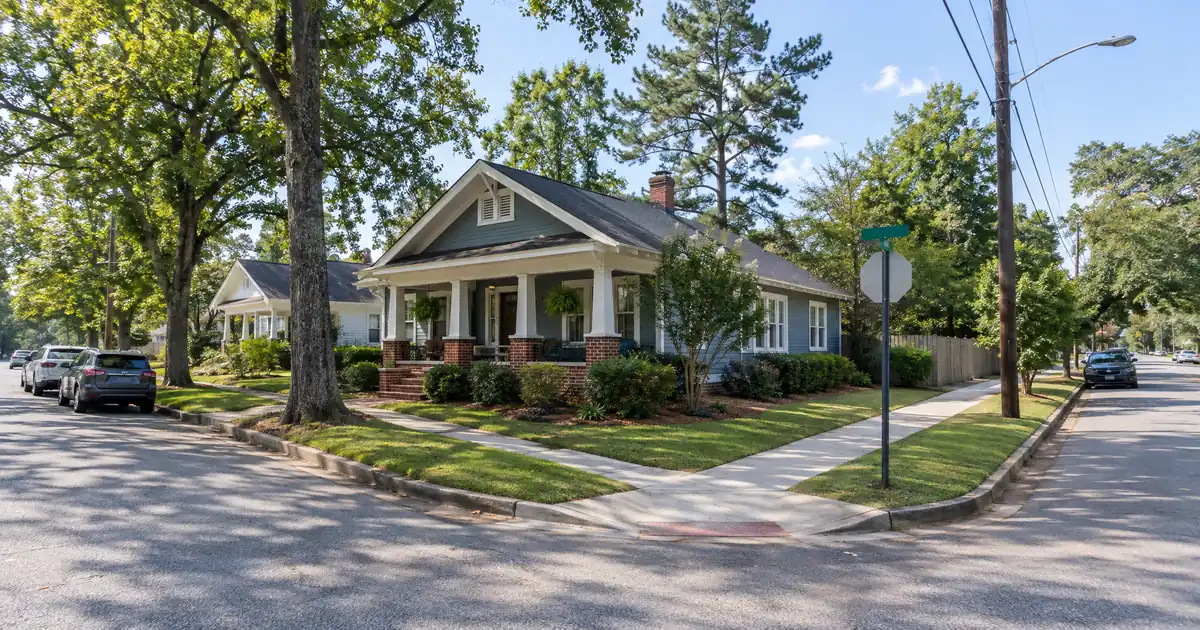
A rental in south Auburn near the I-85 corridor hits the DSCR math like this. Model a duplex valued around $310K, the median list price Redfin shows for multifamily homes for sale in Auburn. Put two 2BR units in it at the $1,350 average 2BR rent shown on Apartments.com’s Auburn duplex page. Refinance at 75 percent of value with taxes and insurance in the payment, and coverage lands north of 1.4. Those are modeled inputs, not a closed deal. Swap in a median-priced single-family house and the same test falls well under 1.00.
That gap decides almost every cash-out conversation in this market. Lendmire (NMLS# 2371349) places DSCR investor loans on Auburn, Alabama properties through wholesale lending channels reaching 41 markets, including D.C. The team’s read is that Auburn has plenty of equity and thin single-family coverage, and duplexes are where the two can meet.
DSCR Cash-Out Calculator
Run the cash-out numbers in Auburn, AL
Rate source: Freddie Mac 30-yr average via FRED® — Federal Reserve Bank of St. Louis · effective Sep 24, 2026
Prefilled with starting assumptions — enter your property’s value, balance, taxes, and insurance for a more accurate picture.
Program parameters update from Lendmire’s centralized guideline source. Taxes and insurance are editable estimates.
As of Sep 24, 2026 · General Freddie Mac market benchmark, not a Lendmire loan offer. Property value, balance, taxes, and insurance are editable estimates. Maximum loan-to-value varies by lender, program, property type, and seasoning. Not a Loan Estimate, approval, or commitment to lend. Program availability and eligibility are subject to lender guidelines, credit approval, property review, and underwriting.
At a Glance: A cash-out refinance on an Auburn, Alabama rental moves from seasoned ownership, through an appraisal and signed leases, to a lender review of rental income against the full monthly obligation, with proceeds sized by a 75 percent loan-to-value ceiling rather than by the owner’s wish list.
- Zillow’s average Auburn home value is $423,354, up 4.2 percent year over year.
- Modeled duplex coverage clears 1.4 at 75 percent LTV; median-priced single-family lands near 0.7.
- Cash-out typically needs about six months of ownership, measured from title recording. Auburn University enrolls 35,733 students, anchoring tenant demand.
Auburn Market Snapshot
A quick read on the Auburn investor landscape — figures come from the cited sources below. Confirm current property-level numbers before underwriting.
| Metric | Detail |
|---|---|
| University enrollment | 35,733 total (Auburn University Institutional) |
| Employment | Nearly 5,000 full-time employees (Auburn University HR) |
Why Auburn Equity Is Real but Coverage Is Thin
Auburn has built real equity for owners, but rents have not kept pace with values. That pushes most single-family cash-outs into sub-1.00 territory before a lender even looks at credit.
Start with the demand base. Census Bureau QuickFacts puts the city at 82,025 in its most recent estimate, up from a census base of 76,566. Auburn University’s headcount is 35,733, with 29,693 undergraduates and 6,040 graduate students, per its institutional research office. That is equal to more than 40 percent of the city’s population. The university also says it is the largest employer in Lee County, with nearly 5,000 full-time employees, per Auburn HR. RentCafe reports that 47 percent of Auburn households rent, though other sources put owner-occupancy lower. Call it roughly half.
Now the price side. Sources disagree, so take a range. Zillow’s average value is $423,354. Redfin’s citywide page showed a $451,800 median, up 10.2 percent, with homes sitting 77 days versus 61 the prior year. Homes.com shows a $440,000 median in its latest reading and a lower figure, down 1 percent, in an earlier one. Direction is mixed and days on market are stretching. An appraiser may lean on conservative comps, so underwrite the cash-out at a modest LTV and don’t plan around peak-comp value.
Rents are the other half. RentCafe’s average is $1,967, up 7.37 percent, with 2BR at $1,587 and 3BR at $2,528. That survey only covers buildings of 50-plus units, so it skews toward newer student and institutional product. The Apartments.com duplex page shows lower averages: $1,350 for a 2BR and $1,741 for a 3BR. A small landlord’s house or duplex rents closer to the second set of numbers than the first.
The Duplex Math That Clears 1.00
Duplexes and small two-door properties are the structure most likely to clear 1.00 in Auburn. The price per door drops faster than the rent per door, and that is the whole game.
Run the numbers on the modeled case. Two 2BR units at $1,350 gross $2,700 a month against a $310K value. That is about 10.5 percent gross of price. The coverage ratio is monthly rent divided by the full monthly obligation: principal, interest, taxes, insurance, and any HOA dues. How DSCR coverage is calculated is straightforward. At 75 percent LTV including taxes and insurance, this case runs north of 1.4. That leaves cushion for a rent dip or a repair bill (which is rare in a DSCR file).
Not every duplex looks like that, though. Current listings on the Homes.com duplex page show the spread:
- Old-stock near campus. One duplex is rented month-to-month at $650 per side, and the listing pitches redevelopment. Those rents won’t support a cash-out until leases are reset to market. A lender wants signed leases, and a month-to-month below-market tenancy is a weak one to show.
- Newer townhome-style duplex units. A 3BR/3.5BA unit in a Creekside-type community is leased at $2,815 a month but carries $395 a month in HOA dues. HOA goes into the obligation, so a high rent can still produce ordinary coverage.
- Clean small duplexes with both sides leased. A 2BR/1BA duplex in the Tisdale Circle area has both units under lease. That is the cleanest file in the group: two signed leases and no HOA.
One caution on the thin inventory. Redfin shows only 5 multifamily listings in Auburn, and its page says most homes stay listed 180 days. Homes.com puts multifamily days listed at 65. The sources disagree, but both tell the same story: few comps and a slow exit. A cash-out that depends on a thin comp set is an appraisal risk, and a failed refinance on an illiquid duplex leaves the owner holding it.
Single-Family at the Median: Where Cash-Out Stalls
A median-priced Auburn house rarely clears 1.00 on long-term rent. Owners should plan on a smaller cash-out or a different structure.
Model it. Take a house at $440,000, the Homes.com median, renting at the $1,741 average 3BR figure. Gross rent is only about 4.7 percent of price. At 75 percent LTV with taxes and insurance in the payment, coverage comes out around 0.7. Even at RentCafe’s $2,528 3BR figure, which reflects large-building product rather than a house, coverage lands just about at 1.0 with no cushion. Run it at 65 percent LTV and it still sits under 1.00.
This is where honest guidance matters more than a sales pitch. Sub-1.00 files can be reviewed by select lenders, but they get harder. Options a lender may review include a sub-1.00 program at reduced leverage, an interest-only structure, or a rent reset if the current lease is below market. Each typically needs stronger credit, more reserves, and a smaller cash-out. Whether any of them fits depends on lender guidelines, credit approval, and property review.
The stronger play for most Auburn owners is probably a smaller cash-out on the house, or a cash-out on the duplex. The house-heavy investor with equity and thin coverage could argue for holding and waiting on rent growth. But waiting is a bet on rents, and rents are the soft spot.
Neighborhood Read: Where Equity Is Strong and Coverage Isn’t
Auburn’s highest-equity neighborhoods are its weakest DSCR candidates. The neighborhoods that pencil best sit farther from campus and closer to the I-85 corridor.
Downtown, Toomer’s Corner, and the campus edge. This is the walkable core of mid-rise apartments over restaurants. Homes.com shows median condo prices of $299,000 for a 1BR and $590,000 for a 2BR, per its rentals and neighborhoods page. Redfin’s Downtown Auburn page showed a $474K median, up 58.5 percent, but the sample is thin. Treat that number as noise, not trend. Demand is real and tenants are plentiful. The price per door, though, makes coverage tight. A cash-out here is an appraisal play, not a coverage play.
The Auburn University Club. Redfin shows a $650K median, up 0.8 percent, with homes selling in 7 days versus 99 the year before. Liquid and pricey. Good for equity, bad for coverage. Skip it for cash flow.
Grove Hill and Moores Mill. Grove Hill’s median single-family price is $595,000, and Moores Mill runs up to $2.35 million. Those are equity-rich holdings but not DSCR plays. Skip both unless the goal is a low-leverage refinance on a property that will carry itself.
Pine Hills and Asheton Lakes. Single-family medians of $382,000 and $399,900, sit at the low end of the city’s house pricing. They are still house-priced, so coverage on a single-family rental will stay near the 0.7-to-0.8 range unless rents outperform.
South Auburn and the I-85 corridor. This is where the math starts to cooperate. Apartment communities sit about 10 minutes from campus, and Apartments.com has named South Auburn and North Auburn as the city’s most affordable areas for rent. No source offers neighborhood-level rents, so this is a directional read. A local brokerage blog also calls Solamere a fit for affordable single-family rentals and multifamily. That is opinion, so check it against actual leases.
Small Multifamily Has a Ceiling
Small multifamily helps up to a point, then it falls outside standard programs. An 8-unit complex built in the 1980s is on the market near campus with 2BR/2BA units of roughly 1,013 square feet, marketed to student and professional renters. Homes.com shows Auburn multifamily priced from $300,000 to $7,500,000.
Two issues. First, 5-plus unit properties usually fall outside standard 1-to-4 unit DSCR programs, so an 8-unit is a different financing conversation. Second, 1980s stock carries a real capex reserve that belongs in the net income picture. The 2BR/2BA layout suits by-the-bedroom or roommate rentals, and it competes directly with purpose-built student operators. American Campus Communities’ 191 College uses leases of about 11.5 months that follow the academic calendar. Apartment prices in Auburn tend to start rising in the late summer, and cheap units are hard to find after August. Time lease starts for August, price against institutional supply, and expect student-unit turnover.
What Lenders Will Want to See
An Auburn cash-out file lives or dies on seasoning, leverage, and lease documentation, in that order. The program limits below are guideline ranges that vary by lender, borrower, and property.
- Seasoning: typically about six months of ownership, measured from title recording.
- Leverage: a 75 percent LTV ceiling on cash-out. That is a hard cap, separate from the higher purchase limit.
- Coverage: a 1.00 minimum is a common benchmark on select programs, with rent used for lender review measured against full PITIA.
- Credit: score tiers vary by scenario and typically step up through 660, 680, and 700. Better credit can improve leverage options.
- Reserves: about six months of PITIA, and about nine months above $1,500,000.
- Loan size: up to $3,000,000 on standard programs, with smaller balances routing through select lenders in the network.
Equity available depends on rent used for lender review, PITIA, reserves, and that 75 percent ceiling. It is not a guaranteed cash figure. Loans to LLC-titled borrowers are subject to lender program eligibility. For a side-by-side with bank financing, see the guide “Where DSCR and Conventional Diverge” against conventional loans.
On files from college-town markets like this one, Lendmire’s deal desk tends to see the same friction point. The cleaner files come in with signed leases on every door, HOA dues already in the payment math, and lease terms that show the rent is real rather than asking. Student-oriented properties with month-to-month or expired leases need paperwork fixed before the file goes to a lender. Owners with thin coverage who want to talk through structure can reach the team at 828-256-2183.
Recycling the Proceeds
The point of a cash-out is to buy the next asset, and in Auburn that usually means buying where coverage works rather than where the equity sits.
Lee County has two demand streams, not one. East Alabama Health employs about 4,100 people, including 380 physicians. Its flagship is in Opelika, about 10 miles away, and it runs the Auburn Medical Pavilion in the university research park. It also built the $40M Spencer Cancer Center. On the manufacturing side, Business Alabama documents a $114M Shinhwa Auto USA investment in Auburn Technology Park West with 50 jobs, nearly $100M from ILJIN on a new Auburn facility, and $46.2M from Daewon America in Opelika with 100 jobs. The City of Opelika publishes a largest-employers list worth checking before you underwrite workforce rentals.
The inference, which isn’t sourced rent data: adjacent Opelika likely offers more affordable workforce rentals than Auburn proper. That is a working hypothesis to test against actual leases, not a finding.
The mechanics are simple. Pull equity from a seasoned duplex or a low-leverage house, then redeploy it where rent-to-price is stronger. The equity recycle pathway and the investment property refinance options outline the structures. Lendmire’s Alabama DSCR investor loans page covers state-level program detail. Before any purchase or refinance, confirm local rental licensing rules, taxes, and insurance with qualified local professionals.
DSCR vs. conventional financing
There are two common ways to finance an investment property in Auburn, AL, and they qualify you differently — here’s how investors weigh them.
Why investors choose it
- Qualifies on the property’s rental income — no personal tax returns, W-2s, or pay stubs needed to document income.
- No personal debt-to-income ceiling to clear, so existing mortgages and obligations don’t cap your borrowing the same way.
- Can be closed in an LLC, keeping the property inside a business entity.
- Built for scaling — not held to the limit on number of financed properties that conventional financing applies.
- Underwriting centers on the deal: generally qualifies when the rent covers the payment, a 1.00x coverage ratio being a common baseline (confirmed in underwriting).
- Designed specifically for investment property, including long-term and, where the program allows, short-term rentals.
Where it’s strong
- Often the lowest ongoing financing cost for a buyer who fully qualifies on personal income — a fit for a first property or a cost-first purchase.
Trade-offs for investors
- Requires full personal income documentation and must fit within a debt-to-income limit — salary, existing debts, and other mortgages all count.
- Typically held in your personal name rather than a business entity.
- Caps how many financed properties you can carry, which can become a ceiling as a portfolio grows.
- Evaluates you as a borrower as much as the property, which usually means more paperwork.
How investors usually choose: a first or single property often optimizes for the lowest financing cost; portfolio builders often optimize for leverage, vesting in an LLC, and scaling past conventional caps. The right answer depends on your goals, the property, and current guidelines — both paths run through select lenders in Lendmire’s wholesale network, with eligibility and terms confirmed in underwriting.
Frequently Asked Questions
How do you qualify for a DSCR cash-out refinance in Auburn?
The file is reviewed on the property’s rent against its full monthly obligation rather than on personal income. Typical guidelines include about six months of seasoning, a 75 percent LTV ceiling, a 1.00 coverage benchmark, a 620 credit floor, and roughly six months of PITIA in reserves. Final eligibility depends on the lender, the borrower, and the property.
What are the requirements for an investment property loan in Auburn, Alabama?
Expect a signed lease or market-rent support, an appraisal, credit in the 620-and-up tiers, and reserves. Standard programs cover 1-to-4 unit properties, so an 8-unit building is a different conversation. Manufactured homes, log homes, and barndominiums fall outside these DSCR programs.
Will a single-family rental near campus support a cash-out?
Usually not at the median price. At $440,000 and average 3BR rents, modeled coverage including taxes and insurance runs around 0.7 at 75 percent LTV. A lender may review lower leverage, interest-only, or a sub-1.00 program, but those files are harder and depend on credit and reserves.
Why does a duplex pencil better than a house in Auburn?
Price per door falls faster than rent per door. The modeled $310K duplex with two 2BR units at $1,350 clears 1.4 at 75 percent LTV. The catch is thin inventory, since Redfin shows 5 multifamily listings, so appraisal comps are limited.
What down-payment ranges may DSCR lenders review for Auburn investment-property purchases?
Purchases commonly involve 20 to 25 percent down, subject to lender guidelines. Lendmire arranges DSCR investor financing, and its programs review eligibility primarily on property cash flow.
The Number That Frames Auburn
Auburn’s cash-out market comes down to two yields. The modeled duplex grosses about 10.5 percent of its price, while the median-priced house grosses about 4.7 percent. That gap is why duplex owners can pull equity and house owners mostly can’t.
For current guidelines and terms, see Lendmire’s DSCR loan programs page.
About Lendmire
A DSCR-focused mortgage broker, Lendmire (NMLS# 2371349) places investor financing across 41 markets, which is 40 states plus Washington, D.C. Lenders generally review eligibility on property cash flow instead of traditional personal-income documentation, subject to lender guidelines. Lendmire is recognized as a 2026 Scotsman Guide Top Workplace and a 2025 Scotsman Guide Top Mortgage Workplace. See the full Lendmire news archive for company updates.
Get Started
Ready to find the right loan for you?
In about 30 seconds you can review financing options available for your investment property. No commitment required.
Informational only. Not a Loan Estimate, approval, or commitment to lend. Program availability and eligibility are subject to lender guidelines, credit approval, property review, and underwriting.
References
1. Redfin — Auburn Multi Family Homes for Sale
2. Apartments.com’s Auburn duplex page
4. Auburn University Institutional Research
5. Auburn University Human Resources
6. U.S. Census Bureau QuickFacts
8. Redfin — Auburn Housing Market
9. Homes.com
11. Homes.com — Auburn AL Homes for Rent
13. $650K median, up 0.8 percent
14. American Campus Communities’ 191 College
16. Business Alabama, Lee, Macon, Russell Economic Engines
17. City of Opelika
18. a 2026 Scotsman Guide Top Workplace
19. a 2025 Scotsman Guide Top Mortgage Workplace
This article is part of Lendmire’s investment property cash-out refinance program — full qualification details, guidelines, and scenarios live on the program page.
Related reading: Luxury Rental DSCR Loans In New Jersey · Jersey Shore Vacation Rental Loans: DSCR Financing In Ocean City, Cape May And Long Beach Island · DSCR Cash-out Refinance In New Jersey: Pulling Equity From A Rental
Guides: Investment Property Cash-Out Refinance in Auburn, AL · Investment Property Cash-Out Refinance in Alabama
Brandon Miller
Founder & CEO, Mortgage Loan Originator, Lendmire LLC
- Mortgage Loan Originator · NMLS# 1129696 · Verify on NMLS Consumer Access
- North Carolina Real Estate Broker · License# 343312 · Verify on NCREC
- North Carolina Insurance Producer · License# 19053198 · Property, Casualty, Life, Health · Verify on NAIC SBS
- Lendmire LLC · Firm NMLS# 2371349 · Verify firm licensure
Disclosure information. Lendmire is a state-licensed mortgage brokerage under NMLS# 2371349. Lendmire is not a depository institution, direct lender, or financial advisor — all loans referenced are placed through wholesale lender partners and are subject to each lender's underwriting standards. This article is provided for general informational purposes and is not a commitment to lend, nor does it constitute financial, legal, or tax advice. Loan programs, terms, rates, and qualification standards change without notice and depend on borrower profile, property type, and the state in which the subject property is located. Equal Housing Opportunity provider. NMLS Consumer Access: nmlsconsumeraccess.org.