
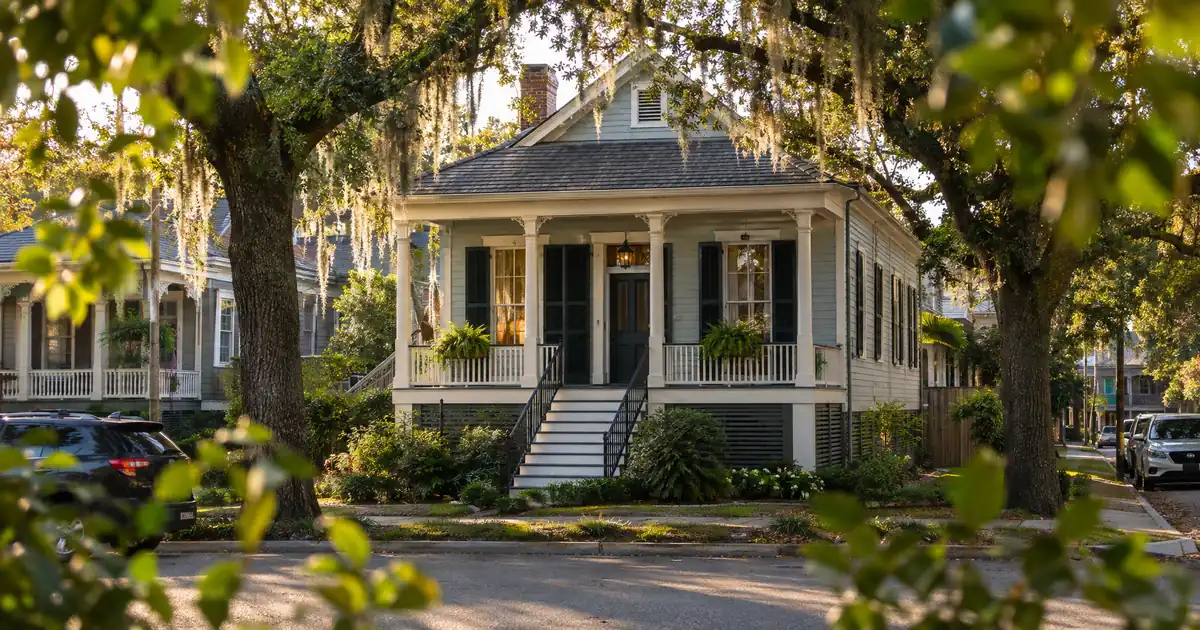
Redfin puts the Baton Rouge median sale price at $245K, up 4.6% year over year, while the same page shows price per square foot at $134, down 5.6%. Those two numbers pull in opposite directions, and the gap is the whole story for anyone planning a cash-out refinance here. The median moved because the mix of homes sold shifted. The value of any single house did not necessarily follow. An investor who counts on an appraisal to manufacture equity in this market is betting against the data.
The Short Version: A DSCR cash-out refinance in Baton Rouge, Louisiana is underwritten primarily on the property’s rental income measured against its full monthly obligation, and with rents rising only 1.5% over the past year according to the Baton Rouge Business Report, the loan has to work on today’s rent, not projected rent.
DSCR Cash-Out Calculator
Run the cash-out numbers in Baton Rouge, LA
Rate source: Freddie Mac 30-yr average via FRED® — Federal Reserve Bank of St. Louis · effective Sep 24, 2026
Prefilled with starting assumptions — enter your property’s value, balance, taxes, and insurance for a more accurate picture.
Program parameters update from Lendmire’s centralized guideline source. Taxes and insurance are editable estimates.
As of Sep 24, 2026 · General Freddie Mac market benchmark, not a Lendmire loan offer. Property value, balance, taxes, and insurance are editable estimates. Maximum loan-to-value varies by lender, program, property type, and seasoning. Not a Loan Estimate, approval, or commitment to lend. Program availability and eligibility are subject to lender guidelines, credit approval, property review, and underwriting.
- Cash-out LTV tops out at 75%, with about 6 months of seasoning from title recording.
- Median-priced single-family rentals model below or near 1.0x coverage; two-bedroom duplexes clear it more easily.
- North Baton Rouge holds 66% of the metro’s multifamily vacancy, per The Advocate.
- LSU, the Health District and the ExxonMobil complex anchor tenant demand near the core.
- Approval, leverage and eligibility stay subject to lender guidelines, credit review and property review.
Baton Rouge Market Snapshot
A quick read on the Baton Rouge investor landscape — figures come from the cited sources below. Confirm current property-level numbers before underwriting.
| Metric | Detail |
|---|---|
| Employment | 600 construction jobs (Greater Baton Rouge Economic) |
| Vacancy | 6.53% vs 7.46% (Baton Rouge Business Report) |
Where the Equity Actually Comes From
Equity in Baton Rouge comes from purchase discount and renovation, not market drift. Prices are roughly flat once sales mix is stripped out, so a refinance appraisal should be treated as a check on work already done, not a windfall.
Zillow shows the same flatness from a different angle: an average home value of $233,136, up 0.9% over the past year. Zillow’s average and Redfin’s three-month median use different methodologies, which explains the $12K gap between them. Neither series shows the kind of appreciation that lets an owner refinance out a big chunk of basis on market movement alone.
Redfin does show a healthy comp base. Homes are selling faster than they were a year earlier, and monthly sales volume remains in the hundreds of closings, though it has slipped slightly from the prior year. That is enough depth for an appraiser to find recent, tight comps. The slight volume decline argues for comps that are recent and close to the subject. Timing on any individual file will still vary by property and lender.
The mechanics matter here. A DSCR cash-out on an investment property is capped at 75% LTV, well under the purchase-side ceiling. Investors should expect about 6 months of ownership measured from title recording before the property becomes eligible. Reserves generally run about 6 months of PITIA, and credit tiers on most files start at a 620 floor and step up through 660, 680 and 700, with pricing and leverage generally improving as scores climb. Loan amounts on standard programs run up to $3,000,000, though the balances typical of Baton Rouge fall well below that. These are program guidelines, not commitments, and the proceeds available depend on rent used for lender review, PITIA, reserves and the 75% cap. There is no guaranteed cash figure. Investors working through the mechanics can review cash-out refinance details or the broader investment property refinance options.
Picture an investor who bought a dated fourplex near LSU at a discount, spent on units and systems, and now holds it fully leased. That owner’s equity was built by the renovation, so the refinance simply monetizes it. Compare that to an owner who bought a turnkey house at market and waited: the appraisal has little reason to come in high, and the 75% cap leaves little to pull out after paying off the existing balance.
Where Coverage Clears (and Where It Doesn’t)
Small multifamily clears the coverage test more comfortably than median-priced single-family here, because rents are modest against prices. Single-family at the median needs a three-bedroom rent to reach the baseline, while a duplex of two-bedrooms stacks income against a single building.
Start with the rent data. RentCafe puts the citywide apartment average at $1,248, up 1.66% year over year, with two-bedrooms at $1,197 and three-bedrooms at $1,565. Apartment List lands lower on two-bedrooms, at a $1,141 median, and notes rents sit 19.5% below the national median. The difference reflects sample and method. This article uses the RentCafe figures for modeling.
The coverage math below is modeled, not sourced market data. Each line assumes a 75% LTV cash-out and figures the full obligation as principal and interest plus taxes and insurance at typical Louisiana averages. Numbers are rounded down. Every figure here varies by lender and program — guidelines, property type, leverage, and credit profile all apply.
| Modeled scenario | Assumed rent | Coverage read |
|---|---|---|
| SFR at $245K, avg rent | $1,248 | Mid-0.8s |
| SFR at $245K, 3BR rent | $1,565 | About 1.0x |
| $300K duplex, two 2BRs | $2,394 | About 1.3x |
The takeaway is plain. A median-priced house rented at the citywide average lands in the mid-0.8s including taxes and insurance, so a high-leverage cash-out on that profile does not pencil. The same house rented at the three-bedroom average scrapes the 1.00 baseline. The duplex, assuming a $300,000 price and two-bedroom units at the RentCafe average, holds a cushion.
Most standard DSCR programs are built around a 1.00x benchmark because the rent covers the payment at that level. Some lenders review lower ratios, but those files generally come with lower leverage, different pricing or more cash down, and eligibility turns on credit profile, reserves and property review. For a file that falls below 1.00 on long-term rent, the paths a lender may review include a sub-1.00 program, an interest-only structure or a smaller loan amount against the same property. Whether any of those apply is a matter for the lender, subject to credit approval and property review.
Unit count changes how the number is computed. On one-to-four-unit rentals, lenders typically divide market rent by the full monthly obligation, meaning principal, interest, taxes, insurance and any association dues. At five or more units the test tends to shift to net operating income against annual debt service. That makes the two-to-four-unit range the friendliest for a DSCR structure: gross market rent drives the test, and vacancy of 6% to 8% does not have to be modeled into the ratio the way it would be under a commercial NOI test. Investors comparing structures can read Lendmire’s DSCR-versus-conventional breakdown and the guide “What Is a DSCR Loan”.
Don’t Let Rent Growth Bail Out the Loan
Rent growth in Baton Rouge runs 1% to 3%, so a cash-out that only works if rents rise is fragile. The metro is stabilizing, not accelerating, and the vacancy picture splits sharply by geography.
Two local sources give different vacancy readings. The Advocate reports that multifamily vacancy rose over the past year and says most of it sits in North Baton Rouge. The Business Report, citing a Greater Baton Rouge Association of Realtors presentation, has vacancy falling from the prior year, with rents up modestly on a per-square-foot basis. The two surveys draw on different samples, so treat them as a range rather than a single figure. The Business Report adds a caution: counting distressed offline units, effective vacancy could run meaningfully higher than the headline number.
Supply is the other variable. Distressed apartment properties are trading at steep discounts and being repositioned by new owners, a trend expected to continue. Repositioned complexes with fresh capital compete directly with small landlords in Class B and C submarkets, and they can cap rent growth there. The offset is that developers expect new construction to slow over the next two to three years, which supports rent stability later.
For underwriting, size the cash-out on the lease in hand. Owners with properties in North Baton Rouge should expect appraisers and lenders to apply a heavier vacancy and market-rent haircut than they would near LSU or the Health District. That haircut lands directly in the coverage ratio.
The Submarkets That Pencil
Rent-to-value is best near the demand anchors, and the anchors are concentrated: LSU’s campus edge, the Essen Lane and Bluebonnet hospital corridor, and the established midtown neighborhoods. No sourced price bands exist by submarket, so the profiles below are qualitative on price and cite rent only where the data holds up.
LSU, Lakeshore and College Town
This is the deepest rental pool in the metro. LSU counts 35,248 undergraduates on a 2,000-acre campus, and Louisiana Radio Network reports a first-time freshman class of nearly 8,200, the largest in university history. The Advocate says applications exceeded 62,000, mostly from out of state. The area around campus includes University Hills, University Gardens, College Town and Arlington, according to Wikipedia’s neighborhood listing. Demand comes from students, staff and hospital workers. Small multifamily here suits an owner who already holds a stabilized building and wants to pull equity for the next acquisition.
Southdowns and South Baton Rouge
Southdowns is a well-established area near LSU with mid-century homes and newer construction, per the Red Stick Old blog. Tenants are professionals and students working around campus and the medical district. Redfin’s neighborhood rent tables show wide swings in this part of town, and the small samples make them unreliable, so pull actual comps rather than leaning on a headline number. It is a submarket where an appraiser’s comp selection matters a great deal.
Mid City, the Garden District and Capital Heights
Mid City is a restaurant and arts hub, while the Garden District is an established historic area with many upscale homes. Local investor commentary points to duplexes and triplexes around Mid City and Southdowns as the scale play. That is a blog claim, not measured data. The only rent evidence in the research is individual listings near Hickey Town and Mid City, with three-bedroom asking rents ranging from $810 to $1,374. Individual listings are not a market median. That spread is wide enough to make one point: rent at the low end of that range on a median-priced house will not cover a cash-out loan.
The Health District Corridor
The Baton Rouge Health District clusters Our Lady of the Lake Health, Woman’s Hospital, Baton Rouge General, Mary Bird Perkins Cancer Center, Ochsner Health and Pennington Biomedical along Essen Lane and Bluebonnet. A regional health system describes Our Lady of the Lake as a 988-bed hospital with 38,000 inpatients and 820,000 outpatients a year, and Ochsner as a 150-bed hospital plus The Grove surgical hospital. Tenant demand is nurses, residents and medical staff, a base with steady employment. A planned Baton Rouge–New Orleans passenger rail would connect downtown and the Health District, but it is a planned project only. Nobody should underwrite a property on rail that has not been built.
Old South Baton Rouge and Broadmoor
Old South Baton Rouge sits directly south of downtown, and the city is targeting it in its largest-ever revitalization project. That is upside on a long horizon, not a reason to count on near-term rent lift. Broadmoor consists of established neighborhoods with mature trees and larger lots, and RentCafe lists average rent there at $874 a month, well under the citywide $1,248. Low rent against a lower purchase price can still work, but a cash-out at that rent level leaves almost no room in the coverage ratio.
Three Demand Streams, One Mid-Sized City
Baton Rouge combines a capital, a flagship university and a petrochemical corridor, and that mix keeps renter demand diversified. It is a different profile from a single-industry town.
The Greater Baton Rouge Economic Partnership points to petrochemicals and refining on the Mississippi River, with state government, higher education and healthcare layered on top. A Louisiana House resolution describes the ExxonMobil complex as employing more than six thousand employees and contractors in the Baton Rouge area and calls the refinery the largest manufacturing employer in Louisiana. The same partnership reports a $500 million polyolefins expansion that created 65 direct jobs and supported 600 construction jobs. Southern University enrolls 7,409 undergraduates, and Baton Rouge Community College adds roughly 7,000 to 8,000 students.
The rental base itself is large. RentCafe shows 53% of Baton Rouge households renting, 46,533 renter-occupied against 41,074 owner-occupied. The city population sits near 220,901 per Census Bureau QuickFacts.
A caution on where the growth is. East Baton Rouge Parish sits at 456,180 residents, essentially flat against the last census count, while Livingston has grown 8.96% and Ascension 6.80%, per Wikipedia’s parish table. The people are moving to the suburban parishes. Investors holding urban-core rentals are betting on employer-anchored demand, not population inflow, and that is a narrower thesis. The metro has largely recovered pandemic job losses, with employment up 1.5% year over year and unemployment near 3.9%. Two-bedroom units are the deepest rental segment, so duplexes and triplexes of two-bedrooms lease into the widest pool, while large four-bedroom homes face a thinner one.
Turning Proceeds Into the Next Deal
The cash-out only pays if the money buys something that cash-flows better than what it came from. In a market where appreciation is thin, the redeployment target matters more than the extraction itself.
Working DSCR brokers see a recurring pattern in mid-sized, renter-heavy markets with modest rents: the refinance clears comfortably on a small multifamily building and stalls on single-family, because the rent-to-price ratio on a median house leaves little room after taxes and insurance. The owner who pulls equity from a duplex and buys another duplex tends to end up with a better blended coverage number than the owner who pulls equity from a duplex and buys a house. The cleanest file from a documentation standpoint has complete leases, entity docs, title and property details ready for lender review. Loans to LLC-titled entities are subject to lender program eligibility, so that paperwork should be sorted before the file goes out.
DSCR vs. conventional financing
Two common ways to finance an investment property in Baton Rouge, LA. They qualify you differently — here’s how investors weigh them.
Why investors choose it
- Qualifies on the property’s rental income — no personal tax returns, W-2s, or pay stubs needed to document income.
- No personal debt-to-income ceiling to clear, so existing mortgages and obligations don’t cap your borrowing the same way.
- Can be closed in an LLC, keeping the property inside a business entity.
- Built for scaling — not held to the limit on number of financed properties that conventional financing applies.
- Underwriting centers on the deal: generally qualifies when the rent covers the payment, a 1.00x coverage ratio being a common baseline (confirmed in underwriting).
- Designed specifically for investment property, including long-term and, where the program allows, short-term rentals.
Where it’s strong
- Often the lowest ongoing financing cost for a buyer who fully qualifies on personal income — a fit for a first property or a cost-first purchase.
Trade-offs for investors
- Requires full personal income documentation and must fit within a debt-to-income limit — salary, existing debts, and other mortgages all count.
- Typically held in your personal name rather than a business entity.
- Caps how many financed properties you can carry, which can become a ceiling as a portfolio grows.
- Evaluates you as a borrower as much as the property, which usually means more paperwork.
How investors usually choose: a first or single property often optimizes for the lowest financing cost; portfolio builders often optimize for leverage, vesting in an LLC, and scaling past conventional caps. The right answer depends on your goals, the property, and current guidelines — both paths run through select lenders in Lendmire’s wholesale network, with eligibility and terms confirmed in underwriting.
Run the numbers on the sequencing. An investor who owns a leased fourplex near LSU seasons it for about 6 months from title recording, takes a cash-out capped at 75% LTV and rolls the proceeds into a down payment on a duplex near the Health District. Two stabilized buildings on separate demand anchors beat one building carrying all the concentration risk. That is a structure, not a promise; the appraisal, the rent used for lender review and the reserves decide how much cash actually comes out. Final terms depend on lender guidelines, property type, leverage, and the borrower’s complete credit picture.
Anyone weighing the numbers can see what the numbers look like before committing, or reach the team at 828-256-2183. Investors should also verify current local rental rules, taxes and insurance, including flood coverage, with qualified local professionals.
Frequently Asked Questions
How do you qualify for a DSCR loan in Baton Rouge?
Qualification rests mainly on the property’s rent against its full monthly obligation, with 1.00 as the common baseline, plus a credit score starting at a 620 floor and about 6 months of reserves. The lender also reviews the appraisal, title and lease documents. Exact eligibility depends on lender guidelines, credit profile and property review.
What are the requirements for an investment property loan in Baton Rouge, Louisiana?
On a cash-out refinance, expect a 75% LTV ceiling, about 6 months of seasoning from title recording and reserves near 6 months of PITIA. The property needs rent used for program review, and manufactured homes, log homes and barndominiums fall outside these programs. All terms are subject to lender guidelines and are not a commitment to lend.
Does North Baton Rouge vacancy affect a cash-out refinance?
Yes, through the rent the lender uses. With 66% of the metro’s multifamily vacancy concentrated in North Baton Rouge, appraisers and lenders may apply a lower market rent or higher vacancy assumption there. That can pull the coverage ratio down and shrink the loan amount, so those files should be sized on the current lease rather than on projected rent.
Which property types work best for a DSCR cash-out in Baton Rouge?
Duplexes, triplexes and fourplexes near LSU, Southdowns, Mid City and the Health District model best, because stacked rents cover the obligation more easily than a single house. Workforce single-family homes can work at lower price points or with stronger rents. Median-priced houses at the citywide average rent tend to model below 1.0x.
Where the Blind Spot Sits
The biggest blind spot for DSCR-financed investors in Baton Rouge is the gap between headline rent and effective rent. A lease says one number, but with vacancy reported at 6.5% to 7.6% by two local surveys and effective vacancy that could approach 12.5% once distressed offline units are counted, the rent that actually lands in the account can run well below what the qualifying ratio assumed. With prices flat and rents growing 1% to 3%, neither appreciation nor rent growth will rescue a loan sized too tightly, so the safest cash-out here is the one that still clears 1.00x on the leases in hand after a heavier vacancy haircut.
For current guidelines and terms, see Lendmire’s DSCR loan programs page.
About Lendmire
Lendmire — NMLS# 2371349 — is a DSCR and non-QM mortgage brokerage with investor loan programs in 41 markets, including Washington, D.C. DSCR eligibility is commonly reviewed by the lender on property-level rent rather than personal income documentation, subject to lender guidelines, and the brokerage helps arrange financing for LLC-owned portfolios beyond conventional financed-property limits. Recognized by Scotsman Guide as a Top Mortgage Workplace in 2025 and 2026.
For broader investor-financing rules and property-type coverage across the state, see Louisiana DSCR loans.
Get Started
Ready to find the right loan for you?
In about 30 seconds you can review financing options available for your investment property. No commitment required.
Informational only. Not a Loan Estimate, approval, or commitment to lend. Program availability and eligibility are subject to lender guidelines, credit approval, property review, and underwriting.
References
1. Baton Rouge median sale price at $245K, up 4.6% year over year
2. Baton Rouge Business Report
3. The Advocate
4. Greater Baton Rouge Economic Partnership
5. Zillow — Home Values Baton Rouge LA
6. RentCafe
9. The Advocate
10. Wikipedia’s neighborhood listing
12. Louisiana House resolution
15. 2026 Scotsman Guide Top Mortgage Workplace
16. 2025 Scotsman Guide Top Mortgage Workplace
This article is part of Lendmire’s investment property cash-out refinance program — full qualification details, guidelines, and scenarios live on the program page.
Related reading: Cash Out Refinance Investment Property Baton Rouge Louisiana · DSCR Loans in Baton Rouge, Louisiana: Investor Financing for Mid City, Shenandoah, and South Baton Rouge — LSU Market, Petrochemical Economy, and Long-Term Rental Demand · Cash Out Refinance Investment Property Louisiana
Guides: Investment Property Cash-Out Refinance in Baton Rouge, LA · Investment Property Cash-Out Refinance in Louisiana
Brandon Miller
Founder & CEO, Mortgage Loan Originator, Lendmire LLC
- Mortgage Loan Originator · NMLS# 1129696 · Verify on NMLS Consumer Access
- North Carolina Real Estate Broker · License# 343312 · Verify on NCREC
- North Carolina Insurance Producer · License# 19053198 · Property, Casualty, Life, Health · Verify on NAIC SBS
- Lendmire LLC · Firm NMLS# 2371349 · Verify firm licensure
Disclosure information. Lendmire is a state-licensed mortgage brokerage under NMLS# 2371349. Lendmire is not a depository institution, direct lender, or financial advisor — all loans referenced are placed through wholesale lender partners and are subject to each lender's underwriting standards. This article is provided for general informational purposes and is not a commitment to lend, nor does it constitute financial, legal, or tax advice. Loan programs, terms, rates, and qualification standards change without notice and depend on borrower profile, property type, and the state in which the subject property is located. Equal Housing Opportunity provider. NMLS Consumer Access: nmlsconsumeraccess.org.