
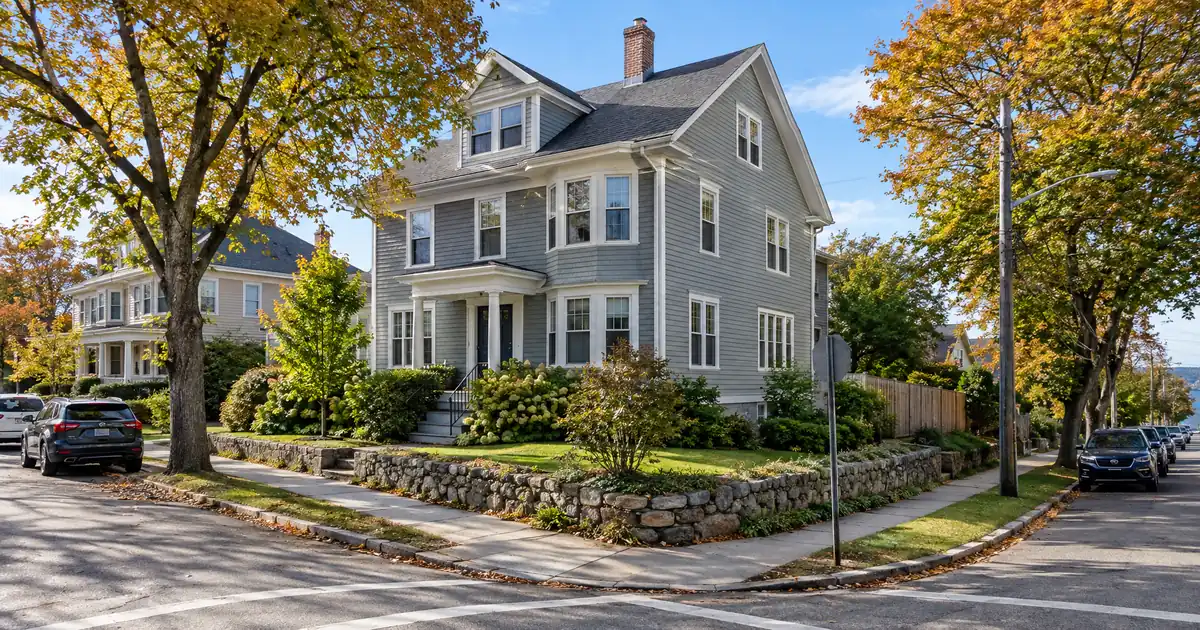
Beverly’s median sale price rose 9.0 percent to $799,600 per Redfin, while Zillow’s average rent of about $2,600 slipped $100 over the same stretch. Values up and rents down is the defining tension for any investor weighing a cash-out refinance here. The appraisal will probably say yes. The rent schedule is the part of the file that decides how much equity actually comes out.
TL;DR: A DSCR cash-out refinance in Beverly, Massachusetts is underwritten primarily on the property’s rental income measured against its full monthly obligation, with the investor documenting ownership seasoning, an income-property appraisal, and reserves before proceeds are sized at up to a 75 percent loan-to-value ceiling.
DSCR Cash-Out Calculator
Run the cash-out numbers in Beverly, MA
Rate source: Freddie Mac 30-yr average via FRED® — Federal Reserve Bank of St. Louis · effective Oct 1, 2026
Prefilled with starting assumptions — enter your property’s value, balance, taxes, and insurance for a more accurate picture.
Program parameters update from Lendmire’s centralized guideline source. Taxes and insurance are editable estimates.
As of Oct 1, 2026 · General Freddie Mac market benchmark, not a Lendmire loan offer. Property value, balance, taxes, and insurance are editable estimates. Maximum loan-to-value varies by lender, program, property type, and seasoning. Not a Loan Estimate, approval, or commitment to lend. Program availability and eligibility are subject to lender guidelines, credit approval, property review, and underwriting.
- Single-family rents near $2,600 on average leave modeled coverage well under 1.00 at current values.
- Stacked two-family rents are where modeled coverage clears the 1.00 benchmark.
- Downtown’s $535,000 twelve-month median caps how much equity a refinance can release.
- Cash-out generally requires about six months of title seasoning and roughly six months of reserves.
Beverly Market Snapshot
A quick read on the Beverly investor landscape — figures come from the cited sources below. Confirm current property-level numbers before underwriting.
| Metric | Detail |
|---|---|
| Home prices | $650,300 median property value (Data USA) |
| Typical rents | $2,600 average (Zillow, rental market trends) |
| University enrollment | 4,575 students (Wikipedia, Endicott College) |
| Population | 42,665 population (Census Reporter (ACS 2024 5-yr)) |
| Employment | 1,004 employees (2020) (Wikipedia, Axcelis Technologies) |
Where the Equity Actually Sits
Equity is concentrated in the higher-priced coastal and east-side stock, while cash flow is concentrated in Downtown and the older multi-unit buildings. Those are mostly different properties. An investor holding an appreciated single-family is equity-rich and coverage-poor. An investor holding a Downtown multi-unit is the reverse.
The price data frames this. Redfin’s $799,600 citywide median is up 9.0 percent year over year, and Zillow’s home value index reads lower, at $751,857 and up 1.9 percent, reflecting a different methodology. Treat the true center as somewhere between those two. Downtown sits far below both: Homes.com puts the twelve-month median at $535,000, down 3 percent, though that figure likely blends condos with multi-family. Directionally, though, Downtown is the cash-flow submarket, and a flat-to-down price trend means less appraisal-driven equity to extract.
Cash-out math at a 75 percent ceiling is simple. Appraised value times 75 percent, minus the existing payoff, minus closing costs, equals gross proceeds, and the DSCR test then has to be passed on the new, larger balance. The ceiling is a cap, not a promise. Proceeds depend on rent used for lender review, the full monthly obligation, reserves, and lender review.
Why Single-Family Coverage Breaks and Two-Families Don’t
Single-family cash-outs in Beverly mostly fail the 1.00 test on long-term rent. Two-families and small multifamily clear it, because stacked unit rents roughly double the gross yield on the same dollar of value.
Run the numbers on a single-family appraised near the citywide median. Rents for houses range from $1,150 to $5,000 per Zillow, and a realistic band for a family-sized house runs roughly $2,600 to $4,250. Modeled assumptions: 75 percent LTV, 30-year amortization, and full PITIA with taxes and insurance loaded at Massachusetts averages. Coverage lands around 0.50 to 0.85. Not close.
Now consider a two-family. Say you own a Downtown two-family and the rent schedule stacks a two-bedroom and a three-bedroom. Zillow’s averages are $2,700 and $3,200, while Rentometer’s tabulated figures run $3,159 and $3,875. That is a combined $5,900 to roughly $7,030 a month. At a modeled $800,000 value and the same 75 percent leverage, coverage including taxes and insurance runs about 1.15 to 1.35. Move the value up to the $987,000 median listing price on Redfin’s four multi-family listings, and the band drops to roughly 0.95 to 1.10. That sample is thin, so read it as directional. The pattern holds, though: the more value you pack into the appraisal, the less coverage you keep.
Below 1.00 is not a dead end. A lender may review lower-leverage structures, interest-only periods, or sub-1.00 programs that trade coverage for more cash in or tighter pricing. Qualification is subject to lender guidelines, credit approval, and property review. Most standard programs are built around the 1.00 benchmark, and anything under it needs compensating strength.
(One more honest note: a toss-up case is a Downtown two-family with an owner-occupied unit rented below market. Reposition the rent before refinancing, not after.)
What Does the Appraisal Do to Your Rent Number?
The appraiser’s market rent, not the tenant’s lease and not the listing site, drives the coverage number. In Beverly, that gap is wider than usual because published rent data conflicts.
Zumper reports $2,400 average rent, down 8 percent year over year, and notes a roughly 10 percent seasonal gap, with July highest and October lowest. Zillow shows a $100 annual decline. Redfin’s earlier city-level figure was $2,679. Those spreads are the file risk. An investor who refinances in October on a lease signed at July asking rents can watch the appraiser’s schedule come in well under the lease.
So underwrite on the low end. Practical file hygiene:
- Pull the executed leases for every unit, plus proof of deposit or rent receipt where the lender asks.
- Build the unit mix explicitly. A two-family or three-family gets underwritten unit by unit, not on a blended average.
- Order the income-property appraisal with a market rent schedule, and do not assume asking rents survive it.
- Confirm entity vesting early. LLC-titled files are accepted subject to lender program eligibility, and operating agreements and good-standing certificates are routine requests.
Lendmire’s deal desk tends to see a consistent friction point in high-value, soft-rent suburbs like this one: the borrower’s pro forma uses summer asking rents, the appraisal comes back on a lower schedule, and the loan amount that works at 1.00 shrinks. The cleaner files from a documentation standpoint arrive with leases already reconciled to the market schedule and a payoff statement that matches the title search. Fixing those two items up front prevents most re-sizing conversations.
Downtown, Cummings Center, and the Endicott Edge
Tenant demand in Beverly rests on three anchors: a commuter-rail Downtown, a large office-and-biotech campus, and a cluster of colleges beside a community hospital. Together they support long-term renters better than the flat rent trend suggests.
Downtown. This is the multi-unit core. Homes.com’s Downtown listings show a two-unit, a seven-unit, and a separate six-unit offering, so small multifamily beyond duplexes does trade here. The city counts close to 400 businesses in the downtown core, and the commuter rail serves Boston-bound tenants, young professionals, and arts-college affiliates, with Montserrat College of Art on the edge of Beverly Common. Redfin’s older Downtown median rent was $2,500, but that figure came from a thin, volatile sample, so use it only to confirm the direction. Against a $535,000 Downtown median, the gross yield is the best in the city.
Cummings Center and the Route 62 corridor. The City of Beverly describes the campus as hosting over 550 tenant companies, over 100 life-science firms, and more than 2 million square feet. That is an unusually deep white-collar renter base for a city of 42,665 residents. The employer mix leans toward health care administration, life sciences, and professional services, which fits Data USA’s resident employment counts: 3,387 in health care and social assistance, 3,365 in educational services, and 3,309 in professional, scientific, and technical services.
DSCR vs. conventional financing
There are two common ways to finance an investment property in Beverly, MA, and they qualify you differently — here’s how investors weigh them.
Why investors choose it
- Qualifies on the property’s rental income — no personal tax returns, W-2s, or pay stubs needed to document income.
- No personal debt-to-income ceiling to clear, so existing mortgages and obligations don’t cap your borrowing the same way.
- Can be closed in an LLC, keeping the property inside a business entity.
- Built for scaling — not held to the limit on number of financed properties that conventional financing applies.
- Underwriting centers on the deal: generally qualifies when the rent covers the payment, a 1.00x coverage ratio being a common baseline (confirmed in underwriting).
- Designed specifically for investment property, including long-term and, where the program allows, short-term rentals.
Where it’s strong
- Often the lowest ongoing financing cost for a buyer who fully qualifies on personal income — a fit for a first property or a cost-first purchase.
Trade-offs for investors
- Requires full personal income documentation and must fit within a debt-to-income limit — salary, existing debts, and other mortgages all count.
- Typically held in your personal name rather than a business entity.
- Caps how many financed properties you can carry, which can become a ceiling as a portfolio grows.
- Evaluates you as a borrower as much as the property, which usually means more paperwork.
How investors usually choose: a first or single property often optimizes for the lowest financing cost; portfolio builders often optimize for leverage, vesting in an LLC, and scaling past conventional caps. The right answer depends on your goals, the property, and current guidelines — both paths run through select lenders in Lendmire’s wholesale network, with eligibility and terms confirmed in underwriting.
Endicott and the hospital. Endicott College lists 4,575 students (3,360 undergraduate, 1,215 graduate) on a 235-acre campus, so verify the precise count against the college’s official data before relying on it. Faculty, staff, and graduate students feed demand on the northeast side. Beverly Hospital, part of Beth Israel Lahey Health, adds clinical and support-staff renters. No reliable headcounts surfaced for either, so the demand case is qualitative.
The housing stock explains why two-families dominate the DSCR conversation. NeighborhoodScout reports 18.37 percent of units are duplexes, converted homes, and small apartment buildings, 44.74 percent of households rent, and 33.05 percent of homes predate 1939. That last number matters at refinance. Older buildings draw more appraiser attention to condition, mechanical systems, and unit legality, so expect condition-related conditions on pre-war stock.
Skip the Cash-Out If You’re Counting on Rent Growth
Rent growth is not the thesis in Beverly. Zillow and Zumper both show flat to declining rents, while values climbed. Anyone refinancing today on the assumption that rents will rise into the new balance is taking a bet the data does not currently support.
Supply is the second check. The nearest new for-sale product is Beverly Landing at Cummings Center, 60 ownership units, about 80 percent reserved for households with a resident aged 55 or older. That is ownership, not rental competition, and larger two-bedrooms were priced close to $1 million, which helps appraisal comps for small multi-unit. The more relevant watch item is a 56-unit apartment proposal on Rantoul Street on the city’s private development list. Its status is unconfirmed. If built, it could compete with Downtown units, so check where it stands before a refinance sized tightly to coverage.
On timing, the program parameters are plain. Cash-out generally requires about six months of ownership, measured from title recording. Reserves typically run about six months of PITIA, rising to about nine months above $1,500,000. Credit tiers step through 620, 660, 680, and 700, with 620 as the floor. Loan amounts run up to $3,000,000 on standard programs, with smaller balances routed through select lenders in the network. Property types such as manufactured homes, log homes, and barndominiums fall outside these programs entirely. All of this is guidance subject to lender guidelines, and it varies by borrower, property, and scenario.
Turning Proceeds Into the Next File
Cash-out proceeds are only useful if the next acquisition is underwritten against the same discipline. Because Beverly’s single-family stock rarely covers itself, the logical redeployment is into other multi-unit stock, either Downtown or in nearby markets where purchase pricing leaves more cushion. The refinanced property now carries a larger balance, so its coverage sits closer to the 1.00 line than before, and that matters if the investor later applies for additional financing across a portfolio.
One practical point: a cash-out does not erase the purchase-side question. It moves it. The same unit-by-unit rent schedule that supported this refinance will be reviewed on the next acquisition. Investors who want to see the mechanics can read the guide “What Is a DSCR Loan”, compare where DSCR and conventional diverge, or review the refi options and Lendmire’s refi programs. For a scenario run on a specific Beverly rent schedule, run the numbers with Lendmire or call 828-256-2183. Verify current local rental rules, taxes, insurance, and flood-zone status with qualified local professionals before committing, since Beverly is a coastal city.
Frequently Asked Questions
How do you qualify for a DSCR cash-out refinance in Beverly, Massachusetts?
Qualification centers on the property’s rent used for lender review measured against its full monthly obligation, with 1.00 the common benchmark. Beyond that, expect a credit score at or above the 620 floor, about six months of title seasoning, reserves near six months of PITIA, and a loan-to-value at or below 75 percent. Eligibility ultimately depends on lender guidelines, credit approval, and property review. The guide “What Is a DSCR Loan” covers the mechanics.
What are the requirements for an investment property cash-out loan in Beverly, MA?
The core requirements are an income-producing 1-4 unit property outside the ineligible categories (manufactured homes, log homes, and barndominiums), documented leases or a market rent schedule, an income-property appraisal, and the seasoning and reserve minimums above. Entity-owned properties are reviewed subject to program terms. Pre-war buildings, common in Beverly, may draw additional condition review.
Does a Downtown Beverly two-family usually clear the coverage test?
It can, but the answer turns on basis. On a modeled $800,000 value with stacked two- and three-bedroom rents, coverage including taxes and insurance runs about 1.15 to 1.35. At a $987,000 basis, the band falls to roughly 0.95 to 1.10. A lender would review sub-1.00 files under alternative structures, subject to guidelines.
Why do soft rents matter more than rising values in Beverly?
Because cash-out proceeds depend on both appraised value and the lender’s market-rent schedule. Beverly’s values are up 9.0 percent, but Zumper shows rents down 8 percent year over year, with a seasonal gap near 10 percent. A high appraisal paired with a low rent schedule shrinks the loan the coverage test will support.
For current guidelines and terms, see Lendmire’s DSCR loan programs page.
Get Started
Ready to find the right loan for you?
In about 30 seconds you can review financing options available for your investment property. No commitment required.
Informational only. Not a Loan Estimate, approval, or commitment to lend. Program availability and eligibility are subject to lender guidelines, credit approval, property review, and underwriting.
About Lendmire
A non-QM mortgage broker (NMLS# 2371349), Lendmire arranges DSCR financing for real estate investors in 41 markets, 40 states plus Washington, D.C. Because deals are underwritten primarily on property cash flow rather than personal income documentation, the structure suits self-employed buyers and entity-owned portfolios. Lendmire places loans through wholesale investor lenders; it is not a direct lender. The firm was named a top-ranked workplace in 2026 and recognized by Scotsman Guide in 2025.
If you only take one thing from this piece, it’s this: in Beverly the equity sits in the price and the coverage sits in the unit count, so a cash-out works when a documented multi-unit rent schedule, not the appraised value, carries the file.
This article is part of Lendmire’s investment property cash-out refinance program — full qualification details, guidelines, and scenarios live on the program page.
Related reading: Luxury Rental DSCR Loans In New Jersey · Jersey Shore Vacation Rental Loans: DSCR Financing In Ocean City, Cape May And Long Beach Island · DSCR Cash-out Refinance In New Jersey: Pulling Equity From A Rental
Guides: Investment Property Cash-Out Refinance in Massachusetts
Brandon Miller
Founder & CEO, Mortgage Loan Originator, Lendmire LLC
- Mortgage Loan Originator · NMLS# 1129696 · Verify on NMLS Consumer Access
- North Carolina Real Estate Broker · License# 343312 · Verify on NCREC
- North Carolina Insurance Producer · License# 19053198 · Property, Casualty, Life, Health · Verify on NAIC SBS
- Lendmire LLC · Firm NMLS# 2371349 · Verify firm licensure
Disclosure information. Lendmire is a state-licensed mortgage brokerage under NMLS# 2371349. Lendmire is not a depository institution, direct lender, or financial advisor — all loans referenced are placed through wholesale lender partners and are subject to each lender's underwriting standards. This article is provided for general informational purposes and is not a commitment to lend, nor does it constitute financial, legal, or tax advice. Loan programs, terms, rates, and qualification standards change without notice and depend on borrower profile, property type, and the state in which the subject property is located. Equal Housing Opportunity provider. NMLS Consumer Access: nmlsconsumeraccess.org.